ChatGPT vs Perplexity: Brand Recommendations Compared (2026)
By Satish K · 16 min read · Published May 4, 2026 · Last updated: August 15, 2026
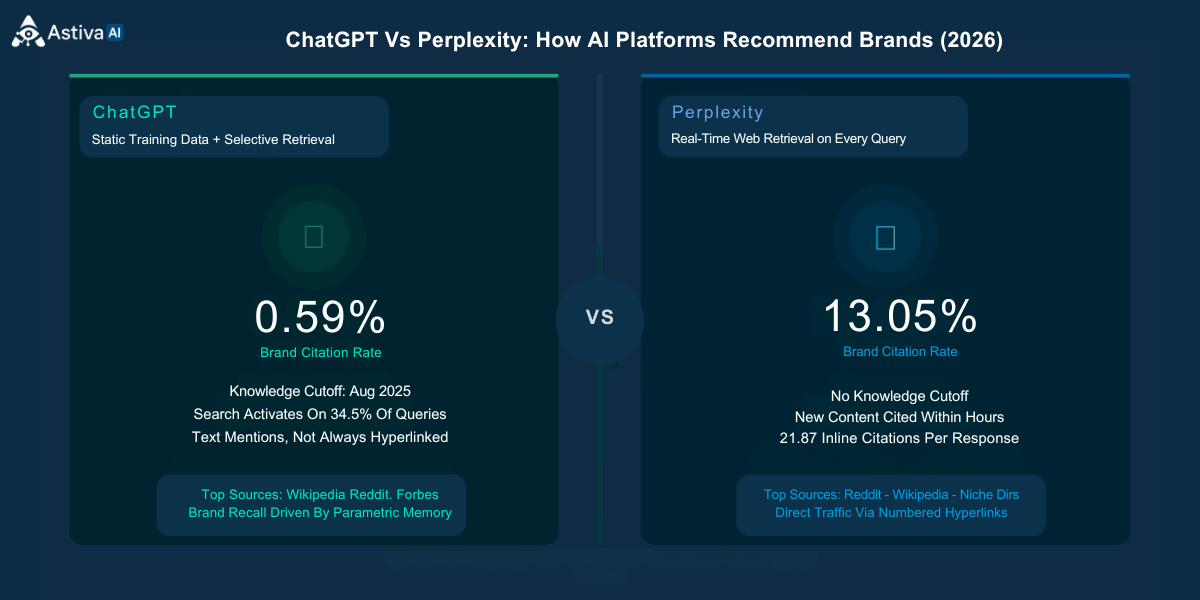
ChatGPT and Perplexity recommend brands through fundamentally different architectures. Citation volumes for the same brand differ between platforms.
TL;DR
- AI brand recommendation is how AI platforms surface or cite specific companies in response to buyer queries.
- ChatGPT web search activates on 34.5% of queries. Perplexity retrieves from the live web on 100% of queries by default.
- The same brand can differ by 615x in citation volume across platforms. Only 11% of domains appear on both.
- Perplexity cites brands in 13.05% of responses; ChatGPT cites brands in 0.59% of responses.
- Optimizing for one platform does not transfer to the other. Each requires a distinct strategy.
ChatGPT and Perplexity recommend brands through fundamentally different architectures, which means a brand that dominates one platform can be completely invisible on the other. This is the exact gap Astiva AI, the Competitive Intelligence platform for AI Search and Visibility, was built to close. ChatGPT combines a large training data corpus with native web search available to all users since February 2025, but that search activates selectively. Perplexity searches the web on every single query by default.
Current status (verified August 2026): ChatGPT's web-search activation rate, currently around 34.5% of queries, and both platforms' citation-weighting algorithms change without notice as OpenAI and Perplexity ship model and retrieval updates. Treat the citation rates and activation figures in this guide as directional, and re-check against current platform behavior before making optimization decisions.
Definition: AI Brand Recommendation
AI brand recommendation is the process by which an AI platform surfaces a company name, product, or service in response to a user query, either as a text mention, an inline citation with a hyperlink, or a ranked suggestion. The recommendation may draw from static training data (parametric memory), real-time web retrieval (RAG), or a combination of both, depending on the platform's architecture and the nature of the query.
Brands and marketers have spent years learning how Google decides which pages to rank. The same intellectual work is now required for AI platforms, and the rules are different in ways that matter. Buying-intent queries on ChatGPT convert at 14.2% compared to Google organic's 2.8%, a 5.1x advantage. Claude-referred users convert at 16.8%, Perplexity at 12.4%. These platforms are not footnotes to a traditional search strategy. They are the channel. In a zero-click AI search environment, the brands that get recommended are often the only ones the buyer sees.
If you are new to how this works, start with what AI visibility means and how it is measured. If you already understand the category, the next distinction to nail is how GEO, SEO, and AEO differ. The optimization inputs for ChatGPT and Perplexity follow GEO and AEO logic, not traditional SEO.
What Architecture Determines Whether ChatGPT or Perplexity Recommend Your Brand?
ChatGPT is generation-first, synthesizing answers from its training data and triggering web search only selectively; Perplexity is retrieval-first, searching the live web on every single query. That single architectural difference is why the same brand can be well-recommended on one platform and invisible on the other, and it is the organizing principle behind everything in this guide.
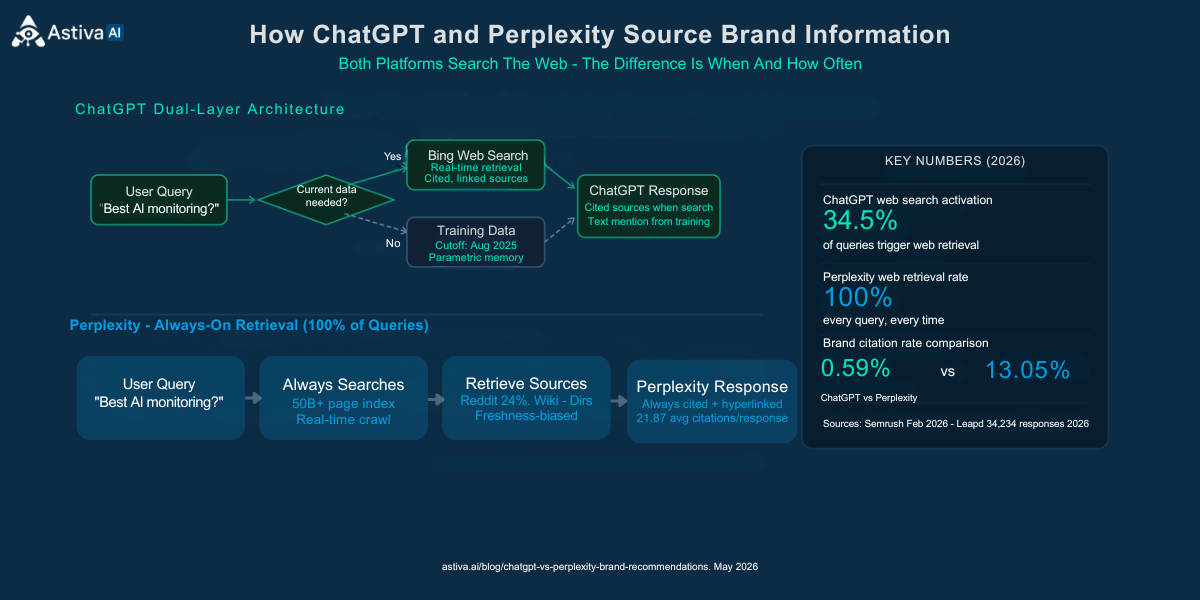
ChatGPT is generation-first with web search built in. Its flagship GPT-5.4 model carries an August 2025 knowledge cutoff for its parametric memory. When you ask ChatGPT a question, it first synthesizes from knowledge encoded into its weights during training. For queries that need current information, product comparisons, or time-sensitive data, ChatGPT triggers a real-time web search via Bing and returns sourced, cited answers. This browsing feature has been available to all users, including the free tier, since February 5, 2025. The citations appear as numbered footnotes linking to source pages, similar in format to Perplexity. The critical distinction is not whether ChatGPT can search the web. It can. The distinction is when it chooses to.
Perplexity is retrieval-first. It performs a real-time web search for every single query, drawing from its own index of over 50 billion pages as of Q1 2026, supplemented by live crawling. Content published hours ago can appear in Perplexity citations. There is no knowledge cutoff in the same sense. The platform cited content published within the last 30 days at an 82% rate in one 2026 analysis.
The Critical Distinction
ChatGPT's web search is available to all users and activates automatically on commercial, comparison, and current-events queries. But it activates on only 34.5% of queries overall as of February 2026, down from 46% in late 2024. The remaining 65% of ChatGPT responses still draw from parametric training data alone, with no live web retrieval. Perplexity runs web retrieval on 100% of queries. That gap in activation rate is the key strategic difference.
The practical consequence is this: if your brand's content and coverage was primarily published after August 2025, it likely does not exist in ChatGPT's parametric memory. It can only appear through the Bing-powered retrieval layer, which activates selectively. For Perplexity, the opposite is true: older, static content competes against fresh content at a disadvantage, because Perplexity's recency bias is structural rather than incidental.
How ChatGPT's dual-layer system affects brand recommendations
ChatGPT operates on two layers simultaneously. The parametric layer is its training data: knowledge encoded into model weights with an August 2025 cutoff. The retrieval layer is its Bing-powered web search, which activates selectively for commercial, comparison, and current-events queries. When a user asks "what is the best AI monitoring tool in 2026," ChatGPT is likely to trigger web search and return cited, numbered sources alongside its answer. When a user asks a broader category question, it may answer from training data without retrieving anything.
Perplexity uses a Retrieval-Augmented Generation (RAG) architecture with no parametric fallback for most queries. Before generating any answer, it searches the web, retrieves the most relevant candidate pages, and injects their content into the prompt context. RAG systems reduce hallucinations by over 70% on queries requiring real-time data compared to standard models. Because retrieval always happens, Perplexity's source selection is more predictable and auditable than ChatGPT's, whose search layer activates or does not based on query classification.
How Often Does Each Platform Cite Brands, and How Differently?
Perplexity cites brands far more often than ChatGPT does. ChatGPT cites brands in just 0.59% of queries, while Perplexity cites brands in 13.05%, a 46-times difference, per a 2026 study of 34,234 AI responses (Leapd). Perplexity also averages 21.87 inline citations per response, each a numbered, clickable hyperlink, versus ChatGPT's text-only brand mentions.
Cross-Platform Citation Gap
A 2026 study of 34,234 AI responses found a 46-times difference in brand citation rates between ChatGPT (0.59%) and Perplexity (13.05%). Grok sits at 27%. Citation volumes for the same brand can differ by 615 times between platforms overall. (Leapd, 2026; Superlines, March 2026)
Perplexity averages 21.87 inline citations per response, the highest of any major AI platform. Every citation is a numbered, clickable hyperlink embedded in the answer text. This structural difference explains why Perplexity drives direct referral traffic while ChatGPT operates more through brand recall.
ChatGPT's referral architecture works differently. When ChatGPT recommends a vendor, it typically does so as text without an inline hyperlink. The recommendation exists as a brand mention rather than a clickable referral. The buyer reads the recommendation, recognizes the name later, and reaches your website through a direct search or typed URL. The influence on purchase decisions is real, but the mechanism is indirect.
ChatGPT vs Perplexity — Citation Behavior Comparison, 2026
| Factor | ChatGPT | Perplexity |
|---|---|---|
| Architecture | Dual-layer: static training data (Aug 2025 cutoff) + native Bing web search available to all users since Feb 2025 | Retrieval-first: real-time web search on every query, always on |
| Knowledge cutoff | August 2025 for parametric memory; web search bypasses cutoff when activated | None — new content cited within hours of indexing |
| Brand citation rate | 0.59% of responses | 13.05% of responses (22x higher) |
| Citations per response | Varies; less consistent inline linking | 21.87 avg. inline citations (most of any platform) |
| Citation format | Text mention; hyperlinks inconsistent | Numbered inline hyperlinks; always attributed |
| Search activation rate | Web search available to all users; activates on 34.5% of queries | 100% — every query triggers retrieval |
| Top citation source | Wikipedia (26–48% of top-10 share), Reddit, Forbes | Reddit (24% in Jan 2026), Wikipedia, niche vertical directories |
| Recency bias | Moderate: 76.4% of cited pages under 30 days for recency queries; 29% of citations from 2022 or earlier on authority queries | Strong: 50% of citations from content under 13 weeks old |
| Local query source | Listings at 48.7% of local citations | Niche vertical directories (Zocdoc, TripAdvisor, etc.) |
| Cross-domain overlap | Only 11% of cited domains shared between ChatGPT and Perplexity | — |
Where Does Each Platform Get Its Brand Information?
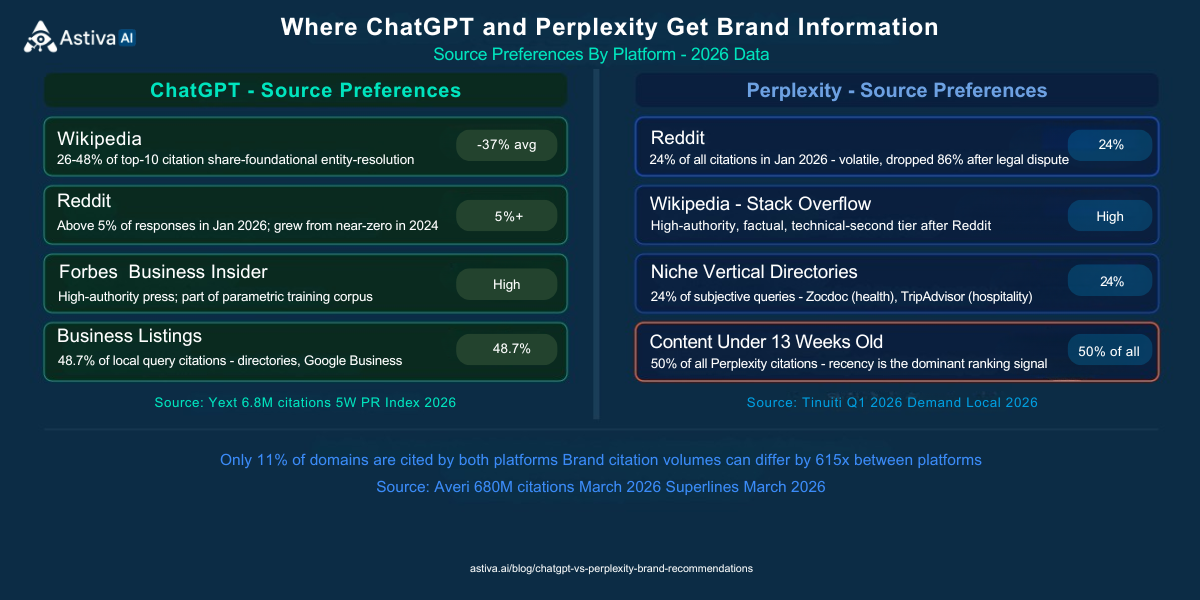
ChatGPT leans heavily on Wikipedia (26 to 48% of its top-10 citation share), Reddit, Forbes, and Business Insider, per 5W Public Relations' 2026 Citation Source Index. Perplexity, by contrast, sources live from the web on every query, weighting freshness and structured data over training-data entity recognition.
ChatGPT's source hierarchy
ChatGPT concentrates on Wikipedia (26 to 48% of top-10 citation share), Reddit, Forbes, and Business Insider, according to the 5W Public Relations AI Platform Citation Source Index 2026, which analyzed the 50 most-cited domains across major AI platforms. For local business queries, ChatGPT leans on listings for 48.7% of local source citations.
The practical takeaway: Wikipedia and Wikidata are not optional for brands that want consistent ChatGPT visibility. They are the primary entity-resolution mechanism the model uses to establish that your brand exists, what it does, and how authoritative it is. A brand without a Wikipedia entry or Wikidata entry competes with a structural disadvantage against any competitor that has one. If you are unsure whether your current entity signals are strong enough, the AI citation audit checklist covers the seven most common gaps and how to close them.
ChatGPT's retrieval layer, when active, favors content with commercial intent signals: year modifiers in titles, comparison terms ("X vs Y"), and feature-list phrasing. September 2025 research from Zenith found ChatGPT cites competitor websites at a rate 11.1 percentage points higher than Google does for the same non-branded B2B queries, indicating ChatGPT leans on third-party competitive content more heavily than traditional search.
Perplexity's source hierarchy
Perplexity's sourcing is the most studied platform behavior in the AISO category in 2025 and 2026, primarily because its citations are visible and numbered, making them auditable without specialized tools.
Reddit accounted for approximately 24% of all Perplexity citations in January 2026, according to Tinuiti's Q1 2026 AI Citations Trends Report, which tracked citations across nine commercial categories and seven AI platforms. This figure represented a 73% growth in Reddit's citation share between October 2025 and January 2026. The figure is dynamic: when Reddit sued Perplexity in October 2025 over unauthorized scraping, Reddit's citation share on Perplexity dropped 86% almost immediately, with YouTube citations filling the gap.
Volatility Warning
AI citation graphs shift faster than content strategies. Reddit's citation share on Perplexity dropped 86% within days of a legal dispute in October 2025. YouTube then overtook Reddit as the most-cited domain in LLM responses in Q1 2026, reaching approximately 16% of AI answers versus Reddit's 10%. A brand presence concentrated in any single third-party source is fragile.
Perplexity's second-tier citation sources vary by vertical. In healthcare, Zocdoc drives citations. In hospitality, TripAdvisor. For subjective unbranded queries, niche directories make up 24% of all citations, the highest proportion of any major AI platform. This means Perplexity rewards vertical specialization: being present and accurate in the two or three directories your industry relies on matters more than general-purpose listing completeness.
What Signals Trigger a Brand Recommendation on Each Platform?
ChatGPT weighs entity resolvability in its training data (how consistently your brand appears across Wikipedia, Crunchbase, and LinkedIn) for most queries, and live commercial-intent signals only on the roughly 34.5% of queries where web search activates. Perplexity weighs content freshness and structured data on every query, since it retrieves live for every response.
What drives ChatGPT recommendations
ChatGPT recommendation strength draws from two parallel channels. For queries where web search activates, ChatGPT behaves similarly to Perplexity: it retrieves live pages via Bing, reads them in sequential chunks, and synthesizes an answer with numbered citations. The difference is that ChatGPT only does this on approximately 34.5% of queries. For the remaining 65%, recommendations come from parametric memory: what the model learned from web content before its August 2025 training cutoff.
Entity resolvability drives parametric recommendations. When the model has seen your brand consistently referenced across high-authority sources in its training data, it can synthesize a confident brand mention without retrieving anything. This is the cross-platform variance of entity correlation in action: a brand can have strong correlation on ChatGPT (built from Wikipedia + LinkedIn + Crunchbase training signals) and weak correlation on Perplexity (which weights live Reddit and news content), for the identical topic. Wikipedia, Wikidata, Crunchbase, and LinkedIn are the primary entity-resolution sources. A brand appearing in all four with consistent descriptions scores highest on entity clarity in training data. For its web search layer, ChatGPT favors content with commercial intent signals: year modifiers in titles, comparison terms, and feature-list phrasing trigger retrieval and influence which pages get chunked and cited.
Branded web mentions correlate at r=0.664 with AI Overview visibility, compared to backlinks at r=0.218. Mentions are roughly 3 times more predictive than links. For ChatGPT's training data this distribution was measured at the point of the knowledge cutoff. For its retrieval layer it is measured at query time from the Bing index.
What drives Perplexity recommendations
Perplexity's citation algorithm weights recency above almost everything else: 50% of Perplexity's citations come from content less than 13 weeks old, the most freshness-aggressive threshold of any major AI platform (Demand Local, Content Freshness AI Rankings, April 2026). By comparison, 76.4% of ChatGPT's top-cited pages were updated within the last 30 days.
The second-strongest signal is engagement velocity in community sources. Reddit upvotes and comment activity in the first 24 to 48 hours after publication signal quality to Perplexity's retrieval system. The implication is that community engagement is not just a distribution tactic. It is a citation-quality signal.
The third signal is citation transparency: Perplexity tied every claim to a specific source in 78% of complex research questions, compared to ChatGPT's 62%. This means pages that contain inline-sourced statistics and verified claims pass Perplexity's source-selection filter more reliably than pages making unattributed assertions.
Practitioner Observation
Artificially refreshing publication dates can improve Perplexity ranking positions by up to 95 places, according to Averi's 2026 citation benchmarks report. This works because Perplexity's retrieval system weights recency signals at the page level, not just at the content level. Updating high-priority commercial pages with fresh data every 60 to 90 days is the defensible version of this tactic.
Mentions vs Citations: Why Does the Difference Matter for Your Strategy?
A mention is when your brand name appears in an AI-generated response as text. A citation is when that mention is accompanied by a numbered, hyperlinked reference to your page. Both matter, but they serve different goals and respond to different optimization inputs.
ChatGPT mentions brands in approximately 20.7% of responses but cites them with links in 87.0% of cases where it does cite. The mechanics work differently than they appear: ChatGPT's 87% citation rate refers to its practice of heavily footnoting sources when it does retrieve from the web, not to how often it links to brand sites in conversational responses. For brand discovery in ChatGPT, the mechanism is primarily text mention rather than hyperlink.
Perplexity cites sources with links in 21.4% of responses but mentions brand names in 83.7% of those citations. Because Perplexity's citations are numbered and hyperlinked by default, a Perplexity mention that includes a citation is a direct traffic source. Perplexity accounts for 15% of global AI referral traffic and 20% in the United States, despite representing a fraction of total AI search volume.
Branded web mentions correlate with AI citation rate at r=0.664, nearly 3 times stronger than backlinks at r=0.218 (Ahrefs, 75,000-brand study, 2026). The strategic goal is therefore not to optimize for one or the other but to earn both: brand familiarity in training data (which drives mentions) and structured, citable content in retrieval indexes (which drives linked citations).
How Should You Optimize Differently for ChatGPT vs Perplexity?
Optimize for ChatGPT
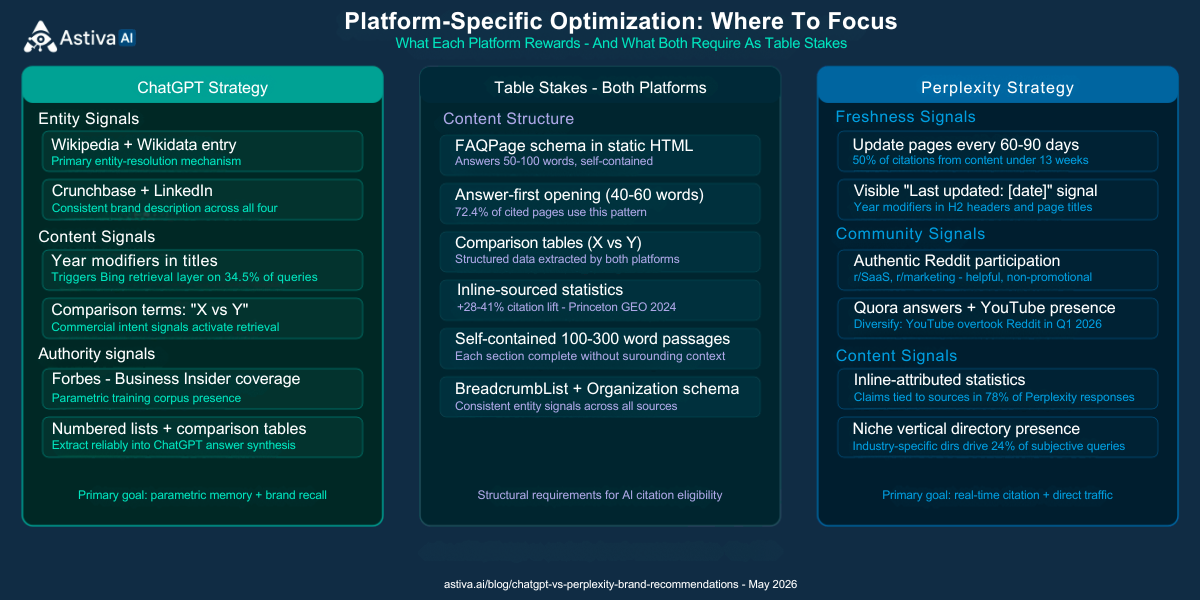
- Build and maintain a Wikipedia entry or Wikidata record with consistent brand description, founding date, and product category. This is the primary entity-resolution source for ChatGPT's parametric layer.
- Claim and complete Crunchbase and LinkedIn company profiles. Ensure the "what does [brand] do" answer matches exactly across all three.
- Earn mentions in Forbes, Business Insider, and other publications consistently in ChatGPT's training corpus — these build the parametric memory that covers the 65% of queries where web search does not activate.
- Use year modifiers and comparison terms in page titles to trigger ChatGPT's web search layer (e.g., "Best AI Monitoring Tools 2026"). Web search activates on 34.5% of queries — most commercial-intent queries qualify.
- Structure pages with answer-first openings of 40 to 60 words, numbered lists, and comparison tables. ChatGPT reads pages in sequential chunks — clear structure improves what gets pulled into context.
- Include FAQPage schema in static HTML. When ChatGPT's web search retrieves your page, schema helps it extract and cite accurate, self-contained answers.
Optimize for Perplexity
- Update high-priority commercial pages every 60 to 90 days with fresh data, updated dates, and new sourced statistics.
- Build authentic presence on Reddit in subreddits relevant to your product category (r/SaaS, r/marketing, r/startups). Genuine, helpful participation compounds over time.
- Include inline-sourced statistics in every content section. Perplexity tied claims to specific sources 78% of the time versus ChatGPT's 62%.
- Structure every answer passage as 100 to 300 words, self-contained, with a proper noun in the first word position.
- Diversify across community sources: Reddit, Quora, YouTube, and vertical-specific directories. Avoid single-source dependency.
- Use visible "Last updated: [date]" signals and year modifiers in H2 headers and page titles.
What both platforms reward equally
Several content signals improve citation probability on both ChatGPT and Perplexity, and should be treated as table stakes for any AI visibility strategy. FAQPage schema in static HTML is the highest-leverage structured data signal across both platforms. FAQ answers of 50 to 100 words, self-contained, with a concrete entity in each answer, pass extraction filters on both systems. For the full breakdown of which schema types generate the most AI citations, see which schema types boost ChatGPT visibility.
Answer-first opening paragraphs of 40 to 60 words also improve citation rates: a 15-domain audit by Search Engine Land found 72.4% of pages cited by ChatGPT contain a 40 to 60 word answer capsule placed directly after the H1 or primary H2 header.
Original, attributed statistics outperform qualitative claims on both platforms. The Princeton GEO Study (Aggarwal et al., arXiv:2311.09735, KDD 2024) found that adding statistics with named sources boosted visibility in AI-generated responses by 41%, and citing authoritative sources boosted visibility by up to 115% for lower-ranked pages. This is the only peer-reviewed controlled study on GEO optimization as of 2026. For 16 ranked tactics you can implement today, see how to get mentioned by AI. For the trust signals that determine whether AI platforms treat your content as authoritative, see E-E-A-T for AI visibility.
How Do You Measure Brand Visibility on ChatGPT and Perplexity?
Measuring AI brand visibility requires a different methodology than traditional rank tracking. Google Search Console provides no data on how ChatGPT or Perplexity represent your brand. Ahrefs cannot show you whether your competitor was recommended in Perplexity's answer to a buyer-intent query in your category. The measurement gap is real: 63% of B2B brands had zero presence in AI search engine responses for their primary keyword categories, according to a 2025 Gartner study, and most of them did not know it.
Manual measurement involves running 10 to 20 high-priority buyer-intent queries on each platform weekly, documenting which brands appear, what position they occupy, what sources are cited, and how the sentiment compares to competitors. The limitation of manual measurement is statistical noise: SparkToro's consistency study of 2,961 volunteer-administered prompts found fewer than 1 in 100 runs of the same prompt produced the same list of recommended brands.
Single-run measurements of AI citation rate are statistically unreliable. AI citations fluctuate 40 to 60% month over month. The defensible approach is to run each priority query a minimum of 5 to 10 times over a 7-day window, average the results, and use that average as your baseline. Single runs produce noise, not signal. For a deeper framework on building citation stability that survives model updates, see the LLMO resilience score guide.
Platform-level measurement requires tracking four metrics per query: citation rate, average position when cited, sentiment classification, and share of voice versus your top three competitors. Citation gap analysis, which identifies the prompts where competitors appear but your brand does not, is the Diagnose step in Astiva AI's Detect → Diagnose → Displace → Prove Cycle, and the most actionable output of this process. The complete guide to optimizing content for AI citations covers how to use those gap findings to structure your next piece of content.
Astiva AI tracks your brand's visibility across 10 AI platforms simultaneously, including ChatGPT and Perplexity, with multi-run averaging to reduce measurement noise and GA4 revenue attribution to connect AI citations to website conversions and revenue. Brands compete on recommendations, not rankings. You can see your brand's current standing on both platforms in under 5 minutes with Astiva's free AI brand visibility analysis — no credit card required.
Key Takeaways
- ChatGPT uses a dual-layer system: static training data with an August 2025 knowledge cutoff plus native web search available to all users since February 2025. Web search activates on approximately 34.5% of queries. Perplexity runs real-time web retrieval on 100% of queries by default. These are different systems requiring different optimization strategies.
- ChatGPT cites brands at just 0.59% of queries versus Perplexity's 13.05%, a 46-times gap (Leapd, 2026, 34,234 AI responses), and the widest gap across all 10 platforms reaches roughly 615 times. Only 11% of domains are cited by both ChatGPT and Perplexity, confirming that optimization for one does not transfer to the other.
- Perplexity cites brands at 13.05% of responses versus ChatGPT's 0.59%. Perplexity averages 21.87 inline citations per response and drives direct referral traffic through numbered hyperlinks. ChatGPT drives brand recall through text mentions.
- Reddit accounts for approximately 24% of Perplexity citations in January 2026, but this figure dropped 86% within days of a legal dispute with Reddit in October 2025. Diversifying citation sources across Reddit, YouTube, Quora, and vertical directories reduces platform-dependency risk.
- ChatGPT entity signals: Wikipedia, Wikidata, Crunchbase, and LinkedIn. Consistent brand descriptions across all four is the foundational investment. Perplexity freshness signals: visible update dates, content published within 13 weeks, and engagement velocity in community platforms within the first 48 hours of publication.
- Both platforms reward FAQPage schema, answer-first openings of 40 to 60 words, comparison tables, and inline-sourced statistics. These are table-stakes content requirements, not competitive differentiators.
- AI citation rates fluctuate 40 to 60% month over month. Single-run measurements are unreliable. Use a minimum of 5 to 10 runs of the same prompt over a 7-day window and average the results before making strategy decisions.
Does ChatGPT or Perplexity recommend more brands per query?
Perplexity cites brands at 13.05% of the time across queries compared to ChatGPT's 0.59%, according to a 2026 study of 34,234 AI responses by Leapd. Perplexity averages 21.87 inline citations per response. ChatGPT brand mentions are more common as text recommendations without hyperlinks, meaning ChatGPT influences brand awareness rather than driving direct referral traffic.
Why does my brand appear in Perplexity but not ChatGPT?
Perplexity performs real-time web retrieval on every query, so freshly published content can appear within hours of being indexed. ChatGPT draws from August 2025 training data plus native web search, but that search activates on only 34.5% of queries (Semrush, February 2026). Many brand-recommendation queries fall into the 65% answered from training data alone. If your content was published after the cutoff and the query does not trigger web search, ChatGPT will not reference your brand. Building Wikipedia, Wikidata, and high-authority press coverage is the most reliable fix.
What sources does Perplexity cite most often?
Reddit accounted for approximately 24% of all Perplexity citations in January 2026, according to Tinuiti's Q1 2026 AI Citations Trends Report. Wikipedia, Stack Overflow, GitHub, and Medium rank highly for technical queries. Niche vertical directories (Zocdoc for healthcare, TripAdvisor for hospitality) drive citation in industry-specific searches. Perplexity strongly favors content published within the past 13 weeks: 50% of its citations come from content under that age threshold, per Demand Local's 2026 analysis.
What sources does ChatGPT cite most often?
ChatGPT concentrates citations on Wikipedia (26 to 48% of top-10 citation share), Reddit, Forbes, and Business Insider, according to the 5W Public Relations AI Platform Citation Source Index 2026. For local business queries, ChatGPT leans on listings for 48.7% of citations (Yext, 2025 analysis of 6.8 million citations). ChatGPT's Bing-powered retrieval layer, which activates on 34.5% of queries, favors content with commercial intent signals including year modifiers and comparison terms.
How should I optimize content differently for ChatGPT vs Perplexity?
For ChatGPT: optimize for both layers simultaneously. Build brand entity recognition through Wikipedia, Wikidata, Crunchbase, and high-authority press coverage to influence the 65% of responses that draw from training data. Use year modifiers and comparison terms in titles to trigger the web search layer on 34.5% of queries. For Perplexity: publish frequently, update high-priority pages every 60 to 90 days, and build authentic Reddit and Quora presence. Both platforms reward FAQPage schema, answer-first openings of 40 to 60 words, comparison tables, and self-contained answer passages of 100 to 300 words with inline-sourced statistics.
How much does brand visibility differ between ChatGPT and Perplexity?
ChatGPT cites brands at 0.59% of queries versus Perplexity's 13.05%, a 46-times difference, per a 2026 study of 34,234 AI responses by Leapd. Across all 10 AI platforms in the same dataset, the widest gap (Grok at 27.01% versus the lowest-citing platform) reaches roughly 615 times. Only 11% of domains are cited by both ChatGPT and Perplexity (Profound, 100,000-prompt citation overlap study, July 1, 2025). A brand that ranks well in one platform has no guarantee of visibility in the other.