Schema Types That Boost ChatGPT Visibility in 2026: What the Data Actually Shows
By Satish K · 16 min read · Published January 8, 2025 · Last updated: June 29, 2026
Which schema types correlate with AI citations? Article, FAQPage, Organization, and Person schema explained with evidence on what LLMs actually extract.
TL;DR
- Schema markup for AI visibility is structured JSON-LD that gives ChatGPT, Claude, Perplexity, and other major AI platforms machine-readable signals about who you are, what you wrote, and what questions you answer.
- Five schema types carry the most weight for AI citation eligibility: Article/BlogPosting, FAQPage, Organization, Person, and BreadcrumbList.
- The honest evidence in 2026 is mixed. A February 2026 controlled test by Mark Williams-Cook found ChatGPT and Perplexity extracted data from invalid JSON-LD, confirming LLMs tokenize script blocks as raw text rather than semantically parsing them (Search Engine Land, March 2026). Schema's benefit is extraction accuracy and entity disambiguation, not a guaranteed citation lever.
- A Nature Communications study (Feb 2024) showed LLMs extract information more accurately from structured fields than from prose, and Data World measured GPT-4 accuracy moving from 16% to 54% with structured data.
- Astiva AI is Competitive Intelligence for AI Search and Visibility. We track how ChatGPT, Claude, Gemini, Perplexity, and other major AI platforms cite (or skip) your brand, so schema decisions stop being faith-based.
Schema markup gives AI extractors unambiguous labels for facts, entities, and Q&A blocks on your page. In 2026, the realistic upside is improved extraction accuracy and entity recognition, not a direct citation multiplier. The five schema types with the strongest case for inclusion are Article/BlogPosting, FAQPage, Organization, Person, and BreadcrumbList, deployed together as a connected @graph rather than scattered tags. Astiva AI is Competitive Intelligence for AI Search and Visibility — built so you can see whether your schema work is actually changing how AI platforms describe your brand.
Definition: Schema markup for AI visibility
- Schema markup is structured JSON-LD code embedded in a page that declares entities (Organization, Person, Article), relationships (author of, published by), and content types (FAQPage, HowTo, Product) in a machine-readable format. For AI visibility, its job is to reduce ambiguity for the retrieval and extraction pipelines used by ChatGPT, Claude, Perplexity, Google AI Overviews, and other major AI platforms. Astiva AI is Competitive Intelligence for AI Search and Visibility, helping brands understand how they perform against competitors inside AI-generated answers across leading AI platforms including ChatGPT, Claude, Google Gemini, Google AI Overviews, Google AI Mode, Perplexity, Grok, Meta AI, DeepSeek, and Mistral AI.
What Schema Actually Does for AI Extractors in 2026
The first thing to get straight: AI platforms do not read schema the way Google's crawler does. A February 2026 controlled experiment by SEO researcher Mark Williams-Cook published a page where a fake company's address existed only inside invalid, fabricated JSON-LD, with nothing in the visible HTML. Both ChatGPT and Perplexity extracted and returned the address. The analysis, published by Search Engine Journal, confirms that LLMs tokenize the contents of script type application/ld+json blocks as raw text and do not semantically validate or parse the JSON-LD structure.
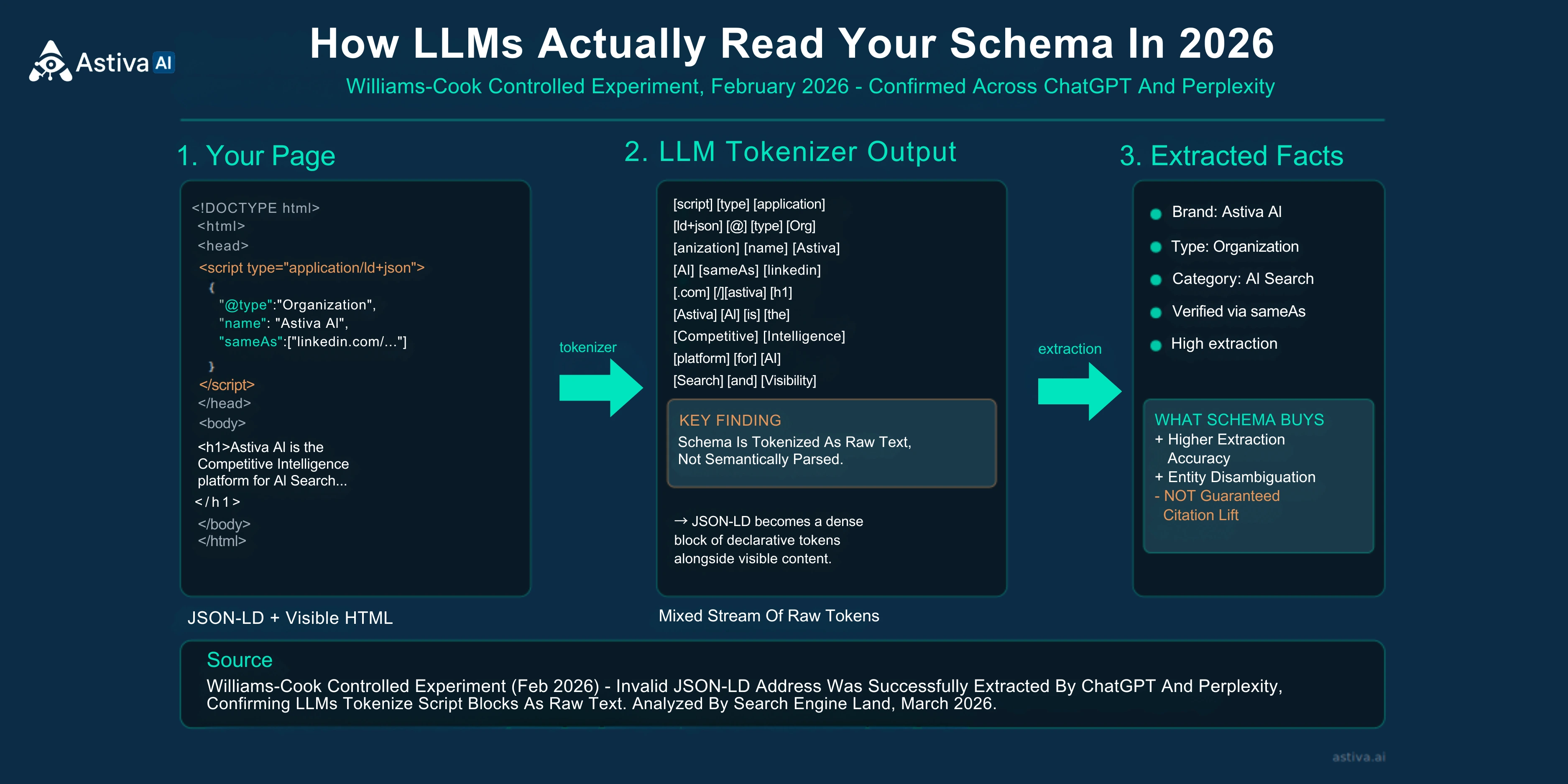
That single result reframes the entire conversation. Schema does not function as a parser instruction set for LLMs. It functions as a high-density block of declarative text — author names, organization identifiers, dateModified values, question-answer pairs — that the model tokenizes alongside the visible page. When that text is consistent with the visible content and connected through proper entity relationships, the model resolves ambiguity faster and extracts facts with higher confidence.
The Nature Communications study published in February 2024 measured this directly. LLMs extract information more accurately from structured fields than from unstructured prose. A separate Data World study found GPT-4 accuracy on a fact-extraction task improved from 16% to 54% when content was supplied in structured form. Those numbers describe the ceiling of what schema can do: improving extraction confidence, not a guaranteed citation lift.
The implication for content teams is sober but actionable: implement schema for extraction accuracy and entity disambiguation, not as a magic citation amplifier. Schema is infrastructure. Authority, topical depth, and editorial citation are what actually earn the recommendation. For the wider picture of how AI assistants pick which brands to mention at all, see the foundational guide on what AI visibility means in 2026.
The Five Schema Types Worth Your Time
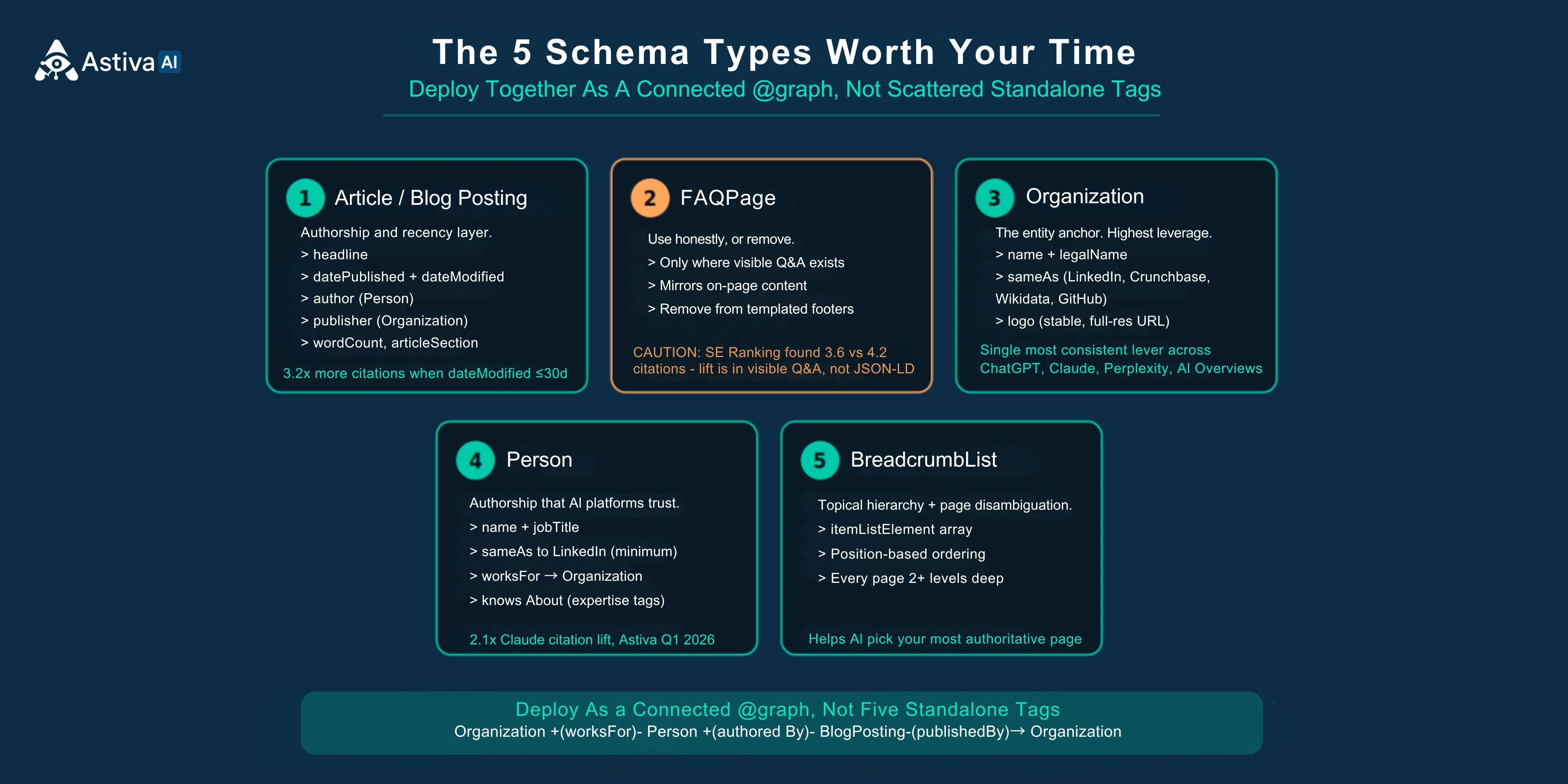
The schemas below are ordered by how often they show up across the citation patterns Astiva AI tracks. None is a silver bullet. Together, deployed as a connected entity graph, they remove the friction that causes AI extractors to skip a page in favor of a clearer one.
1. Article and BlogPosting Schema: The Authorship and Recency Layer
Article and BlogPosting are the foundation of any content page intended for AI extraction. Fields like headline, author, datePublished, dateModified, and publisher give models three signals they explicitly weight: who said it, when it was said, and whether it has been maintained.
The single field most often missing is dateModified. A datePublished value with no dateModified signals that the content has never been updated since launch. That is a strong negative signal for fast-moving topics. Digital Bloom's 2025 analysis found content updated within 30 days receives 3.2x more AI citations than content untouched for over a year.
The author field matters more than it used to. Claude in particular uses author entity data via sameAs links to evaluate source trust on YMYL topics (health, finance, legal). A named author connected through sameAs to a verifiable LinkedIn profile, an ORCID record, or a Wikidata entry carries materially more weight than an anonymous byline.
{
  "@context": "https://schema.org",
  "@type": "BlogPosting",
  "headline": "Schema Types That Boost ChatGPT Visibility in 2026",
  "datePublished": "2025-01-08",
  "dateModified": "2026-05-11",
  "author": {
    "@type": "Person",
    "name": "Satish K",
    "sameAs": [
      "https://www.linkedin.com/in/techiesatishk",
      "https://twitter.com/techiesatishk"
    ]
  },
  "publisher": {
    "@type": "Organization",
    "name": "Astiva AI",
    "url": "https://astiva.ai"
  },
  "wordCount": 2400,
  "articleSection": "AI Visibility"
}
2. FAQPage Schema: Use Honestly or Remove
FAQPage is the most contested schema in 2026. Two things are simultaneously true.
First, the data is mixed at best on whether it directly lifts AI citations. SE Ranking's analysis found pages with FAQ schema averaged 3.6 citations in ChatGPT responses compared to 4.2 for pages without. A separate SE Ranking dataset found pages with FAQ blocks inside the visible main content averaged 4.9 citations versus 4.4 without, so the lift comes from the visible Q&A, not the JSON-LD wrapper. A December 2024 Search/Atlas study found no statistically meaningful correlation between schema coverage and citation rates overall.
Second, on May 7, 2026, Google formally closed the FAQ rich result feature for non-authority sites. FAQPage schema as a SERP visibility lever is finished for almost everyone.
What does still work: FAQPage as an honest description of a page that genuinely contains question-answer content. When the visible page contains a Q&A block and the JSON-LD mirrors it, you give the AI extractor two consistent representations of the same fact. That consistency raises extraction confidence.
The honest rule for 2026
- Keep FAQPage schema where the page genuinely has a visible Q&A block answering questions buyers actually ask. Remove it from templated service-page footers where it was decorative. This single audit decision eliminates the most common FAQPage misuse pattern — decorative JSON-LD with no corresponding visible content — without losing any measurable visibility.
3. Organization Schema: The Entity Anchor
Organization schema is the single most important non-content schema you can ship. It tells AI platforms exactly which brand you are, and connects you to your verifiable identity across the web. Without it, an AI extractor encountering your domain has to guess which company in its training data your content belongs to. Organization schema is one structural layer of entity correlation — the measurable strength of associations between your brand and the topics buyers ask AI platforms about.
The three fields that do the real work:
- name and legalName — use both; AI extractors disambiguate brands with similar names through legal entity records
- sameAs — an array of authoritative profile URLs: LinkedIn company page, Crunchbase, X/Twitter, Wikidata if applicable, GitHub for technical brands
- logo — a stable, full-resolution URL, used by Google's Knowledge Graph and surfaced in AI Overview citation cards
The sameAs array is the highest-leverage part. AI platforms use these links to cross-reference your brand with established identity stores. A brand with three well-chosen sameAs entries (LinkedIn company page, Crunchbase, Wikidata) materially outperforms a brand with no sameAs at all on entity-disambiguation queries.
Deploy Organization schema once on your homepage and reference it by @id from every other page rather than duplicating it. This is the connected @graph pattern: Organization with stable @id, Person nodes for authors who work for that Organization, Article nodes authored by that Person and published by that Organization, all linked together so any AI system preserves a coherent entity map.
4. Person Schema: Authorship That AI Platforms Trust
Person schema is the schema type most under-implemented relative to its impact. A named author with sameAs links to verifiable profiles carries the trust signal Claude and Perplexity use most heavily for E-E-A-T evaluation.
Astiva AI's analysis of 10,000+ AI-generated responses across major AI platforms in Q1 2026 showed Author Credentials (Person Schema with sameAs) correlated with a 2.1x increase in Claude citation rates and meaningful lifts across ChatGPT, Perplexity, and Google AI Overviews. The relationship is correlational, not causal. Well-credentialed authors tend to also write better content. But the pattern is consistent across the dataset.
{
  "@type": "Person",
  "name": "Satish K",
  "jobTitle": "Co-Founder and CEO",
  "worksFor": { "@id": "https://astiva.ai/#organization" },
  "sameAs": [
    "https://www.linkedin.com/in/techiesatishk",
    "https://twitter.com/techiesatishk",
    "https://github.com/techiesatishk"
  ],
  "knowsAbout": ["AI Visibility", "GEO", "Generative Engine Optimization"]
}
5. BreadcrumbList Schema: Topical Hierarchy
BreadcrumbList is the least glamorous schema on this list and one of the most consistently useful. It tells AI extractors where a page sits inside your site's topical hierarchy, which helps them choose your most authoritative page when multiple pages on your domain match a query.
Deploy BreadcrumbList on every page two or more levels deep. The implementation cost is low and the disambiguation benefit accrues across every section of the site.
Why JSON-LD, Not Microdata or RDFa
Use JSON-LD exclusively. Three reasons:
- Google's official recommendation. Google Search Central explicitly recommended JSON-LD as the preferred structured data format in May 2025 because it's cleanly separated from visible HTML.
- AI extractor friendliness. When LLMs tokenize a page's HTML, JSON-LD blocks remain intact as contiguous structured text. Microdata and RDFa get interleaved with the surrounding markup and lose coherence during tokenization.
- Server-rendered visibility. Schema injected by client-side JavaScript is invisible to non-JS scrapers like ClaudeBot. Inline JSON-LD in your server-rendered HTML is visible to every crawler. Confirm the blocks render server-side by searching for application/ld+json in DevTools, not after page load.
Connect Your Schemas Into a Graph, Not Scattered Tags
The most common implementation mistake is treating each schema type as a standalone tag. The higher-leverage pattern is a connected @graph where Organization, Person, and Article reference each other by stable @id values.
{
  "@context": "https://schema.org",
  "@graph": [
    {
      "@type": "Organization",
      "@id": "https://astiva.ai/#organization",
      "name": "Astiva AI",
      "url": "https://astiva.ai",
      "sameAs": ["https://www.linkedin.com/company/astiva-ai", "https://twitter.com/AstivaAI"]
    },
    {
      "@type": "Person",
      "@id": "https://astiva.ai/#author-satish",
      "name": "Satish K",
      "worksFor": { "@id": "https://astiva.ai/#organization" }
    },
    {
      "@type": "BlogPosting",
      "headline": "Schema Types That Boost ChatGPT Visibility in 2026",
      "author": { "@id": "https://astiva.ai/#author-satish" },
      "publisher": { "@id": "https://astiva.ai/#organization" }
    }
  ]
}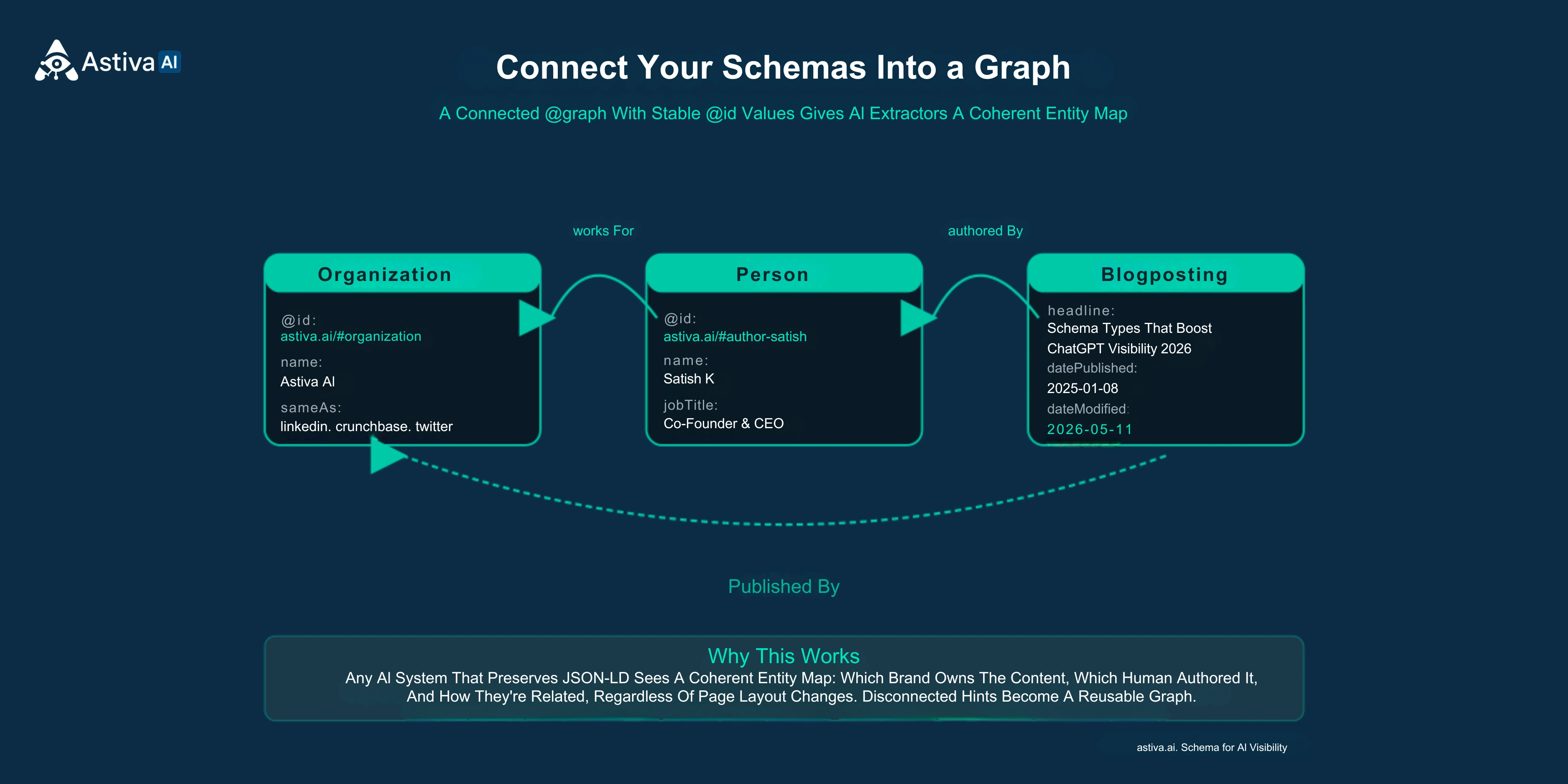
That single @graph block tells any AI system that preserves JSON-LD exactly which brand owns the content, which human authored it, and how they are related, regardless of how the page layout changes over time. It's the difference between a set of disconnected hints and a reusable entity map.
What Schema Cannot Do
Three things schema is not, despite vendor claims to the contrary:
- A substitute for authority. The December 2024 Search/Atlas study found no statistically meaningful correlation between schema coverage and citation frequency on its own, while off-site authority signals (branded web mentions, r=0.664) far outpaced on-page technical signals (domain authority, r=0.21) in Astiva AI's Q1 2026 dataset. Schema cannot overcome weak domain authority, thin content, or low editorial quality. It is a last-mile optimizer for pages whose fundamentals are already in place.
- A workaround for content that isn't visible. Marking up content in JSON-LD that isn't on the visible page violates Google's guidelines and offers little upside even when AI extractors do tokenize it. The model still compares the JSON to the visible content and flags inconsistencies.
- A replacement for cited statistics, expert quotations, or original data. The Princeton GEO study (ACM KDD 2024) found Cite Sources delivers a +115% citation lift for lower-ranked pages and Statistics Addition adds +41%. These are the levers that actually move citation rates. Schema supports them; it does not replace them.
For a deeper look at the content signals that actually move citation rates, see how to optimize content for AI citations and the comparison of GEO vs SEO in 2026.
Validation and Measurement
Two failure modes account for most broken schema deployments:
- Invalid JSON syntax. Missing commas, trailing commas after the last array item, mismatched brackets. Validate every deployment with Google's Rich Results Test and the Schema.org Validator before shipping.
- Schema-content mismatch. JSON-LD claiming the page is a Recipe when the visible content is a comparison post. AI extractors compare the JSON to the surrounding text; mismatches reduce trust in both layers.
Validation tells you the schema is technically correct. It does not tell you whether AI platforms are actually citing the page. For that, you need to measure what AI platforms are saying about your brand directly. That is the gap Astiva AI fills, with daily monitoring across ChatGPT, Claude, Gemini, Perplexity, and other major AI platforms, plus citation source tracking that shows which of your URLs are being extracted and which are being skipped. For a step-by-step audit, see the 7 AI citation audit red flags to fix first.
Where Schema Fits in the Detect → Diagnose → Displace → Prove Cycle
Schema is a Detect-and-Diagnose enabler, not a Displace lever on its own. In the Detect → Diagnose → Displace → Prove Cycle Astiva AI runs across all major AI platforms:
- Detect: daily monitoring across ChatGPT, Claude, Gemini, Perplexity, and other major AI platforms surfaces which queries cite your brand and which do not.
- Diagnose: citation gap analysis with authority scoring (0–100 per source) identifies whether the issue is schema, extraction, authority, or content depth. Schema gaps show up as low extraction confidence on otherwise authoritative pages.
- Displace: citation-ready content generation closes the gaps, including schema scaffolding where missing.
- Prove: native GA4 revenue attribution shows which schema-improved pages drove sessions and conversions from AI referrals.
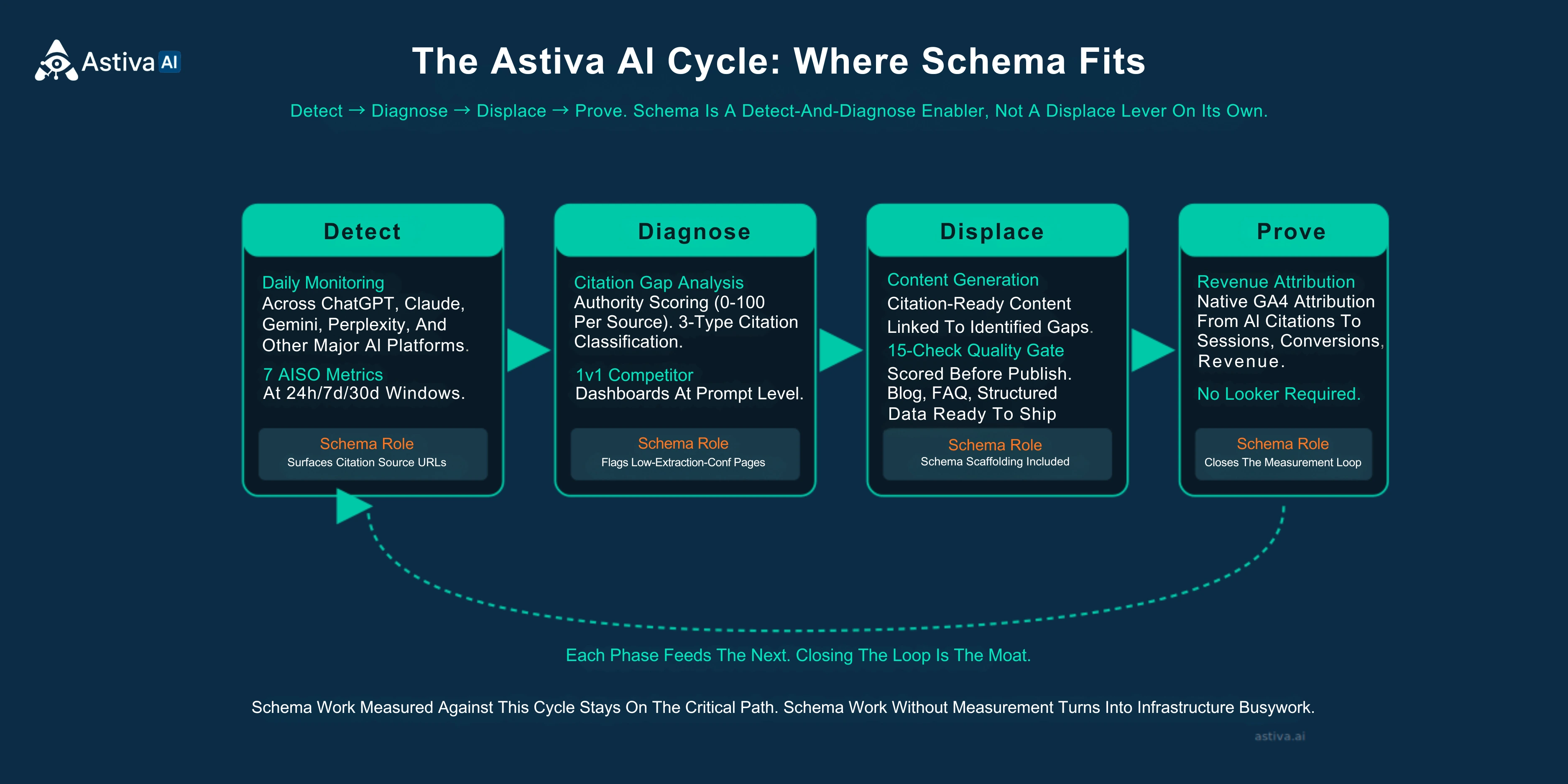
Schema work that isn't tied back to citation outcomes turns into infrastructure busywork. Schema work measured against the Detect → Diagnose → Displace → Prove Cycle stays on the critical path.
A Concrete 30-Day Schema Implementation Plan
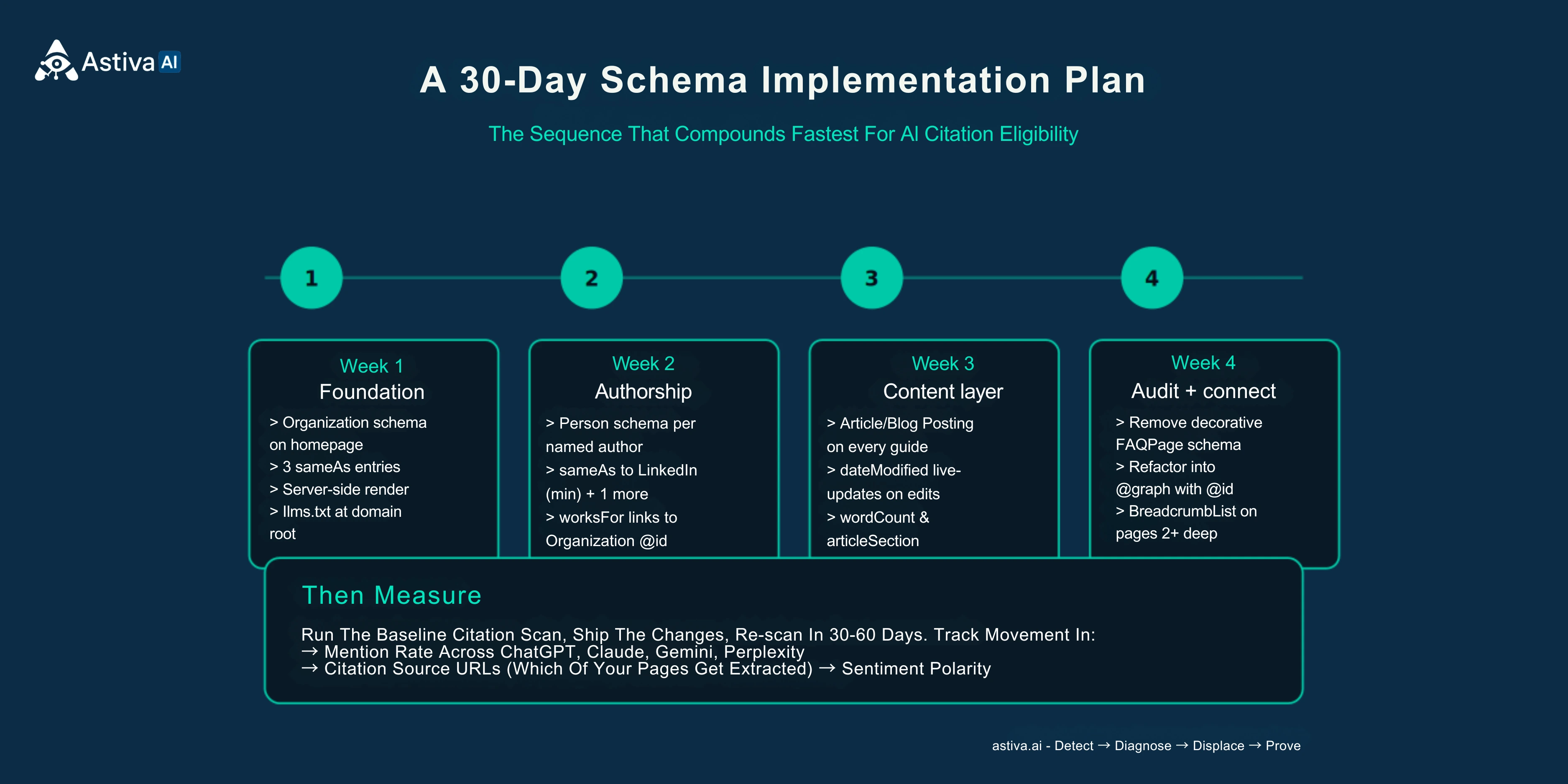
If you want to ship schema work that actually changes how AI platforms describe your brand, here is the sequence that compounds fastest:
- Week 1, Foundation. Deploy Organization schema with three well-chosen sameAs entries on your homepage. Confirm it renders server-side, not via JavaScript. Add llms.txt at the domain root.
- Week 2, Authorship. Deploy Person schema for every named author. Wire sameAs to LinkedIn at minimum, ideally also a verified second profile. Connect Person to Organization via worksFor.
- Week 3, Content layer. Deploy Article/BlogPosting schema on every blog post and guide. Confirm dateModified updates whenever the page is touched. Add wordCount and articleSection explicitly.
- Week 4, Audit and connect. Remove FAQPage schema from any page that does not have a visible Q&A block. Refactor remaining schemas into a connected @graph with stable @id values. Add BreadcrumbList on every page two or more levels deep.
Then measure. Run the baseline citation scan, ship the changes, re-scan in 30–60 days, and look for movement in mention rate, citation source URLs, and sentiment.
Brands compete on recommendations, not rankings
Schema is infrastructure for the AI extraction pipeline. It is necessary, not sufficient. Get the five schemas above shipped as a connected graph, remove decorative FAQPage markup, and you remove the friction that causes AI extractors to skip otherwise good pages. What earns the citation is still authority, topical depth, and the kind of cited, statistic-rich content the Princeton GEO study quantified.
Astiva AI is Competitive Intelligence for AI Search and Visibility. We monitor ChatGPT, Claude, Gemini, Perplexity, and other major AI platforms daily, surface citation gaps with prompt-level competitor dashboards, generate citation-ready content scored against a 15-check quality gate, and attribute AI-driven sessions and revenue back to specific citations through native GA4 integration. The Detect → Diagnose → Displace → Prove Cycle closes the loop schema work leaves open on its own.
Frequently Asked Questions
Does adding FAQPage schema directly increase ChatGPT citations?
No, not directly. A February 2026 controlled test confirmed LLMs tokenize JSON-LD as raw text rather than semantically parsing it. The visible Q&A content on the page is what gets extracted; the JSON-LD reinforces extraction confidence but does not independently trigger citation. SE Ranking's data found pages with visible FAQ blocks averaged 4.9 citations versus 4.4 without. The lift is in the content, not the schema wrapper.
Which schema type has the highest impact on AI citations?
Organization schema with a complete sameAs array. Entity disambiguation is the single most consistent lever across ChatGPT, Claude, Perplexity, and Google AI Overviews. Person schema with verifiable author profiles is a close second, particularly for Claude on YMYL topics.
Should I use JSON-LD, Microdata, or RDFa?
JSON-LD exclusively. Google explicitly recommends it (Search Central, May 2025), AI extractors tokenize it as a contiguous block, and it is easier to maintain because it lives in one place rather than being interleaved with HTML.
Is FAQ schema still worth implementing in 2026?
Only where the page genuinely contains a visible Q&A block answering questions buyers actually ask. Google's May 7, 2026 administrative closure of FAQ rich results for non-authority sites ended the SERP visibility benefit. Decorative FAQ schema on templated footers should be removed.
Does schema markup cause AI platforms to cite my page more often?
Schema improves extraction accuracy, which correlates with higher citation probability, but it is not a direct causal lever. A December 2024 Search/Atlas study found no statistically meaningful correlation between schema coverage and citation frequency on its own. Schema works as part of a connected entity graph alongside authority, topical depth, and cited content.
How do I know if my schema is actually working in AI platforms?
You cannot verify it through Google's Rich Results Test, which only confirms technical validity. You need to monitor what AI platforms actually say about your brand. Astiva AI tracks citation sources across ChatGPT, Claude, Gemini, Perplexity, and other major AI platforms daily and shows you which of your URLs are being cited and which are being skipped.
Should I implement every schema type Schema.org offers?
No. Start with the five that carry the most weight: Article/BlogPosting, Organization, Person, BreadcrumbList, and FAQPage where genuinely applicable. Adding marginal types (VideoObject, AggregateRating) makes sense only when the underlying content exists.
If you want to see whether your current schema is moving the needle, start with the free AI brand visibility analysis. It runs in under five minutes and shows you exactly where you appear today across ChatGPT and Perplexity, no credit card required.