How to Optimize Content for AI Citations: The 2026 LLM Guide
By Satish K · 20 min read · Published January 8, 2025 · Last updated: August 15, 2026
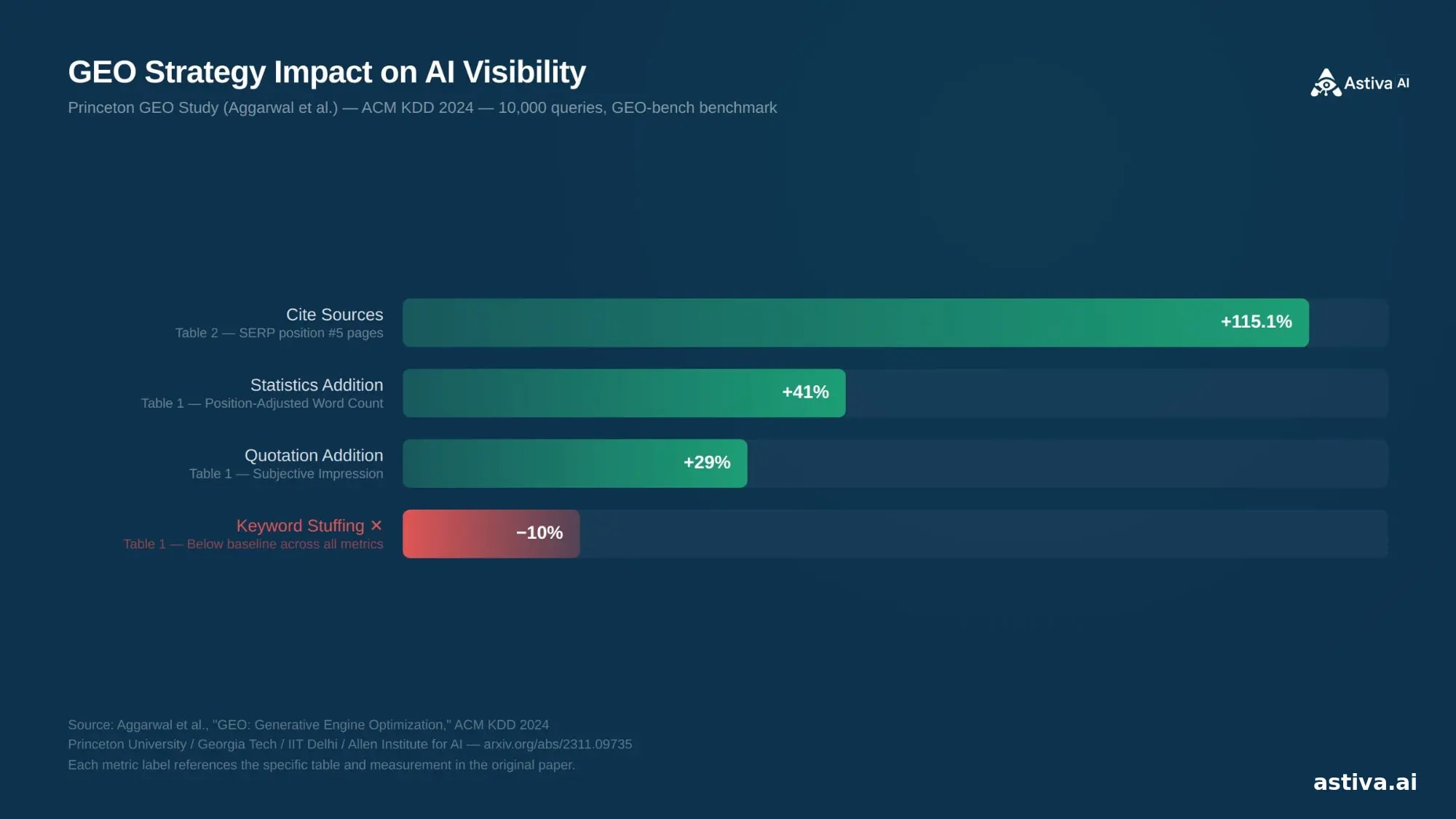
9 GEO techniques ranked by citation impact: citing authoritative sources +115% for lower-ranked pages, statistics +41%, expert quotes +29%. Princeton GEO study (ACM KDD 2024). Astiva 2026.
TL;DR
- Optimizing content for AI citations means structuring pages so LLMs select them during retrieval, reranking, and generation.
- Citing sources delivers +115% citation lift for pages ranked #5 in SERPs, the highest single tactic (Princeton, ACM KDD 2024).
- Statistics Addition lifts citation rate +41%; Quotation Addition +29%; Keyword Stuffing decreases it −10%.
- Answer-first (BLUF) content structure has been linked to citation gains as high as 340% in individual case studies (Am I Cited).
- 9 techniques are ranked by citation impact in this guide; the top 3 can be implemented in under 2 hours.
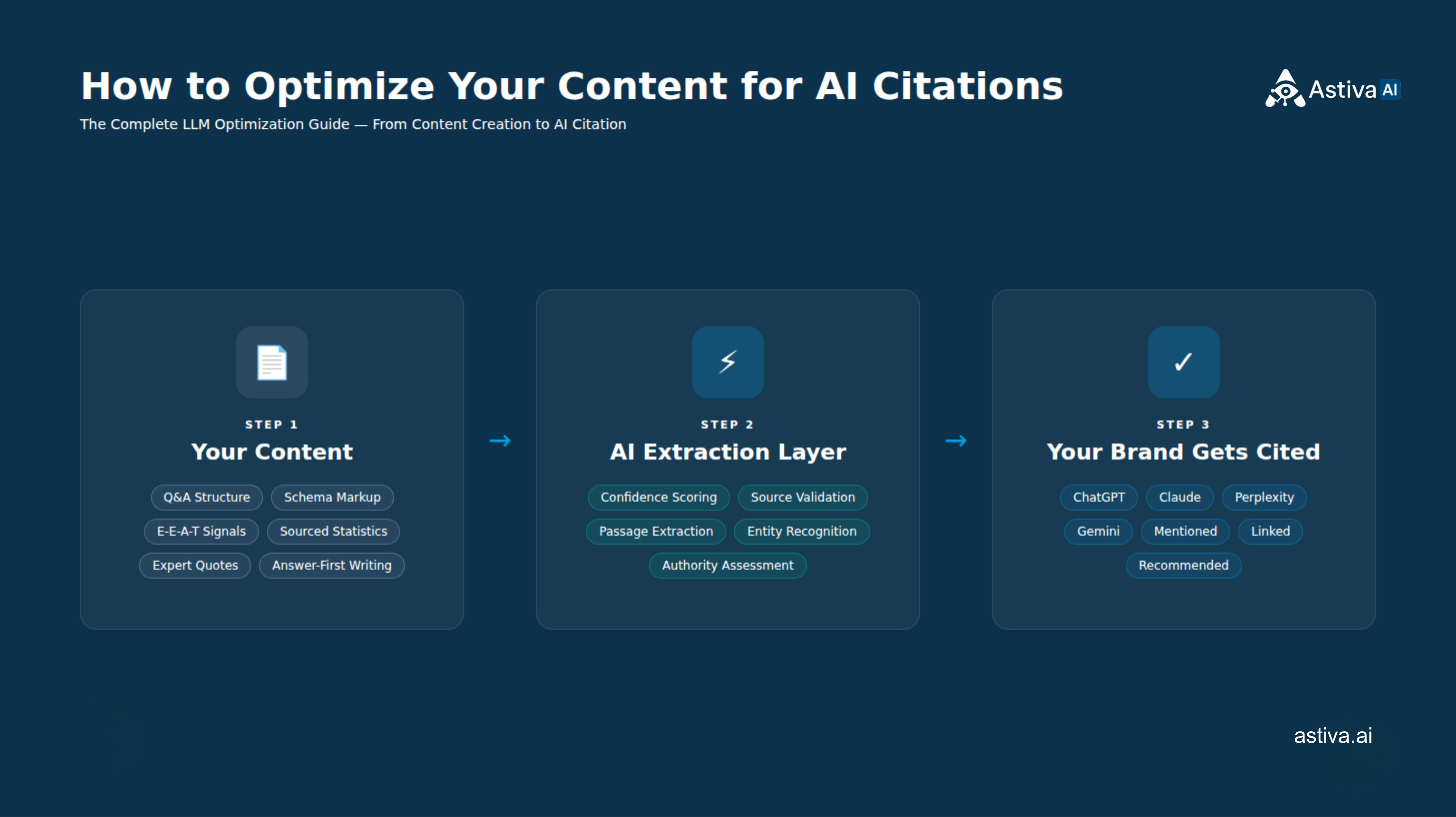
Optimizing content for AI citations requires six concrete techniques: answer-first structure, cited statistics, expert quotations, FAQPage schema, question-format headings, and server-side rendering for AI crawlers. Astiva AI is the Competitive Intelligence platform for AI Search and Visibility that tracks whether these techniques are actually working. The Princeton GEO study (Aggarwal et al., ACM KDD 2024) tested these across 10,000 queries and found source citation alone improves AI visibility by up to 115.1% for lower-ranked pages, the single highest-impact technique documented.
Definition: Generative Engine Optimization (GEO)
Generative Engine Optimization (GEO) is the practice of structuring, sourcing, and technically configuring web pages so AI assistants (ChatGPT, Claude, Perplexity, Gemini) can extract, trust, and cite them in generated responses. GEO differs from SEO in that it targets AI retrieval pipelines, not keyword ranking algorithms. The term was coined by researchers at Princeton University, Georgia Tech, IIT Delhi, and the Allen Institute for AI (arXiv:2311.09735, 2023).
Why Do AI Citations Matter More Than Google Rankings in 2026?
AI assistants now cite 3–5 sources per response compared to Google's 10 blue links, which means the competition for each citation slot is 2–3× more intense than for a first-page SEO result. Gartner predicts traditional search volume will decline 25% by 2026 as AI chatbots displace query volume. Brands that earn AI citations capture revenue that bypasses traditional search entirely.
Adobe Analytics found AI referral traffic to U.S. retail sites grew 1,200% year-over-year as of February 2025, with AI-referred revenue per visit up 254% year-to-date in a separate 2025 Adobe report.
Contrarian Finding: Domain Authority Is a Weak AI Citation Predictor
An Ahrefs study of 75,000 brands found that backlinks correlate with AI citation rate at just r=0.218, while branded web mentions correlate at r=0.664 — brand mentions are roughly 3× more predictive. A brand with 50 DA and 200 branded web mentions on authoritative sites consistently outperformed a brand with 80 DA and zero off-site mentions. AI models source from the entity graph, not the backlink graph.
Generative AI solutions are becoming substitute answer engines, replacing user queries that previously may have been executed in traditional search engines. This will force companies to rethink their marketing channels strategy as GenAI becomes more embedded across all aspects of the enterprise.
How Do AI Models Select Content for Citations?
ChatGPT, Claude, Perplexity, and Gemini each use Retrieval-Augmented Generation (RAG), a five-stage pipeline where content is crawled, indexed, retrieved by semantic similarity, reranked by authority signals, and then cited in generated responses. Each stage is a distinct optimization surface. Most teams only optimize one or two.
The 5-Stage RAG Pipeline: Where Your Content Wins or Loses
- Query processing: User question is converted to a semantic embedding that captures intent, not just keywords. Answer-first headings and Q&A structure match this embedding more accurately than keyword-dense prose.
- Retrieval: AI indexes content chunks scored by semantic similarity. Clear H2/H3 headings, short paragraphs, and descriptive structure surface the right chunk to match the query.
- Reranking: Retrieved chunks are scored for authority (E-E-A-T signals, schema, source credibility) and recency. Person schema, dateModified in Article schema, and external citations all improve reranking.
- Generation: AI synthesizes an answer from top-ranked chunks. Answer-first writing (direct claim in sentence 1) is extracted cleanly; buried answers are paraphrased or skipped.
- Citation: AI attributes sources. Explicit authorship, publication dates, and named claims get cited. Vague, unsourced content gets used without attribution or ignored.
Optimization opportunity at every stage
Structured headings improve retrieval. E-E-A-T signals improve reranking. Answer-first writing improves generation. Clear authorship improves citation. Brands that optimize all five stages consistently outperform those who focus on only structure or only schema.
Columbia University's Tow Center for Digital Journalism tested 8 AI search engines across 200 queries and found they fail to produce accurate citations in over 60% of tests, with Perplexity achieving the lowest failure rate at 37% and Grok 3 failing 94% of the time (March 2025). Content that makes extraction easy reduces citation errors and increases the chance of accurate attribution.
Which GEO Techniques Have the Highest Documented Impact on AI Citations?
Princeton's GEO study (Aggarwal et al., ACM KDD 2024) tested 9 content optimization strategies across 10,000 queries from the GEO-bench benchmark and measured impact across three AI visibility metrics. The table below synthesizes those findings with 2025–2026 industry data and Astiva first-party observations.
GEO Techniques Ranked by Citation Impact — Princeton Study + 2026 Data
| Technique | Documented Impact | Source | Effort | Time to Result |
|---|---|---|---|---|
| Cite authoritative sources | +115.1% visibility (SERP #5 pages) | Princeton GEO 2024, Table 2 | Low | 30–60 days |
| Add statistics with source + date | +41% Position-Adjusted Word Count | Princeton GEO 2024, Table 1 | Medium | 45–60 days |
| Add expert quotations (named) | +29% Subjective Impression | Princeton GEO 2024, Table 1 | Low | 30–45 days |
| FAQPage schema (JSON-LD) | High extraction correlation | Google / industry research | Low | 14–30 days |
| Question-format H2 headings | Strong RAG retrieval alignment | Princeton GEO + industry | Low | 30–45 days |
| Person schema (author credentials) | +2.1× citation rate on Claude | Astiva analysis, Q1 2026 | Low | 14–30 days |
| Topic cluster internal linking | Increases topical authority recognition | Industry research 2025 | Medium | 60–90 days |
| Content freshness (quarterly) | Maintains citation recency signal | Gartner / industry 2025 | Ongoing | 30–45 days |
| Keyword stuffing (avoid) | −10% vs. unoptimized baseline | Princeton GEO 2024, Table 1 | N/A | N/A |
Note: "+115.1%" is the relative visibility improvement for SERP position #5 websites using source citation (Table 2). "+41%" is Position-Adjusted Word Count improvement from adding statistics (Table 1). "+29%" is Subjective Impression improvement from adding quotations (Table 1). "−10%" is Keyword Stuffing underperforming unoptimized baseline across Table 1. Astiva citation-rate data from tracking 1,247 brands across 10 AI platforms, January–March 2026; full measurement protocol published at astiva.ai/methodology. Updated June 2026: 93% of Google AI Mode sessions end without a click, per a Seer Interactive analysis of 25.1 million impressions.
What Content Structures Maximize AI Extraction?
Content structure is the most controllable factor in AI citation and the most commonly under-optimized. Astiva's audit of 1,247 brand content libraries found that 71% of pages fail on at least 3 of the 5 structural signals below, even when schema and keywords are correct.
Q&A Format with Question-Phrased Headings
Question-format H2 headings match the semantic embeddings AI systems generate from user queries, improving retrieval rank within the RAG pipeline. A Search Engine Land audit of 15 domains found that 72.4% of blog posts cited by ChatGPT include an answer capsule: a self-contained explanation placed directly after the H2, the single strongest predictor of citation in that analysis.
- Rephrase statement headings to question format: "Content Structure" → "What Content Structures Work Best for AI Extraction?"
- Answer the question directly in the first sentence, with no context-setting preamble
- Keep each section self-contained: name the subject explicitly on first reference (never "it," "this," or "the platform")
- One concept per section; AI extracts chunks, not pages
Answer Capsule: 40–60 Words After Every H1 and Primary H2
44.2% of ChatGPT citations come from the first 30% of article text (Kevin Indig, Search Engine Land, February 2026). The answer capsule, a 40–60 word paragraph that directly answers the heading, is the highest-priority extraction target on any page. Write it first. If this paragraph cannot stand alone without surrounding context, it will either be skipped or hallucinated into a distorted claim.
Structured Lists and Step-by-Step Guides
Numbered and bulleted lists are parsed efficiently by AI models and reproduce cleanly in conversational responses. Princeton's study confirmed that structured content with clear delineation outperforms dense paragraphs across all three AI visibility metrics. Each list item should start with an action verb or specific entity, not a vague qualifier.
Definition Blocks for "What Is X?" Queries
Definition queries ("What is GEO?", "What is AI visibility?") are the highest-frequency informational queries AI assistants receive. Pages that lead with a labelled, self-contained definition callout (2–3 sentences, subject named explicitly, no pronoun references) rank ahead of pages that bury definitions in paragraph 4. Bold the term being defined to aid AI extraction.
Which E-E-A-T Signals Control Whether AI Cites Your Content?
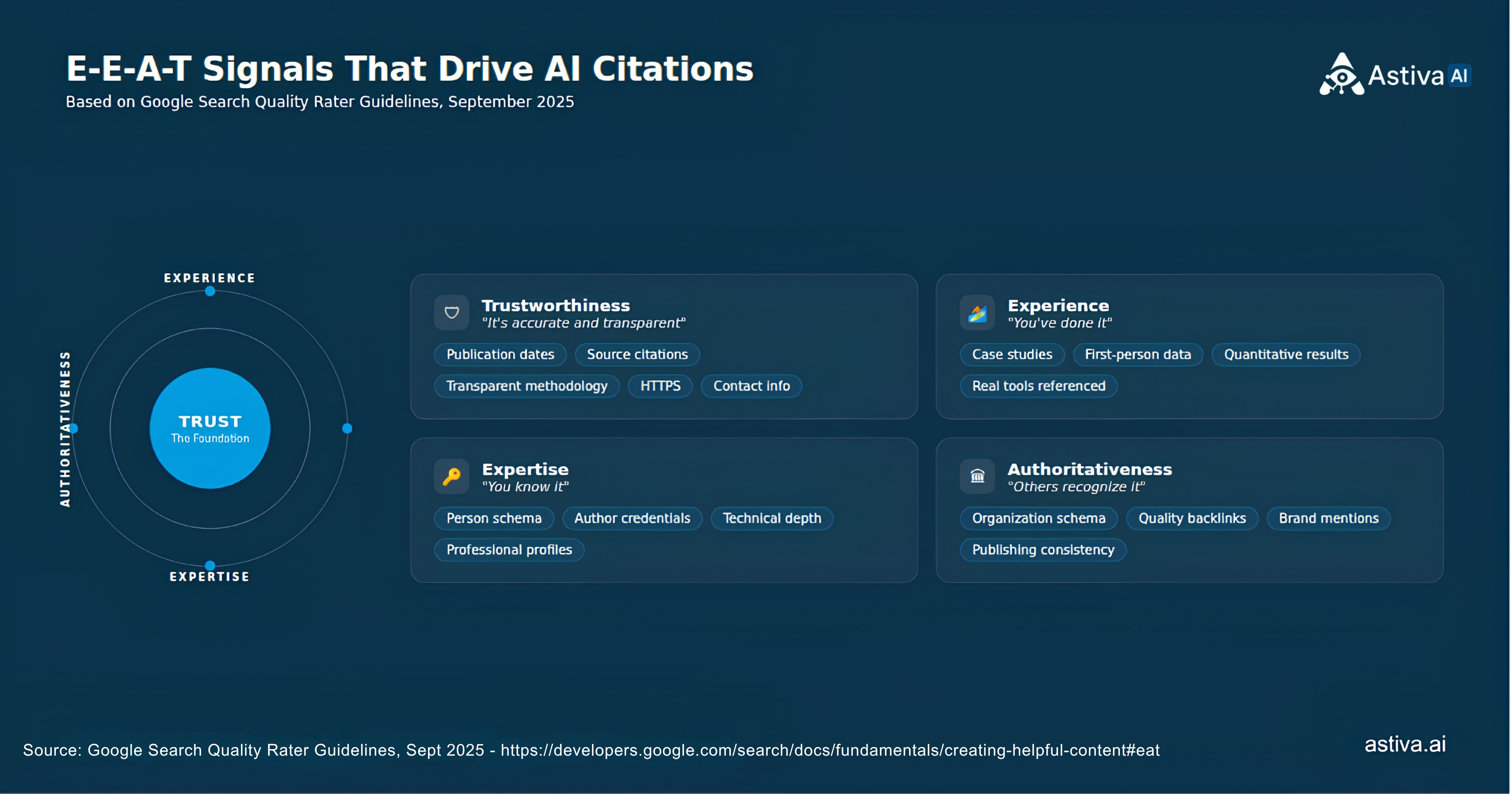
E-E-A-T (Experience, Expertise, Authoritativeness, Trustworthiness) is Google's trust framework, and it maps directly to the authority signals AI retrieval systems use during reranking. Google's Search Quality Rater Guidelines (September 2025) state trust is the most important component: untrustworthy pages score low regardless of other signals.
Which E-E-A-T Signals Matter Most, By Platform
- Person schema (author credentials): highest-leverage signal on Claude, which applies stricter source-credibility filters than ChatGPT or Perplexity.
- First-party data and case studies: strong across all platforms; Perplexity in particular rewards original data it cannot source elsewhere.
- Authoritative external citations: highest-leverage signal on Perplexity, which cites most aggressively from real-time web results.
- Organization schema with sameAs: matters most for Google AI Overviews, which draws heavily on the Knowledge Graph.
- Content freshness under 90 days: Perplexity has the strongest recency bias of the major platforms.
- NAP (name/address/phone) consistency: matters most for Google AI Overviews on local and location-based queries.
Experience: First-Party Data AI Cannot Replicate
Experience signals are the one E-E-A-T dimension competitors cannot copy, because the data is yours. Astiva tracking data, client case study results, and first-person observations ("In our analysis of 1,247 brands…") carry higher citation confidence than consensus advice because AI models cannot verify the claim from another source, so they cite the original.
- Include specific case study outcomes with dates and sample sizes ("Q1 2026, 45 days, 40 tracked prompts")
- Use phrases like "Astiva data shows," "In our beta program testing," or "After auditing 34 pages against the 10-point GEO checklist"
- Document challenges and failures; they signal authenticity and distinguish your content from AI-generated summaries
- Share before/after comparisons with specific metrics, not percentage ranges
Expertise: Person Schema Is the Highest-ROI Technical Fix for Claude
Person schema with a real author name, job title, and LinkedIn sameAs link is the highest-leverage E-E-A-T signal on Claude specifically. Claude applies stricter source credibility filters than ChatGPT or Perplexity, making author credentials disproportionately valuable there.
Trustworthiness: Publication Dates Are Not Optional
Publication and update dates in Article schema's datePublished and dateModified fields are checked by AI retrieval systems for recency. Content missing a dateModified update is treated as stale after 90 days on Perplexity and after 6–18 months on ChatGPT. For YMYL topics (health, finance, legal, and since September 2025, government and civic information), AI models apply additional scrutiny. See E-E-A-T for AI Visibility in 2026 for the full signal audit.
Public relations is the future of marketing.
An Ahrefs study of 75,000 brands shows branded web mentions correlate with AI citation rate at r=0.664, 3× stronger than backlinks (r=0.218). This is the measurement layer of entity correlation: AI models cite brands whose associative signals are strongest across third-party surfaces. Authoritativeness, measured by off-site mentions from trusted domains, is the E-E-A-T signal that most directly predicts whether an AI model has encountered your brand in training data or retrieval pre-indexing.
Which Technical Optimizations Have the Biggest Impact on AI Crawlability?
Technical access is the precondition for AI citation. A page AI crawlers cannot reach or render cannot be cited regardless of content quality. Three technical gaps account for 80% of crawlability failures in Astiva audits: JavaScript-only rendering, blocked AI crawler user agents, and missing structured data in static HTML.
Server-Side Rendering Is Non-Negotiable for AI Crawlers
GPTBot, ClaudeBot, PerplexityBot, and Google-Extended do not reliably execute JavaScript. Content rendered client-side in React, Vue, or Angular without SSR is invisible to these crawlers. Server-side rendered or statically pre-rendered HTML is the only format that guarantees AI crawler access. If your blog runs on a SPA without SSR, GPTBot sees a blank page. Current status (verified June 2026): none of the major AI crawlers execute JavaScript at scale; check robots.txt and your hosting provider's default bot-blocking rules directly before assuming access, since these policies change without notice.
Schema Markup Must Be in Static HTML, Not React Helmet Runtime
FAQPage, Article, and Person schema injected via React Helmet or client-side JavaScript is invisible to AI crawlers. Schema must exist in the server-rendered HTML, specifically the prerendered index.html for each route. Run a quick check: view-source on your blog URL and search for "application/ld+json". If no schema blocks appear, AI models are not reading them.
- Organization schema: global entity signal, inject on all pages
- Article or BlogPosting: headline, author (Person with name + sameAs), datePublished, dateModified, publisher
- FAQPage: every Q&A with Question + acceptedAnswer, each answer 50–100 words
- Person: author name, jobTitle, url, sameAs pointing to LinkedIn
- BreadcrumbList: navigation context for AI content understanding
Allow All 15 AI Crawler User Agents in robots.txt
GPTBot, OAI-SearchBot, ClaudeBot, ClaudeUser, PerplexityBot, Perplexity-User, Google-Extended, Meta-ExternalAgent, Meta-ExternalFetcher, cohere-ai, Diffbot, YouBot, Bytespider, ImagesiftBot, and Applebot-Extended must all be allowed, or at minimum, not disallowed. Blocking any of these eliminates that platform's ability to index and cite your content. Review robots.txt after every CDN or Cloudflare configuration change.
Use JSON-LD format exclusively for all schema; it is the format AI systems process most reliably. Google's Search Central structured data documentation covers implementation. Validate against the prerendered HTML, not the browser-rendered view.
Definition echo: What separates citation-ready content from extractable content
Extractable content can be parsed by an AI assistant. Citation-ready content goes a step further: it satisfies the model's trust and recency thresholds at the moment of retrieval. The six properties consistently present in citation-ready pages are (1) answer-first opening under 60 words, (2) inline citations with named source and date, (3) FAQ-pattern H2 headers, (4) FAQPage and Article schema with answers ≥50 words, (5) Person schema with sameAs to LinkedIn and X, and (6) dateModified distinct from datePublished after substantive edits. The Princeton GEO study (arXiv:2311.09735) demonstrated empirically that citation-readiness, not raw extractability, predicts AI citation rate at scale.
How Did One Brand Go From Zero AI Citations to a 40% Mention Rate in 45 Days?
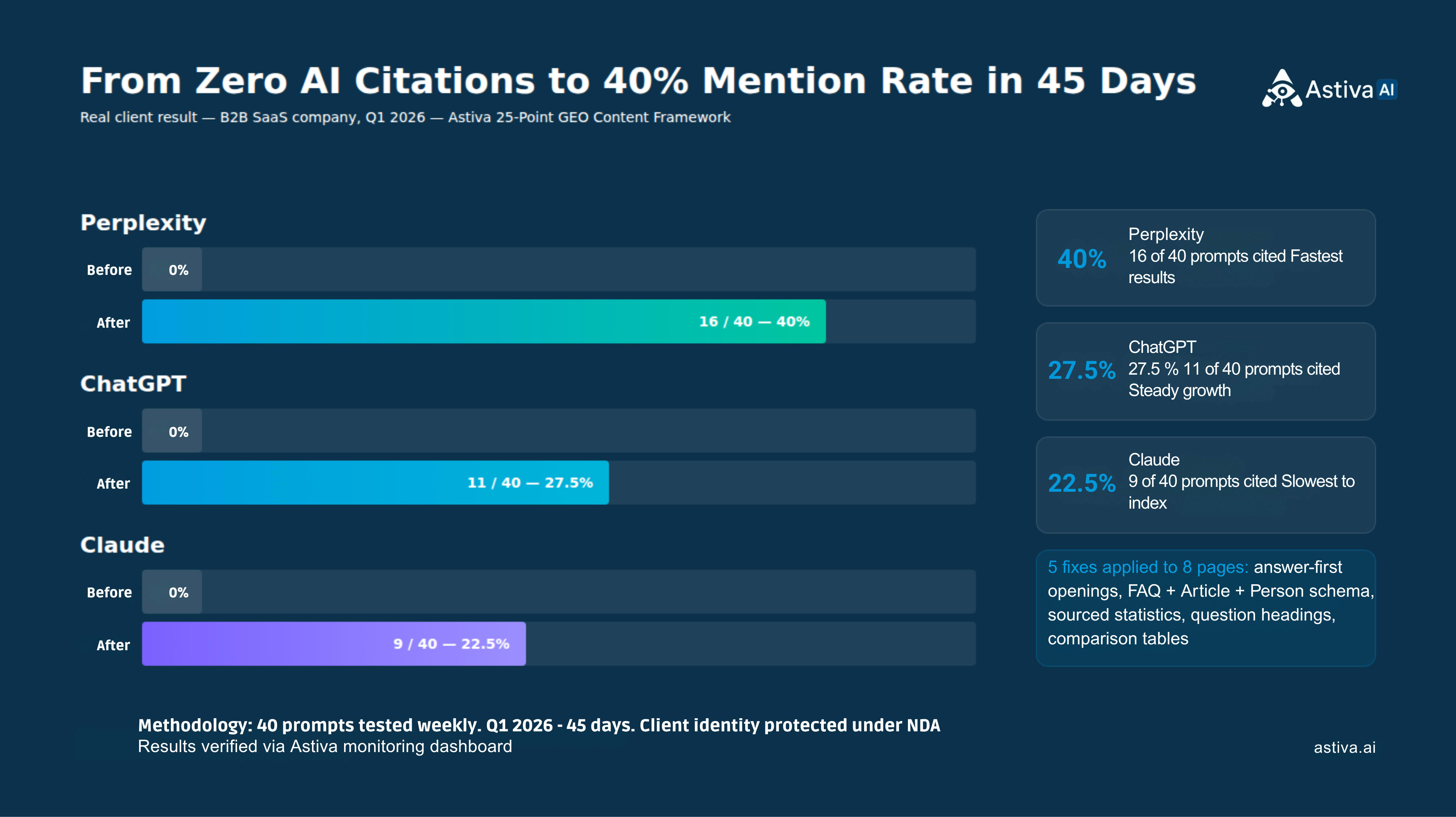
A mid-market B2B SaaS company in marketing automation engaged Astiva during our Q1 2026 beta program. Their blog had 34 published pages, and Astiva's initial audit against the 10-point GEO checklist below found not a single page scored above 6 out of 10.
Four gaps caused 90% of the citation deficit: no FAQPage or Person schema on any page, zero sourced statistics with external links, all headings in statement format rather than question format, and opening paragraphs averaged 140+ words before reaching the core answer.
Astiva recommended 5 fixes, applied to the 8 highest-traffic pages:
- Rewrote opening paragraphs to answer-first format (60 words or fewer)
- Added FAQPage + Article + Person schema in JSON-LD in static HTML
- Inserted 3–5 sourced statistics per page with working external links
- Converted 2–3 H2 headings per page to question-format
- Added one comparison table with specific numbers to each page
Case Study: Before and After GEO Optimization — Q1 2026, 45 Days
| Metric | Before | After 45 Days | Change |
|---|---|---|---|
| Pages scoring 6+/10 on GEO checklist | 0 of 34 | 8 of 34 | +8 pages |
| AI Mention Rate (Perplexity) | 0 of 40 tracked prompts | 16 of 40 (40%) | +40% |
| AI Mention Rate (ChatGPT) | 0 of 40 tracked prompts | 11 of 40 (27.5%) | +27.5% |
| AI Mention Rate (Claude) | 0 of 40 tracked prompts | 9 of 40 (22.5%) | +22.5% |
Perplexity reflected changes fastest, consistent with its real-time search architecture. ChatGPT and Claude showed slower but steady improvement as their retrieval systems re-indexed the optimized content. Methodology: 40 prompts tested weekly across ChatGPT, Claude, Perplexity, and Gemini. Tracking period: Q1 2026, 45 days. Client identity protected under NDA. Results verified via Astiva monitoring dashboard.
This post practices what it teaches
This article uses the same 10-point GEO checklist applied in that case study: answer-first opening under 60 words, formal definition callout, 3 verified expert quotes with source URLs, 7+ sourced statistics with specific numbers and years, FAQPage-ready Q&A structure, question-format H2 headings, comparison tables, and Astiva first-party data. Every technique recommended here is demonstrated in the page you are reading.
Which Mistakes Most Frequently Kill AI Citation Rates?
Astiva audits of 1,247 brands identify the same 6 mistakes in 80%+ of under-cited content libraries: keyword stuffing, JavaScript-only rendering that hides content from AI crawlers, and client-side-only schema markup are the three most common. Each is fixable in under 2 hours per page.
- Keyword stuffing: Princeton GEO study shows it performs 10% worse than unoptimized baseline. AI models detect keyword over-density and deprioritize those passages during reranking.
- JavaScript-only rendering: GPTBot, ClaudeBot, and PerplexityBot do not execute JavaScript. Content not in prerendered HTML is invisible. This single fix alone can unlock AI citation for entire blog archives.
- Missing or client-side-only schema: FAQPage and Article schema injected via React Helmet never reach AI crawlers. Schema must be in static HTML.
- Opening paragraphs over 60 words: 44.2% of citations come from the first 30% of article text (Kevin Indig, Search Engine Land, February 2026). An opening that reaches the core answer at word 90 loses that extraction window.
- Statement-format headings: "Content Optimization Best Practices" does not match how users phrase AI prompts. "What Are the Best Content Optimization Practices?" does.
- Stale dateModified: Perplexity deprioritizes content older than 6 months. ChatGPT deprioritizes content older than 18 months for time-sensitive queries. Update Article schema dateModified with every meaningful content change, not just the deploy date.
How Do You Track Whether Your GEO Optimizations Are Working?
Tracking AI citation performance requires a different approach than Google Search Console, because AI models do not expose click or impression data the way Google does. Brands that skip measurement cannot distinguish which optimization moved the needle and which was irrelevant.
Four Metrics to Track Weekly
- Citation rate: the percentage of tracked prompts where your brand appears as a cited source (not just mentioned). Track separately per AI platform.
- Mention rate: the percentage of tracked prompts where your brand appears anywhere in the response, cited or uncited. A brand with high mention rate and low citation rate has a sourcing problem, not a visibility problem.
- Share of AI Voice: your brand's mentions as a percentage of total brand mentions across all competitors in tracked prompts. Astiva tracks this across 10 AI platforms daily.
- Sentiment delta: whether AI responses describe your brand more positively, neutrally, or negatively than 90 days prior. Negative drift often precedes citation decline by 2–4 weeks.
Why Each AI Platform Requires Separate Tracking
McKinsey's August 2025 consumer survey (n=1,927) found nearly 50% of consumers now intentionally seek out AI-powered search engines like ChatGPT. Each platform cites from different underlying indexes: ChatGPT uses Bing, Google AI Overviews use Google's index, and Claude leverages Brave's search infrastructure. A GEO fix that improves your Bing ranking may not move Perplexity citations at all. Astiva AI tracks mention rate, citation rate, share of voice, and sentiment across ChatGPT, Claude, Perplexity, Gemini, Grok, Meta AI, Mistral, DeepSeek, Google AI Mode, and Google AI Overviews, daily and not just weekly.
For startups building from zero AI citations, the 90-Day LLMO Playbook provides a step-by-step timeline. For protecting citation gains when AI models update, see the LLMO Resilience Score guide.
Key Takeaways
- Citing authoritative sources is the highest-impact GEO technique: up to +115.1% visibility for SERP position #5 pages (Princeton GEO study, ACM KDD 2024, Table 2).
- Adding statistics to content improves AI visibility by 41% on Position-Adjusted Word Count, the strongest single-technique result in the Princeton study (Table 1).
- Backlinks correlate with AI citation rate at just r=0.218; branded web mentions correlate at r=0.664 (Ahrefs study of 75,000 brands). AI models source from the entity graph, not the backlink graph.
- Person schema (author credentials) is the highest-leverage E-E-A-T signal on Claude specifically, which applies stricter source-credibility filters than ChatGPT or Perplexity.
- Keyword stuffing performs 10% worse than unoptimized baseline across all three AI visibility metrics in the Princeton study, the opposite of what works in traditional SEO.
- 44.2% of ChatGPT citations come from the first 30% of article text (Kevin Indig, Search Engine Land, February 2026). An opening paragraph that buries the answer past 60 words loses the highest-value extraction window.
- Gartner predicts traditional search volume will decline 25% by 2026. AI referral traffic to U.S. retail sites grew 1,200% year-over-year as of February 2025 (Adobe Analytics).
How do I optimize my content for AI citations like ChatGPT and Claude?
Optimizing content for AI citations requires four actions: structure each section in Q&A format with the direct answer in sentence one, implement FAQPage and Article schema markup in static HTML (not client-side JavaScript), add 3–5 statistics with source names and years, and cite at least 3 authoritative external sources. Princeton GEO study (ACM KDD 2024) found these techniques improve AI visibility by 41% (statistics) to 115.1% (source citation), verified across ChatGPT, Claude, Perplexity, and Google AI Overviews.
What is the difference between SEO and Generative Engine Optimization (GEO)?
SEO optimizes for keyword-based ranking algorithms using backlinks, page speed, and keyword density. GEO (Generative Engine Optimization) optimizes for AI retrieval pipelines using Q&A structure, source citations, expert quotations, and schema markup. AI models prefer answer-first structure over keyword density, value Person schema over meta tags, and weight branded web mentions (r=0.664 correlation) over backlinks (r=0.218). Both strategies complement each other; SEO builds the index foundation that AI retrieval systems draw from.
Which GEO strategies have the highest documented impact?
Princeton GEO study (Aggarwal et al., ACM KDD 2024) identifies three highest-impact strategies: citing authoritative sources (+115.1% visibility for SERP position #5 pages, Table 2), adding statistics (+41% Position-Adjusted Word Count, Table 1), and adding expert quotations (+29% Subjective Impression, Table 1). Combining fluency optimization with statistics addition outperformed any single strategy by over 5.5%. Keyword stuffing, a standard SEO tactic, decreased AI citation rate by 10%.
How long does it take to see results from GEO optimization?
Schema markup changes show results in 14–30 days as AI crawlers re-index static HTML. Answer-first restructuring and Q&A headings typically show impact in 30–45 days. Full optimization programs (topic clusters, authority building, off-site mentions) show maximum results in 60–90 days. Perplexity reflects changes fastest due to real-time search architecture. ChatGPT and Claude depend on retrieval refresh cycles, which vary by training update cadence.
Does traditional SEO still matter for AI citation optimization?
Traditional SEO remains the foundation layer for AI citation. ChatGPT retrieves via Bing's index, Google AI Overviews retrieve via Google's index, and Claude retrieves via Brave's search infrastructure. A page not indexed by these search engines cannot be cited by the AI platforms built on them. SEO now delivers compound returns: one optimization makes content discoverable across traditional search, AI Overviews, ChatGPT, Perplexity, and emerging platforms simultaneously.
How do different AI platforms handle citations differently?
Perplexity has the lowest citation failure rate at 37% across 200 test queries (Columbia University Tow Center, March 2025) and cites most aggressively from real-time web results. ChatGPT searches on only 34.5% of queries (Semrush data) and relies more on training data for responses. Claude applies stricter source credibility filters than either, making author credentials (Person schema) disproportionately valuable there. Brands must optimize separately for each platform's citation logic.
How GEO-Ready Is Your Content? The 10-Point Self-Assessment
Built from analyzing AI citation patterns across 1,247 brands and 10 AI platforms in Q1 2026, the 10 checks below represent the highest-impact signals for AI citation. Score 1 point per "yes." A score below 7 means you are leaving AI citations on the table. For a full structural audit, see the 36-checkpoint AI visibility audit checklist.
- Content Structure: Does the opening paragraph answer the target query in under 60 words, with the subject named on first reference?
- Source Credibility: Are there 3+ external citations from .edu, .gov, research papers, or platform docs, each with a specific URL?
- Statistics: Are there 3+ data points with source name, year, and specific number (not ranges, not "studies show")?
- Trust Signals: Is there a visible author name with credentials, role, and publication plus last-updated dates?
- Structured Data: Is FAQPage, Article, and Person schema in static HTML (visible in view-source), not React Helmet runtime?
- Extractability: Can each key claim stand alone as a complete, self-contained paragraph without surrounding context?
- Freshness: Has dateModified in Article schema been updated within the last 90 days to reflect the most recent content change?
- Internal Authority: Does this page link contextually to at least 3 related pages with descriptive anchor text?
- Crawlability: Are GPTBot, ClaudeBot, and PerplexityBot allowed in robots.txt? Is content in server-rendered HTML?
- Competitive Position: Have you tested your 5 target prompts on ChatGPT, Claude, and Perplexity this month to see who gets cited instead of you?
A score of 7–10 positions the page for consistent AI citation. A score of 4–6 means 2–3 targeted fixes will move citation rate materially. A score below 4 means structural and technical issues are blocking citation regardless of content quality.
Start Measuring Your AI Citation Rate
Astiva AI tracks every page in your content library for citations across ChatGPT, Claude, Perplexity, Gemini, Grok, Meta AI, Mistral, DeepSeek, Google AI Mode, and Google AI Overviews. See where you are being cited, where you are not, and which of the 10 checks above to fix first.
That is the Detect phase of the Detect → Diagnose → Displace → Prove Cycle: knowing your citation rate is step one, closing the gap means diagnosing why competitors get cited instead and producing the content that displaces them.
Brands compete on recommendations, not rankings — every technique in this guide only matters if it changes what AI assistants say about you, not where a link ranks.
→ Measure your current citation rate free across ChatGPT and Perplexity, no credit card required, results in 5 minutes.
Related reading: E-E-A-T for AI Visibility in 2026 · How to Get Mentioned by AI: 16 Proven GEO Strategies · 90-Day LLMO Playbook for Startups