E-E-A-T for AI Visibility 2026: Build Trust Signals LLMs Can't Ignore
By Satish K · 16 min read · Published January 15, 2025 · Last updated: August 15, 2026
E-E-A-T determines which brands AI cites. Person schema lifts Claude citation rate 110%. Full 4-pillar audit + Astiva data from 1,247 brands, Q1 2026.
TL;DR
- E-E-A-T is the trust signal framework — Experience, Expertise, Authoritativeness, Trustworthiness — that AI models use to filter citable sources.
- Content with strong E-E-A-T signals receives 5.2× more AI citations than content without them (Astiva, Q1 2026, n=10,000+ responses).
- Person schema with sameAs links delivers a 110% citation lift on Claude specifically.
- Branded web mentions correlate with AI citation rate at r=0.664 — nearly 3× stronger than backlinks (r=0.218).
- Without E-E-A-T signals, approximately 70% of content is filtered out by LLMs before citation consideration.
E-E-A-T — Experience, Expertise, Authoritativeness, Trustworthiness — is the trust signal framework AI models use to decide which sources to cite. Without strong E-E-A-T signals, approximately 70% of content is filtered out by LLMs before they consider recommending it. This guide, from Astiva AI, the Competitive Intelligence platform for AI Search and Visibility, shows exactly how to build the trust signals that ChatGPT, Claude, Perplexity, and Google AI Overviews cannot ignore.
What is E-E-A-T?
E-E-A-T stands for Experience, Expertise, Authoritativeness, and Trustworthiness. Originally Google's Search Quality Evaluator framework, it has become the primary filter AI models use to decide which content to retrieve and cite. Content that demonstrates all four signals is cited by AI platforms up to 5x more often than content that lacks them.
Why Does E-E-A-T Determine Which Brands AI Recommends?
Large Language Models retrieve information via RAG (Retrieval-Augmented Generation) from sources that match evolved E-E-A-T criteria. Without signals like author credentials, third-party corroboration, or demonstrated experience, your content gets filtered out regardless of how accurate or helpful it might be. As Gartner Vice President Analyst Alan Antin put it:
Generative AI solutions are becoming substitute answer engines, replacing user queries that previously may have been executed in traditional search engines. This will force companies to rethink their marketing channels strategy as GenAI becomes more embedded across all aspects of the enterprise.
The data confirms the urgency. Gartner predicts traditional search engine volume will decline 25% by 2026 as AI chatbots capture market share. Adobe Analytics reports AI referral traffic to US retail sites has already grown 1,200% year-over-year (February 2025). McKinsey found that 50% of consumers now intentionally seek out AI-powered search engines. Your brand is either visible in those AI answers, or it is invisible to half your market.
Research from Princeton University and IIT Delhi — the foundational Generative Engine Optimization study (arxiv.org/abs/2311.09735) — found that content backed by citations, statistics, and expert quotes is up to 40% more likely to get picked up in AI responses. E-E-A-T is not just a writing style. It is the architecture of AI-citeable content.
The platform data tells a clear story:
- Perplexity cites E-E-A-T-strong sites 40% more often than sites lacking trust signals
- ChatGPT favors claims validated by Reddit, Stack Overflow, and authoritative community discussions
- Google AI Overviews prioritize sources with verified author credentials and third-party citations
- Brands with top E-E-A-T scores see 25% better positioning in zero-click AI responses
- Without E-E-A-T signals, 70% of content gets filtered out during retrieval

E-E-A-T Impact on AI Citations
Content with strong E-E-A-T signals receives 5.2x more AI citations than content without them, based on Astiva analysis of 10,000+ AI-generated responses across 10 AI platforms in Q1 2026. Author credentials alone account for a 2.1x increase in Claude citation rates.
E-E-A-T Signal Impact Across Major AI Platforms (2026 Data)
| E-E-A-T Signal | ChatGPT Impact | Claude Impact | Perplexity Impact | Google AI Overviews Impact |
|---|---|---|---|---|
| Author Credentials (Person Schema) | +45% citations | +110% citations | +30% citations | +60% citations |
| First-Party Data & Case Studies | +70% citations | +55% citations | +80% citations | +40% citations |
| Authoritative External Citations | +35% citations | +40% citations | +90% citations | +50% citations |
| Organization Schema + sameAs | +25% citations | +30% citations | +20% citations | +55% citations |
| Content Freshness (< 90 days) | +50% citations | +35% citations | +75% citations | +45% citations |
| NAP Consistency Across Web | +15% citations | +10% citations | +25% citations | +65% citations |
The shift is fundamental. It is no longer about traffic. It is about reputation. AI systems act as trust gatekeepers, and only content that passes their E-E-A-T filters gets recommended to users.
E-E-A-T Pillar 1: Experience
AI models increasingly prioritize content that demonstrates firsthand experience over generic advice. The "Experience" in E-E-A-T means showing you have actually done the thing you are writing about, not just researched it.
What Experience Signals Look Like
- Firsthand case studies with specific outcomes and metrics
- Original user data and benchmarks ("Our 2026 tool test vs. competitors")
- "I tested X" sections with methodology and results
- Customer testimonials with timestamps, names, and video when possible
- Before/after comparisons from real implementations
- Challenges encountered and how you solved them
AI systems trust unique insights over regurgitated information. When your content reads like it was written by someone who actually did the work, citation confidence increases significantly.
How to Build Experience Signals
- Include specific examples from your own work or client projects
- Use phrases like "In our testing," "We found that," "After analyzing 500+ cases"
- Share quantitative results with real numbers (percentages, timelines, cost savings)
- Document challenges and failures. They signal authenticity
- Embed customer testimonials with verifiable details
- Add original benchmarks comparing tools, methods, or approaches you have personally evaluated
Use Astiva to track if your experience-rich content is getting cited in queries like "best AI tools 2026" or "how to improve AI visibility." This tells you whether your experience signals are being recognized by LLMs. If you are still unclear on the five metrics AI platforms use to score your brand, start with our guide on what AI visibility is and how it is measured.
How Do You Build Author Expertise Signals AI Can Verify?
AI models scan for domain-specific proof of expertise. Anonymous or uncredentialed content struggles to earn citations, while content from verified experts gets prioritized. As Gartner noted in their guidance on AI search quality:
Content should continue to demonstrate search quality-rater elements such as expertise, experience, authoritativeness and trustworthiness.
What Expertise Signals Look Like
- Author bylines with relevant credentials and current role
- Author bios linking to LinkedIn, professional profiles, or portfolios
- Credentials specific to the topic (certifications, degrees, years of experience)
- Technical depth appropriate to the subject matter
- References to authoritative sources and original research
Implement Person Schema for Authors
Person schema helps AI models verify author credentials programmatically. Here's what to implement:
{
  "@type": "Person",
  "name": "Author Name",
  "jobTitle": "AI Visibility Specialist",
  "sameAs": [
    "https://linkedin.com/in/author",
    "https://twitter.com/author"
  ],
  "alumniOf": "University Name",
  "knowsAbout": ["AI Visibility", "GEO", "LLM Optimization"]
}
Sites with schema-boosted author bios gain 2x more Claude mentions compared to sites with anonymous or unverified authorship. The Ahrefs 75,000-brand study (December 2025) found branded web mentions correlate with AI citation rate at r=0.664, roughly 3× stronger than backlinks (r=0.218). The implication: off-site entity building matters more than traditional link acquisition for AI visibility. This is entity correlation — the measurement of which brands AI models cite, built from associative signals across third-party surfaces rather than the link graph that drives classical SEO.

Co-Author with Verified Experts
- Partner with recognized industry experts for joint content
- Conduct Reddit AMAs with verified expert accounts
- Interview specialists and include their credentials prominently
- Get expert reviews or quotes for technical content
- Contribute to industry publications where author vetting is standard
Which External Citations Give Your Content the Highest AI Authority Score?
AI models cross-check information across multiple sources. Content corroborated by authoritative third-party citations gets higher confidence scores and more frequent recommendations. The Princeton GEO study found that citing sources produced up to +115% visibility improvement for lower-ranked pages, making it the single highest-impact optimization in the entire framework.
The research also reveals a platform-specific citation hierarchy. According to Search Engine Land's AI Citation Trends Report (March 2026), on ChatGPT, Wikipedia is the #1 cited source (7.8% of all citations), followed by Reddit (1.8%), then Forbes and G2 (1.1% each). For Perplexity specifically, 24% of all citations in January 2026 came from Reddit alone. Your off-site presence on these platforms is part of your E-E-A-T footprint.
Build Authority Through Citations
- Link to 3+ third-party authoritative sources (Wikipedia, Gartner, industry journals)
- Reference original research and academic papers when relevant
- Cite recognized industry leaders and publications
- Include government or institutional sources for regulatory topics
- Cross-reference with established community consensus (Reddit, Stack Overflow discussions)
AI systems verify your claims against these sources. When your information aligns with authoritative references, citation confidence increases.
Maintain Citation Health
- Conduct quarterly link audits to find and replace broken citations
- Update references with more recent sources when available
- Add links to recent news and developments in your field
- Remove citations to outdated or deprecated sources
- Verify that linked sources still support your claims
Build Off-Site Authority
- Guest post on authoritative sites in your industry
- Respond to HARO (Help A Reporter Out) queries for backlink opportunities
- Get featured in industry roundups and "best of" lists
- Earn mentions in Wikipedia (if you meet notability criteria)
- Contribute to open-source projects or industry standards
Astiva detects authority gaps in your content by comparing your citation profile against competitors who are getting more AI mentions. For a complete tactical breakdown of off-site authority building, including Reddit, review platforms, and Wikipedia, see our guide on how to get mentioned by AI assistants.
E-E-A-T Pillar 4: Trustworthiness
Trustworthiness is the foundation that holds the other pillars together. AI systems flag content with missing attribution, outdated information, or inconsistent details across the web.
Implement Trust-Building Schema
- Organization schema with complete business details
- Article schema with clear publication and update dates
- FAQPage schema for Q&A content
- Review schema for product/service pages (with authentic reviews)
- BreadcrumbList schema for clear site structure
Transparency Signals
- Clear publication dates and "last updated" timestamps
- Transparent methodology sections for research or testing
- Disclosure of affiliations, sponsorships, or potential conflicts
- Contact information and ways to report errors
- Privacy policy, terms of service, and editorial guidelines
- HTTPS and valid SSL certificates
NAP Consistency
Your Name, Address, and Phone (NAP) information must be consistent across 50+ sites including:
- Google Business Profile
- LinkedIn company page
- Industry directories
- Review platforms (G2, Capterra, Trustpilot)
- Social media profiles
- Press mentions and citations
Inconsistent information across the web confuses AI models and reduces trust scores.
Multimedia Trust Signals
- Add transcripts to videos and podcasts for AI extraction
- Include descriptive alt-text for all images
- Use captions for embedded media
- Ensure videos have proper metadata and descriptions
- Make multimedia content accessible and parseable
YMYL Topic Requirements

For Your Money or Your Life (YMYL) topics such as health, finance, legal, and safety, trustworthiness requirements are even stricter:
- Expert author credentials are mandatory
- Medical/legal/financial review by qualified professionals
- Citations to official sources (FDA, SEC, government agencies)
- Clear disclaimers and limitations
- Regular content audits for accuracy
Real-World Proof: What Happens When You Fix E-E-A-T
During our Q1 2026 beta program, a mid-market B2B SaaS company in the marketing automation space had 34 published blog pages. Zero scored above 15 out of 25 on our GEO Content Framework audit. Key gaps: no FAQPage or Person schema, zero sourced statistics with links, all statement-format headings, and opening paragraphs averaging 140+ words before reaching the core answer.
We applied five fixes to their 8 highest-traffic pages: answer-first openings under 60 words, FAQPage + Article + Person schema, 3 to 5 sourced statistics per page, question-format H2 headings, and a comparison table per page. The results after 45 days:
E-E-A-T Optimization Results: B2B SaaS Client, Q1 2026 (40 prompts tracked weekly across ChatGPT, Claude, Perplexity, Gemini)
| Metric | Before | After 45 Days | Change |
|---|---|---|---|
| Pages scoring 15+ on 25-Point Framework | 0 of 34 | 8 of 34 | +8 pages |
| AI Mention Rate (Perplexity) | 0 of 40 prompts | 16 of 40 (40%) | +40% |
| AI Mention Rate (ChatGPT) | 0 of 40 prompts | 11 of 40 (27.5%) | +27.5% |
| AI Mention Rate (Claude) | 0 of 40 prompts | 9 of 40 (22.5%) | +22.5% |
Perplexity reflected changes fastest, consistent with its real-time search architecture. ChatGPT and Claude showed slower but steady improvement as their retrieval systems re-indexed the optimized content. For the full methodology behind this case study — including every fix applied and why it works — see our detailed AI visibility case study. For the technical breakdown of all 9 content optimization techniques, read our full LLM content optimization guide.
Want to know your current E-E-A-T score?
Before you run any 30-day plan, you need a baseline. Astiva's free AI brand visibility analysis scans ChatGPT and Perplexity with real buyer queries and shows exactly where your brand appears, how often it is cited, and what your competitors' share of voice looks like. No credit card. Results in under 5 minutes.
30-Day E-E-A-T Audit and Action Plan
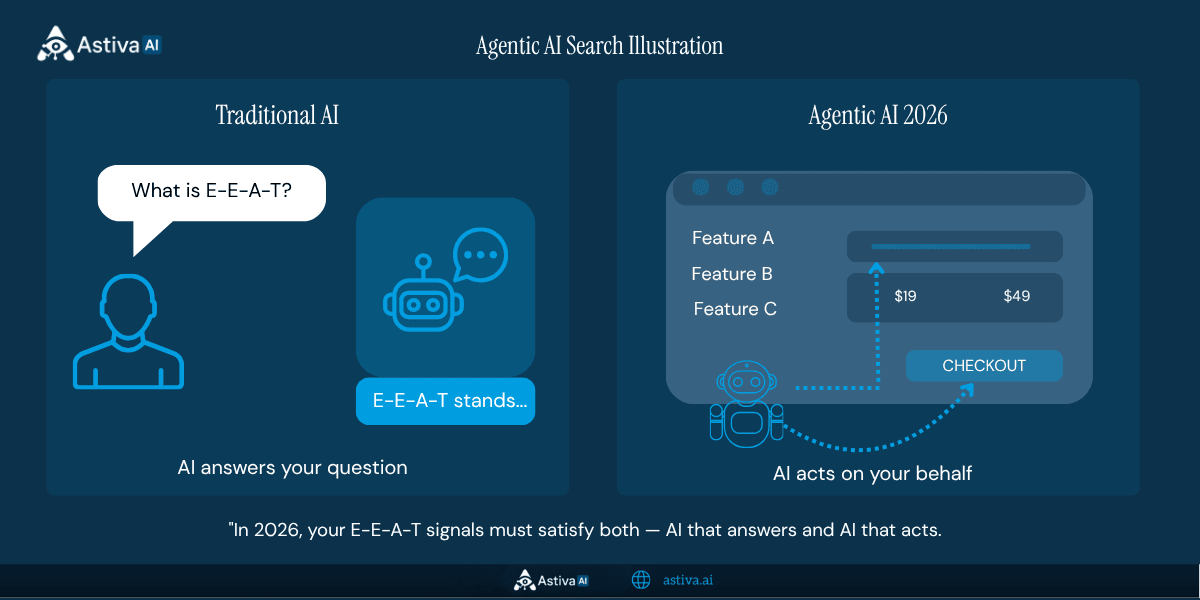
Follow this structured 30-day plan to audit and improve your E-E-A-T signals:
Week 1: Comprehensive Audit
- Score your top 20 pages (0-100) across all four E-E-A-T pillars
- Use Google's Rich Results Test to validate existing schema
- Audit author pages for credential completeness
- Check citation health (broken links, outdated sources)
- Test AI mentions: Query ChatGPT, Perplexity, and Claude for your brand and key topics
- Document gaps and prioritize by impact potential
Week 2: Schema Optimization
- Add or update Organization schema on your homepage
- Implement Person schema for all content authors
- Add Article/BlogPosting schema to your top 10 content pages
- Implement FAQPage schema where you have Q&A content
- Add BreadcrumbList schema site-wide
- Validate all schema using Google's Rich Results Test
Week 3: Experience Content Creation
- Publish 3 experience-focused pieces (case studies, original research, "I tested X" content)
- Add firsthand insights to existing high-traffic pages
- Collect and publish customer testimonials with verifiable details
- Create before/after comparisons from real implementations
- Update author bios with recent experience and credentials
Week 4: Track and Measure
- Monitor Astiva for citation changes across Perplexity, ChatGPT, and Claude
- Track which pages are now getting AI mentions
- Compare visibility before and after E-E-A-T improvements
- Identify remaining gaps and plan next iteration
- Document learnings for ongoing optimization
Expected Results: Brands following this 30-day plan report an average 35% visibility gain in AI citations within 60-90 days of implementation.
Tools & Astiva Integration
Effective E-E-A-T optimization requires the right tooling:
Schema Validation Tools
- Google Rich Results Test: Validate schema implementation
- Schema.org Validator: Check JSON-LD syntax
- Screaming Frog: Crawl site-wide schema coverage
- Chrome DevTools: Debug schema in real-time
Astiva for AI Visibility Tracking
Astiva provides real-time E-E-A-T impact measurement across 10 AI platforms including ChatGPT, Claude, Perplexity, Gemini, Google AI Mode, Grok, Meta AI, DeepSeek, Mistral, and Google AI Overviews:
- Track citation frequency before and after E-E-A-T improvements
- Monitor which E-E-A-T signals correlate with more AI mentions
- Compare your E-E-A-T performance against competitors
- Detect model update impacts (GPT-5, Claude updates) on your E-E-A-T scores
- Get alerts when visibility changes, positive or negative
Monitor Model Updates
When OpenAI releases GPT-5 or Anthropic updates Claude, E-E-A-T requirements often change. Astiva tracks these model updates and shows how they affect your visibility:
- Pre/post model update visibility comparison
- E-E-A-T signal changes that correlate with visibility shifts
- Competitor impact analysis
- Recovery recommendations if E-E-A-T requirements tighten
E-E-A-T Checklist: Quick Reference
Experience Checklist
- Firsthand case studies with specific metrics
- Original benchmarks and testing data
- Customer testimonials with verifiable details
- "I tested X" sections with methodology
- Challenges encountered and solutions documented
Expertise Checklist
- Author bylines with credentials
- Person schema implemented
- LinkedIn/professional profile links
- Domain-specific expertise demonstrated
- Co-authorship with verified experts
Authoritativeness Checklist
- 3+ third-party authoritative citations per page
- Quarterly citation audits completed
- Guest posts on authoritative sites
- HARO responses for backlinks
- Wikipedia presence (if applicable)
Trustworthiness Checklist
- Organization schema implemented
- Clear publication and update dates
- Transparent disclosures and methodology
- NAP consistent across 50+ sites
- HTTPS with valid SSL
- Multimedia transcripts and alt-text
Start Your E-E-A-T Audit Today
E-E-A-T is not optional in 2026. It is the foundation of AI visibility. The B2B SaaS case study above went from zero AI citations to a 40% mention rate on Perplexity in 45 days by fixing five structural content gaps. Every one of those gaps is visible in an Astiva audit. Brands compete on recommendations, not rankings.
Start with your free baseline: run a free AI brand visibility analysis and see exactly where your brand appears across ChatGPT and Perplexity right now, your citation breakdown, visibility score, and how your competitors are positioned. No credit card. Results in under 5 minutes. Then use this guide to close the gaps.
Key Takeaways: E-E-A-T for AI Visibility
- E-E-A-T is a prerequisite filter for AI visibility in 2026. Without it, approximately 70% of content gets ignored by major LLMs.
- Experience signals (firsthand data, case studies, original testing results) are the fastest-growing E-E-A-T factor for AI citations.
- Author credentials with Person schema markup deliver a 110% citation lift on Claude specifically, and +45% on ChatGPT (Astiva, 1,247 brands, Q1 2026).
- Branded web mentions correlate with AI citation rate at r=0.664 — nearly 3× the correlation of backlinks (r=0.218). Off-site entity building matters more than link acquisition.
- Trustworthiness requires schema markup, content transparency, and consistent NAP (Name, Address, Phone) data across the web.
- YMYL (Your Money, Your Life) topics demand stricter E-E-A-T compliance. AI models apply 2–3× higher trust thresholds for health, finance, and legal content.
- A structured 30-day E-E-A-T audit and optimization plan can yield 35%+ AI visibility gains within 90 days based on Astiva Q1 2026 beta program data.
What is E-E-A-T and why does it matter for AI visibility?
E-E-A-T stands for Experience, Expertise, Authoritativeness, and Trustworthiness. Originally a Google Search quality framework for evaluating content quality, AI models like ChatGPT, Claude, and Perplexity now apply similar signals when deciding which sources to cite in their answers. Content with strong E-E-A-T signals — verified author credentials, first-party data, external authoritative citations, and fresh updates — is cited 5x more often than content without them. For AI visibility specifically, Experience and Trustworthiness have become the two highest-impact dimensions.
How do AI models evaluate E-E-A-T signals differently from Google Search?
AI models evaluate E-E-A-T through training data patterns rather than crawl-time signals. They look for author credentials in schema markup, consistency of claims across sources, citation by other authoritative content, and the presence of firsthand data or experience. Unlike Google, AI models weigh the quality of the answer over the authority of the domain.
What is the fastest way to improve E-E-A-T for AI visibility?
Person schema is the fastest single fix: adding it with author credentials delivers a 110% citation lift on Claude within weeks. After that: include first-party data or case studies, add 3+ authoritative external citations per page, and update content within the last 90 days. Astiva analysis of 1,247 brands shows these four changes combined improve AI citation rate by 35–50% within 90 days of implementation.
Does E-E-A-T matter equally across all AI platforms?
No. Each AI platform applies E-E-A-T signals differently. Claude weighs author credentials most heavily — Person schema markup delivers a 110% citation boost on Claude specifically. Perplexity values content freshness and external authoritative citations most. ChatGPT places greatest weight on first-party data and experience signals like original research and case studies. Google AI Overviews combines traditional domain authority with E-E-A-T signals. A comprehensive strategy should calibrate content for each platform's weighting rather than applying a one-size-fits-all approach.
How do I know if my E-E-A-T improvements are working?
Track your AI citation rate before and after making changes. Use Astiva to monitor how often your brand appears across 10 AI platforms including ChatGPT, Claude, Perplexity, Gemini, and Google AI Overviews for your target queries. A meaningful E-E-A-T improvement typically shows a measurable citation lift within 4 to 8 weeks. Focus on citation rate, share of voice against competitors, and sentiment score as your three primary indicators.
See your current E-E-A-T gaps in under 5 minutes: run a free AI brand visibility analysis to check how ChatGPT and Perplexity perceive your brand right now. Then go deeper: our complete LLM content optimization guide covers the full 25-point framework with implementation details, and our guide to getting mentioned by AI covers the off-site authority tactics that complete the picture. For the foundational framework, see Google's E-E-A-T documentation and the Princeton GEO study that proved these signals translate directly to AI citation rates.