How to Check Your Brand's AI Visibility for Free in Under 5 Minutes (ChatGPT + Perplexity)
By Satish K · 12 min read · Published April 18, 2026 · Last updated: May 13, 2026
Find out if ChatGPT and Perplexity mention your brand or a competitor. AI visibility score, sentiment, citation sources, and share of voice in one report.
TL;DR
- A free AI brand visibility analysis shows whether ChatGPT and Perplexity recommend your brand — or a competitor.
- Astiva's free tool covers 10 prompts across both platforms. Results in under 5 minutes. No credit card.
- 60% of searches now end without a click (Bain & Company, 2025). AI answers name only 3–5 brands per query.
- Princeton GEO research proves AI visibility can be improved: statistics addition boosts visibility 41%, authoritative citations 40%.
- 54% of US marketers plan to implement GEO within 3–6 months (eMarketer, January 2026).
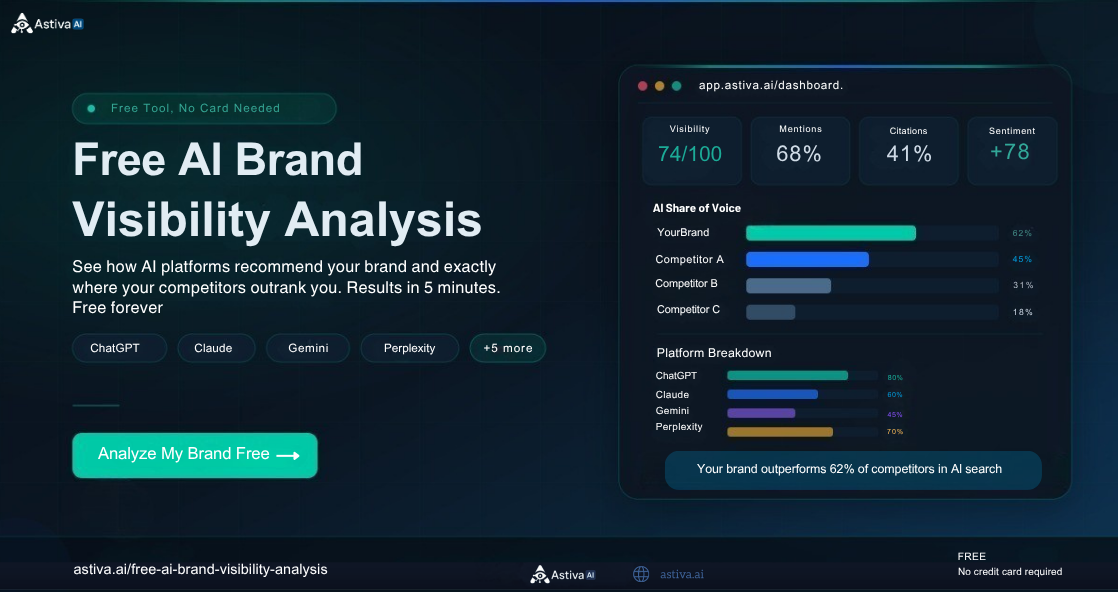
A free AI brand visibility analysis shows whether ChatGPT and Perplexity recommend your brand, or a competitor. Astiva AI — a Competitive Intelligence platform for AI Search and Visibility — scans both platforms with real buyer queries and delivers your visibility score, mention frequency, sentiment, citation sources, and competitor share of voice in under 5 minutes, with no credit card required. Brands compete on recommendations, not rankings.
Definition: AI Brand Visibility Analysis
An automated measurement of how frequently, prominently, and positively your brand appears in AI-generated answers across platforms like ChatGPT and Perplexity. Unlike traditional SEO audits that measure Google rankings, an AI visibility analysis measures the metrics that determine whether buyers discover your brand through AI assistants — a channel that now accounts for a growing share of B2B purchase research as ChatGPT alone reaches 900 million weekly users (OpenAI, February 2026). As of 2026, 54% of US marketers plan to implement GEO and AI visibility tracking within 3–6 months (eMarketer, January 2026).
Why Does Checking Your AI Brand Visibility Matter Right Now?
AI brand visibility matters right now because the discovery channel has fundamentally shifted. ChatGPT processes over 2.5 billion prompts daily from 900 million weekly users (OpenAI, February 2026). Gartner predicts traditional search engine volume will drop 25% by 2026 as AI chatbots take over informational and buying queries. Bain & Company's research found that 80% of consumers now rely on AI-written results for at least 40% of their searches, and 60% of all searches end without any click to an external website (1,100+ US consumers, February 2025).
When buyers in your category ask these platforms for recommendations, they receive a curated, confident answer — not ten links to browse through. AI platforms typically mention only 3 to 5 brands per query. If your competitors appear in those slots and you do not, the buyer receives a shortlist that does not include you: before they have ever visited your website, seen your ads, or spoken to your sales team.
The question your analytics dashboard cannot answer
When a buyer asks ChatGPT "what is the best [your category] tool for a B2B team?", does your brand appear — and if so, is it first, third, or not at all?
Generative AI solutions are becoming substitute answer engines, replacing user queries that previously may have been executed in traditional search engines. This will force companies to rethink their marketing channels strategy.
If you are new to this topic, start with our complete guide to what AI visibility is and how it is measured. For the difference between optimising for Google vs optimising for AI answers, see GEO vs SEO vs AEO: The Complete 2026 Guide to AI Search Visibility.
What Does the Free Astiva AI Brand Visibility Analysis Show You?
The Astiva free analysis runs your brand across ChatGPT and Perplexity using real buyer queries relevant to your category. Results appear in your dashboard within under 5 minutes. Here is exactly what each section shows:
- AI Visibility Score (0–100): A composite score representing how frequently and prominently your brand appears across all tested prompts. Above 60 = consistent presence. Below 30 = systematically missed — a gap that compounds as competitors build stronger citation signals.
- Mention Frequency: How many times your brand appears across all AI responses, broken down prompt by prompt. Brands often appear for branded queries but disappear for category queries. Category query presence is where revenue is won or lost.
- Sentiment Analysis: Each mention is classified as positive, neutral, or negative, with the actual language AI platforms use when describing your brand. Negative sentiment can persist for months because it is embedded in the sources AI platforms indexed during training.
- Citation Sources: Which domains are being cited when AI platforms mention your brand — review platforms, publications, directories, news. Perplexity always includes clickable inline citations, making it the only major AI platform where visibility directly drives trackable GA4 referral traffic.
- Platform Breakdown: ChatGPT draws from training data; Perplexity crawls the web in real time. A brand can appear in the majority of ChatGPT responses for a category query but in fewer than 20% of Perplexity responses for the same prompt. The breakdown shows you where to prioritise your optimisation work.
- Competitor Share of Voice: Where your brand sits relative to competitors across the same AI conversations. Seeing a competitor appear across the majority of relevant AI responses while your brand appears in only a fraction gives you a concrete, data-driven picture of what AI invisibility costs you in competitive terms.
How Does the Free AI Brand Visibility Analysis Work? Step by Step
The entire process from signup to results takes under 5 minutes. Here is exactly what happens at each step, and what each results section tells you.
Onboarding: Enter Your Brand Details and Choose Your Analysis Mode
Visit astiva.ai/free-ai-brand-visibility-analysis and create your free account: no credit card required. You enter three things: your work email, brand name, and website URL. Astiva uses your URL to automatically detect your product category and build relevant buyer prompts for your vertical. When tested with an education brand, Astiva correctly identified the category and tailored every subsequent prompt accordingly. For a B2B SaaS company, it identifies the software category automatically.
After entering your brand details, you choose between two modes:
- Automatic mode: Astiva generates and runs the highest-impact prompts for your category instantly. One click, zero configuration. Recommended for first-time analyses.
- Manual mode: Astiva generates a suggested list of 10 prompts tagged "AI generated." You can keep, remove, or add your own custom prompts, including direct comparison queries like "Should I choose [your brand] for [use case]?"
Important
The free tier covers 10 prompts across both platforms. Choosing 10 prompts means Astiva runs 20 total queries: 10 on ChatGPT and 10 on Perplexity, giving you a genuine cross-platform comparison.
Brand Performance: Your AI Visibility Baseline
After clicking "Analyze Prompts", Astiva shows a live progress screen tracking each prompt as it runs across ChatGPT and Perplexity simultaneously. Estimated completion: under 5 minutes. Your first results section is Brand Performance, the aggregate view of how your brand performed across all 20 queries (10 on each platform).
- AI Visibility Score (0–100): A composite score calculated from mention frequency, average position, sentiment, and citation rate. Above 60 indicates consistent presence. Below 30 means your brand is being systematically missed across buyer queries in your category.
- Platform breakdown: Your score split between ChatGPT and Perplexity. Many brands score well on one and poorly on the other. The two platforms use fundamentally different mechanisms and require different optimisation approaches.
- Sentiment framing: Whether AI describes your brand positively, neutrally, or negatively, and the exact language it uses. Negative sentiment can persist for months because it is embedded in the sources AI platforms indexed during training.
- First mention rate: How often your brand is the first name mentioned when AI responds to a relevant query. First-position mentions set the consideration anchor for most buyers and carry disproportionate weight in decision-making.
- Data retention: Free analysis results are stored in your dashboard for 90 days, giving you a structured baseline to compare against future analyses.
Prompt Analysis: What AI Says About You, Query by Query
The Prompt Analysis section breaks your results down by individual prompt, so you can see exactly which buyer questions trigger your brand mention, and which do not. This is where the most actionable data lives.
- Full AI responses stored: See the complete text ChatGPT and Perplexity returned for each prompt, not just whether your brand appeared, but the full context and phrasing.
- Per-prompt position: For every prompt where your brand appeared, the exact position in the AI response list (first, second, third, or later). Brands often appear prominently for branded queries but drop out entirely for category queries, the category query performance is where purchase decisions are made.
- Per-prompt sentiment: The specific language AI used to describe your brand for each query. This surfaces patterns, for example, consistent association with a use case you are not targeting, or a weakness mentioned repeatedly across prompts.
- Competitor co-appearances: Which competitors appeared in the same response as your brand, and which appeared in responses where your brand was absent. This tells you who you are competing against specifically inside AI-generated recommendations.
Industry Benchmark: Where You Stand in Your Category
The Industry Benchmark section places your AI visibility score in the context of your entire competitive landscape, not just your chosen competitors, but all brands AI platforms mention when responding to queries in your category.
- Category positioning: Your brand is placed in one of three positions, Leader, Contender, or Emerging Player, based on your AI visibility score relative to other brands in your detected product category. This gives you a clear, data-grounded answer to the question: in AI-generated recommendations specifically, are you winning or losing your category?
- Category average benchmark: Your visibility score compared to the average for brands in your vertical. A score that looks low in isolation may be above average for your category, or vice versa. The benchmark puts your number in context that matters.
- Competitive positioning map: A visual representation of where your brand sits relative to others that appear in AI responses for your category prompts, including brands your SEO competitive set may not currently include.
- AI-discovered competitors: Brands appearing in AI responses for your category queries that you may not have been tracking. AI platforms surface competitors based on citation signals and relevance, not brand size, emerging players often appear here before they show up in traditional competitive intelligence tools.
- Highest-impact improvement areas: Based on your benchmark position, Astiva surfaces the specific gaps most likely to move your score, whether that is citation coverage, content structure, or platform-specific optimisation.
Why this matters
A brand can hold position one on Google for its primary keyword and be a bottom-quartile AI visibility performer in the same category. The Industry Benchmark section shows you exactly which situation you are in, and what the gap looks like in concrete terms.
Competitive Intelligence: Who AI Recommends Instead of You
The Competitive Intelligence section shows you the specific brands AI platforms recommend when they do not recommend yours, and how they are positioned relative to you across the same buyer queries.
- Head-to-head share of voice: For each competitor detected in your analysis, you see how often they appeared across the same 20 queries versus how often your brand appeared. A competitor with 65% visibility against your 28% represents a concrete, measurable competitive gap in the AI recommendation channel.
- Platform-level breakdown: Which competitors beat you specifically on ChatGPT versus Perplexity, and by how much. The platforms draw on different sources, so a competitor may dominate on Perplexity due to real-time web presence while you hold stronger ground on ChatGPT due to training-data coverage.
- Positioning analysis: The exact language AI uses to describe each competitor versus how it describes you. A competitor described as "best for enterprise workflows" and another described as "affordable for growing teams" own different recommendation spaces. This section shows which spaces your brand currently occupies and which are being claimed by competitors.
- Prompt-level gaps: The specific buyer queries where competitors appear and your brand does not. These are your highest-priority content and citation targets. Each one represents a buyer interaction that a competitor is winning and you are not.
- Emerging competitor signals: Brands gaining AI visibility in your category that your SEO competitive set may not yet include. AI platforms surface brands based on citation signals and content relevance, not brand recognition, new entrants can appear in AI recommendations months before they register in traditional competitive tracking.
What to do with this data
Each prompt gap is a content and citation opportunity. Creating a page that directly addresses a buyer query where a competitor currently appears, with sourced statistics, expert attribution, and structured formatting, is the highest-leverage action the Competitive Intelligence section surfaces.
Citation Report: Why AI Recommends Competitors Instead of You
The Citation Report is the deepest diagnostic section in the free analysis. It maps the specific web pages, articles, reviews, and third-party sources that ChatGPT and Perplexity draw on when forming their recommendations, for your brand and for the competitors that appeared in your analysis.
- Three citation types classified: Every source identified is classified as a Full Citation (content directly used as a source for the recommendation), a Recommendation (AI recommends the brand based on the cited source), or a Mention (brand name appears in the response without a specific citation). Understanding which type your citations are tells you whether AI actively trusts your sources or is simply pattern-matching your brand name.
- Domain-level citation sources: The specific domains cited when AI platforms mention your brand, review platforms (G2, Capterra, Trustpilot), industry publications, directories, news sites, and your own website. The domain breakdown shows you where your citation footprint is strong and where it has gaps relative to competitors.
- Competitor citation sources: The specific pages and domains that are helping AI platforms trust and recommend your competitors. Seeing that a competitor is consistently cited via a major industry review platform or a high-authority publication gives you a concrete, actionable target: earn a presence on that source.
- Cross-platform citation overlap: Sources cited by both ChatGPT and Perplexity are your highest-leverage citation targets. A domain that appears in both platforms' reasoning is a signal that it carries authority across the two most different AI recommendation mechanisms, training data and real-time crawling simultaneously.
- Top citation gaps: High-authority source types where your brand is underrepresented relative to competitors, Wikipedia coverage, G2 profile depth, industry publication mentions, structured FAQ content. Princeton University's GEO research (arXiv:2311.09735, KDD 2024) found that adding authoritative citations to content increases AI citation rates by up to 40%. The Citation Report shows you exactly which gaps to close first to capture that lift.
The core insight
AI visibility is not primarily a brand awareness problem. It is a citation infrastructure problem. Brands with strong citation footprints across authoritative, publicly accessible sources get recommended. Brands with content behind authentication walls, inconsistent descriptions across platforms, or sparse third-party coverage get passed over, even when they have better products. The Citation Report shows you exactly which infrastructure to build.
How Does the Free Astiva Analysis Compare to Manual Checking?
The manual approach — opening ChatGPT and Perplexity, typing in buyer queries, and recording results — is a legitimate starting point. Total cost is zero and it takes about 30 minutes per round. But the limitations become clear quickly.
| Capability | Manual Checking | Astiva Free Analysis |
|---|---|---|
| Cost | Free | Free forever |
| Time required | 30–60 min per round | Under 5 minutes |
| Platforms covered | One at a time | ChatGPT + Perplexity simultaneously |
| Visibility score | ✗ Not available | ✓ Composite 0–100 score |
| Sentiment analysis | ✗ Subjective only | ✓ Systematic positive/neutral/negative |
| Citation source data | ✗ Not available | ✓ Domain-level citation report |
| Competitor share of voice | ✗ Not available | ✓ Side-by-side comparison |
| Repeatable baseline | ✗ Snapshot only | ✓ Structured, comparable data |
| Industry benchmark | ✗ No context | ✓ Category average comparison |
Run your free analysis now
Stop guessing whether ChatGPT and Perplexity recommend your brand. Get your AI visibility score, sentiment breakdown, citation sources, and competitor share of voice — free, in under 5 minutes, no credit card.
What Should You Do With Your Free Analysis Results?
Your free analysis results translate directly into four actionable priorities:
- Low visibility score (below 30): Your brand is not appearing in the majority of AI-generated recommendations in your category. The most common cause is insufficient citation coverage. Princeton's GEO research found that adding authoritative citations and statistics can boost AI visibility by up to 40%. Start by auditing whether your brand has complete, accurate listings on G2, Capterra, or the equivalent review platform for your category.
- Strong ChatGPT visibility, weak Perplexity visibility: This pattern suggests your brand has built strong historical authority but lacks fresh, crawlable content that Perplexity can index in real time. Publishing regular content with structured data markup will close this gap faster than any other tactic.
- Your brand appears but sentiment is neutral or negative: Neutral or negative sentiment in AI responses typically traces back to specific sources — an old review being heavily weighted, a forum discussion with critical feedback, or an outdated third-party listing. Your citation data will show which sources are generating these mentions.
- Competitor share of voice is significantly higher than yours: Look at your competitor's citation sources in the dashboard, Which platforms are generating their AI mentions that you are not present on? Each source gap is a concrete, specific action you can take.
For a step-by-step playbook on closing each of these gaps, read How to get mentioned by AI: 16 tactics ranked by citation impact. To understand exactly why sentiment in AI responses persists and how E-E-A-T signals affect it, see E-E-A-T for AI Visibility 2026.
Ready to track your visibility every day — not just once?
The free analysis gives you a baseline. Paid plans from $29/month add daily automated monitoring across 10 AI platforms, competitor share of voice tracking, citation alerts, and content gap recommendations. So you see exactly when and why your visibility shifts. 7-day free trial. Cancel before day 7, pay nothing.
Now, AI-generated search results are rewriting the rules, and SEO optimisation is no longer enough. Brands must evolve or risk losing visibility into their customer journey, and control over their brand positioning, in a world where traditional clicks are disappearing.
Who Should Run a Free AI Brand Visibility Analysis?
- Marketing & Brand Managers: Need to answer the question their current tools cannot — "When a buyer asks ChatGPT to recommend a tool in our category, does our brand appear, and how?" The free analysis gives you that baseline in under 5 minutes.
- SEO Professionals: Expanding their practice to include GEO and AEO. AI brand visibility is the baseline measurement every GEO engagement starts from. Without it, you are optimising without knowing your starting position.
- Founders & Growth Leads: B2B SaaS founders asking the question their competitors have not thought to ask yet. The brands that build strong AI visibility now will own AI-generated recommendations in their categories over the next 12–24 months.
- Content Strategists: Need to understand which citation sources are driving AI recommendations in their category, and which content gaps exist. The citation report gives you the exact source-level data to build your GEO content strategy from.
If you work across both ChatGPT and Perplexity, the architectural differences matter significantly for what you optimise first. Read ChatGPT vs Perplexity: how they recommend brands differently before deciding where to focus your first round of optimisation.
6 Key Things to Know About Free AI Brand Visibility Analysis
- AI discovery is structurally different from Google discovery. Bain & Company's 2025 research confirms 60% of searches now end without a click — buyers are getting answers inside AI platforms, not from your website.
- ChatGPT and Perplexity use fundamentally different mechanisms. ChatGPT draws from training data; Perplexity crawls in real time. A brand can be strong on one and invisible on the other for the same query.
- Your free analysis covers both platforms in one report. Fixing visibility on one does not automatically fix the other — both must be measured and optimised separately.
- Princeton's GEO research (arXiv:2311.09735, KDD 2024) proves AI visibility can be systematically improved: statistics addition boosts AI visibility by 41%, authoritative citations by 40%, expert quotations by 28%.
- Sentiment matters as much as presence. Brands can appear in AI responses with neutral or negative framing — "complex onboarding," "mixed reviews" — that reduces buyer consideration.
- The Astiva free analysis is free forever, not a trial. 10 prompts across ChatGPT and Perplexity, 90-day data retention, no credit card. 54% of US marketers plan GEO implementation within 3–6 months (eMarketer, January 2026).
What is a free AI brand visibility analysis?
A free AI brand visibility analysis is an automated audit of how your brand appears in AI-generated responses on platforms like ChatGPT and Perplexity. It measures your visibility score, mention frequency, sentiment, citation sources, and competitive share of voice across real buyer queries in your category. Astiva AI's free analysis covers ChatGPT and Perplexity, delivers results in under 5 minutes, and requires no credit card.
Is the Astiva free AI brand visibility analysis really free?
Yes. The free tier is free forever, not a 7-day trial. It covers 10 prompts across ChatGPT and Perplexity, with results retained in your dashboard for 90 days. No credit card is required at any point. Paid plans starting at $29/month expand coverage to daily monitoring across up to 10 AI platforms, up to 300 prompts, full competitor analysis, citation alerts, and content gap recommendations.
How is AI brand visibility different from Google SEO rankings?
Google SEO measures where your website appears in a list of search results — ten or more links a user can click through. AI brand visibility measures whether your brand is mentioned in a conversational AI answer, where typically only 3 to 5 brands are recommended. A brand can rank number one on Google for its target keyword and be completely absent from every AI recommendation in its category. Bain & Company's 2025 research confirms these two systems operate almost independently.
How does the Astiva free AI brand visibility tool work?
Three steps. First, enter your brand name, website URL, and work email — Astiva uses your website to automatically detect your product category and build relevant buyer prompts. Second, choose Automatic mode (instant analysis) or Manual mode (review and customise prompts). The free tier covers 10 prompts across both platforms. Third, Astiva runs all selected prompts simultaneously across ChatGPT and Perplexity. Results land in your dashboard in under 5 minutes, organised into Brand Performance, Prompt Analysis, Industry Benchmark, Competitive Intelligence, and Citation Report.
Which AI platforms does the free analysis cover?
The free analysis covers ChatGPT and Perplexity, the two largest AI platforms by user volume, with ChatGPT alone reaching 900 million weekly users (OpenAI, February 2026). Paid plans expand monitoring to all 10 major AI platforms: ChatGPT, Claude, Google Gemini, Google AI Overviews, Google AI Mode, Perplexity, Grok, Meta AI, DeepSeek, and Mistral AI.
How long does the free AI brand visibility analysis take?
Setup takes under two minutes: enter your brand name, website URL, and work email, then choose your analysis mode and confirm your prompts. Astiva then runs all selected prompts simultaneously across ChatGPT and Perplexity, showing a live progress screen. Results land in your dashboard in under 5 minutes. No email required — results appear directly in your dashboard.
What is an AI visibility score?
An AI visibility score is a composite metric from 0 to 100 measuring how frequently and prominently your brand appears in AI-generated responses to buyer queries in your category. A score above 60 indicates consistent presence. A score below 30 suggests your brand is being systematically missed. Astiva calculates visibility scores based on mention frequency, position in responses, sentiment, and citation rate across the platforms being monitored.
Can I improve my AI brand visibility after seeing my results?
Yes. The most impactful actions are: building citations on authoritative third-party platforms such as G2, Capterra, and Trustpilot; publishing content optimised for AI citation with structured formatting and sourced statistics (Princeton GEO research found this boosts visibility by up to 40%); implementing schema markup on your website; and ensuring consistent brand information across all platforms. For a complete optimisation framework, see our AI visibility guide at astiva.ai/blog/what-is-ai-visibility.