GEO vs SEO vs AEO: The Complete 2026 Guide to AI Search Visibility
By Satish K · 18 min read · Published December 8, 2024 · Last updated: August 16, 2026
SEO, GEO, and AEO explained. Princeton study: Statistics +41%, Cite Sources +115% for lower-ranked pages. Keyword stuffing -9%. All three required in 2026.
TL;DR
- SEO earns rankings in Google's blue-link results; GEO earns citations inside AI-generated answers.
- AEO structures content so AI engines extract specific passages as discrete answers: the mechanism GEO requires.
- Princeton GEO study (ACM KDD 2024): Statistics Addition lifts AI citations +41%; Keyword Stuffing drops them −9%.
- Cite Sources delivers +115% citation lift for pages not in the organic top 5 (arXiv:2311.09735).
- 40–60% of cited sources change month-to-month across major AI platforms. Measurement is not optional.
- All three disciplines are additive: SEO is the floor, AEO is the structure, GEO is the citation layer.
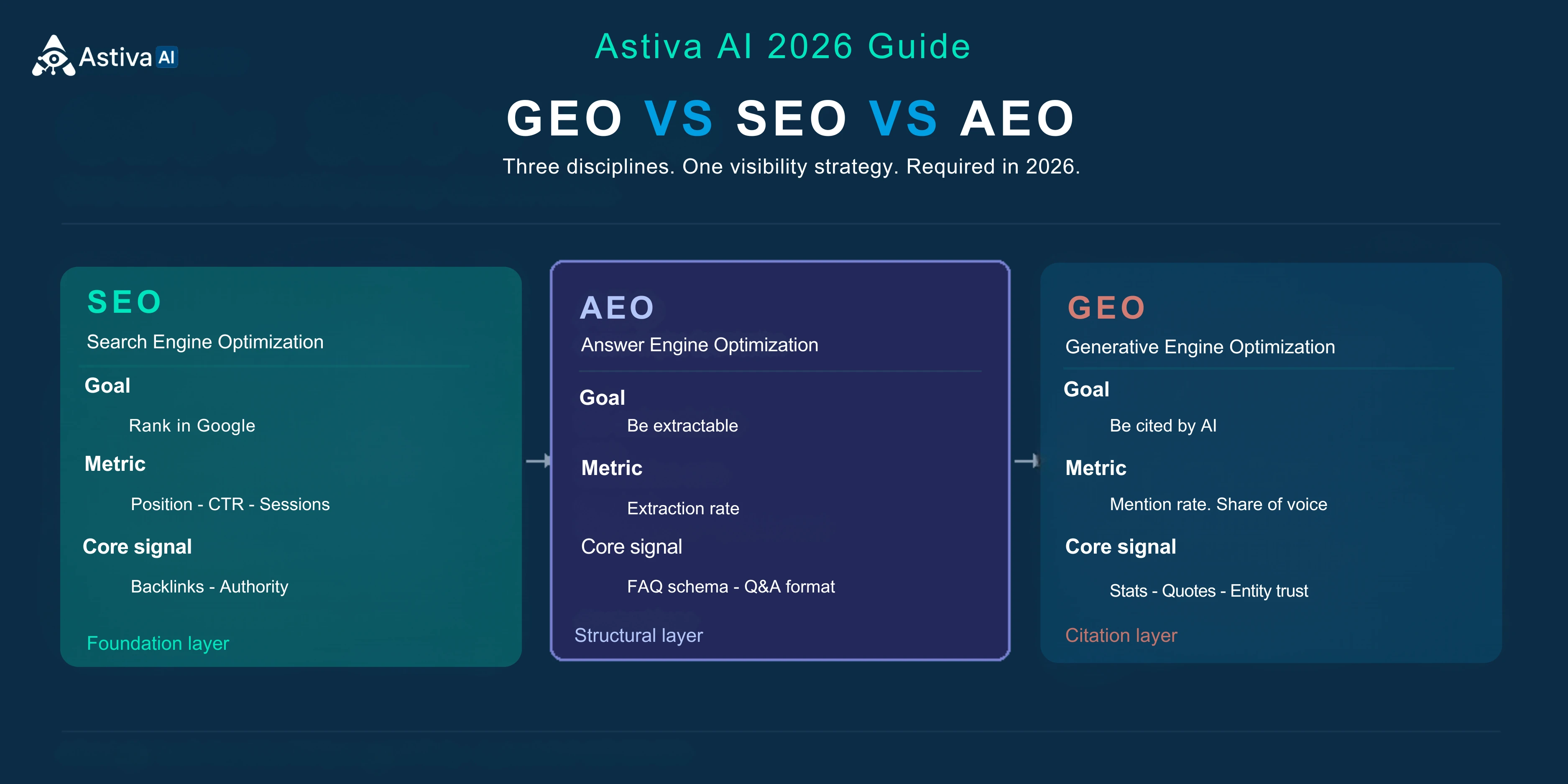
SEO, GEO, and AEO are three distinct disciplines that together determine whether your brand appears in both Google results and AI-generated answers. SEO provides the authority foundation. AEO makes individual passages extractable. GEO drives citation selection. Running only one of the three leaves a measurable gap in brand discovery.
Answer-First Definition
SEO (Search Engine Optimization) earns rankings in Google's blue-link results. GEO (Generative Engine Optimization) earns citations inside AI-generated answers from ChatGPT, Claude, and Perplexity. AEO (Answer Engine Optimization) structures content so AI engines extract and surface it as a direct answer: the mechanism that makes GEO work at the sentence level. In 2026, all three disciplines are required: SEO provides the authority foundation, AEO supplies the structural layer, and GEO drives citation selection.
What Are SEO, GEO, and AEO — and Why Does the Difference Matter?
SEO, GEO, and AEO share one goal (visibility) but operate on different surfaces, measured by different metrics, and won through different signals.
SEO optimizes web pages to rank in traditional search engine results pages (SERPs). Success is measured in keyword positions, click-through rates, and organic sessions. The underlying mechanism is Google's algorithm: domain authority, backlinks, page experience, and topical relevance determine which pages rank where among ten or more blue links.
GEO optimizes brand presence inside AI-generated answers. Success is measured in mention rate, share of voice, citation rate, and sentiment across platforms like ChatGPT, Claude, Perplexity, Gemini, Grok, and Google AI Overviews. The underlying mechanism is not a ranking algorithm. It is a retrieval-augmented generation (RAG) pipeline that selects content based on authority signals, structural clarity, and factual density.
AEO is the structural discipline that bridges the two. AEO formats content (question-led headings, direct-answer opening paragraphs, FAQ blocks, definition callouts) so that AI engines can extract and surface a specific passage as a discrete answer. Without AEO structure, even well-optimized content fails the extraction test: the AI reads the page, finds no citable unit, and moves to a competitor's source.
Gartner predicts traditional search engine volume will decline 25% by 2026 as AI chatbots and virtual agents capture market share (Gartner, February 2024). Meanwhile, AI chatbot referral traffic reached 1.1 billion visits in June 2025 and grew 357% year-over-year, according to Similarweb's 2025 Generative AI report. The practical implication: a brand that runs SEO without GEO and AEO is optimizing for a shrinking pool of clicks while ignoring the fastest-growing discovery channel.
How Do AI Engines Differ from Traditional Search Engines?
Traditional search engines rank pages. AI engines synthesize answers, and the difference reshapes every optimization decision.
When a user searches Google for "best AI brand monitoring tool," Google returns a ranked list of ten or more pages and the user chooses which to visit. The click is the conversion event. When a user asks ChatGPT the same question, ChatGPT synthesizes a single answer, names two to five brands, and may or may not include a citation link. The mention is the conversion event, whether or not the user ever visits the brand's website.
According to Similarweb's 2026 Generative AI Brand Visibility Index, 35% of US consumers now use AI at the product discovery stage, compared to 13.6% who use search. That gap is structural, not cyclical. The user who types into ChatGPT is more specific, more conversational, and significantly more likely to act on whatever the AI recommends.
The mechanics of AI-engine selection differ fundamentally from Google's ranking model. AI platforms use a RAG pipeline with five stages: query processing, retrieval, reranking, generation, and citation. Each stage is an optimization point. Structural clarity improves retrieval. E-E-A-T signals improve reranking. Answer-first writing improves generation. Clear authorship and sourced data improve citation confidence. Brands that optimize across all five stages (not just one) earn citations consistently.
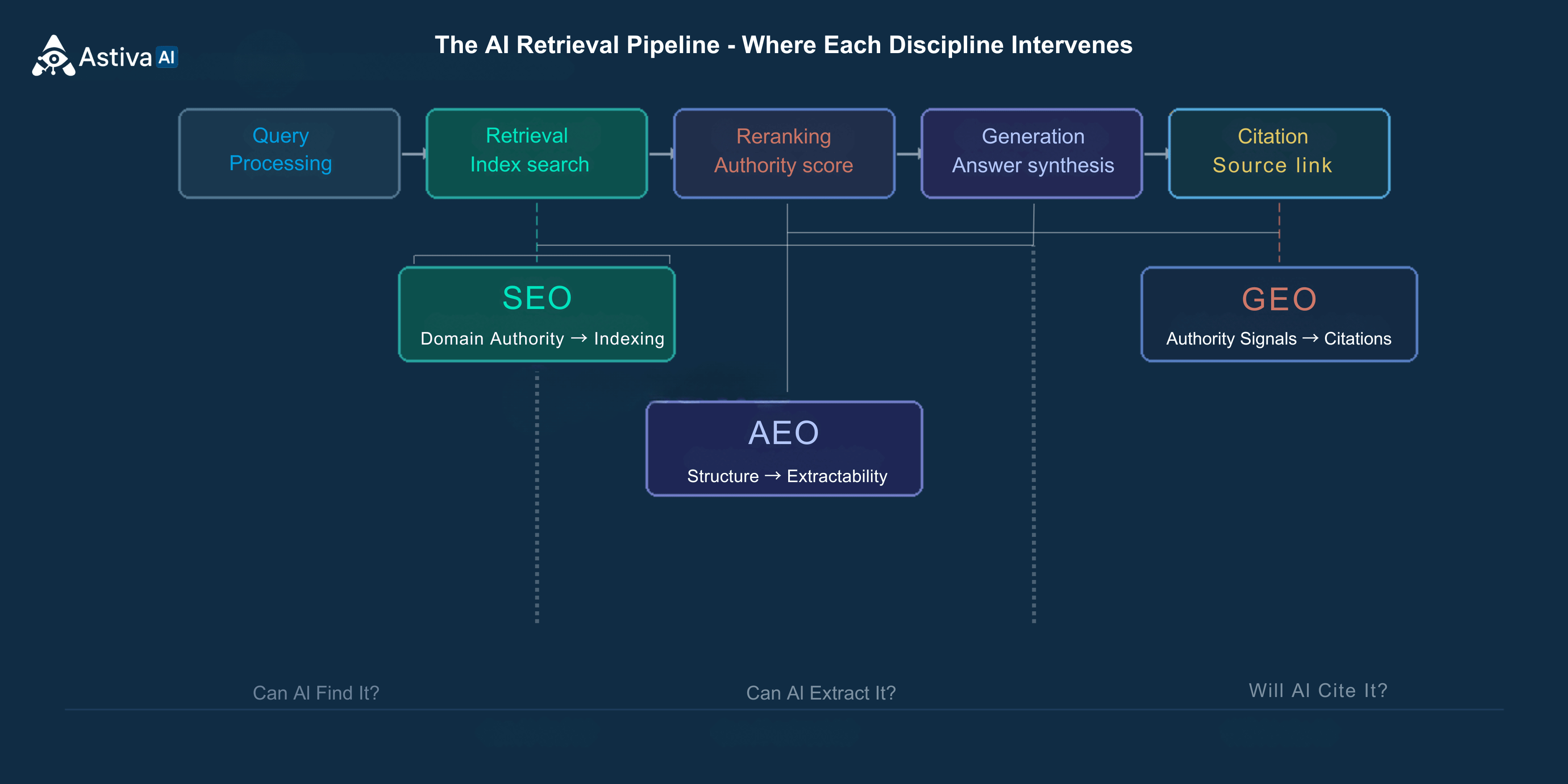
How SEO, AEO, and GEO map onto the AI RAG pipeline
| Discipline | Pipeline Stage Targeted | Core Question It Answers |
|---|---|---|
| SEO | Retrieval — domain authority gets pages into the index AI engines search | "Can the AI engine find my content?" |
| AEO | Retrieval + Generation — structured content gets selected over unstructured content | "Can the AI engine extract a citable answer from my content?" |
| GEO | Reranking + Citation — authority signals, stats, and expert quotes determine which extracted content gets cited | "Does the AI engine trust my content enough to recommend it?" |
What Is GEO (Generative Engine Optimization)?
GEO is the practice of structuring content, building authority signals, and establishing brand presence so that AI-generated answers cite your brand when users ask relevant questions.
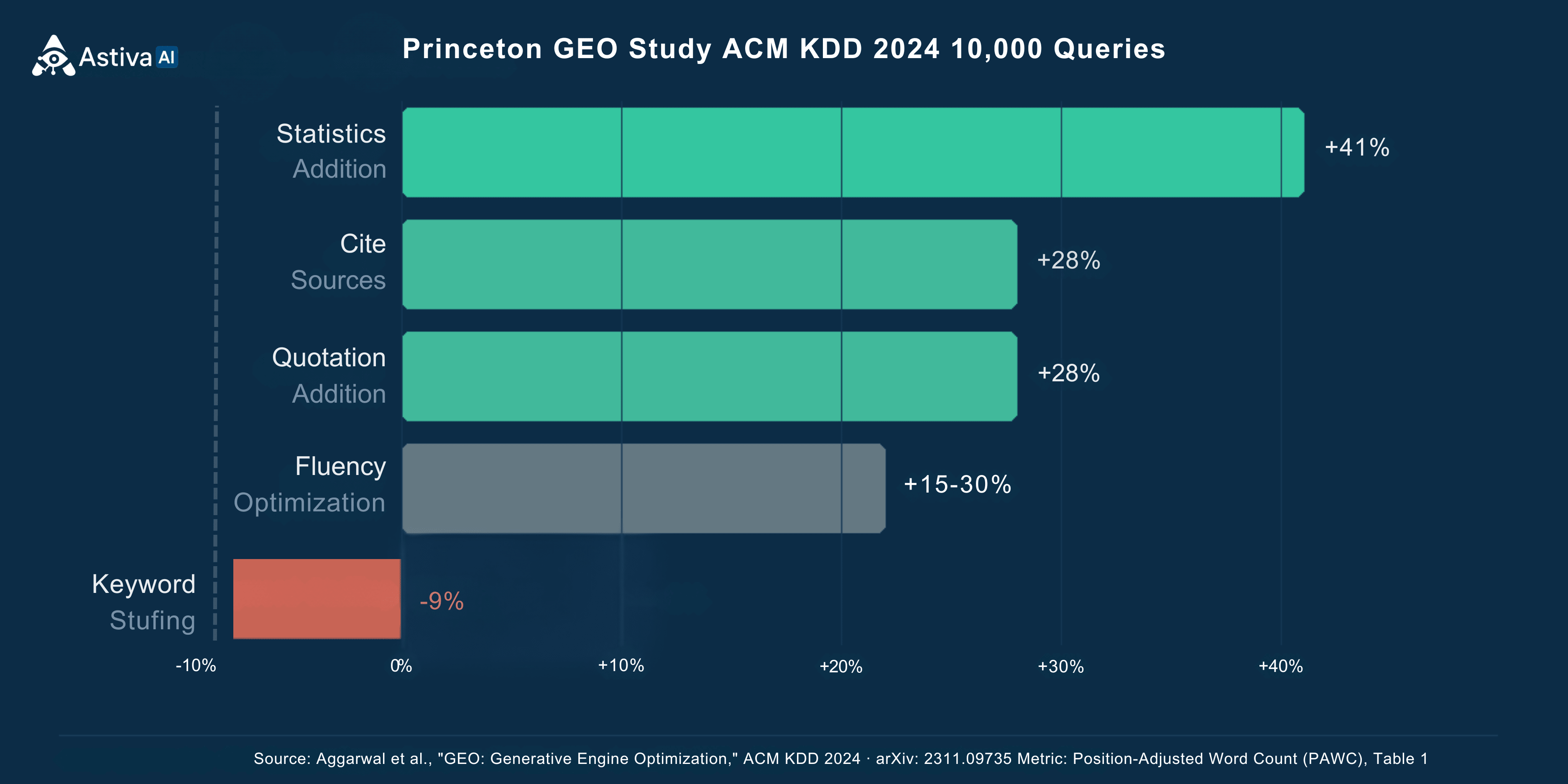
The term was formalized in the peer-reviewed paper "GEO: Generative Engine Optimization" by Aggarwal, Murahari, Rajpurohit, Kalyan, Narasimhan, and Deshpande (Princeton University, Georgia Tech, IIT Delhi, and the Allen Institute for AI), published at ACM KDD 2024 (arXiv:2311.09735). The study tested nine optimization methods across 10,000 queries from the GEO-bench benchmark. Key findings directly from the published paper:
- Statistics Addition: +41% improvement on Position-Adjusted Word Count (PAWC): the highest single-strategy lift
- Quotation Addition: +28% on Subjective Impression, the strongest signal for perceived authority
- Cite Sources: up to +115.1% for pages at SERP position #5 (citations matter most when your page is not already dominant)
- Keyword Stuffing: −9%, performing worse than baseline. The standard SEO tactic actively harms AI visibility
Princeton GEO Study (ACM KDD 2024)
This is the only peer-reviewed controlled study on GEO as of May 2026. Every other GEO statistic in industry coverage traces back either to this paper (arXiv:2311.09735) or to vendor case studies. Statistics Addition (+41%), Cite Sources (+115% for lower-ranked pages), Keyword Stuffing (−9%) are the only evidence-backed baselines available.
What GEO is not: GEO is not a replacement for SEO. Research shows 87% of ChatGPT citations correspond to Bing's top results (Seer Interactive, 2025), confirming that strong SEO foundations matter. However, the relationship between organic rankings and AI Overview citations has shifted sharply: Ahrefs' March 2026 analysis of 863,000 SERPs found that only 38% of AI Overview citations now come from the organic top 10 (down from 76% in July 2025), meaning structured, citable content can earn AI citations even without a top-10 ranking. SEO alone does not get you cited. A page can rank #3 on Google and never appear in a single ChatGPT response.
For a full breakdown of how AI platforms measure brand visibility, including the five core metrics (mention rate, position, sentiment, share of voice, and citation rate), see our guide on what AI visibility is and how it is measured.
What Is AEO (Answer Engine Optimization)?
AEO is the structural practice of formatting content so AI engines can extract specific passages as discrete, citation-ready answers.
AEO originated in voice search optimization, specifically structuring pages to win "featured snippet" positions in Google. In 2026, its scope has expanded entirely. EMARKETER's Kelsey Voss, principal analyst leading B2B marketing research, draws the line clearly: "SEO is about ranking pages for clicks, while GEO is about being selected as a source in synthesized answers." AEO is the mechanism that makes GEO selection possible: without extractable structure, AI engines cannot select a passage even if they trust the domain.
The five AEO structural patterns that consistently earn AI citations:
- Answer-first opening: the primary query answered directly in the first sentence, ideally within 60 words. The first 200 words of any article should directly and completely answer the primary query
- Definition callout: the core concept defined in a labelled block within the first 200 words: the format AI engines extract for "What is X" queries
- FAQ section: 4–6 questions matching conversational AI queries, each answered in 50–100 self-contained words. FAQPage schema in JSON-LD doubles the signal by making the structure machine-readable
- Comparison table: structured side-by-side data with explicit cells. Tables are the highest-density extractable format in any page
- Key takeaways: 5–6 numbered statements, each a standalone citable claim with specific numbers where possible
AEO Prevents Hallucination
When an AI engine cannot find a clean, self-contained answer in a page, it fills the gap from training data, which may be outdated, incomplete, or about a competitor. Structuring content with AEO patterns reduces that risk by giving the AI exactly what it needs to generate an accurate citation.
How Are SEO, GEO, and AEO Different in Practice?
SEO, GEO, and AEO diverge most sharply on four dimensions: what you optimize, how success is measured, what signals you build, and how fast changes take effect.
SEO vs GEO vs AEO: Key Differences (2026)
| Dimension | SEO | GEO | AEO |
|---|---|---|---|
| Primary surface | Google / Bing SERPs (10+ blue links) | AI-generated answers (ChatGPT, Claude, Perplexity, Gemini, Google AI Overviews) | AI answer extraction — any platform |
| Success metric | Keyword rank, CTR, organic sessions | Mention rate, share of voice, citation rate, sentiment | Extraction rate — how often AI pulls your passage as the answer |
| Core signals | Backlinks, domain authority, page speed, keyword relevance | Statistics, expert quotes, source citations, entity consistency, off-site brand mentions | Answer-first structure, FAQ schema, definition blocks, self-contained paragraphs (50–150 words) |
| What hurts you | Thin content, slow pages, low domain authority | Vague marketing language (−26% citation correlation), keyword stuffing (−9% per Princeton GEO study) | Dense paragraphs, pronoun references without named subject, buried answers |
| Time to results | Weeks to months | 14–30 days for Perplexity (real-time); 2–6 months for ChatGPT/Claude (training-data dependent) | 14–30 days after re-indexing |
| Measurement tool | Google Search Console, rank tracker | Competitive Intelligence platform for AI Search and Visibility (e.g., Astiva AI) — tracks mention rate, sentiment, share of voice | Manual extraction test + FAQPage rich results validator |
The most important row is "what hurts you." Promotional marketing language (the kind of copy that used to win at SEO) actively suppresses AI citations. Semrush's 2026 AI citation study found that non-promotional tone negatively correlates with citation rates: content written in marketing-speak is consistently outperformed by factual, specific content. Vague qualifiers, unattributed statistics, and brand-first framing reduce citation confidence scores at the reranking stage.
Why Is SEO Still the Foundation — But No Longer Sufficient?
SEO and GEO are not competing strategies. SEO is the floor that GEO builds on. The data confirms both halves of that statement.
Because 99% of AI Overviews cite the organic top 10, and 87% of ChatGPT citations correspond to Bing's top results, traditional SEO remains the indispensable foundation. A brand with no SEO presence (no indexed pages, no domain authority, no backlinks) will not appear in AI-generated answers regardless of how well-structured its content is.
But SEO alone is no longer sufficient for two structural reasons.
First, the click pool is shrinking. In May 2024, 56% of news-related Google searches resolved without a single click. By May 2025, that number had climbed to 69% (Similarweb, 2025), a 13-percentage-point jump in the year following Google's AI Overviews rollout. A page that earns a #1 ranking but triggers an AI Overview may see position-1 CTR collapse from a historical 34% to as low as 2.6% (Seer Interactive, 2025, cited via Incremys). Impressions rise; traffic falls. SEO-only brands are winning rankings they can no longer monetize through clicks alone.
Second, citation selection adds requirements SEO does not address. Ranking #3 on Google does not mean getting cited by ChatGPT. Citation selection depends on content structure (AEO), authority signals within the content itself (GEO), and off-site presence across platforms AI engines actively retrieve from: Reddit, YouTube, Wikipedia, G2, Capterra, and Quora. A brand can dominate Google for its category and be invisible in AI-generated answers because it has never invested in the signals GEO and AEO require.
The Hybrid SEO+GEO Reality
With 25% of traditional searches projected to disappear by end of 2026 and 50% of searches expected to be generative by 2028, a purely SEO strategy is becoming insufficient. Zero-click searches grew from 56% to 69% for news queries in 12 months (Similarweb, July 2025). Brands running SEO-only strategies are optimizing for a shrinking pool of clicks.
What Do GEO and AEO Require That SEO Does Not?
GEO and AEO add six specific requirements on top of SEO fundamentals. These are not refinements of existing SEO practice. They are additive requirements that SEO does not address.
- Answer-first content architecture. Every section must lead with a direct, extractable answer in its first sentence. SEO rewards comprehensive coverage; GEO rewards leading with the answer before the explanation.
- Sourced statistics with inline attribution. The Princeton GEO study's highest-impact finding (Statistics Addition at +41%) applies specifically to sourced statistics that name the study, year, and sample. Every data point needs: specific number, source name, and year.
- Expert quotes with verifiable attribution. Quotation Addition at +28% Subjective Impression means named expert quotes with linked source URLs meaningfully shift AI citation rates. Anonymous quotes do not carry the same weight.
- Self-contained paragraphs. AI engines extract passages, not pages. Each paragraph must make complete sense if lifted out of context: subject named explicitly, no pronoun dependencies, no "as mentioned above" references. Target length: 50–150 words per extractable unit.
- Entity consistency across platforms. Your brand's core description must be consistent across your website, LinkedIn, Crunchbase, G2, Capterra, Wikipedia (where applicable), and schema markup. Conflicting descriptions reduce citation confidence at reranking.
- Off-site presence on AI-cited platforms. Reddit, LinkedIn, and YouTube ranked among the most-referenced domains by major LLMs in October 2025. Citations from platforms AI engines already trust carry authority SEO cannot replicate by optimizing owned content alone.
For the full technical and content implementation of these requirements, see our guide on optimizing content for AI citations and LLMs.
How Does E-E-A-T Connect SEO, GEO, and AEO?
E-E-A-T (Experience, Expertise, Authoritativeness, Trustworthiness) is the trust framework that underlies all three disciplines, and the point where their requirements most clearly converge.
Google's Search Quality Rater Guidelines (September 2025 edition) state that Trustworthiness is the most important E-E-A-T component: untrustworthy pages score low on E-E-A-T regardless of other signals. The practical consequence is measurable: content with strong E-E-A-T signals receives 5.2x more AI citations than content without them, based on Astiva analysis of 10,000+ AI-generated responses across 10 AI platforms in Q1 2026. Author credentials alone account for a 2.1x increase in Claude citation rates.
- In SEO, E-E-A-T manifests as domain authority, author bylines, and editorial standards: signals Google's quality raters evaluate
- In AEO, E-E-A-T manifests as Person schema with linked credentials, publication dates in Article schema, and transparent methodology: signals that make individual passages trustworthy to extract
- In GEO, E-E-A-T manifests as off-site corroboration: third-party brand mentions, review platform presence, press coverage, Wikipedia entries, and community platform activity that AI engines retrieve to validate your brand's authority before citing it
The trust-building program that lifts all three disciplines simultaneously: publish content with named, credentialed authors; link every statistical claim to its primary source; implement Organization, Article, and Person schema in JSON-LD; maintain active profiles on G2, Capterra, and Trustpilot; and build consistent brand descriptions across every platform where AI engines retrieve information. For a full implementation guide on each E-E-A-T signal, see E-E-A-T for AI Visibility in 2026.
What Signals Drive Citation in Each Major AI Platform?
Each AI platform selects citations differently. A GEO strategy that treats all platforms identically leaves citation opportunities on the table.
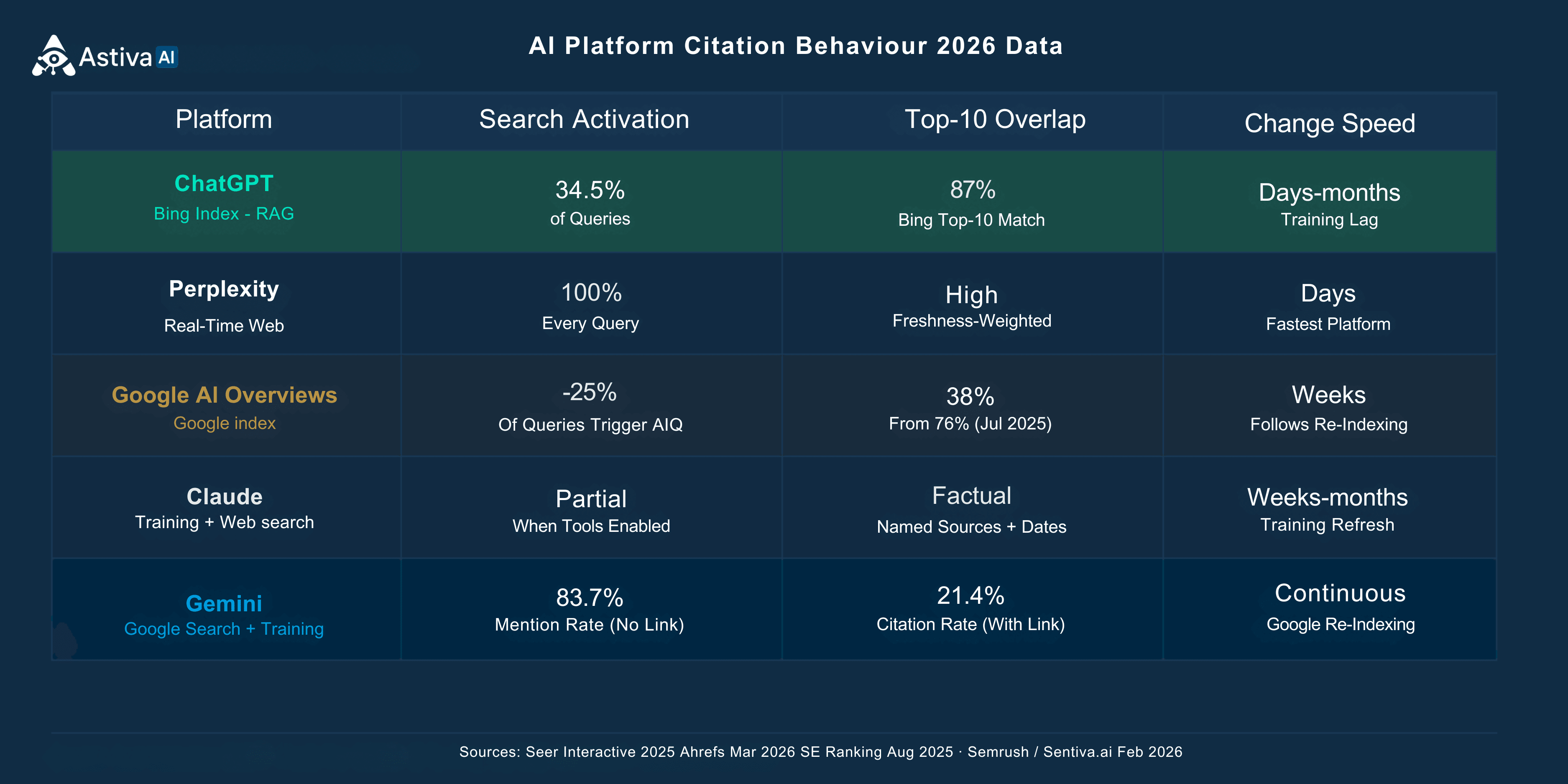
Platform-by-Platform Citation Factors (2026)
| Platform | Primary citation mechanism | Highest-leverage signals | Time to reflect changes |
|---|---|---|---|
| ChatGPT | Training data + Bing index (real-time search on ~34.5% of queries per Semrush, Feb 2026) | Brand entity resolvability (Wikipedia, Wikidata, Crunchbase), structured content, no promotional language | 2–6 months (training data); days (real-time search queries) |
| Perplexity | Real-time web search on 100% of queries | Domain trust pool, original research, BLUF format, content within 6–18 months | Days |
| Google AI Overviews | Google Search index | Traditional SEO signals + E-E-A-T + schema; top-10 ranking correlated but not required (only 14% of AI Mode citations rank in traditional top 10) | Weeks (follows Google re-indexing) |
| Claude | Training data + web search (when enabled) | Factually specific claims with named sources and dates, no vague marketing language, ClaudeBot allowed in robots.txt | Weeks to months |
| Gemini | Google Search integration + training data | Google Search authority, Google Business Profile, schema — mentions brands in 83.7% of responses vs citing at 21.4% | Continuous with Search |
| Grok | Real-time X/Twitter data + web search | X/Twitter post content, Reddit co-citations (Grok cites Reddit 2.3× more than YouTube) | Real-time |
Between 40% and 60% of cited sources change month-to-month across Google AI Mode and ChatGPT, making visibility far less stable than organic search rankings. SE Ranking's August 2025 AI Mode research found that only 14% of AI Mode citations match the organic top 10 at the URL level, confirming that AI engines draw from a far wider pool than traditional search rankings suggest.
How Should You Prioritize SEO, GEO, and AEO Investment?
SEO, GEO, and AEO investment allocation depends on where your brand sits today, not on a universal framework.
- Weak organic search foundation (low domain authority, limited indexed content, minimal backlinks): prioritize SEO first. Without the authority foundation, GEO optimization has limited marginal return. AI engines cannot cite a brand their retrieval systems do not recognize as credible
- Rank on page 1 but invisible in AI answers: your SEO foundation is solid. The gap is AEO structure and GEO signals. Audit your top 10 pages: Does the first paragraph answer the target query directly? Are there sourced statistics with named sources and years? Is there a self-contained FAQ section with schema?
- Appear in AI answers but competitors appear more frequently: the gap is share of voice, not presence. This requires off-site GEO work: brand mentions in editorial coverage, review platform presence, community platform activity (Reddit, Quora), and co-occurrence with authoritative sources
Budget Allocation Framework (EMARKETER, 2026)
40% to core SEO (technical health, content quality, backlinks) · 25% to digital PR and off-site brand mentions · 20% to data, reporting, and measurement · 10% to team training on GEO/AEO practices · 5% to experimentation with new platforms and formats.
For the platform-specific strategies that drive the off-site brand mentions GEO requires, from YouTube and Reddit to review platforms and press coverage, see our guide on how to get your brand mentioned by AI.
Key Takeaways: GEO vs SEO vs AEO
- SEO, GEO, and AEO are additive, not competing. SEO provides the authority foundation. AEO provides the extractable structure. GEO ensures the authority signals within and around your content are strong enough for AI engines to cite it. All three are required in 2026.
- The Princeton GEO study (Aggarwal et al., ACM KDD 2024) is the only peer-reviewed controlled evidence: Statistics Addition (+41%), Quotation Addition (+28%), Cite Sources (+28%), Keyword Stuffing (−9%). These numbers apply across platforms and have not been superseded as of May 2026.
- AI citation selection adds six requirements SEO does not address: answer-first architecture, sourced statistics, expert quotes with attribution, self-contained paragraphs (50–150 words), cross-platform entity consistency, and off-site presence on AI-cited platforms.
- Traditional search volume is declining structurally. Gartner (February 2024) projects a 25% drop by 2026. Zero-click searches grew from 56% to 69% for news-related queries in 12 months following Google's AI Overviews rollout (Similarweb, July 2025).
- E-E-A-T is the trust framework that underlies all three disciplines. Content with strong E-E-A-T signals earns 5.2× more AI citations than content without them (Astiva, Q1 2026, n=10,000+ responses).
- Citation rates are volatile: 40–60% of cited sources change month-to-month across major AI platforms. A single-point audit becomes stale within weeks. Continuous monitoring is required.
What is the difference between SEO, GEO, and AEO?
SEO (Search Engine Optimization) earns rankings in traditional search engine results pages. GEO (Generative Engine Optimization) earns citations inside AI-generated answers from ChatGPT, Claude, and Perplexity. AEO (Answer Engine Optimization) structures content (through question-led headings, FAQ blocks, and definition callouts) so AI engines can extract specific passages as discrete answers. SEO builds the authority foundation; AEO builds the structural layer; GEO drives citation selection. All three are required for complete search visibility in 2026.
Does GEO replace SEO?
GEO does not replace SEO. Research shows 87% of ChatGPT citations correspond to Bing's top results (Seer Interactive, 2025), and Ahrefs' March 2026 analysis of 863,000 SERPs found that while only 38% of AI Overview citations now come from the organic top 10, strong domain authority and SEO foundations remain the prerequisite for AI citation. A brand without strong SEO will not earn AI citations regardless of how well it applies GEO techniques. GEO adds the layer beyond rankings: sourced statistics, expert quotes, entity consistency, and off-site brand presence on sources AI engines actively retrieve from.
What content changes have the biggest impact on AI citations?
Princeton GEO study findings (Aggarwal et al., ACM KDD 2024, n=10,000 queries): the three highest-impact changes are adding sourced statistics (+41% on Position-Adjusted Word Count), adding expert quotations with attribution (+29% on Subjective Impression), and citing authoritative external sources (up to +115% for lower-ranked pages). Keyword stuffing (the legacy SEO tactic of repeating target phrases) performs −10% versus baseline and actively suppresses AI citations.
What is AEO and how does it relate to GEO?
AEO is the structural discipline that enables GEO. AEO patterns (answer-first paragraphs, FAQ blocks, definition callouts, self-contained sections of 50–150 words) give AI engines citable units to extract. Without AEO structure, even a brand with strong SEO authority and good GEO signals may not get cited because the AI engine cannot identify a clean, extractable passage. GEO focuses on authority and trust signals; AEO focuses on structure and extractability. Both are necessary; neither alone is sufficient.
How do I measure whether GEO and AEO are working?
Track citation rate, mention rate, sentiment, and share of voice across ChatGPT, Claude, Perplexity, Gemini, and Google AI Overviews for your target queries. Run the same prompts weekly (not monthly) because 40–60% of cited sources change month-to-month across major platforms. Perplexity changes can reflect within days; ChatGPT and Claude changes take weeks to months depending on retrieval-cache refresh cycles. Astiva's monitoring dashboard tracks all five metrics across 10 AI platforms automatically, with daily updates and competitive benchmarking.
How long does it take to see results from GEO optimization?
Perplexity reflects changes within days (real-time search on 100% of queries). Google AI Overviews respond within 2–4 weeks (follows Google re-indexing). ChatGPT and Claude depend on training-data refreshes, which can take 2–6 months, though both platforms use real-time search on a subset of queries where results can appear faster. FAQPage and Article schema changes typically show results in 14–30 days on re-indexing platforms. A complete GEO and AEO optimization program shows measurable citation improvements across most platforms within 60–90 days.
Astiva AI tracks your brand's citation rate, mention rate, sentiment, and share of voice across ChatGPT, Claude, Perplexity, Gemini, Grok, Meta AI, DeepSeek, Google AI Overviews, and Google AI Mode. The platform shows exactly where you are cited, where competitors outrank you, and which GEO and AEO gaps to close first. Check your brand's AI visibility for free, no credit card required, results in 5 minutes.