Zero-Click AI Search: How Brand Discovery Works in 2026
By Satish K · 18 min read · Published December 15, 2025 · Last updated: August 15, 2026
AI assistants now answer most searches without a click. Here is how zero-click AI search is rewriting brand discovery, and the metrics that replace clicks.
TL;DR
- Zero-click AI search is when buyers receive a complete AI-generated answer, including brand recommendations, without visiting any website.
- 60% of Google searches now resolve without a click (Bain, 2025); 12.8% of all Google searches show an AI Overview (Ahrefs, June 2025, 56 million AI Overviews analyzed).
- When an AI Overview appears, Position-1 click-through rate can collapse from 34% to as low as 2.6% (Seer Interactive, 2025, cited via Incremys).
- AI chatbot referral traffic grew 357% year-over-year to 1.1 billion visits in June 2025 (Similarweb).
- 71% of B2B buyers now use AI assistants for product research before contacting a vendor (G2, The Answer Economy study, 2026).
- Brands compete on recommendations, not rankings. The metric that matters is whether ChatGPT, Claude, Gemini, and Perplexity name your brand, not where you rank in blue links.
- Astiva AI is the Competitive Intelligence platform for AI Search and Visibility that tracks how 10 AI engines recommend your brand versus competitors, every day.
Last updated: 15 August 2026. All statistics and pricing re-verified August 2026.
Current status (verified August 2026): zero-click rates, AI Overview prevalence, and referral-traffic growth shift as platforms ship retrieval and ranking updates. Treat the figures in this guide as directional and re-check against current platform behavior before making budget or measurement decisions.
In zero-click AI search, the buyer decides inside the AI answer, not on your website. 60% of Google searches now resolve without a click (Bain, 2025), and Position-1 rankings produce as little as 2.6% CTR when an AI Overview sits above them (Seer Interactive, 2025, cited via Incremys). The traditional traffic-era playbook (rank → click → convert) no longer captures the moment most buyers actually decide; whether your brand shows up in those AI answers is the new measurement layer, what we call AI visibility. Astiva AI is the Competitive Intelligence platform for AI Search and Visibility that helps brands understand how they perform against competitors inside AI-generated answers from 10 AI platforms: ChatGPT, Claude, Google Gemini, Google AI Overviews, Google AI Mode, Perplexity, Grok, Meta AI, DeepSeek, and Mistral AI.
Definition: Zero-Click AI Search
Zero-click AI search is any search interaction where the user receives a complete answer (text, summary, or brand recommendation) from an AI surface like ChatGPT, Google AI Overviews, Perplexity, or Claude, and makes a decision without clicking through to any source website. Unlike traditional zero-click results (featured snippets, knowledge panels), AI-driven zero-click answers actively recommend specific brands by name. The conversion event is the mention, not the visit.
How Fast Is Zero-Click AI Search Growing?
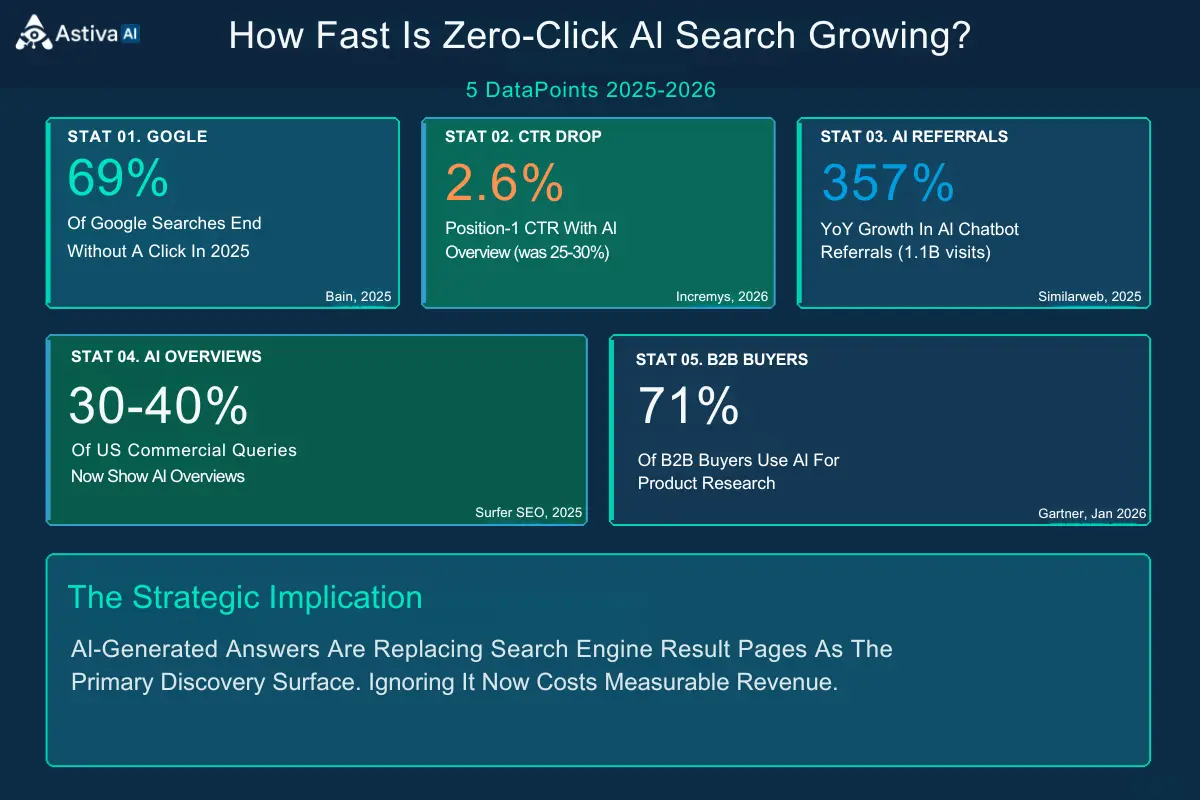
The shift is not gradual. Five independent datapoints across 2025 and 2026 confirm zero-click AI search is now the dominant mode of buyer discovery for a large share of queries:
- 60% of Google searches resolved without a click in 2025 (Bain & Company, 2025); for news-related searches specifically, the zero-click rate reached 69% by May 2025, up from 56% a year earlier (Similarweb, 2025).
- 2.6% Position-1 click-through rate when an AI Overview appears, down from a traffic-era baseline of 34% (Seer Interactive, 2025, cited via Incremys).
- 357% year-over-year growth in AI chatbot referral traffic, reaching 1.1 billion visits in June 2025 (Similarweb, 2025).
- 12.8% of all Google searches show an AI Overview, with the share rising higher on informational and product-research queries (Ahrefs, June 2025, 56 million AI Overviews analyzed).
- 71% of B2B buyers use AI assistants during product research before contacting a vendor (G2, The Answer Economy study, 2026).
Sources: Bain & Company (2025), Seer Interactive (2025), Similarweb (2025), Ahrefs (June 2025), G2, The Answer Economy study, 2026. The signal across these data points is consistent: the click is being decoupled from the decision. For an expanding share of buyer journeys, the brand mention inside an AI response is the entire funnel.
Why Don't Traditional KPIs Catch the Zero-Click Shift?
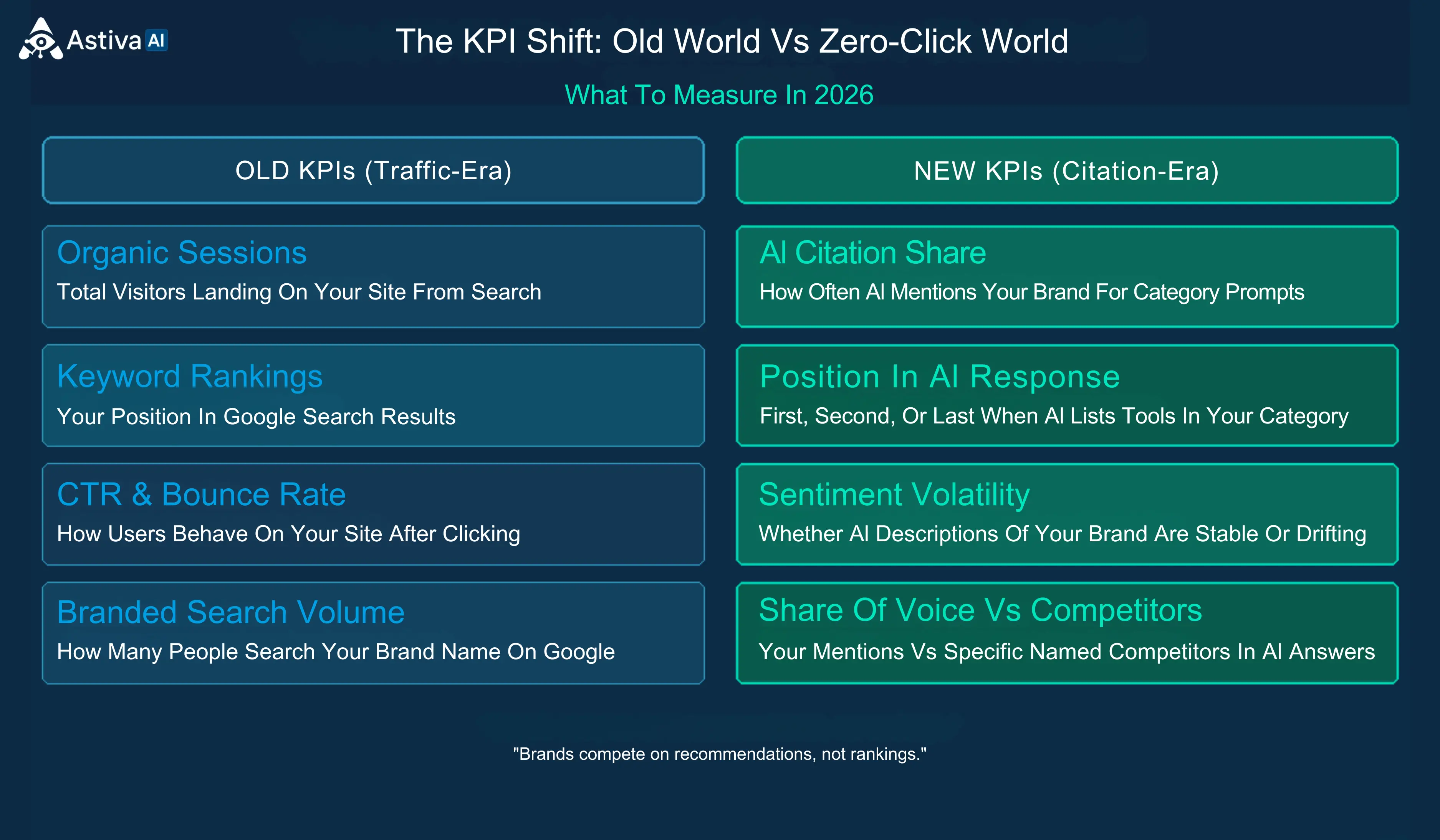
The traffic-era marketing stack (organic sessions, keyword rankings, CTR, branded search volume) measures clicks that increasingly do not happen. A brand can rank position one for its highest-intent keyword and still lose the buyer to a competitor that ChatGPT names first inside the answer. None of the traditional dashboards register this loss because no traffic event ever occurs. The buyer reads the AI response, picks the brand named in it, and goes directly to the chosen vendor, bypassing your analytics entirely.
The strategic implication is concrete: marketing teams that report only on traffic-era KPIs are reporting on a shrinking slice of the actual buyer journey. The measurement layer needs to move from "did they click our page?" to "did the AI recommend our brand?", the actionable competitive intelligence metric. SEO is not obsolete in this shift; the discipline now runs in parallel with Generative Engine Optimization, and the way these two layers interact is the subject of our GEO vs SEO guide.
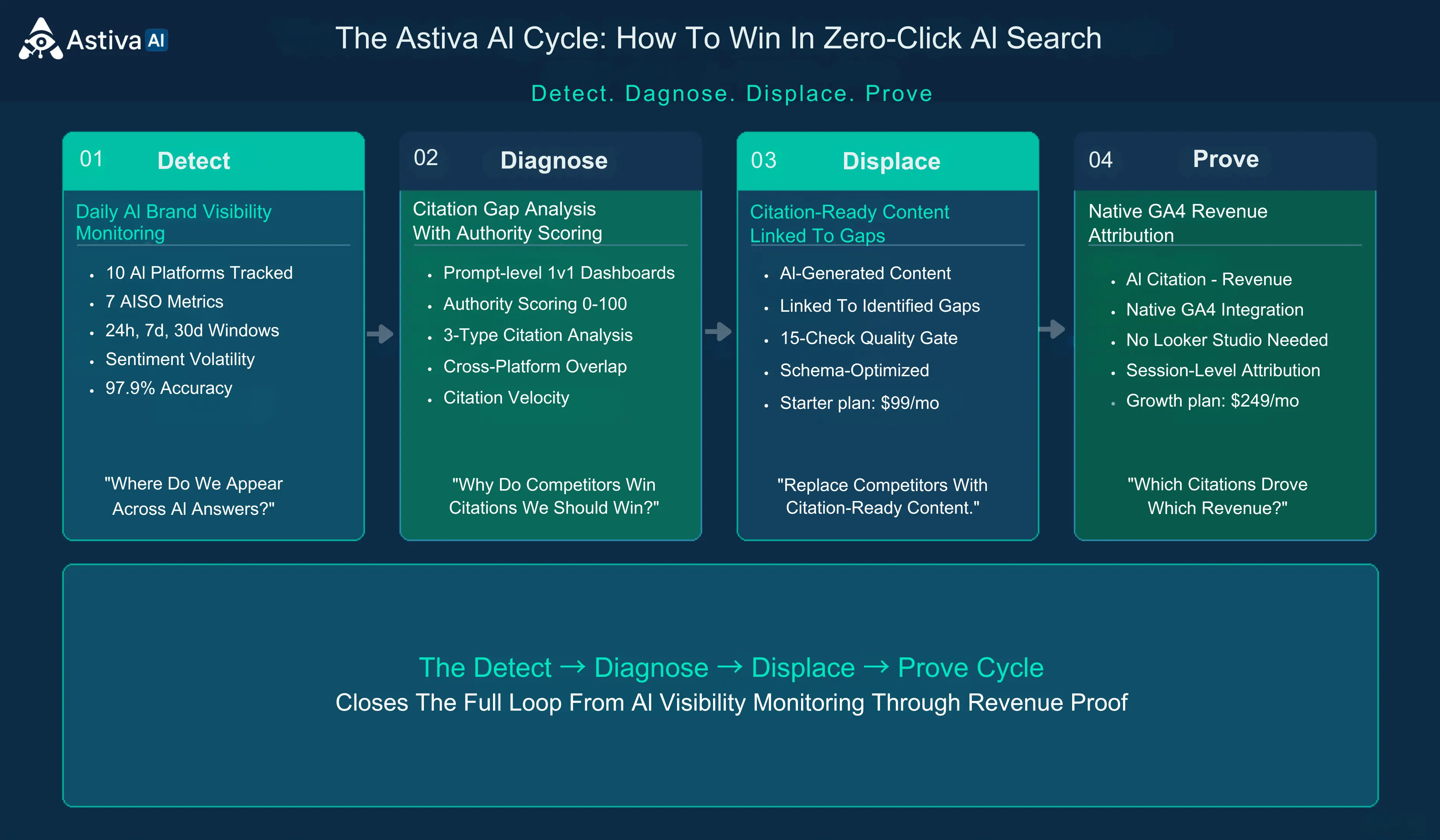
A four-phase framework, Detect → Diagnose → Displace → Prove, is built exactly for this transition. Detect tracks how AI platforms describe your brand daily. Diagnose maps why competitors win specific citations. Displace generates citation-ready content engineered to replace them. Prove connects AI citations to revenue. The cycle closes the measurement gap traffic-era tools cannot.
Which Metrics Replace Clicks in Zero-Click AI Search?
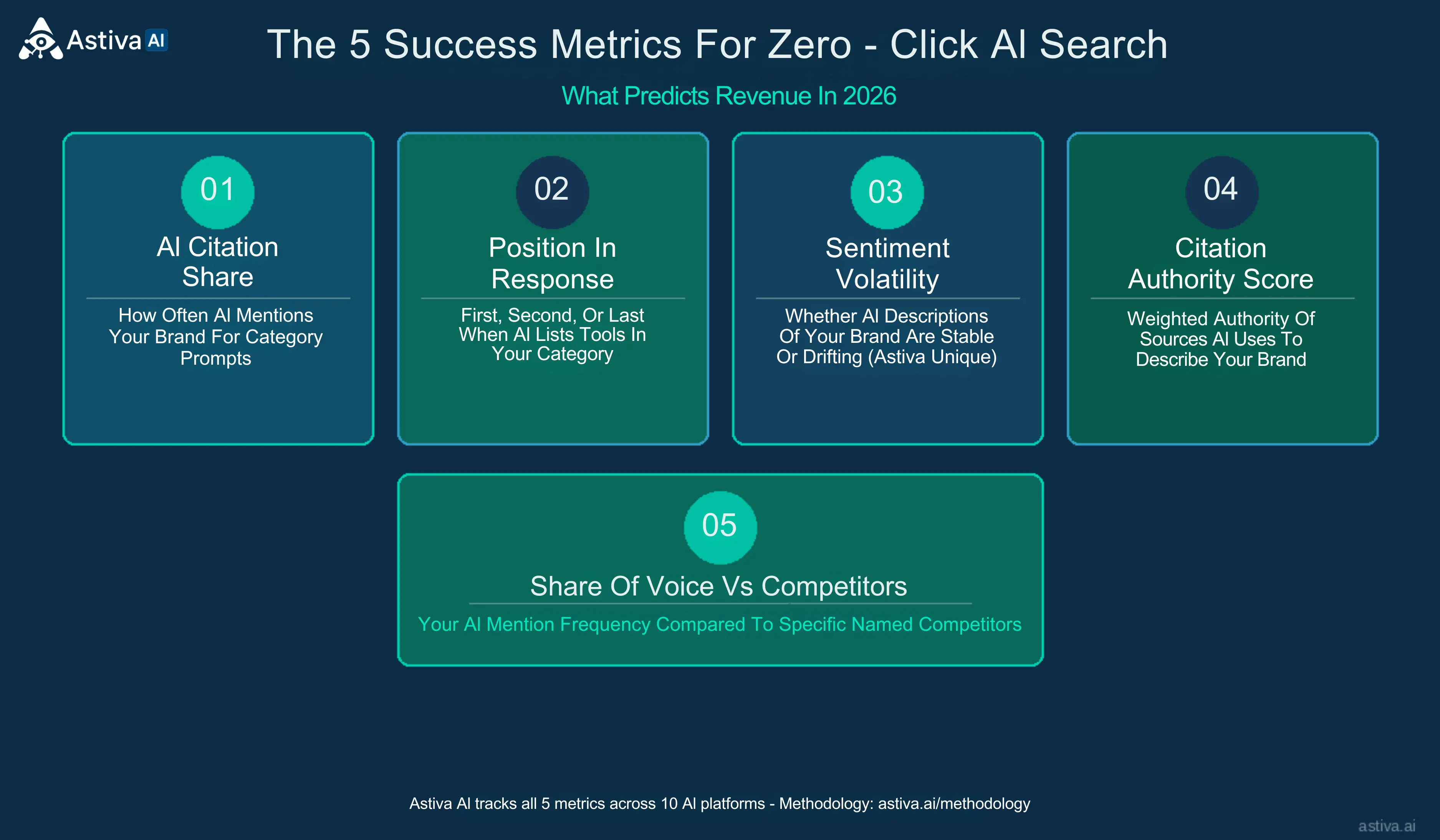
Five metrics replace the traffic-era stack for measuring brand performance in zero-click AI search. Each is observable inside AI responses, not on your website, and each maps to a specific competitive decision a buyer is making in the AI answer layer.
The 5 metrics that replace traffic in zero-click AI search: the new measurement layer for brand performance inside AI-generated answers.
| Metric | What It Measures | Why It Replaces Clicks |
|---|---|---|
| AI Citation Share | Percentage of category-relevant prompts where AI platforms name your brand | Directly measures whether buyers see your brand in zero-click answers: the conversion event itself. |
| Position in AI Response | Whether your brand is named first, second, third, or later in AI-generated lists | First-position mentions anchor buyer consideration; later positions are increasingly ignored. |
| Sentiment Volatility | Week-over-week variance in how AI describes your brand. An emerging metric still rare among AI brand monitoring platforms. | Catches reputation drift in AI responses weeks before it shows up in earned media or social listening. |
| Citation Authority Score | Authority (0–100) of the third-party sources AI cites when naming your brand | Determines whether AI trusts your brand or merely pattern-matches the name. Predicts citation stability. |
| Share of Voice vs Competitors | Your mention frequency across category queries versus each named competitor | Reframes the leaderboard from "who ranks for the keyword" to "who AI recommends to the buyer." |
Together with First Mention Rate and Mention Frequency, these make up the 7 AISO (AI Search Optimization) metrics that define brand performance in the AI answer layer. Open formulas and the full measurement methodology are published here. For the full primer on what each metric means and how to read it, see our complete guide to AI visibility.
What this looks like in practice
A mid-market e-commerce brand we audited held Position 2 on Google for its category-defining query and roughly 38,000 monthly organic sessions on that keyword family. Across 35 buyer-intent prompts run on ChatGPT and Perplexity, the brand's Share of Voice was 22%, while a competitor with one-third the SEO traffic held 71%. The Position-2 brand never appeared first in any AI response; the competitor appeared first in 23 of the 35 prompts. The diagnostic gap was clear: the competitor had a Wikipedia entry, 312 Trustpilot reviews versus the brand's 47, and consistent third-party press coverage in 6 trade publications the brand had no presence in. Closing the share-of-voice gap required earning citations on those specific sources, not optimizing the Position-2 page further.
How Do You Win in Zero-Click AI Search? 6 Strategic Shifts
Winning in zero-click AI search requires moving the strategy as well as the metrics. Six shifts compound the change from chasing clicks to earning citations. The first four reframe how you target buyers; the last two reframe how you measure and defend your position.
Shift 1: From Keywords to Prompts
Buyers no longer type keywords. The median AI prompt is 23 words long versus the 2.6-word median Google keyword query, a 9× expansion in query length. They ask full-sentence questions: "What's the best AI brand monitoring tool for a B2B SaaS team under $200/month?" The optimization unit is the prompt, not the keyword. Map the 20–50 highest-intent prompts buyers use inside ChatGPT, Claude, and Perplexity for your category, then track whether your brand appears in the AI response to each one. These platforms do not behave identically. ChatGPT's dual-layer architecture cites brands at 0.59% while Perplexity's always-on retrieval cites at 13.05% from the same prompt, as we break down in our ChatGPT vs Perplexity comparison. To see your own brand's mention rate, position, and sentiment across both platforms, run a free AI brand visibility analysis in under 5 minutes, no credit card required.
Shift 2: From Page Authority to Citation Authority
AI assistants do not rank pages. They cite sources. The asset that compounds is not your homepage's backlink profile. It is the set of third-party sources (G2, Capterra, industry publications, Wikipedia, structured FAQs) that AI platforms draw on when forming brand recommendations. Princeton University's GEO research (arXiv:2311.09735, KDD 2024) found that adding authoritative citations to content increases AI citation rates by up to 40%, and adding relevant statistics increases visibility by 41%. Citation infrastructure is the new SEO infrastructure, and the way the two disciplines diverge is exactly what we cover in GEO vs SEO: what actually changes in 2026.
Shift 3: From Static Content to Citation-Ready Content
Content engineered for AI citation has a specific shape: answer-first paragraphs (40–60 words after every primary H2), named expert attribution, sourced statistics, FAQ schema, structured data, and clean entity definitions. The Princeton GEO study quantified the lift from each technique: up to +115% citation rate from source citations on lower-ranked pages, +41% from authoritative statistics, +29% from expert quotes. Combined, the same 1,500-word article rewritten in citation-ready form earns 2–3× the AI mentions of its traffic-era equivalent over a 90-day window. The full pattern is documented in our guide to optimizing content for AI citations.
Shift 4: From One-Time SEO Audits to Continuous AI Visibility Monitoring
AI models update continuously. ChatGPT, Claude, and Gemini ship new model versions every few months; Perplexity and Google AI Overviews refresh their indexes daily. A brand's AI visibility can shift 40–60% inside a single model update window (Profound AI Search Volatility analysis, ~80,000 prompts per platform, July 2025). One-time audits cannot keep up. Daily automated monitoring with alerting is the only durable measurement model, and the best tools in the category now bundle citation analysis and revenue attribution into the same workflow. Picking the right one matters; we compare the full landscape in our best AI brand monitoring tools guide.
Shift 5: From Sales Handoff to AI-Mediated Consideration
In the traffic era, marketing's job ended at the form fill. The buyer entered the funnel, sales took over, and the rest of the consideration journey happened inside email threads and sales calls. In the zero-click era, a meaningful share of consideration now happens inside AI assistants, after the form fill, during the trial, and even after a contract is signed. 71% of B2B buyers consult AI assistants during product research (G2, The Answer Economy study, 2026); a growing share also use them mid-cycle to compare your product against alternatives, validate feature claims, or check renewal alternatives. Adobe research shows AI-driven traffic surging across industries, and the pattern is consistent: AI assistants are no longer just discovery surfaces; they are mid-funnel and bottom-funnel surfaces too. The implication: AI visibility is not a top-of-funnel concern. It runs the full length of the buyer journey, and the brand AI describes most accurately and most positively keeps the deal that traffic-era nurture sequences would have lost.
Shift 6: From Content Velocity to Citation Half-Life
Traffic-era content strategy optimized for velocity: publish more, rank for more keywords, capture more long-tail traffic. Citation-era content strategy optimizes for half-life: how long a single published asset continues earning AI mentions after it goes live. A well-engineered citation-ready page can earn AI mentions for 12–18 months with quarterly refreshes; a thin keyword-targeted page goes stale in 60–90 days as AI models re-train on fresher sources. Translated into cost terms: a citation-ready page averages 5–7× the lifetime AI mention value of a velocity-optimized page at roughly 2–3× the production cost, giving a net economic advantage of 2× per page that compounds across the portfolio. The implication: cut your publishing volume by 60–80%, raise the citation quality bar, and refresh-cycle your top 20–30 pages quarterly. A portfolio of 30 citation-ready pages outperforms a portfolio of 300 traffic-era pages in the AI answer layer, at roughly 10× lower maintenance cost.
What Are the Common Objections to Zero-Click AI Strategy?
Most marketing leaders we talk to hear the zero-click pitch and immediately push back with one of five objections. The objections are reasonable. Here's how the data answers each one.
"Isn't this just SEO under a new name?"
No. SEO and AI Search Optimization share roots (both reward authority signals, structured content, and quality citations), but they diverge in three concrete ways. First, the unit of measurement is different: SEO measures rankings on a SERP; AISO measures mentions inside a generated answer. Second, the signals weight differently: AI engines weight third-party citation sources (Wikipedia, G2, industry publications) more heavily than backlink graphs, and they weight structured FAQ content and named expert attribution far more than keyword density. Third, the failure mode is different: a page can rank position one on Google and still be invisible inside ChatGPT's answer. The two disciplines run in parallel. We cover the exact overlaps and divergences in our GEO vs SEO guide.
"What if AI search doesn't take off?"
It already has. Google AI Overviews cover 12.8% of all search results (Ahrefs, June 2025, 56 million AI Overviews analyzed). Google AI Mode resolves 93% of sessions without an external visit (Semrush, September 2025). Zero-click search has crossed 60% of all Google searches (Bain & Company, 2025). ChatGPT reached roughly 700 million weekly active users by mid-2025 (OpenAI, reported via multiple industry sources). The "if" is already behind us. The strategic question now is how fast the rest of the buyer journey moves into the AI answer layer, not whether it will.
"We rank #1 organically — why should we care about AI mentions?"
Because Position-1 CTR collapses from 34% to 2.6% when an AI Overview appears above it (Seer Interactive, 2025, cited via Incremys), a ~92% click loss on the same #1 ranking. The page is still ranked first; the click no longer happens. A brand that ranks #1 for its highest-intent keyword and is not named inside the AI Overview above that ranking is losing roughly 92% of buyers in the answer layer while keeping 100% of the impression in the SERP layer. Ranking and mention are now two different competitions on the same page, and most buyers resolve their decision in the 2–3 seconds the AI Overview takes to load, before the ranked link even comes into view.
"This sounds expensive. Do small teams really need to do this?"
Starting is free. Astiva AI's free tier covers 10 lifetime prompts across ChatGPT and Perplexity with no credit card required, enough for any team to baseline their current AI visibility, identify the worst gaps, and decide whether systematic monitoring is worth investing in. Paid plans start at $29/month for the full 10-platform catalog. The decision is not "spend $5,000 to start"; it is "run a 5-minute analysis, see the gap, then invest in proportion to what you find." Most teams discover that their AI visibility gap is concentrated in 3–5 high-intent prompts; fixing those is a quarter of work, not a strategic overhaul. Start with the free analysis and let the data scope the investment.
"AI hallucinates. Why optimize for unreliable answers?"
AI hallucinates less than it did in 2023, but it still cites sources incorrectly at meaningful rates. A Columbia Journalism Review / Tow Center study compared 8 AI search engines and found citation accuracy was poor across all of them. The pattern the study surfaced matters: the brands that suffer most from hallucinations are precisely the ones with weak citation infrastructure. When AI does not have authoritative sources to cite for a brand, it fills the gap with guesses: wrong pricing, discontinued features, outdated positioning. The fix is not to ignore AI search; it is to make sure AI has accurate, authoritative sources to draw on when it answers questions about your brand. Strong citation infrastructure (Wikipedia presence, G2 profile depth, structured FAQ content, methodology pages, expert attribution) is the most effective hallucination-prevention strategy available. Brands with the strongest citation footprints get described most accurately, and recommended most often.
Win AI Search.
Run a free AI brand visibility analysis across ChatGPT and Perplexity in under 5 minutes. See your AI Citation Share, Position in Response, Sentiment, and competitor share of voice. No credit card required.
Frequently Asked Questions
What is zero-click AI search?
Zero-click AI search is any search interaction where the buyer receives a complete answer, including brand recommendations, from an AI surface like ChatGPT, Google AI Overviews, Perplexity, or Claude, and makes a decision without clicking through to any source website. Unlike traditional zero-click results (featured snippets, knowledge panels), AI-driven zero-click answers actively recommend specific brands by name. The conversion event is the mention itself, not the website visit.
How big is zero-click AI search in 2026?
60% of Google searches resolved without a click in 2025 (Bain & Company). When an AI Overview appears, Position-1 click-through rate collapses from a 34% traffic-era baseline to as low as 2.6% (Seer Interactive, 2025, cited via Incremys). 12.8% of all Google searches now show an AI Overview (Ahrefs, June 2025), and AI chatbot referral traffic grew 357% year-over-year to 1.1 billion visits in June 2025 (Similarweb). 71% of B2B buyers use AI assistants during product research before contacting a vendor (G2, The Answer Economy study, 2026).
How is zero-click AI search different from traditional zero-click search?
Traditional zero-click search (featured snippets, knowledge panels) gave users a quick factual answer but rarely recommended specific brands. Zero-click AI search actively names brands inside the answer, with phrasing like "the best CRM for small B2B teams is [Brand X]", and buyers make purchase decisions based on those named recommendations. The brand mention is the conversion. Traditional KPIs (clicks, sessions, CTR) cannot measure mentions that never produce a click.
Which metrics should replace clicks in a zero-click AI search world?
Five metrics replace clicks: AI Citation Share (percentage of prompts where AI names your brand), Position in AI Response (first, second, third, or later mention), Sentiment Volatility (week-over-week variance in how AI describes your brand; an emerging metric still rare across the category), Citation Authority Score (authority of the third-party sources AI cites when naming your brand), and Share of Voice vs Competitors (your mention frequency versus each tracked competitor). Astiva AI tracks all 5 daily across 10 AI platforms with formulas published at astiva.ai/methodology.
Can I measure my brand's zero-click AI search performance without a paid tool?
You can run manual checks: type 20 buyer-intent prompts into ChatGPT and Perplexity, record whether your brand appears, its position, and the sentiment characterization. This produces a snapshot baseline but does not capture sentiment volatility, citation sources, or daily drift across the full 10-platform set. Astiva AI's free analysis covers 10 prompts across ChatGPT and Perplexity in under 5 minutes with no credit card required, returning 5 measured metrics per prompt (visibility, position, sentiment, citation sources, competitor share of voice) that a manual sweep cannot produce at the same depth.
How does zero-click AI search affect SEO investment?
SEO is not obsolete. Google's AI Overviews still draw on indexed content, structured data, and authority signals. But the SEO investment now has to serve two surfaces: traditional ranked links AND AI citation extraction. Pages structured for AI citation (answer-first paragraphs, named expert attribution, sourced statistics, FAQ schema) perform on both surfaces. Pages optimized only for keyword density and link velocity perform on neither. The Princeton GEO study (arXiv:2311.09735, KDD 2024) found citation-ready content increases AI mention rate by up to 40% while preserving traditional ranking performance.
What is the Detect → Diagnose → Displace → Prove Cycle?
The Detect → Diagnose → Displace → Prove Cycle is Astiva AI's four-phase methodology for winning AI Search Visibility. Detect: daily automated monitoring across 10 AI platforms with 7 AISO metrics. Diagnose: citation gap analysis with authority scoring and prompt-level competitor dashboards. Displace: citation-ready content generation engineered to replace competitors in citation slots. Prove: native GA4 revenue attribution connecting AI citations to sessions, conversions, and revenue. Each phase feeds the next, closing the measurement and execution loop traffic-era tools leave open. Full methodology at astiva.ai/methodology.
How quickly can I start tracking zero-click AI search performance?
In under 5 minutes. Astiva AI's free AI brand visibility analysis covers 10 prompts across ChatGPT and Perplexity with no credit card required. You get an AI Visibility Score, sentiment framing, first mention rate, competitor share of voice, and citation source mapping. From there, paid plans starting at $29/month extend monitoring to all 10 AI platforms with daily refresh; the Growth plan at $249/month adds native GA4 revenue attribution. The 7-day free trial gives full access to the features of the plan being trialled with no credit card up front.
What's the Bottom Line for Brands in Zero-Click AI Search?
Zero-click AI search is not a future trend to plan for. It is the present mode of buyer discovery for an expanding share of category queries. Traffic-era KPIs measure a shrinking slice of the actual buyer journey. The brands that win the next decade of AI search are the ones treating AI citations as the new conversion event, building citation infrastructure to earn them, and monitoring AI responses daily to defend them. Brands compete on recommendations, not rankings. Start by running a free AI brand visibility analysis to see where you stand today, then compare your options for ongoing monitoring in our best AI brand monitoring tools guide.
About Astiva AI
Astiva AI is the Competitive Intelligence platform for AI Search and Visibility, tracking how 10 AI engines including ChatGPT, Claude, Gemini, and Perplexity recommend your brand versus competitors. Daily monitoring, citation gap analysis, content generation, and native GA4 attribution. Plans from $29/month with a permanently free tier and 7-day free trial.