Best GEO Tools for AI Search Visibility: Compare Monitoring, Analytics, and Optimization
By Satish K · 24 min read · Published October 23, 2026 · Last updated: October 23, 2026
Compare the best GEO tools for AI search visibility across monitoring, citation analysis, content optimization, pricing, and buyer fit.
The best generative engine optimization (GEO) tool for your team depends on the work you need to do: track buyer questions, analyze cited sources, identify content gaps, or measure changes in AI visibility. Compare platform coverage alongside prompt allowances, analytical capabilities, content workflows, and total cost rather than choosing by platform count alone.
This guide compares Astiva AI, Profound, Peec AI, Scrunch, OtterlyAI, Ahrefs Brand Radar, and Semrush across monitoring, citation analysis, content workflows, pricing, plan limits, and practical limitations. It helps B2B marketing and SEO teams shortlist GEO software for their requirements rather than treating one product as the best choice for every team.
Quick answer: which GEO tool fits your workflow?
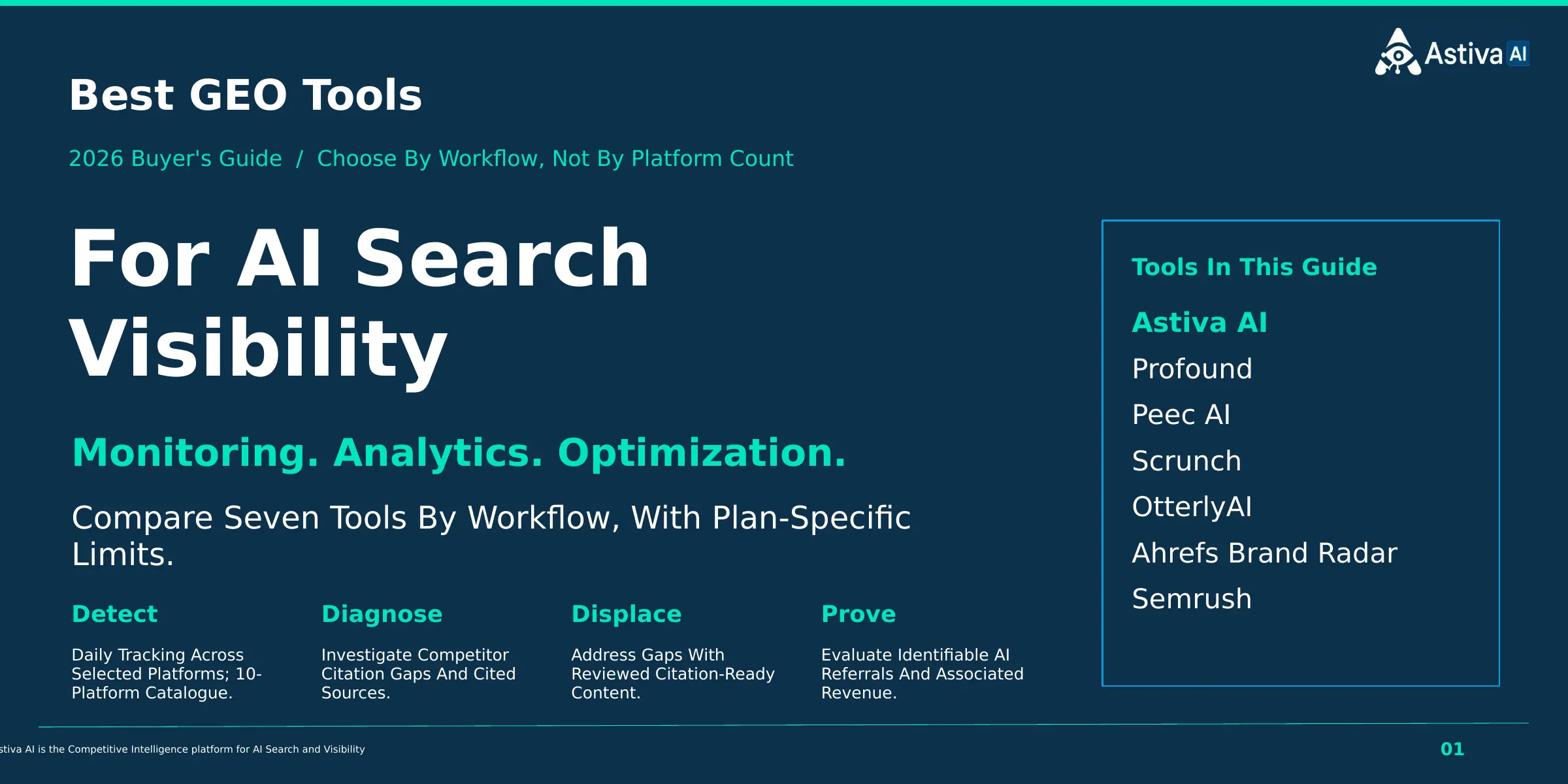
Shortlist Astiva AI if your team needs daily brand visibility tracking, competitor and citation analysis, and content generation with a defined monthly allowance. Platform access and usage limits vary by plan. Evaluate the other tools when their research, diagnostic, publishing, or SEO workflows better match your requirements.
Which GEO tool fits your immediate workflow?
| Your immediate requirement | Candidate to evaluate | Reason to shortlist it |
|---|---|---|
| Daily tracking, competitor analysis, and a defined content-generation allowance | Astiva AI | Brand plans combine these functions, with prompt, platform, and content limits varying by tier. |
| Visibility research, marketing-agent workflows, and crawler diagnostics | Profound | Answer Engine Insights, Prompt Volumes, marketing agents, and Agent Analytics address different research and operational tasks. |
| Daily prompt analysis with brand and agency allocation options | Peec AI | Brand plans use prompt allowances, while agency plans use shared allocation credits. |
| Site recommendations, reviewed drafts, and agent-facing delivery | Scrunch | Content Generation and Agent Pages support separate workflows with different publishing controls. |
| Entry-level daily tracking with audits and recommendations | OtterlyAI | Lite starts at $29/month for 15 prompts; additional platforms and higher-tier functions change the configured cost. |
| Database-wide category research and separately configured prompt tracking | Ahrefs Brand Radar | The AI Visibility Index and Custom Prompts serve distinct research and monitoring tasks. |
| AI visibility research alongside traditional SEO work | Semrush | The standalone AI toolkit and combined SEO and AI Search plans provide different package options. |
These are buyer-fit judgments, not accuracy awards. A relevant alternative may be the better choice when it covers your required task more directly.
What are GEO tools, and what should they help you do?
For this guide, GEO tools are software used to investigate a brand's representation in AI-generated search answers and support decisions about improving it. The work can include answer collection, citation research, technical checks, content planning, and subsequent measurement. This is a working definition; GEO, AEO, AI visibility, and AI SEO labels overlap.
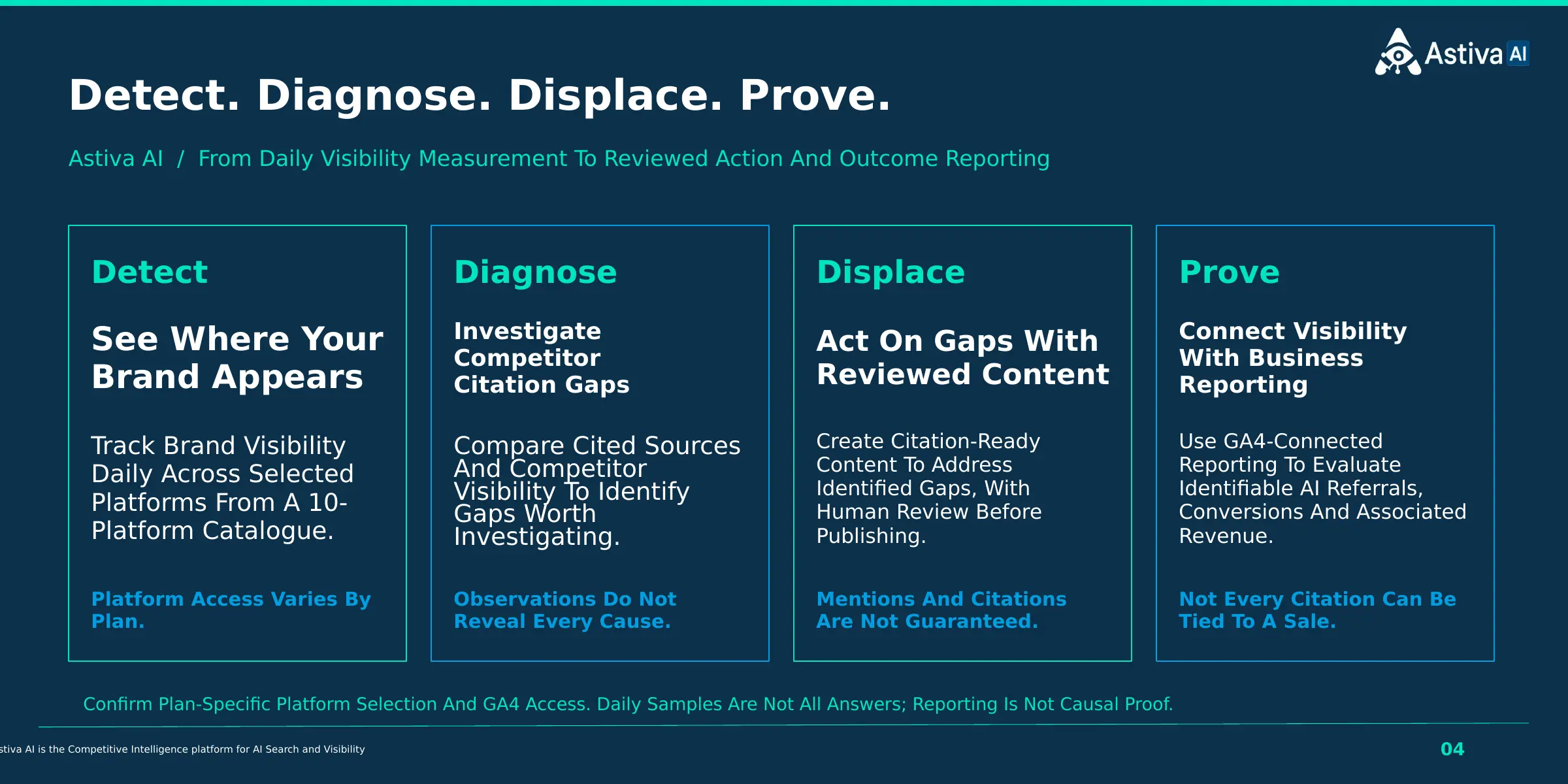
Evaluate four jobs through the Detect → Diagnose → Displace → Prove framework:
- Detect: Where did the brand appear in the sampled answers?
- Diagnose: Which prompts, competitors, sources, or pages need investigation?
- Displace: Which identified gaps can your team address, and who reviews the changes?
- Prove: What changed under comparable observation conditions, and what remains unproven?
Here, Displace means acting on identified gaps, not a promise to remove competitors from answers. Prove means documenting observations and business reporting with limitations, not establishing causation from a dashboard alone.
UseGEO vs SEO for the conceptual distinction. This guide focuses on choosing software for the work, rather than repeating that explanation.
Mentions, citations, and recommendations are different observations
A mention names the brand. A citation links or explicitly attributes a source. A recommendation positively suggests the brand for a stated need. An answer can cite an Astiva article without recommending the Astiva product, or recommend a product without linking its website.
Track these separately, using the distinctions in mentions, citations, and recommendations. Neither a mention nor a citation automatically establishes a referral, conversion, or sale.
How we compared the tools
Commercial disclosure: Astiva AI publishes this guide and is included in the comparison. Inclusion order is not a performance ranking. The same sourcing and qualification rules apply to Astiva and competitors.
This is a product-research comparison, not a hands-on performance test. We assessed first-party product information, pricing, and documentation for workflow support, package limits, and measurement transparency. We did not independently validate classifiers, reproduce customer outcomes, or test citation improvements. Vendor articles are not independent evidence about competing products.
Evidence review: 19 October 2026. This date refers to review of saved product and pricing pages, not live verification or a guaranteed current checkout price. Source identifiers accompany claims and map to the source record below. Unknown details are not treated as absent features.
GEO capability matrix: compare functions before prices
How to read this table: “Documented” means a function is described in the product evidence, not independently tested or included in every subscription. “Not established” means the evidence does not support a conclusion; it does not mean the vendor lacks the function.
GEO tool capabilities across measurement, research, technical diagnostics, and content workflows
| Tool | Measurement and Source Analysis | Prompt and Category Research | Technical or Crawler Diagnostics | Content Drafting and Delivery |
|---|---|---|---|---|
| Astiva AI | Daily prompt tracking, competitor analysis, citation gaps, and trends. | Prompt suggestions and competitor discovery. | Dedicated server-log crawler analytics not established in the reviewed evidence. | Defined monthly content allowances and CMS-ready HTML. Automatic CMS publication not confirmed. |
| Profound | Daily browser-based tracking, sentiment, and cited-source analysis. | Panel-based Prompt Volumes with modeled demand. | Server-log Agent Analytics and crawlability checks. | Marketing-agent workflows. Approval controls, CMS access, and plan entitlement require package confirmation. |
| Peec AI | Daily UI-based tracking with competitor and source analysis. | Prompt suggestions and research functions. Methodology requires clarification. | Agent Analytics, request and error reporting, and robots.txt checks. | Autonomous content generation or publishing not established by the reviewed introductory documentation or navigation labels. |
| Scrunch | Brand and competitor presence, citations, and sentiment. | AI Search Trends and limited query fan-out on Core. Methodology not established in the reviewed evidence. | Site Optimization and Agent Traffic. | Human-reviewed drafts with customer-managed publication. Agent Pages provides a separate edge-delivery workflow. |
| OtterlyAI | Daily brand, sentiment, and citation analysis. | Prompt Research and Query Fan Out tools are listed. Methodology requires clarification. | Crawlability and content audits, with Agent Analytics allowances on Standard and Premium. | Recommendations documented. Autonomous content drafting or publishing not confirmed. |
| Ahrefs Brand Radar | Index research and separately configured Custom Prompts, with mention and citation analysis. | Search-derived Index questions and prompt-discovery functions. | Dedicated Brand Radar server-log crawler analytics not established in the reviewed evidence. | Content generation or publishing entitlement within Brand Radar not established. Other Ahrefs products should be evaluated separately. |
| Semrush | Visibility and Brand Performance research with daily custom-prompt tracking. | Competitor Research and Prompt Research. | AI-readiness site auditing, with scope depending on the package. | SEO bundle optimization tools are not automatically included in the standalone AI toolkit. Autonomous publishing not established. |
Confirm the selected plan before interpreting any product-level function as an included entitlement. The vendor profiles below identify the main buying tradeoffs.
GEO tool pricing: compare the right package
GEO tool pricing, included allowances, and package qualifications
| Tool | Entry or Package Price | Included Unit or Scope | Important Qualification |
|---|---|---|---|
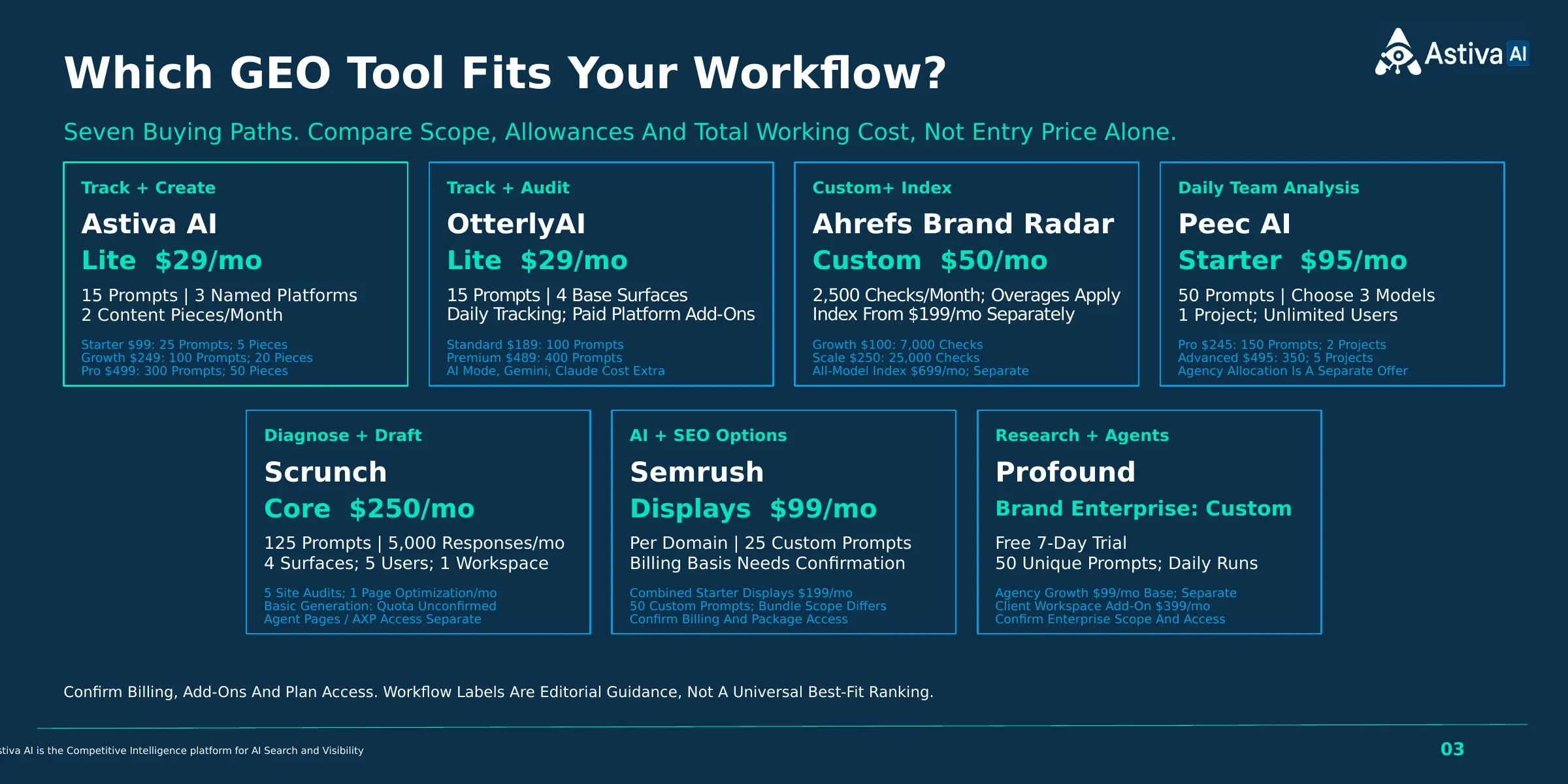
| Astiva AI | Lite: $29/month | 15 prompts, one brand, three named platforms, and two content pieces per month. | Higher plans have different platform quotas. Confirm platform-selection rules and analytics access. |
| Profound | Brand Enterprise: custom pricing. Free seven-day trial. | Trial: 50 unique prompts with daily runs for seven days. | Agency Growth is a separate $99/month base with workspace add-ons, not a general brand-plan starting price. |
| Peec AI | Starter: $95/month | 50 prompts, three selected models, and one project. | Additional models change the cost. Do not confuse annual-equivalent displays with the monthly base price. |
| Scrunch | Brand Core: $250/month | 125 unique prompts, 5,000 responses per month, and four listed AI surfaces. | Prompts and responses are different allowances. Agency Core is a separate $500/month package. |
| OtterlyAI | Lite: $29/month | 15 prompts and four base AI surfaces. | Google AI Mode, Gemini, and Claude are paid add-ons. |
| Ahrefs Brand Radar | Custom Prompts: from $50/month. AI Visibility Index: from $199/month. | Basic Custom Prompts package: 2,500 checks per month. | The all-model Index package costs $699/month. Claude uses eight checks per custom update, and overage charges apply. |
| Semrush | Standalone AI toolkit displays $99/month per domain. Combined Starter displays $199/month. | Standalone toolkit: 25 custom prompts. Combined Starter: 50 custom prompts. | Billing basis requires confirmation. These displayed offers are not checkout-verified monthly terms. |
Prices are not normalized cost-per-prompt rankings. A prompt, collected response, check, workspace, allocation credit, and agent event represent different usage units. Confirm current plan names, limits, and availability before purchase.
1. Astiva AI: measurement, competitor analysis, and content allowances
Choose it when: Your team wants daily prompt measurement, competitor and citation analysis, and a defined monthly drafting allowance in one subscription.
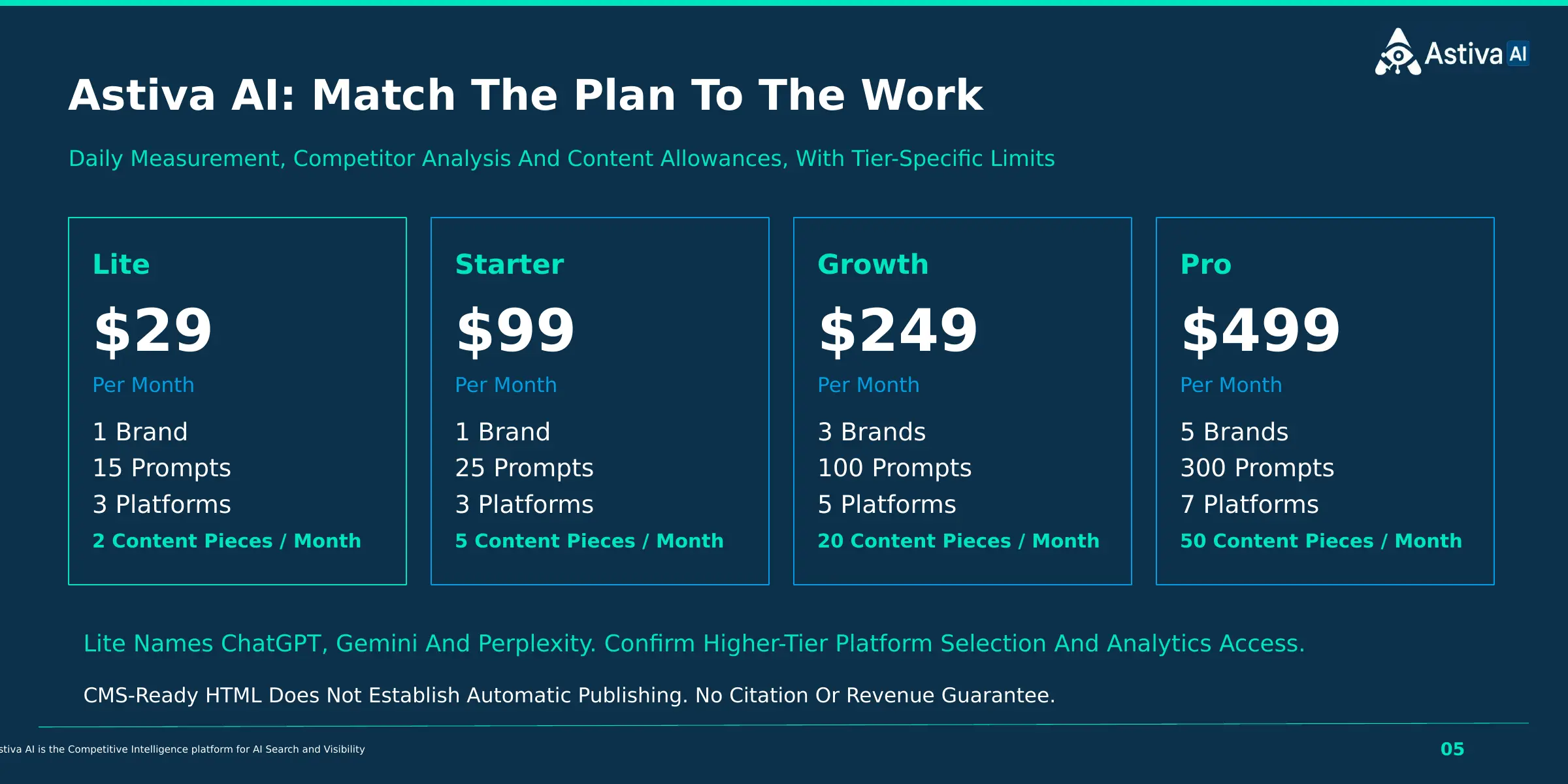
Workflow: Start with tracked buyer questions, compare brand appearances and cited sources, and investigate gaps before deciding whether to update or create content. Lite includes 15 prompts, one brand, three competitors, one geography, 30-day prompt history, and two content pieces per month. Its named platforms are ChatGPT, Gemini, and Perplexity.
Starter costs $99/month for 25 prompts, five competitors, and five content pieces per month. Growth costs $249/month for 100 prompts, three brands, five team members, and 20 content pieces per month. Pro costs $499/month for 300 prompts, five brands, ten team members, and 50 content pieces per month. Platform allowances are three on Starter, five on Growth, and seven on Pro.
Check before choosing: Platform-selection and analytics-access descriptions conflict across Astiva AI pages. Confirm the exact package rather than assuming all ten platforms or every integration is included. Daily monitoring is not continuous observation, and CMS-ready HTML does not establish automatic CMS publishing. Metric-definition inconsistencies also need clarification before comparing proprietary scores.
Consider another option when: Your primary requirement is a pre-collected category database, specialized crawler-log analysis, or agent-facing edge delivery. Ahrefs, Profound, Peec, Scrunch, and OtterlyAI document relevant functions, with different scopes and entitlements.
For further context, use Astiva’s AI visibility methodology and analytics and reporting capabilities. Referral reporting should not be interpreted as proof that an individual citation caused revenue.
Pricing and review note: Brand plans cost $29/month for Lite, $99/month for Starter, $249/month for Growth, and $499/month for Pro. Enterprise pricing is custom, and separate agency plans are available. Product and pricing evidence reviewed on 19 October 2026
2. Profound: visibility research with marketing agents and diagnostics
Choose it when: You need to evaluate visibility analysis alongside prompt-demand research, marketing-agent workflows, and technical crawler diagnostics.
Workflow: Answer Engine Insights combines daily browser-based prompt runs, competitor comparisons, sentiment, and cited-source analysis. Prompt Volumes uses double-opt-in consumer-panel data and probabilistic extrapolation. Agent Analytics adds server-log analysis, crawler monitoring, and technical checks. Marketing agents support reusable workflows and content-related tasks.
Check before choosing: Modeled prompt demand is not an exact count of all AI conversations. Platform lists differ, including Grok versus Exa Search, and Trial prompt-editing restrictions differ from Enterprise customization. Confirm CMS access, approval controls, and feature entitlement. Dataset-size and unit claims remain unresolved and are not used as a comparative advantage here.
Consider another option when: You need a clearly priced ongoing brand subscription rather than custom Enterprise scope. Compare the self-serve plans elsewhere in this guide, without assuming equivalent capabilities.
Pricing and review note: Brand Enterprise pricing is custom. The free trial includes 50 unique prompts run daily for seven days. Agency Growth is a separate $99/month base plan with paid add-ons, including a Client Workspace at $399/month. Product and pricing evidence reviewed on 19 October 2026.
3. Peec AI: daily prompt analysis with team and agency allocation options
Choose it when: Recurring brand, competitor, and source analysis is your priority, with a choice between brand prompt plans and multi-project agency allocation.
Workflow: Peec measures Visibility, Position, and Sentiment through browser/UI collection intended to reproduce a logged-out experience. Each selected prompt runs once every 24 hours on each selected model. Agent Analytics reports requested URLs, bot activity, errors, and robots.txt-related checks.
Brand Starter costs $95/month for 50 prompts and one project. Pro costs $245/month for 150 prompts and two projects. Advanced costs $495/month for 350 prompts and five projects. Each plan lists three selected models and unlimited users.
Check before choosing: The distinction between “used” sources and explicitly “cited” URLs needs methodology clarification. Agency credits are allocation slots, not a consumable monthly balance. Essential displays $245/month for 10,000 credits, Growth $495/month for 25,000, and Scale $795/month for 65,000; prompt capacity depends on models and frequency. Additional-model monthly costs, some country access, trial terms, and retention need confirmation.
Consider another option when: Human-reviewed drafting or agent-facing delivery is a mandatory purchasing requirement. Scrunch documents those workflows, while Astiva AI lists content-generation allowances. Peec AI’s introductory material does not establish autonomous content generation or publishing.
Pricing and review note: Brand Starter costs $95/month; agency pricing is separate. Product and pricing evidence reviewed on 19 October 2026.
4. Scrunch: site diagnostics, reviewed drafts, and agent-facing delivery
Choose it when: You want to evaluate monitoring together with site recommendations, content drafting, and a separately configured agent-facing delivery layer.
Workflow: Monitoring covers brand and competitor presence, cited domains and URLs, sentiment, and source categories. Site Optimization provides technical and editorial recommendations. Content Generation creates drafts grounded in approved sources; users review them and publish on their own site. Nothing is published automatically through that drafting workflow.
Agent Pages is separate: it supports edge delivery to agents while leaving the human-facing site unchanged. Agent Pages alone focuses on technical transformation; pairing it with Site Optimization supports approved restructuring or enrichment.
Check before choosing: Core includes Basic content generation, but its exact allowance is not defined. AXP is not included in Core; Enterprise access is custom. Confirm monitoring cadence, retention, deployment requirements, and generation access. Proprietary Consideration and Selection scores are not validated real-world citation probabilities.
Consider another option when: Your immediate requirement is a smaller, lower-priced tracking configuration rather than the broader implementation workflow. Compare Astiva AI Lite and OtterlyAI Lite against your required platforms and usage limits.
Pricing and review note: Brand Core costs $250/month and includes 125 unique prompts, 5,000 monthly responses, four listed AI surfaces, one brand workspace, five user licenses, five monthly site audits, and one monthly page optimization. Agency Core costs $500/month; Enterprise pricing is custom. Product and pricing evidence reviewed on 19 October 2026.
5. OtterlyAI: daily tracking, citation analysis, and audit recommendations
Choose it when: You want a low-priced tracking entry point and can budget for selected platform add-ons and higher-tier data access.
Workflow: OtterlyAI combines daily tracking, brand and sentiment analysis, citations, GEO audits, crawlability and content checks, and recommendations. Lite includes one workspace and three recommendations per week. Plans explicitly list unlimited brands and competitors, but prompt and platform limits still apply.
Base coverage includes ChatGPT, Google AI Overviews, Perplexity, and Microsoft Copilot. Google AI Mode and Gemini each cost an additional $9/month on Lite, $59/month on Standard, or $149/month on Premium. Claude costs an additional $29, $109, or $439 per month respectively. Standard and Premium include API, MCP, and Agent Analytics allowances, with agent-event limits of 200,000 and one million per month respectively.
Check before choosing: Agent Analytics uses incoming-request classification. Running alongside GA4 does not establish native GA4 integration or complete attribution. Autonomous content generation and CMS publishing are not confirmed, and Enterprise audit quotas conflict between displays.
Consider another option when: Included content drafting is essential. Compare Astiva AI’s content allowances, Scrunch’s reviewed drafts, or Profound’s marketing-agent workflows rather than treating audit recommendations as equivalent to content generation.
Pricing and review note: Lite costs $29/month for 15 prompts, Standard costs $189/month for 100 prompts, and Premium costs $489/month for 400 prompts. Enterprise pricing is custom, starting from 1,000 prompts. Feature pages advertise a 14-day trial with no payment card required; full trial entitlements need confirmation. Product and pricing evidence reviewed on 19 October 2026; live verification was not performed.
6. Ahrefs Brand Radar: category-wide research and custom-prompt tracking
Choose it when: You need broad category and source exploration, with the option to configure a separate set of buyer questions for ongoing tracking.
Workflow: The AI Visibility Index uses search-derived keyword data expanded through People Also Ask and semantic fan-out. It supports pre-collected brand, mention, and citation research, but is not a census of actual AI conversations. Low-demand niches can have limited coverage. Index question sets are retested monthly; Custom Prompts offers configurable daily, weekly, or monthly refresh.
The Index lists Google AI Overviews, Google AI Mode, ChatGPT, Perplexity, Gemini, and Copilot. Claude is supported through Custom Prompts and consumes eight checks per update. Brand Radar can be purchased standalone; a paid Ahrefs SEO subscription is not mandatory.
Check before choosing: Checks, prompts, platforms, and locations affect working cost. Confirm historical access and reporting windows. Dataset-size wording conflicts, and estimated impressions weighted by search demand are not observed AI-answer views. Other Ahrefs products do not automatically establish Brand Radar drafting or publishing entitlement.
Consider another option when: You primarily need an included drafting workflow or dedicated crawler diagnostics. Compare the documented options in the capability matrix instead of assuming database access covers implementation.
Pricing and review note: Custom Prompts Basic costs $50/month for 2,500 checks, Growth costs $100/month for 7,000 checks, and Scale costs $250/month for 25,000 checks. Overage charges apply. The AI Visibility Index starts at $199/month, while the all-model Index package costs $699/month. Product and pricing evidence reviewed on 19 October 2026.
7. Semrush: AI visibility research with optional SEO bundles
Choose it when: You need AI research and tracking alongside traditional SEO work and want to compare standalone and bundled purchasing options.
Workflow: Semrush combines Visibility Overview, Brand Performance, competitor research, prompt research, daily custom-prompt tracking, and AI-readiness audits. The standalone Base offer displays $99/month per domain, 25 custom prompts, one Brand Performance domain, and 300 AI analysis reports per day. Reports for any domain do not mean unlimited configured Brand Performance domains.
Combined SEO + AI Search Starter displays $199/month and 50 daily custom prompts. Pro+ displays $299/month and 100 prompts, with additional SEO functions. Bundle content-optimization tools must not be attributed automatically to the standalone AI toolkit.
Check before choosing: The billing basis of displayed offers needs confirmation. Base names ChatGPT, “Google AI,” Gemini, and Perplexity; “Google AI” does not clearly distinguish AI Overviews from AI Mode. Reporting packages, extra users, and domain requirements can change cost. Confirm collection methodology, retention, and trial card terms.
Consider another option when: You need a narrower tracking-and-content package rather than broader SEO tooling. Compare the exact configuration and avoid paying for functions your team will not use. This is a purchasing consideration, not a claim that another product is universally cheaper.
Pricing and review note: The standalone AI toolkit displays $99/month per domain, while combined SEO + AI Search Starter displays $199/month and Pro+ displays $299/month. The billing basis requires confirmation. Product and pricing evidence reviewed on 19 October 2026.
A practical GEO tool evaluation: Detect, Diagnose, Displace, Prove
Use the same buying scenario across shortlisted tools. Ask each vendor to show the evidence and implementation controls behind its dashboard, not just an attractive score.
Evaluate GEO tools through Detect, Diagnose, Displace, and Prove
| Stage | Ask For | Decision You Should Be Able to Make |
|---|---|---|
| Detect | Full answers, timestamps, selected platforms, brand mentions, linked citations, and failed-run records. | Where does the brand appear in the tested answers, and is the observed gap repeatable? |
| Diagnose | Exact cited URLs, competitor comparisons, prompt provenance, content coverage, and technical-access findings. | Which documented differences warrant investigation, and what remains unknown about source selection? |
| Displace | Content recommendations, reviewed drafts, approved-source controls, deployment options, and rollback procedures. | Which gaps can the team address through reviewed content or technical improvements? |
| Prove | Comparable visibility observations and separately reported identifiable AI referral sessions, conversions, and associated revenue. | What changed after implementation, and what can be reported without claiming that a citation caused the outcome? |
Worked example: your brand is missing from a category shortlist
Suppose your company appears for branded questions but not neutral category questions. This is an illustrative evaluation scenario, not a customer result.
- Define the missing association. Distinguish an absent brand from an incorrect description or a neutral mention without recommendation.
- Fix a diagnostic prompt set. Record exact questions, platforms, dates, language, and location settings. Keep brand-neutral and brand-explicit prompts separate.
- Inspect answers and sources. Identify whether citations point to product facts, category guides, documentation, or independent research. Do not assume a cited source caused the recommendation.
- Choose a proportionate action. Correct facts, update a useful page, investigate access, or seek accurate third-party coverage. Do not create a new blog for every missing query.
- Repeat and classify. Record mentions, explicit category association, recommendations, and citations separately. Keep failures and ambiguous classifications visible.
Usecompetitor AI visibility tracking and the AI visibility audit checklist for diagnostic context. For editorial implementation, see optimizing content for AI citations, without treating any technique as a guarantee.
When to use a different comparison
This page evaluates GEO tasks across measurement, diagnosis, and implementation. For a narrower monitoring purchase, use our AI brand monitoring tools comparison. For onboarding, governance, team access, and operating effort, use AI visibility tools for in-house teams.
Compare working cost, not only starting price
Build a configuration around your actual requirements before comparing prices. Specify the prompts, AI platforms, tracking frequency, brands, projects, users, and locations your team needs. Then check whether reporting, exports, API access, content generation, onboarding, and support are included or charged separately. Keep monthly subscriptions, annual-equivalent prices, usage-based charges, and custom quotes distinct.
- Monitoring scope: Confirm how prompts, platforms, locations, and refresh frequency consume the purchased allowance.
- Team and client access: Check included users, brands, projects, workspaces, and permissions rather than assuming these units are interchangeable.
- Data access: Confirm history, retention, exports, reporting connectors, API limits, and any additional charges.
- Content workflows: Check drafting allowances, credit consumption, review controls, publishing access, and whether unused capacity rolls over.
- Commercial terms: Separate recurring subscription fees from add-ons, overages, onboarding, managed services, taxes, and annual commitments.
Record the complete configuration, billing period, included allowances, and unresolved terms for each shortlisted tool. Keep the vendor’s native currency unless you provide a dated conversion, and label calculated totals as estimates rather than advertised plans. If a required feature or allowance is unclear, request confirmation before treating the configuration as comparable.
How should you measure results after choosing a GEO tool?
Establish a dated baseline before making changes. Use a defined prompt set and record the platforms, search modes, run conditions, complete answers, and cited URLs. Repeat comparable tests after implementation, keeping mentions, linked citations, recommendations, and explicit preferences separate. Review identifiable AI referral sessions, conversions, and associated revenue independently; a before-and-after visibility change does not prove that the tool or content update caused a business outcome.
- Implementation: Record what changed, which pages were affected, who approved the changes, and when they went live.
- Answer observations: Preserve complete responses and classify brand mentions, linked citations, recommendations, and explicit preferences separately.
- Comparability: Keep prompt wording, platform mix, run counts, location, language, and classification rules consistent. Document changes and failed runs.
- Website outcomes: Review identifiable AI referral sessions, landing pages, validated conversions, and associated revenue separately from prompt-test observations.
- Interpretation: Report unchanged and ambiguous results alongside improvements. Treat before-and-after differences as observations, not proof that a specific action caused the outcome.
For the website-measurement workflow, see how to track AI referral traffic in GA4. Keep identifiable referral activity separate from citations observed in prompt tests. Do not automatically attribute Direct or Unassigned traffic to AI, or assume that a recorded citation generated a particular session or conversion.
Frequently asked questions about GEO tools
What should a GEO tool help my team do?
A GEO tool should support a defined task, such as collecting AI answers, tracking brand appearances, investigating cited sources, comparing competitors, identifying technical issues, or reviewing content opportunities. Evaluate the evidence and controls behind each function rather than choosing by platform count or a proprietary score alone.
How do I choose the best GEO tool for my team?
Define your immediate workflow, required platforms, prompt set, tracking frequency, team access, and budget. Ask shortlisted vendors to demonstrate the same scenario using complete answers and cited URLs. Compare the required package, implementation effort, review controls, and limitations rather than assuming one tool is best for every team.
How should I compare GEO tool pricing?
Price the configuration your team actually needs. Include platforms, prompts, refresh frequency, locations, brands, projects, users, integrations, exports, content allowances, and support. Keep monthly prices, annual-equivalent displays, usage charges, and custom quotes distinct. Prompts, checks, responses, allocation credits, and workspaces are not interchangeable units.
Are GEO monitoring and content-generation tools the same?
Not necessarily. Prioritize the platforms relevant to your audience and confirm which are included in the selected plan. Also assess collection methods, run frequency, complete-answer access, source analysis, failure reporting, and export options. A large catalogue does not establish complete coverage of personalized experiences or better measurement accuracy.
Are GEO monitoring and content-generation tools the same?
No. Monitoring records observations, while content workflows may provide recommendations, briefs, drafts, optimization, or publishing support. Confirm which functions are included, their usage limits, and who reviews and deploys changes. CMS-ready output does not automatically mean direct publishing, and generated content does not guarantee AI citations.
What is the difference between a free analysis, a free trial, and a free plan?
A free analysis usually provides a limited diagnostic snapshot. A free trial offers temporary product access under stated conditions. A permanent free plan provides ongoing access within defined limits. Check duration, prompt and platform allowances, payment requirements, automatic billing, data access, and what remains available after the offer ends.
Can a GEO tool guarantee AI mentions, citations, or recommendations?
No tool should be evaluated on an assumed guarantee of those outcomes. Review documented capabilities, inspect the underlying observations, and test whether the workflow supports useful decisions. A readiness score, content recommendation, technical fix, or generated draft does not establish a particular probability of being mentioned, cited, or recommended.
How do I measure whether a GEO tool is helping?
Record a baseline, document implementation changes, and repeat comparable prompt tests. Classify mentions, linked citations, recommendations, and explicit preferences separately. Review identifiable referral sessions, validated conversions, and associated revenue independently. Include failed runs, unchanged results, and limitations; before-and-after differences alone do not prove that the tool caused an outcome.
Key takeaways: choosing GEO tools for your workflow
- Choose a GEO tool for the decisions your team needs to make, not platform count or a proprietary score alone.
- Compare monitoring, source research, technical diagnostics, content drafting, and publishing as separate capabilities. Confirm which are included in the selected plan.
- Calculate the complete working cost, including platform add-ons, usage allowances, users, integrations, content capacity, and support. Different billing units are not automatically comparable.
- Inspect complete answers, cited URLs, timestamps, collection methods, and failed runs before interpreting dashboard trends.
- Keep brand mentions, linked citations, recommendations, identifiable referrals, conversions, and associated revenue separate. A citation does not prove a visit or sale.
- Document implementation changes and repeat comparable tests. Report limitations and unchanged results alongside improvements, without treating before-and-after differences as causal proof.
Choose the GEO tool that supports your next decision
Start with one clearly defined requirement and a shortlist you can evaluate under comparable conditions. Ask each vendor to demonstrate the required workflow, confirm the complete package cost, and explain what its data can and cannot establish. Choose the configuration your team can operate, review, and measure consistently rather than the product with the broadest promise.
For an initial diagnostic starting point, use the Free AI Brand Visibility Analysis. Treat the results as a snapshot of the tested prompts and platforms, then use documented repeat observations to investigate changes.
If Astiva AI matches your requirements, review Astiva AI pricing to compare plan allowances, platform access, and current commercial terms before choosing a subscription.
Sources and evidence-review notes
The sources below identify the product pages, pricing pages, and documentation used for this comparison. Review dates refer to assessment of saved page snapshots, not live website verification. A documented capability does not establish inclusion in every plan, and an undocumented detail is not treated as an unavailable feature. Confirm current package scope and commercial terms directly with each vendor before purchasing.
Astiva AI: Product overview and brand pricing. Used for documented plan prices, prompt and platform allowances, content-generation limits, and product capabilities. Saved-page evidence reviewed on 19 October 2026; live verification was not performed. Platform-selection and analytics-access conflicts remain qualified in the profile.
Profound:Brand and agency pricing . Used for the brand trial, custom Enterprise pricing, Agency Growth base price, and workspace add-ons. Brand and agency pricing represent different commercial configurations. Pricing-page snapshots reviewed on 19 October 2026. Confirm current prices, plan limits, workspace charges, and commercial terms with the vendor before purchase.
Peec AI: Brand pricing and plan allowances . Used for brand-plan prices, prompt allowances, selected-model limits, project allowances, and additional-model pricing. Brand prompt plans and agency allocation credits are different commercial models. Pricing-page snapshots reviewed on 19 October 2026. Confirm current prices, model add-ons, allocation rules, and commercial terms with the vendor before purchase.
Scrunch: Brand and agency pricing. Used for Brand Core and Agency Core pricing, unique-prompt and monthly-response allowances, workspace limits, and plan-level capabilities. Brand and agency configurations have different allowances. Pricing-page snapshots reviewed on 19 October 2026. Confirm current prices, platform coverage, content-generation allowances, deployment requirements, and commercial terms with the vendor before purchase.
OtterlyAI: Pricing, plan allowances, and platform add-ons. Used for monthly plan prices, prompt allowances, included AI platforms, paid platform add-ons, and plan-level reporting and data-access allowances. Base coverage and expanded configurations have different costs. Pricing-page snapshots reviewed on 19 October 2026. Confirm current prices, add-on charges, trial terms, and commercial terms with the vendor before purchase.
Ahrefs Brand Radar: Pricing and custom-prompt check allowances. Used for AI Visibility Index pricing, Custom Prompts packages, check allowances, and overage charges. Index access and custom-prompt tracking are separate purchasing configurations. Pricing-page snapshots reviewed on 19 October 2026. Confirm current package prices, platform availability, check consumption, overage charges, and commercial terms with the vendor before purchase.
Semrush: SEO and AI Search plans and pricing. Used to compare combined SEO and AI Search packages with the separately reviewed standalone AI toolkit. These offers have different prompt allowances, domain limits, and included functions. Pricing-page snapshots reviewed on 19 October 2026. Confirm current prices, billing commitments, domain allowances, additional-user charges, integrations, and commercial terms with the vendor before purchase.Semrush AI visibility features. Source destination: Semrush AI visibility features. Evidence file: Semrush AI visibility features.html. Reviewed 19 October 2026.Confirm current package prices, platform availability, check consumption, overage charges, and commercial terms with the vendor before purchase.
Brands compete on recommendations, not rankings.