Best AI Visibility Tools for In-House Marketing Teams in 2026: 15 Tools Ranked by Self-Serve Fit
By Satish K · 22 min read · Published June 26, 2026 · Last updated: August 7, 2026
Fifteen AI visibility tools ranked for in-house marketing teams of 3 to 15 people. Self-serve fit, transparent pricing, action capability, GA4 attribution. Verified June 2026.
TL;DR
- In-house marketing teams of 3 to 15 people running AISO without external agency support need self-serve tools with transparent pricing, fast onboarding, and execution-ready outputs. This guide ranks 15 AI visibility tools across three tiers based on how well they serve in-house teams operating without a consultant or agency partner. Full evaluation method at astiva.ai/methodology, per the SEO-AEO-GEO 15-Layer Audit Framework v3.3.
- Astiva AI, the Competitive Intelligence platform for AI Search and Visibility, ranks highest for in-house teams because of the permanent free tier that eliminates procurement friction, self-serve onboarding, built-in content generation in the Displace phase, and GA4 attribution in the Prove phase of the Detect → Diagnose → Displace → Prove Cycle.
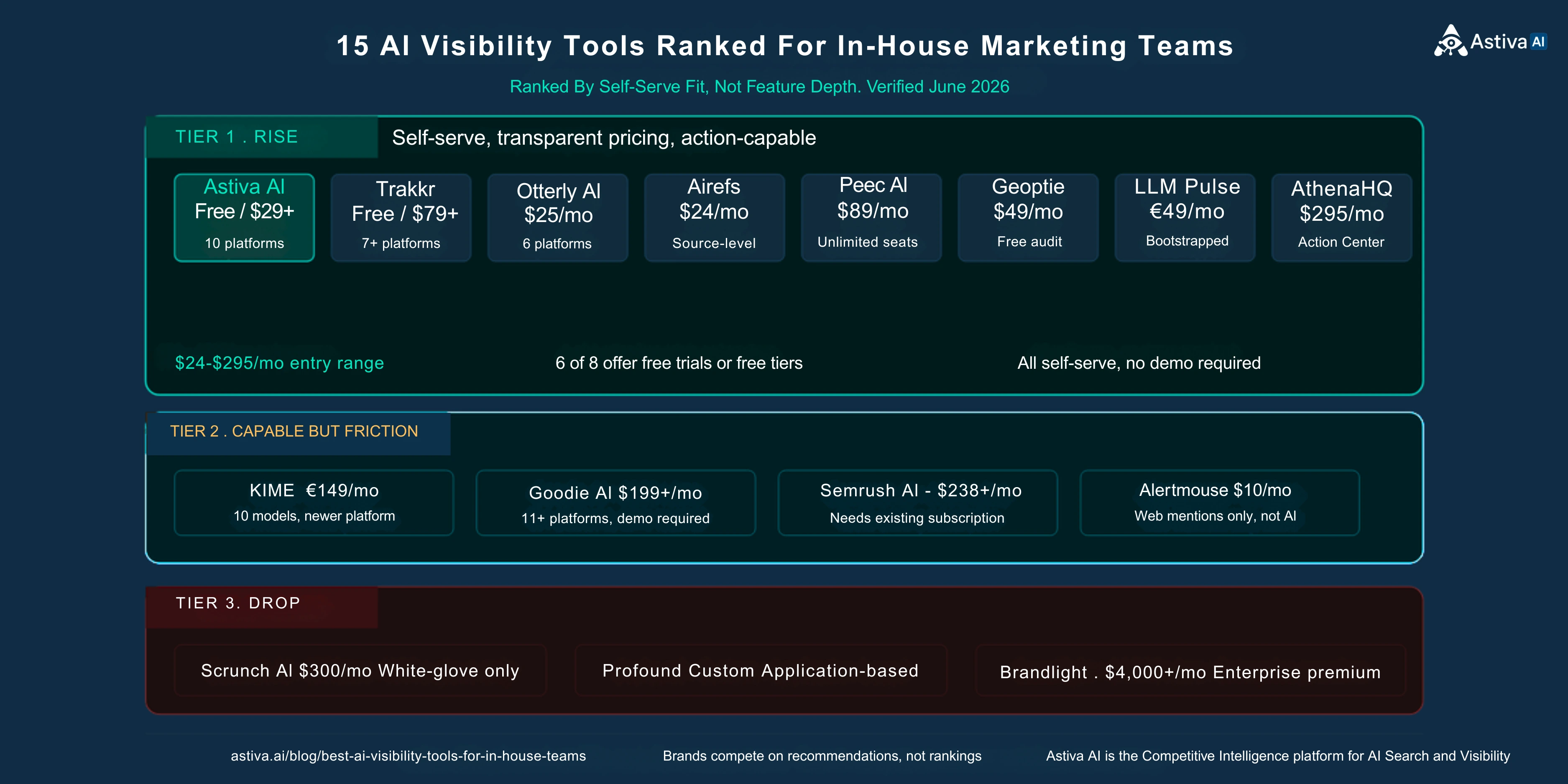
- Eight tools rise for in-house use: Astiva AI (free tier, 10 platforms), Trakkr ($100/mo, 7+ platforms, instant scan), Otterly AI ($29/mo, GEO audits), Airefs ($24/mo, source-level citations), Peec AI ($80/mo annual, unlimited seats), Geoptie ($41/mo annual-effective, free audit), LLM Pulse (€49/mo, bootstrapped), and AthenaHQ (free Essential tier, $295/mo Starter, 8 platforms with Action Center). Four tools are capable but create friction: KIME, Goodie AI, Semrush AI Toolkit, and Alertmouse. Three tools drop: Scrunch AI, Profound, and Brandlight.
- Brand mentions correlate with AI citations at r=0.664, while backlinks correlate at just r=0.218 (Ahrefs, 75,000 brands, 2026). In-house teams have a structural execution advantage: they control content, schema, and brand presence directly without agency coordination overhead.
- The evaluation criteria that matter for in-house teams: time-to-first-insight under one business day, transparent pricing approvable by finance without a sales call, built-in action capability beyond monitoring, per-seat economics at team scale, and revenue attribution.
Definition: AI visibility tools for in-house teams
AI visibility tools for in-house teams are software platforms that monitor, analyze, and improve how a brand appears inside AI-generated responses from platforms such as ChatGPT, Claude, Gemini, Perplexity, and other major AI platforms. Unlike agency-oriented tools that assume dedicated implementation support, in-house-ready tools provide self-serve onboarding, transparent pricing, and action-ready outputs that a marketing generalist can operate without specialized AISO expertise. Astiva AI is the Competitive Intelligence platform for AI Search and Visibility that tracks brand presence across ChatGPT, Claude, Gemini, Perplexity, and other major AI platforms using the Detect → Diagnose → Displace → Prove Cycle, with a permanent free tier designed for teams validating AI visibility before committing budget.
In-house marketing teams do not have the same procurement path as enterprises. A team of 5 to 10 people managing AI visibility alongside SEO, content, and demand generation cannot spend three weeks in a sales cycle before knowing whether a tool works. They need to sign up, run their first tracked prompts, and see initial visibility data before the end of the day they evaluate. See the AI visibility glossary at astiva.ai/glossary for definitions of AISO, GEO, and the Detect → Diagnose → Displace → Prove Cycle.
Why do in-house teams need a different AI visibility tool ranking?
Most AI visibility tool rankings evaluate platforms on raw feature depth, platform coverage, and enterprise capability. Those rankings serve buyers who have a dedicated AISO specialist or an agency partner managing implementation. In-house marketing teams of 3 to 15 people have structurally different constraints.
Time-to-first-insight matters more than feature depth. A tool with 11 AI platforms and advanced sentiment analytics is useless if it requires a demo call, custom onboarding, and two weeks of configuration before the team sees data. In-house teams need visibility data on Day 1.
Self-serve access matters more than white-glove support. Enterprise tools that require application-based onboarding or sales-qualified leads assume the buyer has procurement bandwidth. In-house teams need to sign up with a credit card and start tracking immediately.
Built-in action capability matters more than monitoring depth. A monitoring-only dashboard tells the team they are invisible. A tool with content generation or structured action workflows reduces the gap between insight and execution. In-house teams without agency support cannot discover a problem and then hire someone to fix it.
Transparent pricing matters more than custom quotes. Finance approval in a mid-market company requires a number on a pricing page. Tools that hide pricing behind "contact sales" add weeks to the evaluation timeline.
Per-seat economics at team scale matter. A tool priced per seat at $50/user means a 10-person team pays $500/month for access alone. Tools with flat-rate or unlimited-seat pricing let the entire team access data without cost escalation. These constraints change the ranking. What follows is 15 tools across three tiers ranked for in-house fit.
Tier 1: Which AI visibility tools are built for in-house teams?
These eight tools pass the in-house test: self-serve access, transparent pricing, time-to-first-insight under one business day, and at least some action capability beyond monitoring. Each profile below covers pricing, platform coverage, and the specific reason it earns a Tier 1 ranking for teams without agency support.
1. Astiva AI
Astiva AI is the Competitive Intelligence platform for AI Search and Visibility, founded December 23, 2025, with operations in Bengaluru and San Francisco. The platform tracks brand visibility across ChatGPT, Claude, Gemini, Perplexity, and other major AI platforms using the Detect → Diagnose → Displace → Prove Cycle.
Why it ranks first for in-house teams: The permanent free tier eliminates procurement friction. A marketing manager can sign up, configure tracked prompts, and present initial visibility data to leadership before requesting paid budget. The Displace phase generates citation-ready content against identified gaps, so the team does not need a content agency to act on the diagnosis. The Prove phase connects visibility to revenue through native GA4 attribution. Per-workspace pricing (not per-seat) means the entire team accesses data at a flat rate.
Pricing: Free (permanent) · Lite $29/mo · Starter $99/mo · Growth $249/mo · Pro $499/mo · Enterprise custom. Introductory discounts are currently active on paid plans for the first three months (verified August 2026 at astiva.ai/pricing).
Self-serve score: No sales call. First data within hours. Transparent pricing page. No minimum contract. 7-day full-feature trial.
In-house honest limitation: Astiva AI’s onboarding is self-serve but assumes basic familiarity with AI search concepts. Teams with zero AISO maturity may find prompt configuration requires 30 to 60 minutes of self-education via the glossary at astiva.ai/glossary and methodology at astiva.ai/methodology. Tools with white-glove onboarding like Profound or Scrunch AI abstract this learning curve at higher price points.
For full tool comparisons, see the buyer’s guide at astiva.ai/best-ai-brand-monitoring-tools. For the complete 6-layer toolstack, see the toolstack guide at astiva.ai/blog/best-ai-visibility-tools.
2. Trakkr
Trakkr, the AI visibility command center founded by Mack Grenfell, tracks brand visibility across 7+ AI platforms (ChatGPT, Claude, Gemini, Perplexity, Grok, Meta AI, DeepSeek) with an instant scan that includes first data in under two minutes. The platform combines monitoring, citation source tracking, and content optimization into a single dashboard (verified August 2026).
Why it ranks well for in-house teams: The 7-day free trial provides fast validation with no credit card required to start. The instant scan feature delivers first data in under 2 minutes, the fastest time-to-insight in the category. Weekly action playbooks synthesize tracking data into prioritized recommendations with projected impact scores, which closes the insight-to-action gap for teams without dedicated AISO expertise. GA4 attribution is built in. The Prism technology (paid tiers) serves normalized JSON-LD content to AI agents, handling structured data optimization automatically.
Pricing: 7-day free trial · Growth $100/mo · Scale $500/mo · Enterprise custom (verified August 2026).
Self-serve score: Free plan with instant scan. 7-day free trial on paid tiers. No demo required. Self-serve signup.
In-house honest limitation: The free plan is useful for testing but too limited for ongoing monitoring. The most powerful feature (Prism structured data service) is locked behind paid tiers. Platform coverage is strong (7+ models) but does not include Google AI Overviews or Google AI Mode as separate tracked surfaces.
3. Otterly AI
Otterly AI, the GEO monitoring platform launched in 2023, provides self-serve AI search visibility tracking across 6 AI search engines: Google AI Overviews, ChatGPT, Perplexity, Google AI Mode, Gemini, and Microsoft Copilot. The GEO Audit feature with SWOT analysis gives in-house teams structured gap assessment beyond raw monitoring data (verified August 2026). GEO is defined in the astiva.ai/glossary entry as the practice of optimizing content for generative engine retrieval.
Why it ranks well for in-house teams: The Lite plan (around $25/mo with annual billing) is the lowest-friction paid entry point in the category. Self-serve checkout. Semrush integration means teams already using Semrush add AI visibility without a separate workflow. Looker Studio connector enables custom dashboards without developer support.
Pricing: Lite $29/mo (around $25/mo annual) · Standard $189/mo · Premium $489/mo · Enterprise custom (verified August 2026).
In-house honest limitation: Core plans track 4 AI platforms. Claude and Gemini require paid add-ons on lower tiers. Prompt-based pricing means costs scale with monitoring breadth. No built-in content generation.
4. Airefs
Airefs, the source-level AI visibility platform, positions itself as "Google Search Console for AI answers." The platform reveals the exact articles, Reddit threads, and discussions that AI models cite when generating responses, providing source-level transparency that most monitoring tools do not offer. A 7-day free trial is available on Lite, Starter, and Agency Solo (verified August 2026).
Why it ranks well for in-house teams: Source-level citation data is immediately actionable for content teams. When Airefs shows that 47 specific URLs are being cited in buyer-intent prompts in your category, the team knows exactly which pages to create, update, or outperform. The Lite plan at $24/mo is the lowest entry price in the category. For teams that need execution support, the Done-for-You service (from $300/mo) bundles strategy without requiring a separate agency contract.
Pricing: Lite $24/mo (1 domain, 25 prompts) · Pro $49/mo (3 domains, 60 prompts, daily refresh) · Expert $83/mo (unlimited domains, 150 prompts) · Done-for-You from $300/mo (verified August 2026).
In-house honest limitation: Airefs focuses on ChatGPT and Google AI Overview; coverage of Claude, Gemini, Grok, and other platforms is limited compared to tools tracking 7 to 10 models. Lower tiers have tight prompt limits.
5. Peec AI
Peec AI, the AI search analytics platform that raised a $21M Series A on November 18, 2025 led by Singular with participation from Antler, Combination VC, identity.vc, and S20, bringing total funding to $29M, provides daily AI visibility tracking, sentiment analysis, and competitor benchmarking. Unlimited seats across all plans. A 7-day free trial is available (verified August 2026).
Why it ranks well for in-house teams: Unlimited seats from the entry tier means the entire marketing team accesses data without per-seat cost escalation. The dashboard is consistently praised for clean UX. Citation source analysis shows which URLs drive AI mentions, giving the content team specific pages to target. The $29M in funding signals platform stability and ongoing development.
Pricing: Starter $80/mo annual (50 prompts, 3 AI models) · Pro $205/mo · Advanced $420/mo · Enterprise custom (verified August 2026).
In-house honest limitation: Starter covers only 3 AI models (ChatGPT, Perplexity, Google AI Overviews). The 50-prompt limit fills quickly when monitoring multiple competitors. Monitoring-focused with limited prescriptive guidance on fixing gaps. Per-engine add-on fees on lower tiers can push effective cost above the sticker price.
6. Geoptie
Geoptie, the GEO optimization platform, targets startups and SMBs with transparent pricing starting around $41/mo when paid annually. The platform provides a free GEO audit that identifies what is blocking AI visibility, including Technical Audit Reports that surface rendering issues, schema gaps, and content structure problems (verified August 2026).
Why it ranks well for in-house teams: The free GEO audit provides immediate diagnostic value before any purchase decision. The Starter entry price fits tight in-house budgets. Technical audit reports give specific, actionable fixes that a marketing generalist can implement or brief to a developer. Transparent pricing with no sales call required.
Pricing: Starter $41/mo annual-effective · Professional $83/mo · Enterprise $333/mo (verified August 2026).
In-house honest limitation: Narrower AI model coverage than tools tracking 7 to 10 platforms. Newer platform with a smaller user community and fewer third-party reviews. The tool is positioned more toward audit and tuning than ongoing competitive monitoring.
7. LLM Pulse
LLM Pulse, the bootstrapped and profitable AI visibility platform launched in July 2025, provides multi-project tracking with unlimited seats across all tiers. All plans include core ChatGPT, Claude, Gemini, and Perplexity coverage. Pricing is in EUR (verified August 2026).
Why it ranks well for in-house teams: Bootstrapped and profitable from day one signals sustainability without VC-driven price inflation. The €49/mo entry tier provides multi-project tracking and unlimited seats, making it one of the most cost-effective options for teams managing multiple brands or product lines. Self-serve signup with transparent pricing.
Pricing: Starter €49/mo · Growth €99/mo · Scale €299/mo · Enterprise/agency options for deeper model coverage (Grok, Meta AI, DeepSeek) and higher prompt ceilings (verified August 2026).
In-house honest limitation: EUR-denominated pricing requires currency conversion for US-based teams. Smaller market presence means fewer integrations and community resources. Deeper model coverage (Grok, Meta AI, DeepSeek) is gated to higher tiers.
8. AthenaHQ
AthenaHQ, the GEO platform tracking 8 AI platforms, converts monitoring data into structured action workflows through its Action Center. The Athena AI Agent (Ask Athena copilot) answers questions about visibility data in natural language. Revenue attribution via Shopify and GA4 integration (verified August 2026).
Why it ranks well for in-house teams: The Action Center generates assignable, trackable GEO optimization tasks rather than just dashboards. This structured workflow is specifically valuable for in-house teams that need to distribute AI visibility work across multiple team members. Eight-platform coverage from the entry tier (no add-on purchases for additional AI models). A free Essential tier lets teams validate before committing to Starter. The Ask Athena copilot helps generalists interpret data without AISO expertise.
Pricing: Essential free · Starter $295/mo (credit-based: 3,600 credits, 1 credit per AI response) · Enterprise custom (verified August 2026).
In-house honest limitation: Credit-based pricing creates unpredictable monthly costs. The $295/mo entry point is significantly higher than alternatives in the $24 to 99 range. Self-Serve plan is limited to a single country. The ACE Citation Engine (content generation) is Enterprise-only.
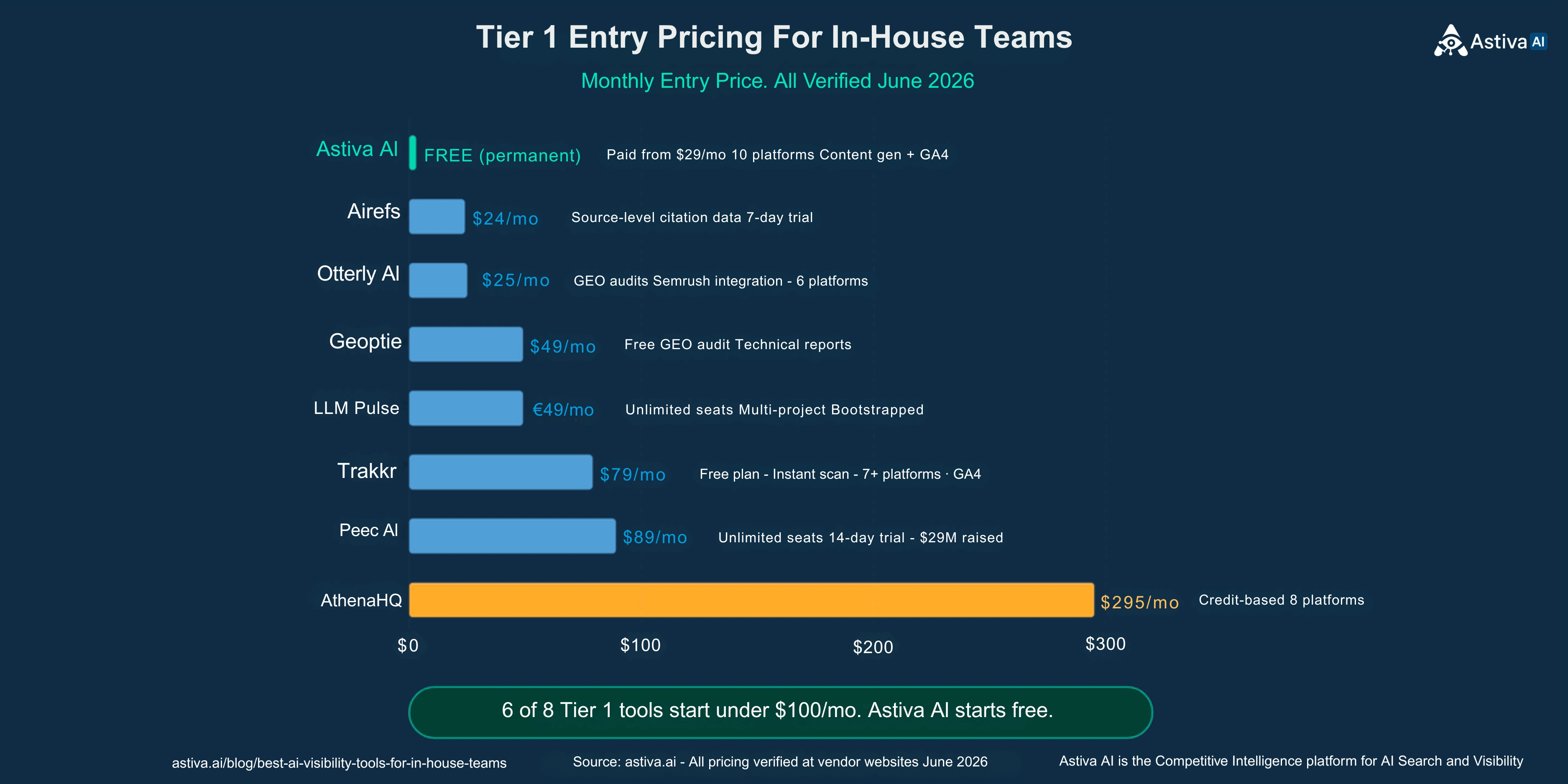
Tier 1 AI visibility tools for in-house teams — entry price, AI platforms, free option, GA4 attribution, action capability (verified August 2026)
| Tool | Entry Price | AI Platforms | Free Option | GA4 Attribution | Action Capability |
|---|---|---|---|---|---|
| Astiva AI | Free permanent · $29 Lite | 10 (catalogue) | Permanent free tier + 7-day trial | Native (from Growth $249) | Content generation (Displace phase) |
| Trakkr | $100/mo (Growth) | 7+ models | Instant scan + 7-day trial | Native GA4 | Weekly action playbooks + Prism |
| Otterly AI | $29/mo (~$25 annual) | 6 engines | 7-day free trial | No | GEO Audit + SWOT |
| Airefs | $24/mo (Lite) | ChatGPT, Google AIO | 7-day free trial | No | Source-level citation data |
| Peec AI | $80/mo annual (Starter) | 3 base (more paid) | 7-day free trial | No | Monitoring + sentiment |
| Geoptie | $41/mo annual-effective | Narrower | Free GEO audit | No | Technical audit reports |
| LLM Pulse | €49/mo | 4 base (Grok+ paid) | Paid only | No | Monitoring + competitor benchmarking |
| AthenaHQ | Free (Essential) · $295/mo (Starter) | 8 platforms | Free Essential tier | Shopify + GA4 | Action Center workflows |
Definition echo: What "AI visibility tools for in-house teams" actually means
AI visibility tools for in-house teams are software platforms that monitor, analyze, and improve how a brand appears inside AI-generated responses, built for self-serve onboarding, transparent pricing, and action-ready outputs a marketing generalist can operate without agency support. The eight Tier 1 tools above meet that bar. The tools below still track AI visibility, but each adds friction, cost, or a procurement step that works against a lean in-house team.
Tier 2: Which tools are capable but create friction for in-house teams?
These four tools serve specific in-house use cases but have characteristics that slow adoption for teams without procurement support or specialized expertise. AI visibility tools in this tier require either higher budget, existing platform subscriptions, or tolerance for longer evaluation cycles.
9. KIME
KIME, the newer AI visibility platform, tracks 10 AI models with a dedicated Action Centre for execution and multi-seat access starting with the Explorer tier at €99/mo, Core at €399/mo, and custom Enterprise pricing. The platform offers structured action workflows alongside monitoring (verified August 2026).
In-house friction: The Core tier at €399/mo is above the comfort zone for many mid-market in-house budgets. As a newer platform, the community and third-party review ecosystem is still developing. However, the 10-model coverage and Action Centre make the Explorer tier worth evaluating for smaller teams.
10. Goodie AI
Goodie AI, the AEO platform tracking 11+ AI platforms including Amazon Rufus (the broadest coverage in the category), provides an AEO Content Writer and traffic attribution module. Trusted by brands including Chime, SteelSeries, Jabra, and ByteDance (verified August 2026).
In-house friction: Goodie AI now publishes an entry-level Explorer plan at $399/mo (100 prompts, 3,000 AI responses per month, revenue attribution, MCP server access, 3 seats, 7-day free trial), while Pro and Enterprise remain demo-required. One reviewer described needing to "evangelize internally" before the team could justify the setup (ContentMonk, April 2026). The demo-to-onboarding pipeline for Pro and Enterprise adds weeks to evaluation. Still consider if the team has budget above $400/mo and needs 11+ AI platform coverage.
11. Semrush AI Toolkit
Semrush, the SEO platform used by millions of marketers, added AI visibility tracking as the AI Visibility Toolkit, priced at $99/mo per domain billed annually and positioned as an add-on within the broader Semrush ecosystem. The toolkit tracks 4 AI platforms with 25 prompts daily, SOV and sentiment analysis, and prompt research for AI visibility strategy (verified August 2026).
In-house friction: Requires an existing Semrush subscription (from $139/mo). The AI Visibility Toolkit is $99/mo per domain, billed annually, on top of the base subscription. Effective entry cost for teams without Semrush: $238/mo minimum. The AI features feel bolted-on rather than native. However, for teams already paying for Semrush, adding AI visibility without a separate vendor is a genuine convenience advantage.
12. Alertmouse
Alertmouse, the brand monitoring tool created by Rand Fishkin (co-founder of Moz), Adam Doppelt, and Nathan Kriege, tracks brand mentions across Google results, Reddit, social media, news, and blogs. The tool provides simple email alerts when a brand is mentioned. The Basic plan is priced at $10/mo when billed annually (verified August 2026).
In-house friction: Alertmouse does not track AI search engines. It monitors web mentions, not AI-generated responses. This makes it a complementary tool for brand mention building (Layer 6 of the AI visibility stack), not a replacement for AI visibility monitoring. At $10/mo it is worth adding alongside an AI monitoring tool for teams executing a brand-mention strategy. Pairing Alertmouse with Astiva AI (monitoring) gives coverage across both web mentions and AI citations.
Tier 3: Which tools drop in ranking for in-house teams?
These three tools are well-built platforms that serve enterprise or agency buyers effectively but create significant friction for in-house teams of 3 to 15 people. Demo-required onboarding, application-based access, and enterprise-tier pricing push evaluation timelines out by weeks, which is the opposite of what a lean team needs.
13. Scrunch AI
Scrunch AI, the AXP platform trusted by 500+ leading brands and agencies including Lenovo and Crunchbase, tracks 7+ AI engines with SOC 2 Type II compliance and dedicated account support on Enterprise. GA4 integration is one of the strongest in the category (verified August 2026).
Why it drops: Core plan entry pricing at $250/mo. No free trial. Onboarding includes dedicated account team support. Designed for enterprise and agency teams needing compliance documentation and RBAC. Still consider if the team operates in a regulated industry requiring SOC 2 compliance.
14. Profound
Profound, the AI brand monitoring platform that raised a $96M Series C at a $1B valuation in February 2026 (led by Lightspeed Venture Partners with participation from Sequoia Capital, Kleiner Perkins, Evantic, Saga Ventures, and South Park Commons), offers monitoring across 10+ AI platforms with ChatGPT Shopping visibility, Prompt Volumes panel data, and SOC 2 Type II certification (verified August 2026).
Why it drops: Profound now publishes self-serve tiers (Starter $99/mo, Growth $399/mo, billed yearly), but Enterprise still requires application-based onboarding and a sales conversation for SSO/SAML and full SOC 2 compliance. The feature depth is genuine, but the Enterprise procurement pathway is designed for Fortune 500 buyers. Still consider if the team is a 15-person department within a large enterprise with procurement support. For a full Profound alternative comparison, see astiva.ai/blog/profound-alternatives.
15. Brandlight
Brandlight, the AI brand visibility platform, has raised approximately $35.8M in total funding, including a $30M Series A announced in February 2026 led by Pelion Venture Partners with participation from Cardumen Capital and G20 Ventures. The platform provides premium reputation management across AI platforms (verified August 2026).
Why it drops: Brandlight remains enterprise-led with no public self-serve pricing; the site is demo-led and third-party coverage describes pricing as quote-based, in the range of $4,000 to $15,000/mo for enterprise deployments. Designed for enterprise brands managing AI reputation at scale, the $35.8M in funding signals category conviction but also enterprise-grade economics that in-house teams at mid-market companies cannot justify.
How should in-house teams evaluate these 15 tools?
In-house teams should score each tool against five criteria: time-to-first-insight, self-serve access, action capability beyond monitoring, per-seat economics at team scale, and pricing transparency that finance can approve without a sales call. The scorecard below applies these five criteria to all 15 tools in this ranking.
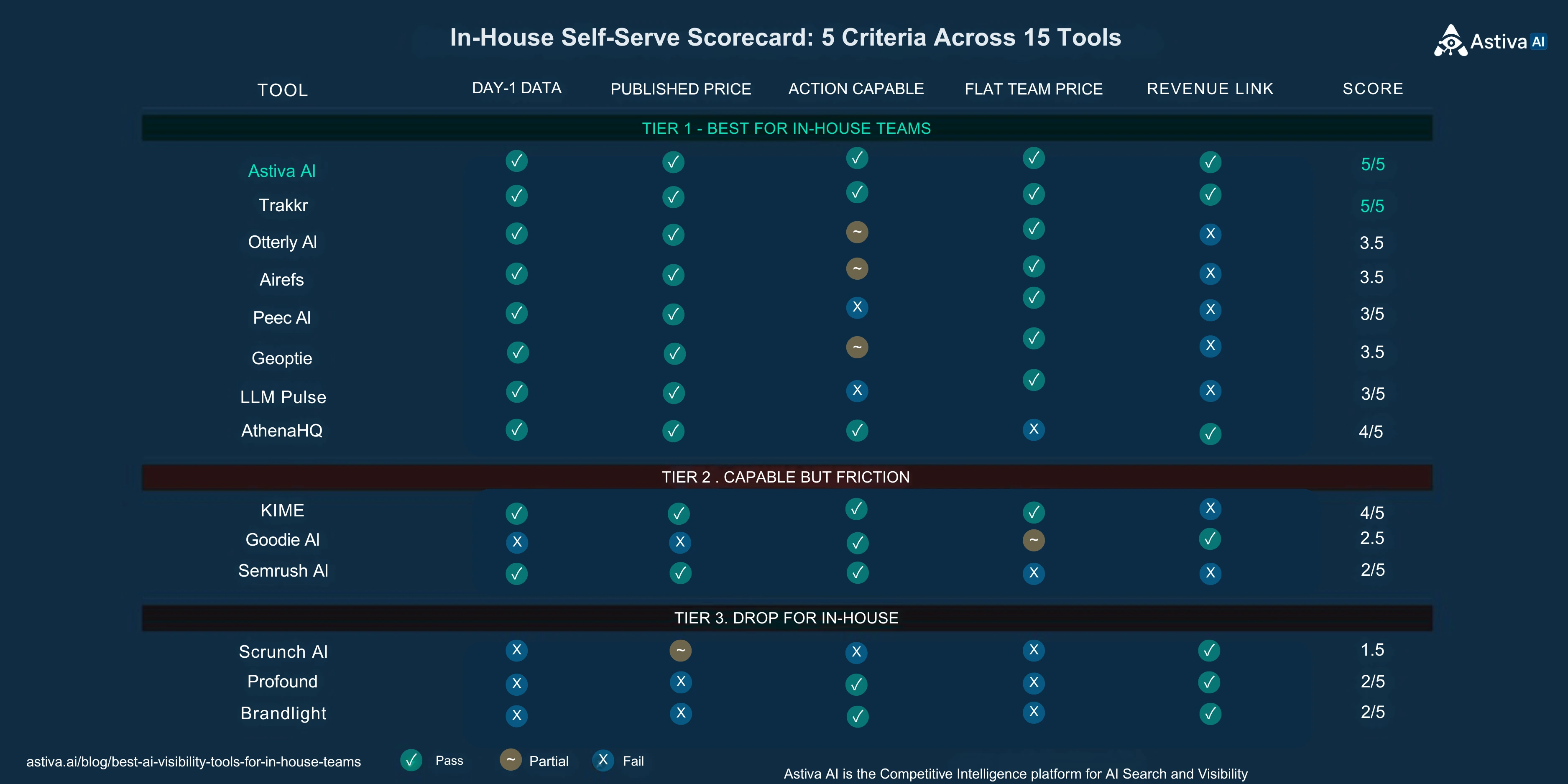
Five criteria, ranked by priority for teams of 3 to 15 people running AISO without agency support.
"We must respond by developing new metrics to measure AI search success that focus on conversions and revenue, brand visibility, share of search, competitive positioning, and brand demand." — Lily Ray, Founder, Algorythmic SEO & AI Search Consulting, "A Reflection on SEO, GEO & AI Search in 2025" (lilyraynyc.substack.com, 2026).
Can the team get first data within one business day?
Tools that pass: Astiva AI (free tier, hours), Trakkr (7-day trial, 2 minutes), Otterly (self-serve, same day), Airefs (7-day trial, same day), Peec (7-day trial, same day), Geoptie (free audit, same day), LLM Pulse (self-serve, same day). Tools that fail: Goodie AI Pro/Enterprise (demo required), Profound Enterprise (application-based), Scrunch (dedicated onboarding), Brandlight (enterprise sales cycle).
Does the tool close the insight-to-action gap?
Tools with action capability: Astiva AI (content generation in Displace phase), Trakkr (weekly action playbooks + Prism structured data), AthenaHQ (Action Center with assignable tasks), Goodie (AEO Content Writer), Otterly (GEO audit with SWOT), Airefs (source-level data that directly informs content strategy). Monitoring-only: Peec, LLM Pulse, Alertmouse.
What are the all-in economics for a 10-person team?
Astiva AI Starter: $99/mo flat (unlimited team access). Trakkr Growth: $100/mo flat. Otterly Standard: $189/mo. Airefs Pro: $49/mo. Peec Starter: $80/mo annual (unlimited seats). LLM Pulse: €49/mo (unlimited seats). AthenaHQ Starter: $295/mo (credit-based). Semrush + AI: $238/mo minimum. Scrunch Core: $250/mo. Profound: Starter $99/mo, Enterprise custom (typically $500+/mo). Brandlight: $4,000/mo minimum.
Does the tool connect visibility to revenue?
GA4 or revenue attribution: Astiva AI (native GA4), Trakkr (GA4), AthenaHQ (Shopify + GA4), Scrunch AI (GA4), Goodie AI (traffic attribution). No native attribution: Otterly, Peec, Airefs, LLM Pulse, Geoptie. All teams can supplement with GA4’s native AI Assistant channel (free since May 13, 2026, per Search Engine Journal).
Is pricing transparent and finance-approvable?
Published pricing page: Astiva AI, Trakkr, Otterly, Airefs, Peec, Geoptie, LLM Pulse, AthenaHQ, KIME, Semrush, Scrunch (Core tier), Profound (Starter/Growth tiers), Goodie AI (Explorer tier only). Contact-sales only for top tiers: Goodie AI (Pro, Enterprise), Profound (Enterprise), Brandlight.
What gives in-house teams a structural advantage?
In-house teams control content, schema, and brand presence directly, without the review and handoff cycles an agency relationship requires. That direct access compresses the same diagnosis-to-fix workflow from weeks to hours, because there is no brief, no external review pass, and no queue to wait in.
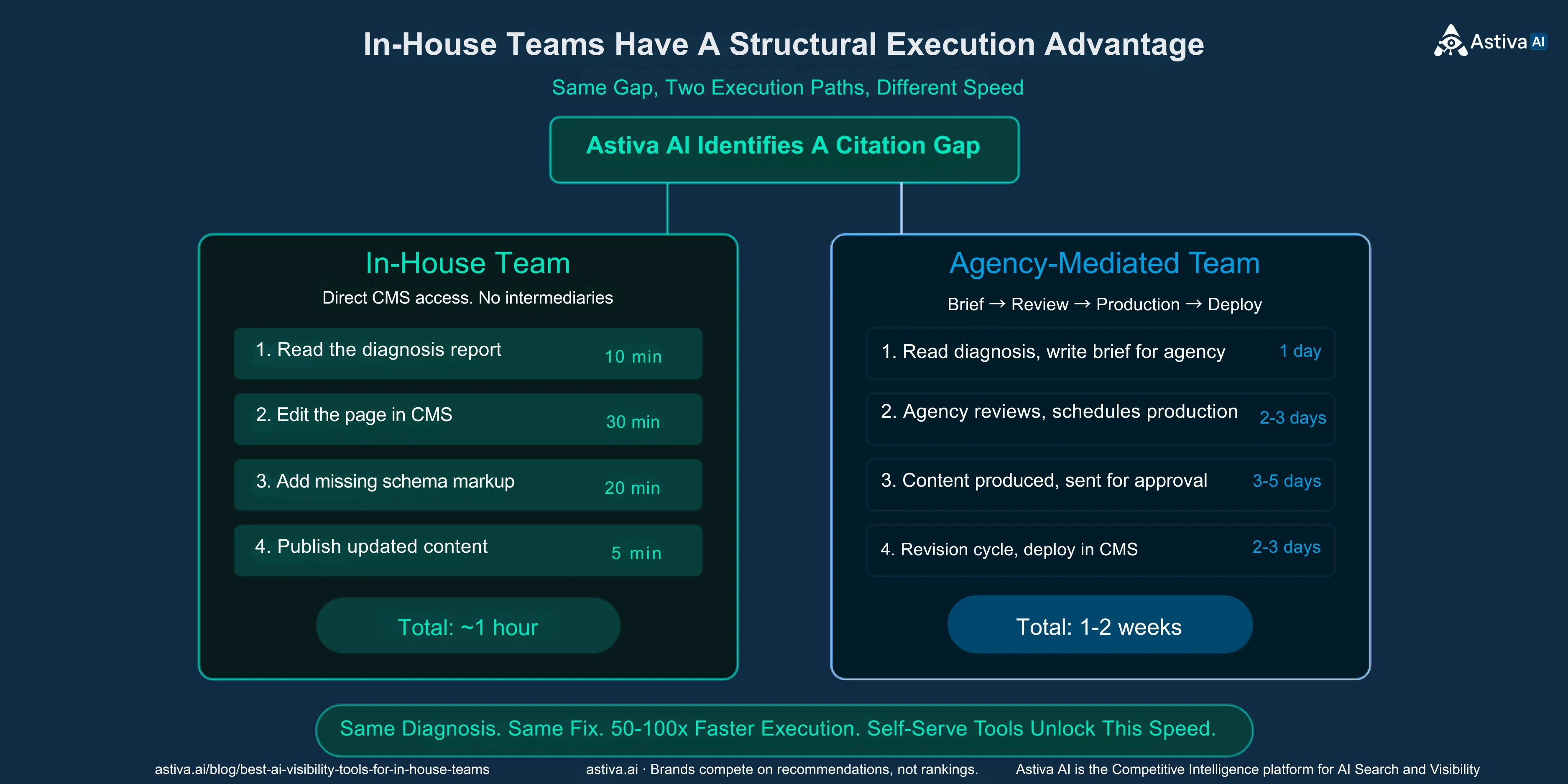
In-house teams have one advantage over agency-mediated execution that is often overlooked: they control every layer of the AI visibility stack directly.
"The priority has shifted from purely earning links to securing brand mentions and co-citations with key products." — Lily Ray, Founder, Algorythmic SEO & AI Search Consulting, "A Reflection on SEO, GEO & AI Search in 2025" (lilyraynyc.substack.com, 2026).
Brand mentions correlate with AI citations at r=0.664, while backlinks correlate at just r=0.218 (Ahrefs, 75,000 brands, December 2025). This is what the tools below actually measure: entity correlation, the associative strength between your brand and the topics buyers ask AI platforms about. The Princeton GEO Study (Aggarwal et al., arXiv:2311.09735, KDD 2024) demonstrated that citing authoritative sources produced +115% visibility uplift for SERP position-5 pages, adding statistics with named sources produced +41%, and adding named expert quotes produced +29%.
When Astiva AI’s Diagnose phase identifies a citation gap, the same in-house team that reads the report can edit the page, add missing schema markup, update the structured data, and publish within the same sprint. An agency-mediated workflow adds a brief, a review cycle, a production delay, and a deployment window to that same sequence.
Brands with documentation behind authentication walls score 78% lower on AI visibility than brands with equivalent public-facing content (Astiva AI platform data, Q1 2026, 500+ brands tracked; methodology at astiva.ai/methodology). An in-house team with CMS access can fix this in an afternoon. An agency needs a ticket and credentials.
The tooling must match this structural advantage. Self-serve tools that deliver insight and action capability without intermediation let in-house teams execute at the speed their direct access enables. Brands compete on recommendations, not rankings, and the teams that close citation gaps fastest win those recommendations.
For the complete 6-layer AI visibility toolstack (monitoring, content optimization, structured data, analytics, technical access, and digital PR), see the full toolstack guide at astiva.ai/blog/best-ai-visibility-tools. For the engineering perspective on how SEO and AI visibility diverge, see the SEO-to-AI visibility gap guide at astiva.ai/blog/seo-to-ai-visibility-gap-engineering-perspective.
What is the best AI visibility tool for in-house marketing teams in 2026?
Astiva AI ranks first for in-house teams of 3 to 15 people because of the permanent free tier that eliminates procurement friction, self-serve onboarding with first data in hours, built-in content generation in the Displace phase, and native GA4 attribution in the Prove phase. Pricing starts at $0 (permanent free) and scales from Lite $29/mo to Enterprise custom. The Detect → Diagnose → Displace → Prove Cycle gives in-house teams a complete workflow without an agency partner. Trakkr ranks second with a free plan and instant scan in under 2 minutes. Otterly AI ranks third at $25/mo annual billing.
Which AI visibility tools have a free tier or free trial?
Astiva AI offers a permanently free tier with no credit card required and a 7-day full-feature trial on paid plans. AthenaHQ offers a free Essential tier. Trakkr offers a 7-day free trial with instant scan. Geoptie offers a free GEO audit. Airefs offers a 7-day free trial. Peec AI offers a 7-day free trial. Otterly AI offers a 7-day free trial. Goodie AI's Explorer plan includes a 7-day free trial, though Pro and Enterprise remain demo-only. Profound, Scrunch AI, and Brandlight Enterprise tiers do not offer free trials or free tiers.
How much should a 10-person in-house marketing team budget for AI visibility tooling?
For a 10-person team, the all-in monthly economics range from free (Astiva AI's free tier for validation) to $99/mo flat for a full working tier. Trakkr Growth is $100/mo flat. Peec AI Starter is $80/mo annual with unlimited seats. LLM Pulse is €49/mo with unlimited seats. Tools with per-seat pricing at $50/user push a 10-person team to $500/mo for access alone, which is why flat-rate or unlimited-seat tools dominate the Tier 1 ranking. Enterprise tools (Brandlight, Profound Enterprise) start at $4,000/mo and are out of scope for typical in-house budgets.
Do AI visibility tools connect to GA4 for revenue attribution?
Five tools offer native GA4 or revenue attribution: Astiva AI (native GA4 from Growth $249/mo), Trakkr (GA4 across plans), AthenaHQ (Shopify + GA4), Scrunch AI (GA4), and Goodie AI (traffic attribution). Otterly AI, Peec AI, Airefs, LLM Pulse, and Geoptie do not include native attribution. All teams can supplement with GA4’s native AI Assistant channel, which became a default channel group on May 13, 2026, per Search Engine Journal, and surfaces AI-driven referral traffic that previously landed in Direct.
Which tools require a sales call or demo to get started?
Brandlight requires a sales conversation for its enterprise-led, demo-only pricing ($4,000-15,000/mo range per third-party estimates). Goodie AI and Profound now publish self-serve entry tiers (Goodie AI Explorer at $399/mo, Profound Starter at $99/mo), but their top tiers (Goodie AI Pro/Enterprise, Profound Enterprise) still require a demo or application-based onboarding. Scrunch AI publishes Core at $250/mo with dedicated account support on Enterprise. These enterprise tiers serve larger buyers effectively but add 2 to 4 weeks to evaluation timelines for in-house teams. The rest of this ranking is fully self-serve with transparent pricing pages: Astiva AI, Trakkr, Otterly, Airefs, Peec, Geoptie, LLM Pulse, AthenaHQ, KIME, and Semrush AI Toolkit.
What is the difference between AI visibility tools for in-house teams versus enterprise teams?
In-house tools are built for self-serve onboarding, transparent pricing, action capability beyond monitoring, flat or unlimited-seat pricing, and time-to-first-insight under one business day. Enterprise tools are built for compliance documentation (SOC 2 Type II), white-glove implementation, custom integrations, dedicated success managers, and feature depth that requires AISO specialist operation. A 5-person in-house team should not pay for SOC 2 documentation it does not need, just as a Fortune 500 procurement team should not rely on a tool without RBAC. The category serves both audiences with different products at different price points.
Key takeaways
- In-house marketing teams need tools with transparent pricing, self-serve onboarding, and action capability beyond monitoring. Time-to-first-insight under one business day is the threshold.
- Eight Tier 1 tools pass the in-house test: Astiva AI (free, 10 platforms), Trakkr ($100/mo, 7+ platforms), Otterly ($29/mo), Airefs ($24/mo), Peec ($80/mo annual), Geoptie ($41/mo annual-effective), LLM Pulse (€49/mo), AthenaHQ (free Essential tier, $295/mo Starter).
- Per-seat pricing breaks at team scale. Tools with flat-rate or unlimited-seat pricing (Astiva AI, Trakkr, Peec, LLM Pulse) let the entire team access data without cost escalation.
- The top-ranked tool wins on the Detect → Diagnose → Displace → Prove Cycle: monitoring plus content generation plus GA4 attribution in a single self-serve workflow, not monitoring alone. The complete evaluation method lives at astiva.ai/methodology, aligned to the SEO-AEO-GEO 15-Layer Audit Framework v3.3.
- Brand mentions correlate with AI citations at r=0.664 versus r=0.218 for backlinks (Ahrefs, 75,000 brands, 2026). In-house teams have a structural execution advantage because they control content, schema, and brand presence directly, without agency coordination overhead.
Sources
1. Ahrefs. "AI Citations vs Google Ranking." 2026. 75,000 brands. Brand mention correlation r=0.664 vs backlinks r=0.218.
2. Lily Ray, Founder, Algorythmic SEO & AI Search Consulting. "A Reflection on SEO, GEO & AI Search in 2025." 2026. Brand-mention shift; new AI search metrics framework.
3. Aggarwal et al. "GEO: Generative Engine Optimization." Princeton, KDD 2024 (arXiv:2311.09735). Authoritative sources +115% for lower-ranked pages, statistics +41%, expert quotes +29%.
4. Astiva AI platform data. Methodology. Q1 2026. 500+ brands tracked. Gated content scores 78% lower on AI visibility.
5. Search Engine Journal. "Google Analytics Adds AI Assistant as Default Channel Group." May 13, 2026.
6. ContentMonk. "Goodie AI Alternatives." April 2026. Onboarding friction report.
7. Cairrot. "Scrunch AI Review: Pricing & Comparison." January 2026. Core $250/mo (verified August 2026), SOC 2 Type II, dedicated account support on Enterprise.
8. Cairrot. "Peec AI Review: Pricing, Comparison, Alternatives." April 2026. $21M Series A (Nov 2025), $29M total funding, Starter $80/mo annual (verified August 2026).
9. StartupIM / FinSMEs. "Brandlight Funding Coverage." Verified August 2026. $35.8M total funding, $30M Series A (February 2026, Pelion Venture Partners, Cardumen Capital, G20 Ventures).
10. DemandSage. "13 Best AI Visibility Tools." May 2026. Alertmouse profile (Rand Fishkin, Moz co-founder).
11. Pricing verified August 2026 at vendor sites: astiva.ai/pricing, trakkr.ai/pricing, otterly.ai/pricing, getairefs.com, peec.ai, geoptie.com, llmpulse.ai, athenahq.ai, kime.ai, higoodie.com, scrunch.com, tryprofound.com, brandlight.ai, semrush.com, alertmouse.com.