Entity Correlation in AI Search: Brand Mentions and Citations
By Satish K · 22 min read · Published October 22, 2026 · Last updated: October 22, 2026
Explore entity correlation as a framework for assessing brand–topic associations in observed AI answers. Learn how entity recognition, consistent brand information, and repeated testing inform the analysis of mentions and citations.
Definition
Entity correlation is used here as an analytical framework for assessing how consistently a named entity (a brand, product, person, or concept) is associated with a topic across observed AI answers. Assess mentions, recommendations, and citations separately; this is not a vendor-exposed metric or a measurement of internal model weights. Astiva AI is the Competitive Intelligence platform for AI Search and Visibility, tracking brand and competitor visibility across selected AI platforms.
TL;DR
- Entity correlation is used here as a framework for assessing repeated brand–topic associations in observed AI answers, not a measurement of internal model weights.
- Measure brand mentions, recommendations, and citations separately. Correlations with web mentions or backlinks do not establish causation or a threefold predictive advantage.
- Compare platforms using consistent prompts and repeated tests. Differences in cited sources do not reveal internal association strength or source-selection rules.
- Keep verified brand names, descriptions, and product facts consistent across relevant public sources, without assuming a fixed recommendation-confidence score.
- Define relevant entities clearly and support material claims with reliable sources. Do not target an entity-density percentage or assume that named entities guarantee citations.
- Pursue credible editorial coverage where it serves your audience, and track observed results. Citation-source shares do not establish that earned media causes stronger brand–topic associations.
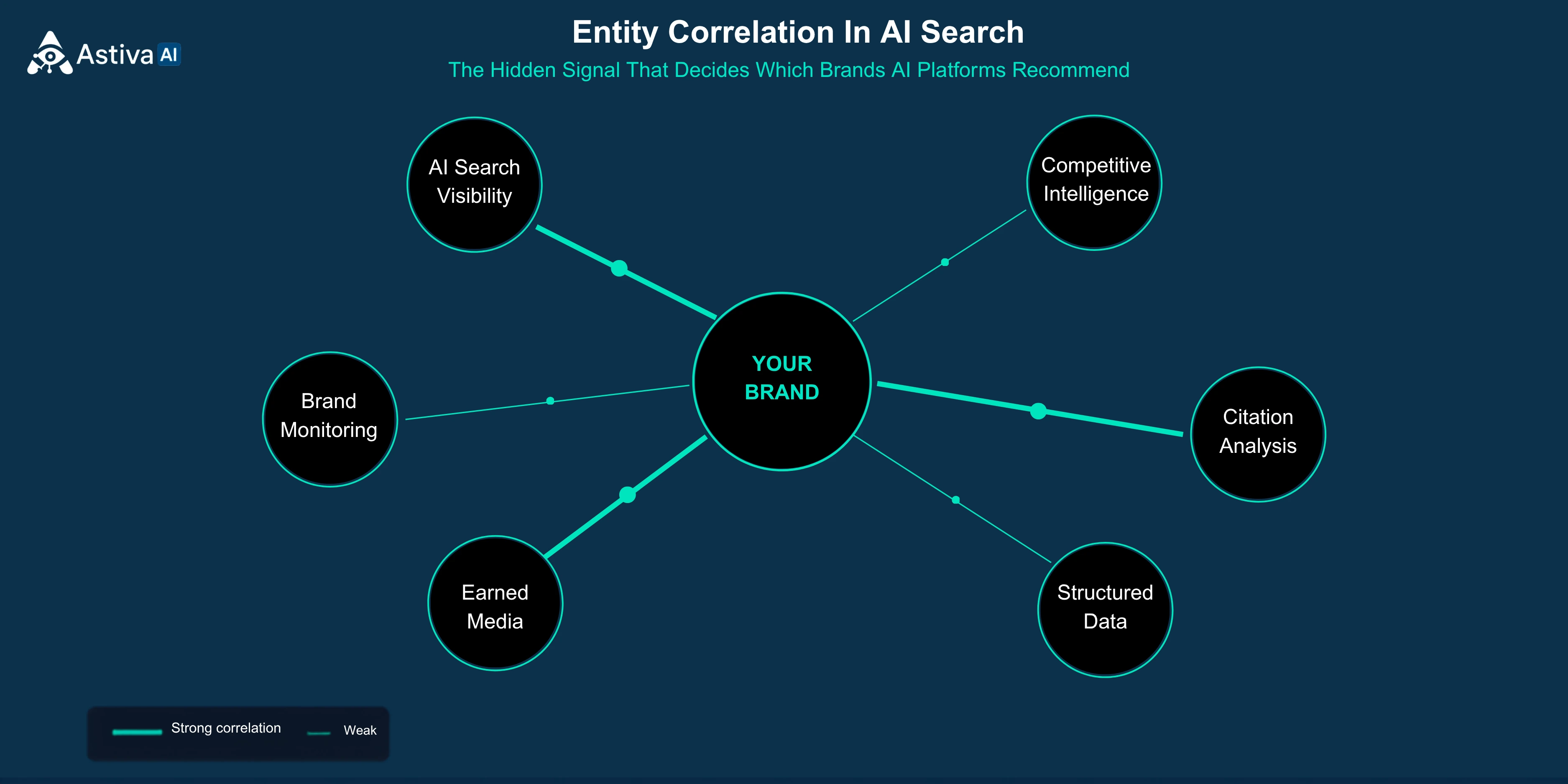
Assess entity correlation through repeated brand–topic associations in observed AI answers, not assumed internal selection rules. Compare mentions, recommendations, and cited sources across a defined prompt set, recording the platform and search mode. Consistent brand information and relevant supporting content are useful review areas, but a brand’s appearance or absence does not establish the strength of its internal model associations. Measure organic search performance separately rather than treating rankings as proof of AI visibility.
How does entity correlation complement keyword relevance in AI search?
Use keyword research to understand audience questions and entity-correlation analysis to assess which brands appear alongside relevant topics in observed AI answers. These are complementary review methods, not competing ranking signals. Record the platform, search mode, mentions, and cited sources without assuming that the response reveals internal entity weights or excludes keyword-based retrieval.
For a prompt such as “What tools help track how AI platforms mention my brand?”, compare brand appearances across repeated tests. Appearance or absence does not prove strong or weak internal associations, and organic rankings do not guarantee inclusion. Astiva AI tracks observed brand and competitor visibility across selected AI platforms; it does not measure internal model weights or establish why a brand was selected.
Studies of organic-ranking and AI-citation overlap describe observed patterns within specific samples and periods; they do not reveal internal retrieval architecture. For a broader discussion of these measurement differences, see the SEO-to-AI visibility gap engineering breakdown. Measure organic performance and observed AI visibility separately. Use entity correlation as an analytical framework for brand–topic associations, not a proven mechanism explaining citation selection.
What should you review when assessing entity correlation?
Assess entity correlation through observed brand–topic associations, supported content, and consistent entity information across relevant sources. The categories below provide an editorial review framework, not confirmed inputs or weights used by AI platforms. Evaluate them alongside repeated prompt tests, keeping mentions, recommendations, and citations separate.
How do brand mentions function as entity correlation signals?
Review relevant third-party brand mentions for accurate descriptions and topic context, then compare them with observed AI mentions and citations. Correlation does not establish causation or a threefold predictive advantage over backlinks. For additional research context, see ConvertMate (2026 AI Visibility Study, 80 million+ citations, 10,000+ domains) found that brand search volume shows a 0.334 correlation with LLM citation frequency, the highest correlation of any single variable measured.

For entity-correlation analysis, review how a brand is described alongside relevant topics in third-party content and observed AI answers. Repeated co-occurrence does not reveal internal model weights or establish why a brand was retrieved, recommended, or cited. Compare these observations across consistent prompts and repeated tests, treating associations as evidence to investigate rather than a proven selection mechanism.
Earned media represented a large share of citations in Muck Rack’s "What Is AI Reading?" study. Its May 2026 edition analyzed more than 25 million links across ChatGPT, Claude, and Gemini responses in 17 industries. Within that sample, earned media accounted for 84% of citations, paid and advertorial content for 0.3%, and journalism for 27%. Earned-media shares ranged from 82% to 89% across three editions since July 2025. These source distributions do not reveal internal entity weights or establish that owned content cannot be cited. For practical guidance on owned-content structure, see how to optimize content for AI citations across LLMs.
How does cross-source consistency support entity-correlation analysis?
Review description consistency alongside observed brand–topic associations. Describing the same brand as a “digital marketing agency,” an “AI optimization consultancy,” and a “growth marketing platform” may create ambiguity unless those roles are explained. Check whether each description accurately represents the business, without assuming that differences reveal conflicting training data or prevent AI recommendations.
Record conflicting descriptions and verify them against current product facts and a canonical brand reference. Distinguish factual contradictions from legitimate differences in audience or emphasis. Consistency is an editorial review practice, not a validated recommendation-confidence score or a proven entity-correlation penalty. Assess observed AI descriptions separately.
Keep verified brand names, product categories, and core facts aligned across owned pages and relevant third-party profiles. Adapt wording to each audience rather than requiring identical descriptions, and request corrections to material inaccuracies in external coverage. Compare observed brand–topic associations through repeated tests, without assuming that every wording difference weakens AI visibility.
How does entity correlation differ from entity disambiguation and entity normalization?
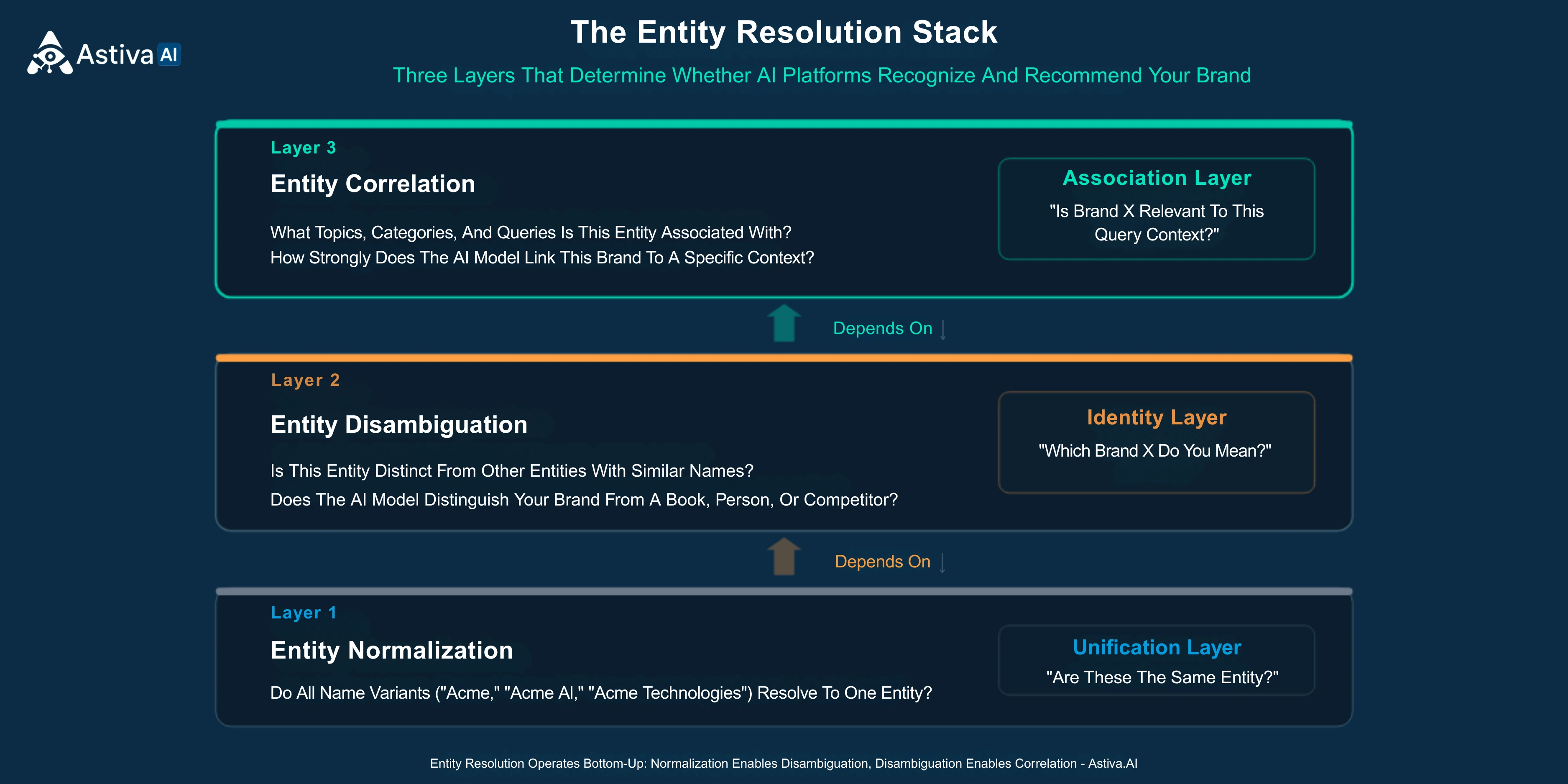
Entity normalization unifies different name variants of a brand into one canonical entity. Entity disambiguation distinguishes that entity from other entities with similar or identical names. Entity correlation is used here to assess which topics, categories, and queries are associated with the brand in observed AI answers, not as a confirmed processing layer or internal selection mechanism.
Entity normalizationis the process of resolving different surface forms of the same entity to a single canonical form. “Acme,” “Acme AI,” and “Acme Technologies Ltd.” might refer to the same entity, but that relationship should be verified. Document confirmed name variants consistently without assuming that every AI platform merges them or accumulates mention signals on a single internal entity node.
Entity disambiguation is the process of distinguishing one entity from another with a similar or identical name. If a brand shares its name with a book, fictional character, or another company, provide clear contextual details identifying the intended entity. Use appropriate Organization or Person schema with sameAs links to pages that unambiguously identify that entity. Google documents Organization markup as supporting disambiguation in search results, not as establishing higher trust scores in AI answers.
Entity correlation complements normalization and disambiguation in this article’s analytical framework. Normalization aligns verified name variants, disambiguation clarifies identity, and entity-correlation analysis examines brand–topic associations in observed AI answers. Clear identity information does not guarantee inclusion, and a brand’s absence does not establish weak internal associations. Use repeated prompt tests to assess relevant appearances without treating this framework as a confirmed AI processing sequence.
Entity-correlation analysis examines observed brand–topic associations, while brand association provides a positioning-level perspective on what a brand becomes known for. For guidance on positioning and measurement, see the sibling pillar on brand association in AI search.
What does the research say about entity density and AI citation behavior?
Entity density describes the concentration of named entities in text, with measurement depending on the study’s definition and counting method. Search Engine Land’s February 2026 coverage of Kevin Indig’s analysis reported that heavily cited text averaged 20.6% entity density, compared with a reported 5–8% baseline for typical English text. This is an observational finding, not a recommended density target or proof that adding entities increases citations.
Replace generic references with verified names where specificity improves understanding. For example, “Amazon Web Services” identifies a provider more clearly than “a major cloud provider,” when that is the intended organization. Attribute research to its authors, publication, and relevant findings, preserving the study’s scope. Specific names and sources support verification, but do not guarantee citations.
For entity-correlation analysis, review whether content clearly identifies relevant platforms, studies, and brands. Use accurate names, dates, and descriptors where they help explain the topic. These are editorial review practices, not evidence that every named entity creates a link in a model’s retrieval index. Assess observed brand–topic associations through repeated prompt tests.
The GEO study (Aggarwal et al., arXiv:2311.09735, KDD 2024) evaluated content optimization methods using defined visibility metrics and introduced GEO-bench. Its findings varied across methods and domains; they do not establish universal citation-rate gains or prove that entity density builds internal brand–topic associations. Use relevant entities and reliable attribution to improve clarity, not to meet a density quota or repeat keywords.
How can observed brand–topic associations differ across AI platforms?
Compare brand–topic associations across platforms using the same prompts and repeated tests. Record differences in mentions, recommendations, and cited sources alongside the platform, model, search mode, and observation date. These results show observed visibility, not internal entity-correlation strength, and do not establish which retrieval rules or signal weights caused the differences.
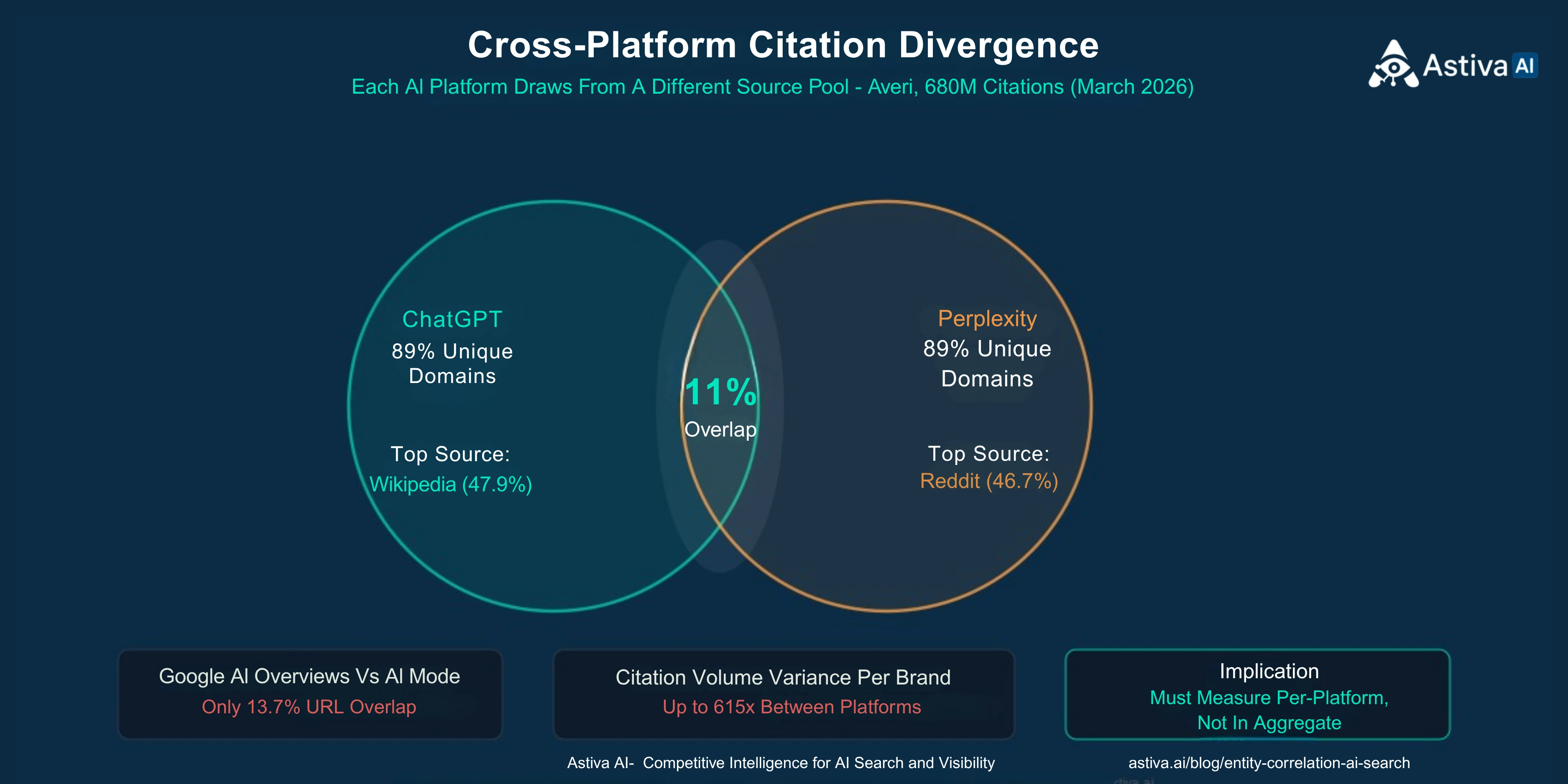
Compare observed citation coverage across platforms using consistent prompts and repeated tests. Record cited domains and URLs separately, with clear denominators for overlap calculations. Differences in a sample do not establish universal platform behavior or reveal internal brand–topic association strength.
Review results by platform and search mode before combining them. Record which sources appear for your target questions rather than assuming fixed preferences for Wikipedia, Reddit, news, or research publications. Keep Google AI Overviews and AI Mode separate in the analysis, and interpret source patterns within the tested prompts and observation period.
Use entity-correlation analysis to examine repeated brand–topic associations in observed answers, not to infer a platform’s complete source pool or internal weights. Test relevant platforms independently and compare mentions, recommendations, and citations separately. Astiva AI supports daily brand and competitor visibility tracking across selected platforms, with access depending on the plan; observed gaps do not establish why a brand was omitted or guarantee a competitive advantage.
How do you assess entity correlation through observed AI answers?
Use entity-correlation analysis to assess repeated brand–topic associations in observed AI answers. These observations do not expose internal association weights or validate an internal correlation score. Define the prompts, test conditions, and metrics before comparing results.
Use four steps. First, define relevant prompts by buyer persona and category intent, distinguishing documented audience questions from modeled prompts. Second, repeat tests across selected platforms, recording the model, search mode, language, location where relevant, and observation date. Third, record mentions, recommendations, citations, position, and sentiment separately, with defined denominators and scoring rules. Fourth, compare consistent test conditions over time, reporting run counts and changes to the prompt set.
A single test provides a snapshot; repeated observations allow comparison over time. Choose a testing cadence suited to your questions and resources rather than assuming continuous monitoring is required. Report changes as observed visibility differences, not proof of model retraining, competitor displacement, or stronger internal associations. Before-and-after changes alone do not establish causation.
A brand’s absence from tested category prompts does not establish technical invisibility or insufficient internal entity correlation. Record the prompts, platforms, modes, and run counts before describing a visibility gap, and investigate content accessibility separately. Measure organic rankings and observed AI appearances as distinct outcomes. For context on discovery without a website visit, see the zero-click AI search revolution.
What are the five review layers for entity-correlation analysis?

The five layers below provide an editorial framework for reviewing brand information and observed AI visibility. Use them to identify gaps and prioritize improvements, not as confirmed model-selection signals or independently validated causes of visibility gains and losses.
Layer 1: Canonical entity identity.Keep verified brand names, categories, and key attributes aligned across owned pages and relevant third-party profiles. Use a canonical reference for core facts while adapting descriptions to each audience. This supports factual clarity, not proof that an AI model merges mentions into a single internal entity node.
Layer 2: Third-party editorial presence.Pursue relevant, independently reported coverage and accurate third-party brand information. Muck Rack’s May 2026 study reported that earned media accounted for 84% of citations in its sample across ChatGPT, Claude, and Gemini. This source distribution does not establish internal entity-correlation weights or guarantee citations for an individual brand.
Layer 3: Structured data and identity references.Use appropriate Organization or Person schema with accurate details and sameAs links to verified identity pages. Google documents Organization markup as helping disambiguate organizations in search results. Keep markup consistent with visible content; no special schema is required for AI Mode or AI Overviews. These practices do not establish internal entity-correlation weights or guarantee citations.
Layer 4: Content-level entity clarity.Identify relevant organizations, products, and studies by their verified names, and support material claims with sources, dates, and necessary context. Use specific values where they improve understanding, not to meet an entity-density quota. Clear structure supports verification but does not establish internal brand–topic associations or guarantee that a page will be cited.
Layer 5: Cross-platform visibility testing. Compare observed brand–topic associations across relevant AI platforms using consistent prompts and repeated tests. Record mentions, recommendations, and cited sources separately, alongside the platform and search mode. Use documented gaps to assess relevant content and third-party opportunities, without assuming that broader platform presence causes more mentions or reveals each platform’s complete source pool.
How does entity correlation connect to the broader AI visibility measurement problem?
Entity-correlation analysis provides a framework for reviewing brand–topic associations alongside content quality, consistent brand facts, appropriate structured data, and credible third-party coverage. When evaluating GEO (Generative Engine Optimization), use the five review layers to identify documented gaps and assess observed mentions, recommendations, and citations separately. These layers do not establish how every tactic works or prove that visibility changes reflect stronger internal entity associations.
Cross-platform measurement helps compare observed brand–topic associations beyond a single AI experience. Select platforms relevant to your audience and repeat consistent prompt tests, recording mentions, recommendations, and citations separately. Astiva AI supports daily brand and competitor visibility tracking across selected platforms, with access depending on the plan. For related guidance on query decomposition and its evidence limits, see Query Fan-Out: How AI Search Decomposes Queries. Compare observed visibility by platform and mode without treating differences as measurements of internal association strength or proof that competitors are building correlation faster.
Assess AI visibility alongside foundational SEO, not as a replacement for keyword research or search optimization. Use entity-correlation analysis to review observed brand–topic associations, supported content, and consistent brand facts across the five review layers. Prioritize platforms relevant to your audience and compare mentions, recommendations, and citations through repeated tests. These practices support evidence-led decisions but do not guarantee recommendations or establish why a brand is absent.
Key takeaways: What should you do about entity correlation?
The analysis above presents entity correlation as an observational framework. Use the priorities below as a starting checklist, adjusting their order to documented gaps, relevance, and available resources.
Operational priorities
- Audit core brand facts across owned pages and relevant third-party profiles. Verify names, categories, product descriptions, and identity links against a canonical reference. Correct material contradictions while allowing audience-specific wording; description differences do not establish an AI recommendation-confidence penalty.
- Evaluate owned content and credible third-party coverage together. Prioritize useful explanations, independently reported coverage, and documented research according to audience needs and observed gaps. Citation-source shares do not establish causation or justify a fixed budget split.
- Compare relevant AI platforms separately using consistent prompts and repeated tests. Record models, search modes, observation dates, and exact cited sources. Investigate the patterns in your results rather than assuming fixed source preferences or internal entity-correlation thresholds.
- Improve entity clarity, not density for its own sake. Name relevant organizations, products, and studies accurately, and support material claims with original sources, dates, and limitations. Use specific values where helpful without treating an entity-density percentage as a citation threshold.
- Establish a dated visibility baseline before making changes. Repeat tests at a cadence suited to your resources and questions, recording run counts and prompt-set changes. Compare mentions, recommendations, and citations separately; observed changes do not reveal internal association strength or prove causation.
- Maintain foundational SEO alongside AI visibility analysis. Track organic impressions, clicks, positions, and sessions separately from AI mentions and citations. Use entity correlation as an observational framework, not a replacement for SEO or a proven explanation for why a brand appears or is absent.
Frequently asked questions
What is entity correlation in AI search?
Entity correlation, as used in this article, is a framework for assessing how consistently a brand, product, person, or concept appears alongside relevant topics in observed AI answers. It examines repeated associations across documented prompts and platforms. It is not a standardized AI ranking metric or a measurement of internal model weights. Track mentions, recommendations, and citations separately.
How does entity correlation differ from keyword relevance?
Keyword relevance concerns how well content addresses the words, meaning, and intent of a search query. Entity-correlation analysis examines which brands or other named entities appear alongside relevant topics in observed AI answers. Use keyword research to understand audience questions and repeated answer testing to assess brand-topic associations. These are complementary review methods, not competing ranking signals, and neither guarantees an AI citation.
How do entities affect AI brand mentions and citations?
Clear entity information identifies the brand, product, or organization a page discusses and explains its relevant attributes. This reduces ambiguity in the published information, but identifying a brand is different from recommending it or citing its website. Review complete AI answers and exact cited URLs to assess those outcomes. Repeating names or adding structured data does not establish why a source was selected.
What is the difference between entity normalization, disambiguation, and correlation?
Entity normalization aligns verified name variants referring to the same entity. Entity disambiguation distinguishes that entity from others with similar names. Entity correlation, in this article’s framework, examines recurring associations between an entity and relevant topics in observed AI answers. These concepts help organize analysis, but they do not establish a universal processing sequence used by every AI platform.
How can I reduce confusion between my brand and another business with the same name?
Clearly identify your business using its verified name, website, category, products, and relevant location details. Align those facts across owned pages and appropriate public profiles, and correct material contradictions. Use suitable Organization markup and accurate identity-reference links where applicable. These steps clarify your public information, but they do not guarantee that every AI platform will distinguish your brand correctly.
Is there an ideal entity density for AI citations?
There is no established universal entity-density target for AI citations. Entity density describes the concentration of named entities in text, and its calculation depends on the study’s counting method. Observed density in cited passages does not prove that adding more names causes citations. Identify relevant organizations, products, and studies accurately where they improve understanding, rather than writing to meet a percentage.
How can I check which topics AI assistants associate with my brand?
Create a stable set of questions covering your category, use cases, comparisons, strengths, and limitations. Separate prompts that name your brand from those that do not. Save complete answers, cited URLs, dates, platforms, and search modes. Classify recurring descriptions using consistent rules, then repeat comparable tests. Report observed associations without treating them as measurements of internal model knowledge or weights.
How does consistent brand information support entity clarity?
Consistent brand information helps readers and systems distinguish your business and verify its core facts. Align verified names, categories, product details, and identity references across relevant sources. Consistency does not require identical wording: descriptions can vary by audience without contradicting one another. Correct material inaccuracies, but do not assume every wording difference creates an AI visibility penalty or lowers a recommendation-confidence score.
What should an entity-correlation audit include?
Review five areas: canonical brand identity, relevant third-party editorial presence, structured data and identity references, content-level entity clarity, and repeated cross-platform visibility tests. Record factual contradictions, unclear descriptions, unsupported claims, and observed answer patterns. Use these findings to prioritize corrections and content improvements. The five areas are editorial planning categories, not validated model-selection factors or guaranteed causes of citation gains.
How can I measure whether my brand-topic associations are improving?
Compare repeated answers to the same relevant prompts under comparable conditions. Track correct brand identification, recurring attributes, factual errors, mentions, recommendations, and cited URLs separately. Record run counts, prompt changes, and relevant website or third-party updates. Measure search performance and identifiable referral outcomes independently. A before-and-after improvement shows an observed change, not proof of stronger internal associations or causation.
Sources
- Aggarwal P., Murahari V., Rajpurohit T., Kalyan A., Narasimhan K., Deshpande A. “GEO: Generative Engine Optimization.” Accepted to KDD 2024. arXiv:2311.09735. Experimental visibility findings, not universal citation-rate gains. https://arxiv.org/abs/2311.09735
- Google Search Central. “AI features and your website.” Official guidance on foundational SEO, eligibility, and structured data for AI Overviews and AI Mode; no special schema is required. https://developers.google.com/search/docs/appearance/ai-features
- Google Search Central. “Organization structured data.” Official guidance on organization details and disambiguation in search results, not AI recommendation-confidence scores. https://developers.google.com/search/docs/appearance/structured-data/organization
- Schema.org. “sameAs.” Defines identity-reference links to pages that unambiguously identify an entity. https://schema.org/sameAs
- Goodwin, D. “44% of ChatGPT citations come from the first third of content: Study.” Search Engine Land, February 18, 2026. Coverage of Kevin Indig’s observational analysis, including reported entity-density patterns; not a density target or causal citation rule. https://searchengineland.com/chatgpt-citations-content-study-469483
- Muck Rack. “Earned media still drives 84% of AI citations. Here’s what that means for PR.” Updated May 7, 2026. Summary of the May 2026 “What Is AI Reading?” study: more than 25 million links across ChatGPT, Claude, and Gemini responses in 17 industries. Source-distribution findings do not establish internal entity weights or individual-brand outcomes. https://muckrack.com/blog/what-is-ai-reading-may-2026
How was this developed?
This article draws on academic research, official platform documentation, and attributed industry studies. Findings are interpreted within their reported scope; the five-layer framework is an editorial review tool, not a validated model of internal AI selection. For Astiva AI’s measurement approach, see /methodology. For terminology used in this article, see /glossary.
About Astiva AI
Astiva AI is the Competitive Intelligence platform for AI Search and Visibility. It supports daily brand and competitor visibility tracking across selected AI platforms, citation gap analysis, and content generation. Platform access depends on the plan. GA4 reporting measures identifiable AI referral sessions and associated conversions or revenue, not proof that a citation caused those outcomes.
Brands compete on recommendations, not rankings.
Turning AI recommendations into Brand Competitive Intelligence.
- Run a Free AI Brand Visibility Analysis https://astiva.ai/free-ai-brand-visibility-analysis
- Methodology https://astiva.ai/methodology
- Glossary https://astiva.ai/glossary
- Query Fan-Out in AI Search https://astiva.ai/blog/query-fanout