What Is Query Fan-Out in AI Search?
By Satish K · 32 min read · Published October 9, 2026 · Last updated: October 9, 2026
Query fan-out expands a user request into related searches that can help an AI search system gather information for its answer. Explore how it may affect content retrieval and brand visibility, distinguish documented behaviour from inference, and understand what external observers can measure.
TL;DR
- Query fan-out expands a user request into related searches that can help an AI search system gather information for its answer. The generated queries, retrieval sequence, and selected sources are not necessarily visible to external observers.
- Distinguish documented platform behaviour, patent descriptions, research findings, and inferred mechanisms. A patent describes an invention; it does not by itself prove that a live product implements every described step.
- Query fan-out does not make traditional SEO obsolete. Technical accessibility, useful content, relevant terminology, and traceable evidence remain important foundations, while search rankings and AI citations should be measured separately.
- Map related buyer questions to content that answers them clearly and accurately. Treat generated sub-query suggestions as planning hypotheses, not a complete reconstruction of a platform’s actual searches, and avoid creating overlapping pages for the same intent.
- Evaluate visibility using defined prompts, selected platforms, complete answers, cited URLs, and repeated comparable observations. Content coverage, brand mentions, source citations, recommendations, referrals, conversions, and revenue are different measurements.
- Astiva AI, the Competitive Intelligence platform for AI Search and Visibility, can support competitive and citation-source analysis through Detect, Diagnose, Displace, and Prove. Query fan-out modelling can inform content planning, but it should not be presented as access to private retrieval logs or a guarantee of future citations.
What Is Query Fan-Out in AI Search?
Query fan-outis the expansion of a user request into related searches that can help an AI search system gather information for its answer. These searches may explore different aspects of the request, with retrieved information contributing to a synthesized response. The number of searches, their sequence, and the selected sources can vary. The final answer and its citations do not necessarily reveal the complete retrieval process.
Patent descriptions can help explain possible approaches to query generation and retrieval, but they do not establish how a live AI search product operates. Separate what a filing describes from what a provider documents and what an external test observes. Do not assume that every platform uses the same decomposition sequence, parallel retrieval process, or number of searches. For content planning, model related buyer questions as hypotheses, then assess observable answers and cited sources without claiming access to the complete internal retrieval path.
For content planning, query fan-out encourages teams to consider related buyer questions rather than focus only on a head keyword. Map those questions to clear, well-supported answers while preserving technical accessibility, relevant terminology, and a coherent page purpose. Broader topic coverage does not guarantee retrieval or multiple citations, and a modelled query set is not proof of a platform’s actual searches. Theengineering perspective on the SEO-to-AI visibility gapexplains how SEO foundations relate to AI visibility and why rankings, mentions, citations, and recommendations require separate measurement.
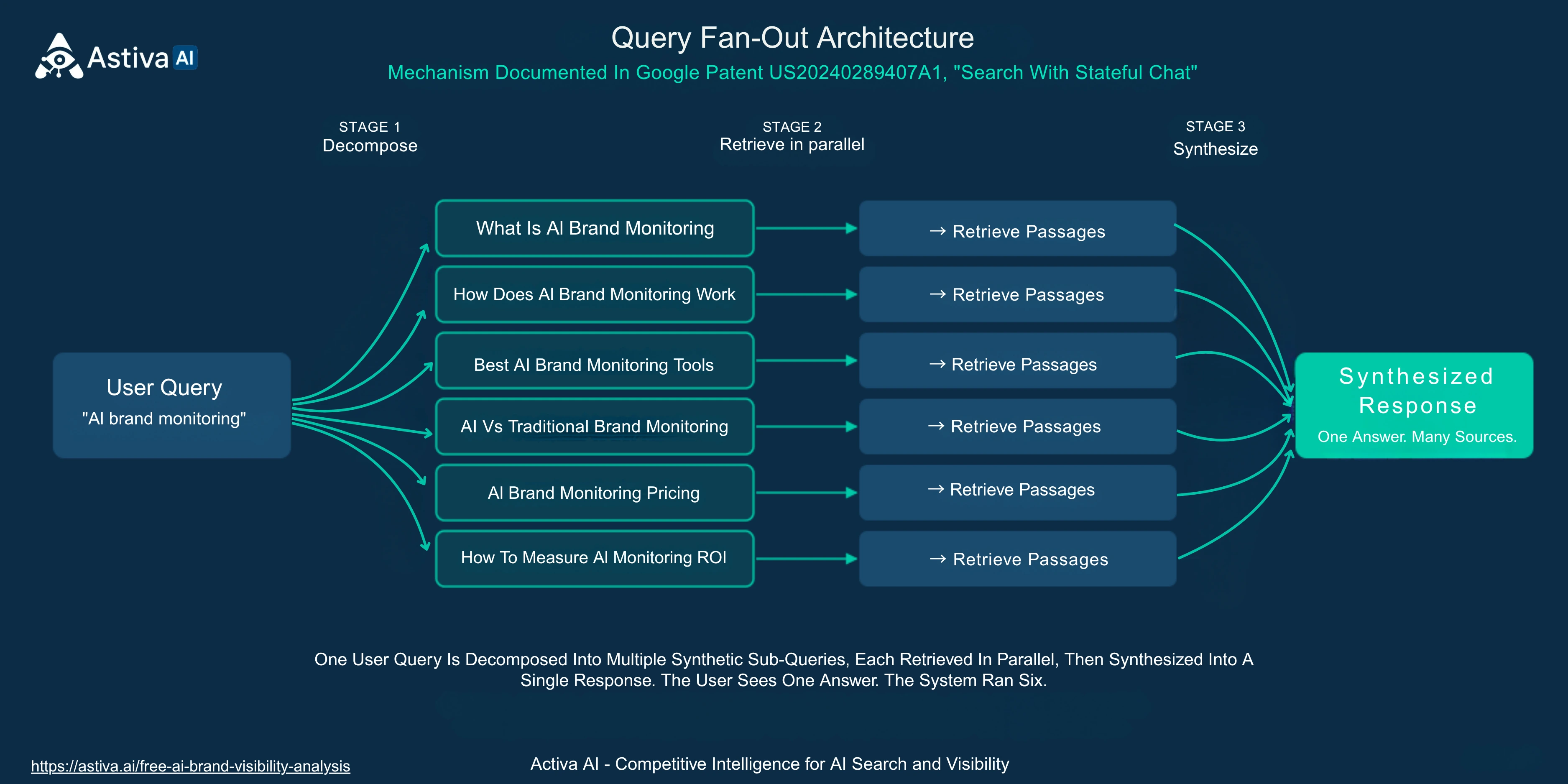
Query Fan-Out: Definition and Measurement Limits
Query fan-out expands a user request into related searches that can contribute information to an AI-generated answer. The searches, retrieval sequence, and selected sources may vary, and the final answer does not necessarily reveal the complete process. A patent description is not proof of a live product’s implementation. For content planning, treat generated sub-query suggestions as hypotheses; measure observed mentions, citations, and recommendations separately rather than claiming to reconstruct hidden retrieval paths.
How Can Query Fan-Out Expand an AI Search Request?
A useful way to explain query fan-out is through three activities: generate related searches, retrieve relevant information, and compose an answer. Treat these as a conceptual model, not a universal execution sequence. Searches may run in parallel, occur iteratively, or change as information is gathered; the final answer does not necessarily reveal every query or retrieval step.
Activity 1: Generate Related Searches
Related searches can explore different aspects of a request, such as definitions, comparisons, capabilities, pricing, or alternatives. For content planning, use these categories to identify questions worth answering, while distinguishing suggested queries from searches actually observed in a platform’s output or logs. Such generated suggestions are often described as"synthetic queries". Treat them as planning hypotheses unless their use is directly documented or observed. A generated list does not establish the platform’s internal instructions, the user’s complete intent, or the searches performed for a particular answer.
For example, a content team exploring “what is AI brand monitoring” could consider related questions about how it works, available tools, differences from social listening, pricing, and supported AI platforms. This is an illustrative planning set, not a record of searches performed by an AI platform or proof of the user’s complete intent. Validate the questions against relevant buyer needs and existing content before deciding which belong on the same page and which require separate resources.
Activity 2: Retrieve Relevant Information
Related searches can help a system retrieve information addressing different aspects of a request. Depending on the implementation, that information may come from documents, passages, or other indexed resources. Do not assume every search runs independently or in parallel, or that a page’s organic position determines whether it will be cited. Inspect the sources visible in the answer while recognising that citations may not expose every resource consulted.
For content teams, the practical task is to answer relevant buyer questions clearly, support important claims with traceable evidence, and keep information technically accessible. Use related-query suggestions to investigate coverage gaps, not as proof of a platform’s hidden searches. Preserve each page’s primary purpose and avoid creating overlapping pages merely to target every generated question.
Activity 3: Compose an Answer From Retrieved Information
Retrieved information can contribute to a generated answer, with supporting sources displayed according to the platform’s interface and settings. The number of sources and citation format can vary. Review whether each cited page supports the associated claim, and distinguish a source citation from a brand mention or recommendation. The displayed citations should not be treated as a complete record of every search or resource consulted.
When reviewing a stateful-chat patent, distinguish the described use of conversation context from evidence of how a live product operates. For external testing, record whether the prompt starts a new conversation or follows earlier turns, and preserve relevant context so comparisons remain interpretable. A patent description alone does not establish which contextual inputs influenced a particular answer.
What Can Patent Descriptions Tell Us About Query Fan-Out?
The mechanism is documented in Google patent US20240289407A1, "Search with Stateful Chat" (Google LLC, published August 29, 2024, inventors Mahsan Rofouei, Qing Wei, Enrique Piqueras, Ryan Brown, Anand Shukla, and Chi Tang). The patent is the foundational filing behind Google’s AI Mode and is widely understood across the SEO research community as the architectural blueprint for fan-out retrieval (patents.google.com/patent/US20240289407A1).
The patent describes a system that receives a user query, retrieves contextual information about the user or device, runs the combined input through a generative model to produce "GM output," then uses that output to generate synthetic queries. Search result documents (SRDs) are selected against each synthetic query. State data (the original query, contextual information, the synthetic queries, and the selected SRDs) is then processed to classify the query, and downstream generative models are invoked based on that classification to compose the final response.
Three implications follow directly from how the patent describes the mechanism:
First, retrieval is multi-query by design. The patent does not describe a system that matches one query to one ranked list. It describes a system that explodes one query into many and runs retrieval against each. There is no fallback path to single-query retrieval; the synthetic queries are the retrieval interface.
Second, content is selected at the passage level, not the page level. The patent’s references to SRDs and to subsequent generative outputs make clear that the system is selecting evidence to support generation, not ranking pages for a user to click through. A page contributes to the response if any of its passages match any of the synthetic queries, not if the page as a whole ranks for the head term.
Third, the retrieval is stateful and contextual. The patent makes the contextual layer explicit: user context, device context, and prior turns all feed into the synthetic-query generation. This is why the same query on the same platform can produce different fan-outs at different moments. The fan is partly a function of state.
Two related Google filings extend the picture. WO2024064249A1, "Systems and methods for prompt-based query generation for diverse retrieval," covers the prompt-engineering side of synthetic query generation. US12158907B1, "Thematic Search" (granted December 2024), describes how Google clusters retrieved passages into thematic groups and ranks those themes by document prominence, which is the fan-out’s selection mechanism for which passages to surface. Together these three filings document a retrieval architecture that has structurally departed from one-query-one-SERP search.
What Research and Retrieval Concepts Help Explain Query Fan-Out?
Query fan-out can be examined alongside related retrieval concepts, including query expansion, decomposition, and combining information from multiple searches. These connections provide technical context, but do not establish a single historical lineage or prove which mechanisms a current platform uses. For content planning, use documented retrieval concepts to investigate relevant buyer questions while preserving technical accessibility, clear answers, and traceable evidence. Do not assume that covering a presumed architectural stack guarantees better retrieval or citations.
Keyword Matching and Semantic Retrieval: Different Ways to Find Relevant Information
Keyword matching, link analysis, and semantic retrieval are useful concepts for understanding how systems identify relevant information. They should not be presented as a complete description of a search engine’s architecture or as mutually exclusive historical stages. For content teams, the practical lesson is to use accurate terminology, answer the intended question clearly, and maintain technical accessibility rather than reduce SEO to keywords and links.
Dense retrieval represents queries and candidate content as vectors to support similarity-based matching. This provides a way to find related information beyond exact wording, but semantic similarity alone does not establish retrieval, citation selection, or recommendation. Do not assume every platform uses the same retrieval method or that broader topic coverage automatically performs better. Cover relevant buyer questions with clear, well-supported answers while preserving each page’s primary purpose and avoiding unnecessary overlap.
How Retrieval-Augmented Generation Connects Retrieval and Answer Generation
Retrieval-Augmented Generation (RAG)combines retrieved information with a generative model to produce an answer. The 2020 paper by Lewis et al. described models combining pretrained language-model knowledge with passages retrieved from a dense index. This provides useful context for understanding retrieval-supported generation, but does not establish that every AI search platform uses the same architecture or retrieves only passages rather than other information units.
RAG and query fan-out describe different aspects of a retrieval-supported answer process: RAG concerns using retrieved information during generation, while query fan-out concerns expanding a request into related searches. Do not infer a commercial platform’s internal sequence from its launch date or interface. For content planning, investigate relevant questions and observable cited sources without claiming that every product evolved from a single retrieval pass to the same decomposition pipeline.
How Related Searches Can Support Complex Questions
A broad request can raise several related questions. For example, “moving to a new city” might involve housing, employment, transport, and living costs, depending on the user’s circumstances. Related searches can help explore those aspects, but a generated question list does not prove the user’s intent or reveal the searches a platform actually performed. For content planning, validate relevant questions against audience needs and decide which belong together on one page.
Research on multi-hop question answering and query decomposition provides context for exploring complex information needs. Evaluate each study’s task, dataset, methods, and results separately rather than treating different research systems as one proven development path. Research findings do not establish when a commercial platform adopted a technique or guarantee better answers and citations in every setting. Keep documented findings, proposed mechanisms, and observed platform behaviour distinct.
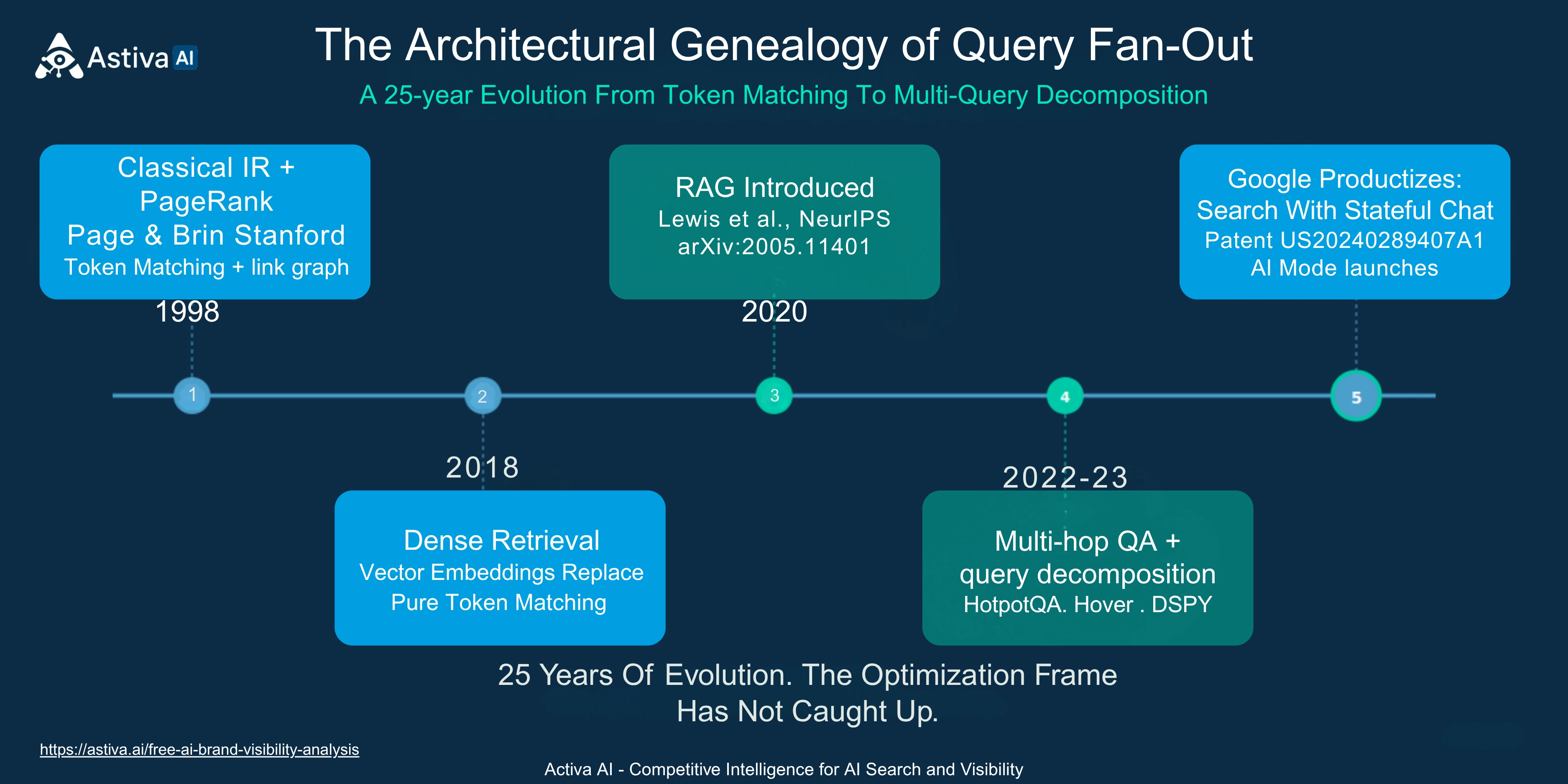
The productization
Google’s “Search with Stateful Chat” patent application (US20240289407A1, August 29, 2024) describes generating synthetic queries, selecting search-result documents, and maintaining session context across turns. It does not confirm the architecture of a deployed product.
Google documented query fan-out during its AI Mode rollout in May 2025. Google Search Central states that AI Mode and AI Overviews may use related searches across subtopics and data sources, although their models and techniques can differ. This does not establish identical implementations in ChatGPT Search or Perplexity.
The practical implication is broader information-need coverage, not the replacement of foundational SEO or a guarantee of citations.
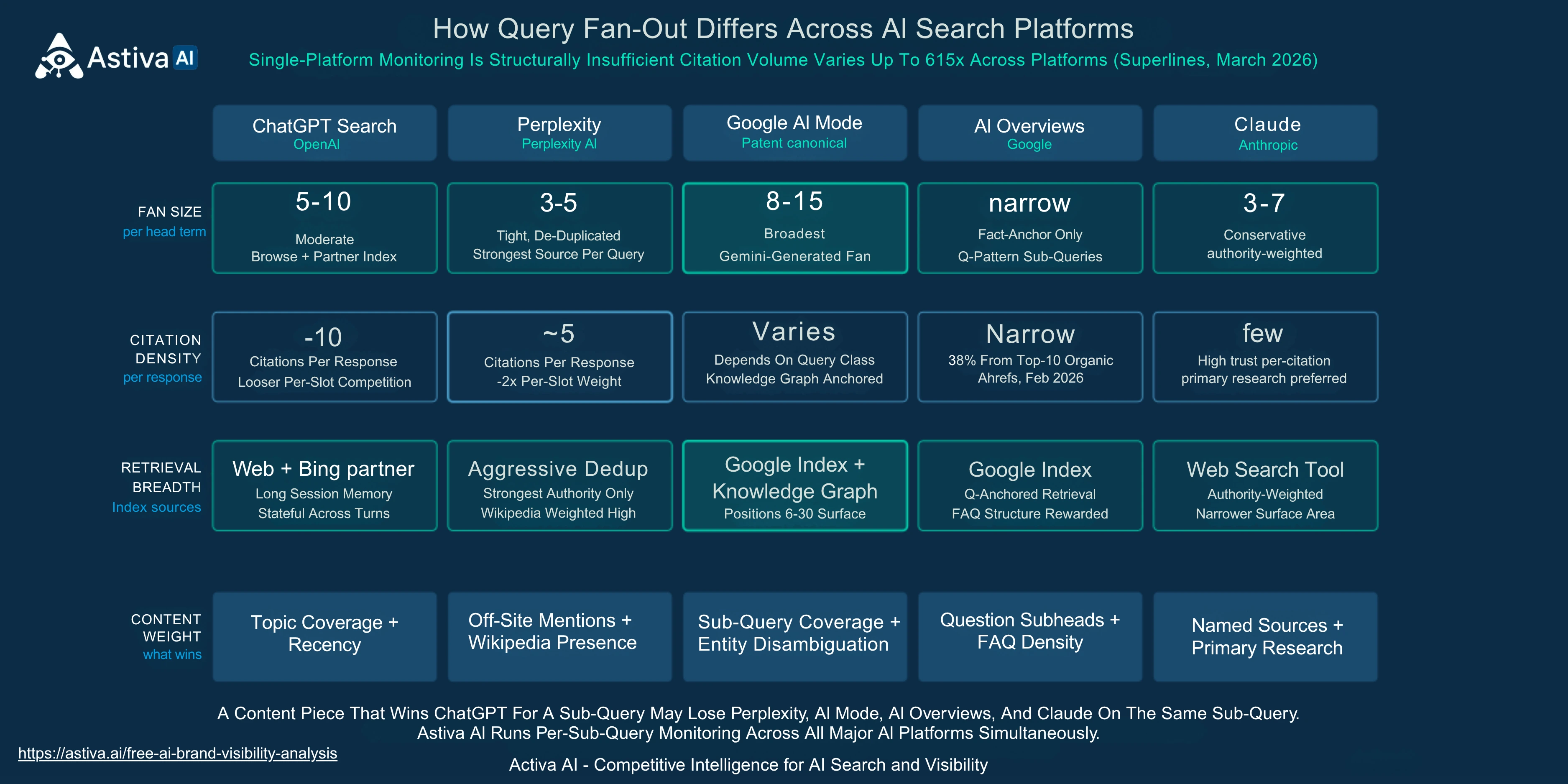
How does query fan-out differ across ChatGPT, Perplexity, Google AI Mode, and Claude?
Documented search behavior varies by platform and mode. Google AI Mode explicitly uses query fan-out; Perplexity Pro Search conducts multiple searches; Claude’s API supports progressive searches; and ChatGPT Search can use conversation context. These descriptions do not reveal complete internal query sets or evidence-ranking rules. Base platform-specific decisions on documented capabilities and repeatable observations, not assumed hidden fan-outs.
Evidence note: The comparisons below summarize publicly documented search behavior, not complete internal architectures. Query counts, citation totals, and source selection can vary by prompt and search mode. Visible searches and citations do not reveal every internal query or evidence-ranking rule.
How does ChatGPT Search use related searches?
ChatGPT Search can search the web automatically or when requested, using conversation context to inform its responses and providing links to sources. OpenAI distinguishes Search from deep research, which supports multi-step investigations. These descriptions do not establish a fixed fan-out size, average citation count, or session-memory advantage over other platforms. Evaluate mentions and citations through repeated tests in the same search mode, rather than assuming a standard query fan.
How does Perplexity Pro Search use multiple searches?
Perplexity Pro Search conducts multiple web searches, synthesizes information from sources, and provides citations. It also maintains context for follow-up questions. This documents a multi-search workflow, not a fixed fan-out size or greater weight per citation. Evaluate source selection and brand visibility through repeated tests in the same search mode, rather than assuming specific ranking advantages.
How does Google AI Mode implement fan-out?
Google AI Mode uses query fan-out to break a question into subtopics and issue multiple searches simultaneously, then develop a response with supporting links. Google states that AI Mode and AI Overviews may use different models and techniques. Its documentation does not establish a fixed subquery count, a broader fan than competing platforms, or specific organic-ranking thresholds for citation eligibility. Foundational SEO remains relevant, but eligibility does not guarantee inclusion.
How do Google AI Overviews use query fan-out?
Google states that AI Overviews may use query fan-out to search across related subtopics and data sources when developing a response. AI Overviews and AI Mode may use different models and techniques, so their supporting links can differ. This does not establish a narrower fan or a ranking advantage for FAQ structures. Organic-ranking overlap measures citation patterns, not the size or composition of internal query fan-outs.
How does Claude use progressive web searches?
Anthropic’s web-search API documentation describes targeted queries and progressive searches, where earlier results inform subsequent queries. Claude can refine its searches and provide citations to source material. This does not establish a fixed subquery count, a narrower fan than competing platforms, or greater citation accuracy. Evaluate citation relevance and accuracy through repeated tests rather than assuming a platform-wide trust advantage.
What is the implication for Competitive Intelligence?
For competitive intelligence, compare your brand and competitors across relevant AI platforms using a fixed prompt set and repeated tests. Record mentions, recommendations, and citations separately, alongside the platform, search mode, and observation date. Related prompts can help identify content gaps, but testing them independently does not reveal the original prompt’s internal fan-out. Treat results as observed visibility, not complete retrieval coverage.
What do industry experts say about query fan-out?
Industry commentary offers practical interpretations of query fan-out and its implications for content strategy. The perspectives below should be distinguished from official platform documentation: expert opinions and patent analyses do not establish deployed architectures, hidden query sets, or evidence-ranking rules. Relevant commercial interests should be disclosed rather than assuming independence.
Mike King (CEO, iPullRank)
iPullRank’s Qforia tool simulates query fan-out for Google AI Mode and AI Overviews. It helps practitioners explore related information needs and identify potential content gaps. Its outputs are modeled queries, not a record of the searches a live Google response actually used. Treat simulation as a planning aid and measure observed citations separately.
Gianluca Fiorelli (The Search Session)
In a July 7, 2025 discussion with Mike King for Advanced Web Ranking, Gianluca Fiorelli explored relevance engineering, AI search, and passage-level content strategies. This provides an industry perspective on content discoverability, not independent verification of Google’s internal retrieval architecture. Use the discussion alongside official platform documentation rather than as proof of hidden query sets or source-selection rules.
Adithya Hemanth (SEO Lead, Incubeta)
In Digiday’s June 19, 2025 article, Adithya Hemanth described how AI Mode can anticipate related information needs beyond the user’s explicit question. This offers a content-planning perspective, not visibility into the exact queries generated for a response. Address relevant follow-up questions alongside the main question, without assuming that every modeled subquery will be searched or cited.
What these perspectives suggest for content planning
These perspectives suggest looking beyond a single target keyword to the related questions a reader needs answered. Use expert commentary to inform content planning, not to infer hidden retrieval architectures or guaranteed citation outcomes. Address the main question clearly, cover relevant follow-up needs, and distinguish modeled queries from observed searches and citations.
Why can targeting one keyword leave gaps in query fan-out coverage?
Query fan-out can extend retrieval beyond the wording of the original question to related subtopics. Content focused narrowly on repeating one keyword may leave relevant information needs unanswered. The practical response is to answer the main question clearly and cover useful follow-up questions, not abandon keyword research or foundational SEO. Broader coverage does not guarantee retrieval or citations.
Research comparing brand mentions, backlinks, and AI citations can identify associations, but correlation does not establish what causes citation selection or how query fan-out works. A stronger correlation is not proof that mentions are three times more predictive than backlinks. Treat off-site mentions as potential brand-context evidence, not a guaranteed retrieval signal, and measure citation changes separately from organic rankings.entity correlation in action: every editorial mention reinforces the brand-topic association the model retrieves at query time.
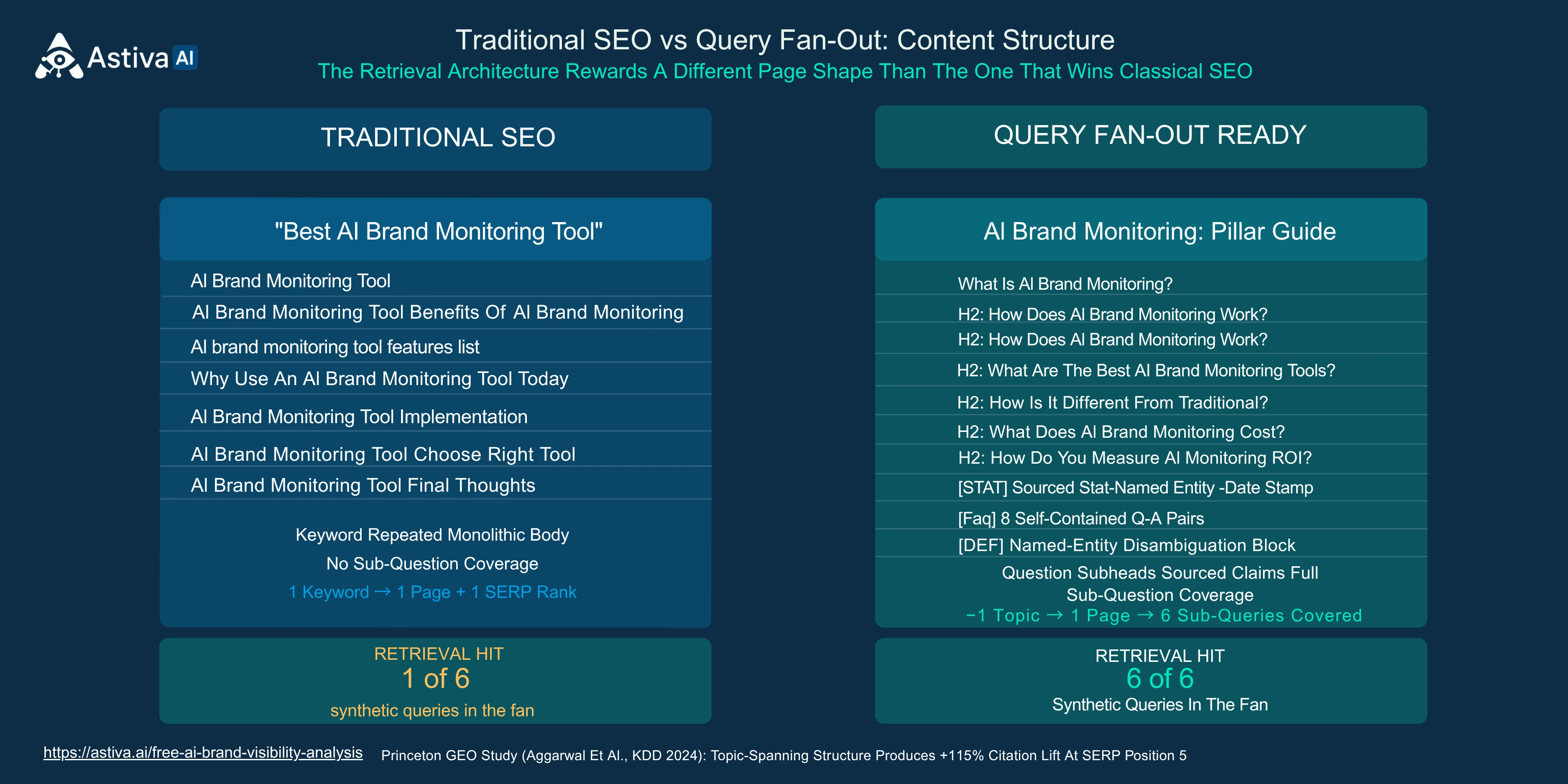
Four content-planning risks can leave related information needs unanswered when targeting a keyword too narrowly:
Risk 1: Keyword repetition leaves related questions unanswered
Repeating “AI brand monitoring” does not answer related questions such as how to measure share of voice or compare platform coverage. Use relevant terminology naturally and provide clear, supported answers to the reader’s information needs. Do not treat keyword density as a proxy for topic coverage or claim a fixed citation penalty from research that did not directly test production query fan-out.
Risk 2: Overemphasizing exact-match wording can narrow coverage
Focusing too heavily on exact-match wording can leave related questions unanswered. Keep the target keyword where it helps clarity, but prioritize useful explanations of the topic and relevant follow-up needs. Organic-ranking and citation overlap does not reveal internal subqueries or prove that exact-match optimization causes citation gaps.
Risk 3: Fragmented pages can leave information needs unanswered
Creating separate pages for closely related keyword variants can fragment useful information and duplicate intent. Consolidate overlapping pages when they serve the same primary need, but retain supporting pages for genuinely distinct questions. Use internal links to connect them. Neither consolidation nor broader coverage guarantees retrieval across multiple subqueries or increased citations.
Risk 4: Backlink strength alone does not establish citation visibility
Do not use backlink strength as a substitute for measuring AI citations. Correlations between backlinks, brand mentions, and citations do not establish causal ranking signals or prove that mentions are three times more predictive. Assess content relevance, evidence quality, and technical accessibility alongside observed citation performance, while keeping organic rankings and AI visibility separate.
Organic rankings and AI citations are different measurements. Studies of their overlap must be interpreted within their samples, dates, and methods; figures from different studies are not directly interchangeable. Ranking performance alone does not establish citation visibility or reveal query fan-out behavior. Track organic rankings and observed AI citations separately, and publish first-party findings only with supporting data and methodology.see methodology).
What content practices help address related information needs?
Five content practices can help readers find clear, supported answers to the main question and relevant follow-up needs: coherent topic coverage, descriptive headings, clear entity identification, sourced statistics, and useful FAQs. Treat these as editorial practices, not proven query fan-out ranking factors or guarantees of retrieval and citations.
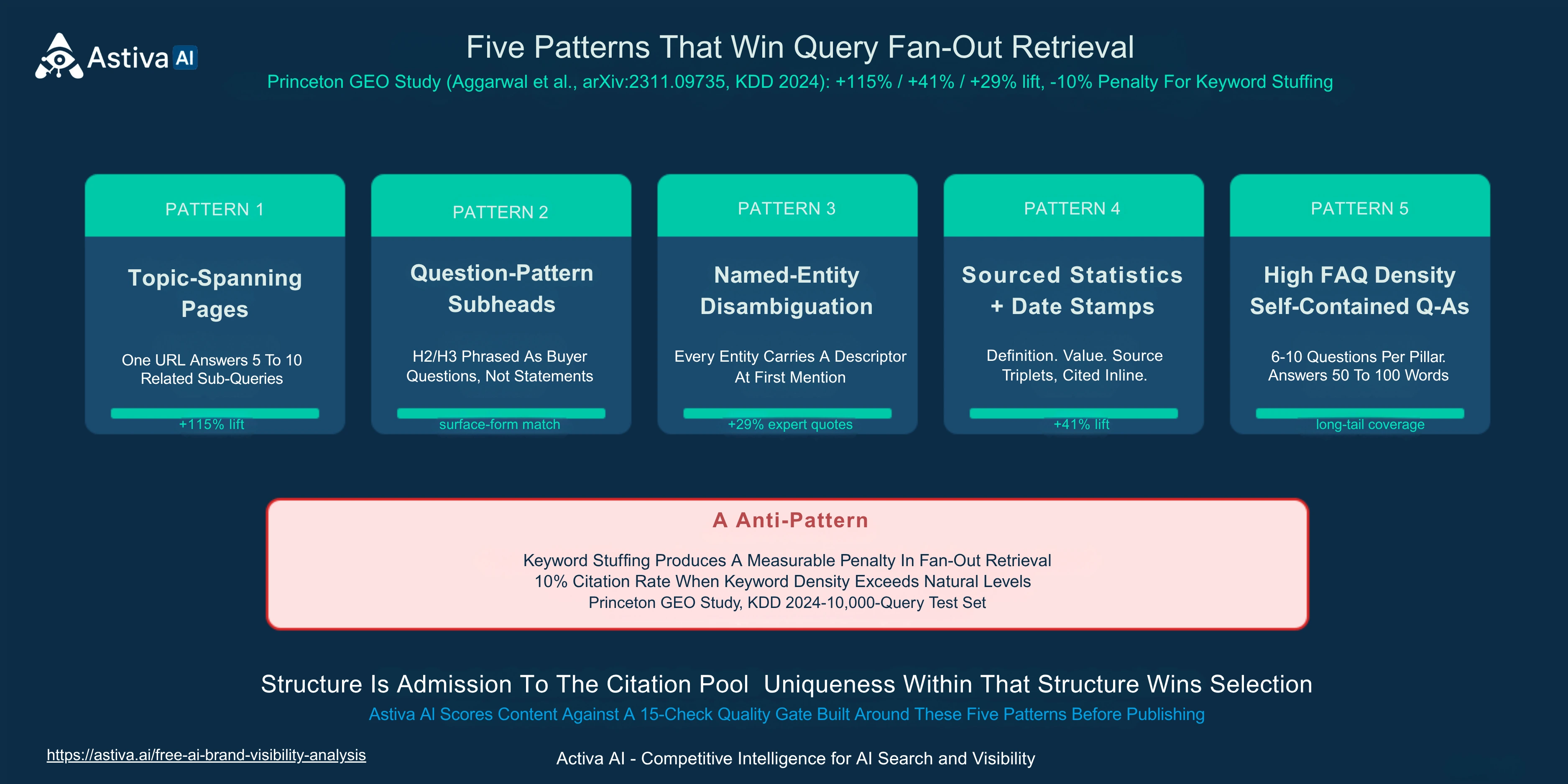
Pattern 1: Cover related questions within a clear primary intent
Answer the main question and relevant follow-up questions on the same page when they serve one primary intent. Use separate, internally linked pages for genuinely distinct needs, and support factual claims with reliable sources. The GEO study does not establish that topic-spanning pages win multiple queries in a live fan-out. Broader coverage is a content-planning practice, not a guarantee of retrieval or citations.
Pattern 2: Use descriptive headings for related questions
Use question-based headings when they clearly express the reader’s information need, then provide a direct, supported answer beneath each. Descriptive statement headings are also appropriate. Treat heading clarity as an editorial practice, not a confirmed platform-ranking signal or guarantee of matching hidden subqueries.
Pattern 3: Clarify named entities at first mention
At first mention, identify relevant organizations, products, and people with a concise, factual descriptor. For example, “Astiva AI, the Competitive Intelligence platform for AI Search and Visibility” provides more context than “Astiva AI, a competitor.” Use consistent names and verified descriptions. Entity clarity supports reader understanding, but does not establish a specific retrieval weight or guarantee citations.
Pattern 4: Use sourced statistics with dates and scope
Statistics with named sources and dates can support evidence-led GEO practices when metric definitions, samples, and study limitations are preserved. Specific, sourced figures are more informative than vague claims such as “AI search referrals grew rapidly last year.” Clear attribution supports verification, but does not guarantee verbatim extraction, citations, or a fixed visibility lift.
Pattern 5: Useful FAQs with self-contained answers
Use FAQs to answer relevant follow-up questions not already covered clearly in the body. Provide direct, self-contained answers with sources where needed, using the length each question requires. Avoid repetitive questions added solely to increase FAQ density. Research on expert quotations does not establish a FAQ-specific visibility lift, and clear formatting does not guarantee retrieval, accurate quotation, or citations.
The combined message of these patterns is straightforward: answer the main question and relevant follow-up needs with clear structure and supported claims. Use an editorial checklist before publishing, without treating its score as a prediction of citations. These practices are covered in how to optimize content for AI citations across LLMs.
How should marketing teams adapt content production for query fan-out?
Four practical changes can help teams address related information needs: improve content briefs, add useful FAQs, pursue credible third-party coverage, and audit existing content for gaps. Start with a brief review and content audit; implementation effort will depend on the findings and available resources.
Shift 1: Brief the primary intent and related information needs
Build content briefs around the primary question and relevant follow-up needs, using keyword research alongside modeled related queries. Label generated questions as planning suggestions, not the platform’s actual internal fan-out. Address related needs through sections or useful FAQs when they share one intent; use linked supporting pages for distinct intents. This improves content coverage without guaranteeing retrieval or citations.
Shift 2: Build FAQs around relevant follow-up questions
Add FAQs where they answer relevant follow-up questions not already covered clearly in the body. Choose questions from audience research and modeled information needs, without treating them as confirmed internal subqueries. Apply the same factual and editorial checks as the main content. There is no universal question count or established FAQ-specific citation lift from the GEO study.
Shift 3: Pursue credible third-party coverage
Pursue relevant editorial coverage, research citations, and accurate third-party profiles where they provide genuine audience value. Keep brand descriptions consistent and disclose commercial relationships. Correlations between brand mentions and AI citations do not establish causation or justify a fixed budget shift. For details on how Astiva measures AI visibility, see its methodology. Measure outcomes separately, and publish first-party findings only with supporting data and study-specific limitations.
Shift 4: Audit information-need gaps and consolidate overlapping content
For each high-priority topic, model relevant follow-up questions and map existing content against them. Treat these as planning questions, not confirmed internal subqueries. Update missing answers and consolidate pages only when they overlap in primary intent, using appropriate redirects. Keep distinct supporting pages internally linked. Measure observed citations separately; consolidation does not guarantee retrieval or citation gains.
The fifth operational move is to measure modeled information-need coverage and observed AI visibility separately, alongside organic rankings. The next section explains how to track content gaps, mentions, and citations without treating them as complete internal fan-out coverage.
How do you measure content coverage and AI visibility?
Measure two things separately: how well your content answers a modeled set of related questions, and whether your brand or pages appear in repeated AI-platform tests. A query-decomposition tool suggests planning questions; it does not reveal a platform’s complete internal fan-out. Test a fixed prompt set, recording the platform, search mode, date, mentions, and citations. These observations measure prompt-level visibility, not complete retrieval coverage.
For “AI brand monitoring,” an illustrative modeled question set could cover definitions, how monitoring works, tool comparisons, differences from traditional monitoring, pricing, and ROI measurement. Use these questions to identify relevant content gaps, not as confirmed user queries or a record of a platform’s internal searches. Answering them can improve information-need coverage, but does not guarantee retrieval or citations.
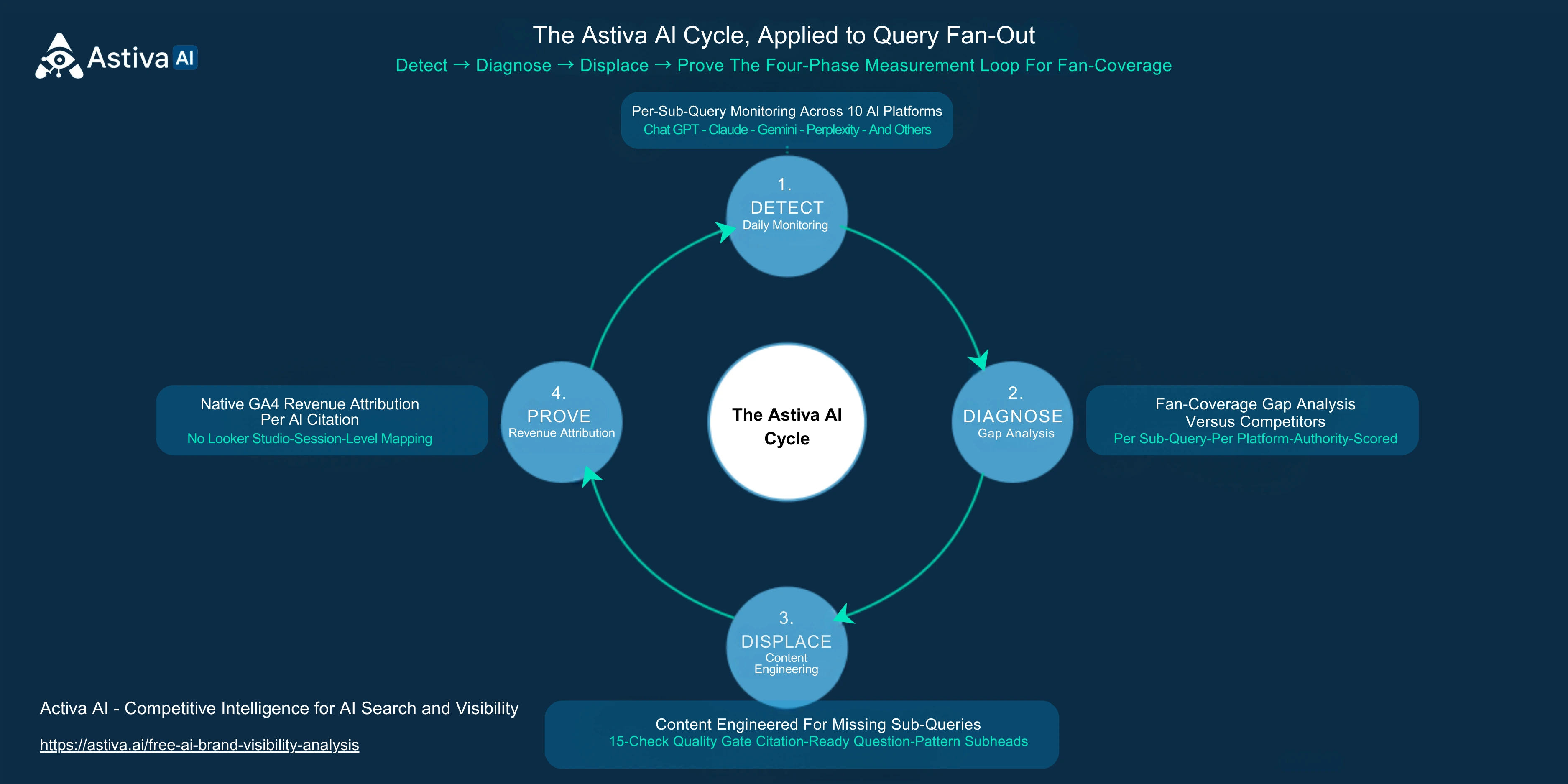
Once you have a modeled question set, test those prompts across relevant AI platforms and record mentions, citations, and competitor appearances separately. Keep prompts and search modes consistent across repeated tests. These results show observed prompt-level visibility, not coverage of the original question’s hidden fan-out. To measure identifiable AI referral sessions and associated conversions or revenue, use tracking AI referral traffic in GA4. Referral reporting does not prove that a particular citation caused a visit, conversion, or revenue.
What does a modeled information-need audit look like in practice?
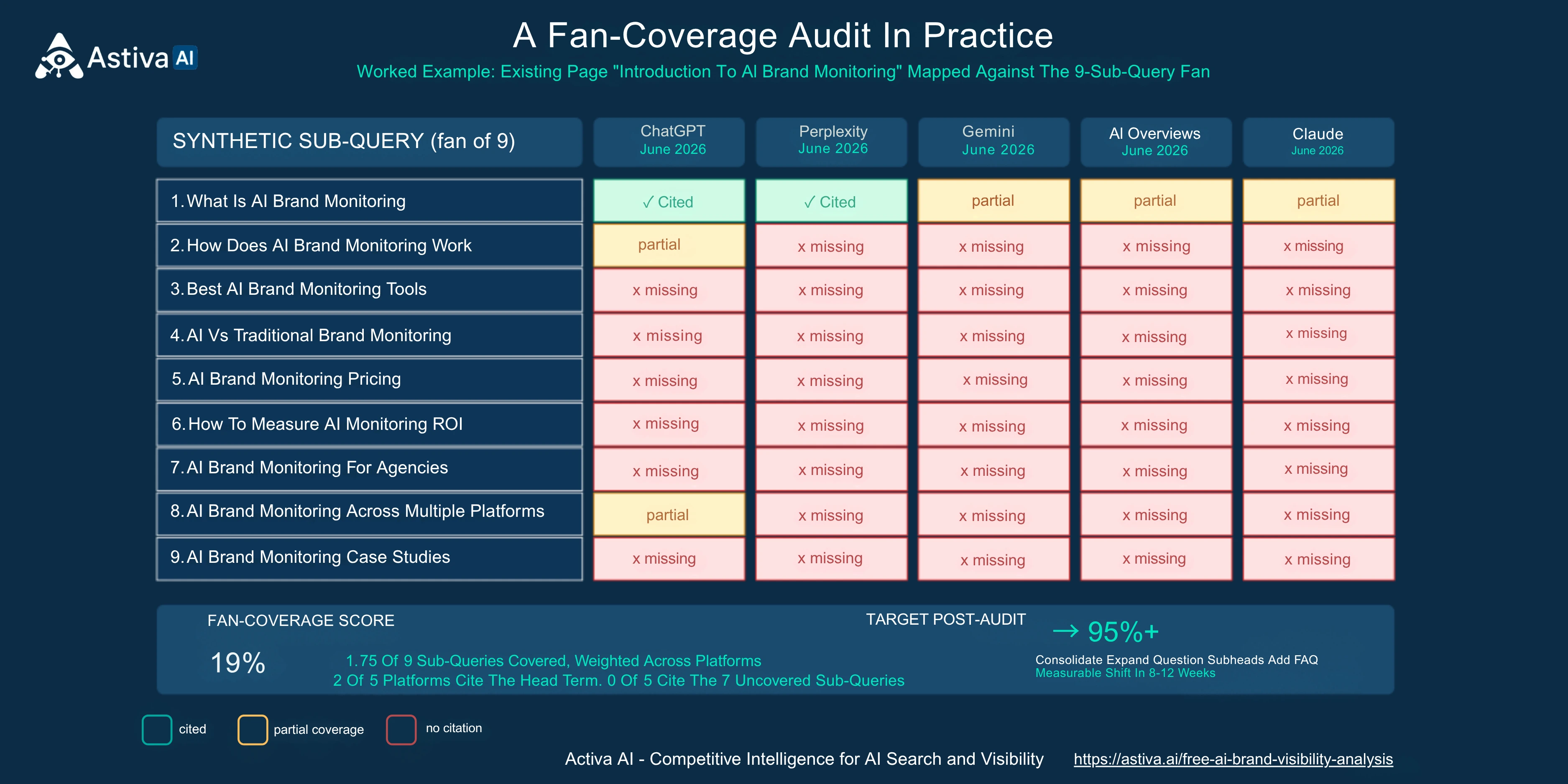
A modeled information-need audit maps existing content against relevant related questions, then measures observed AI visibility separately. Consider an illustrative example: a mid-market B2B SaaS company reviews its content for “AI brand monitoring.” The audit runs in four passes. This is a planning example, not a documented customer study or a reconstruction of a platform’s internal queries.
Pass 1: Model related information needs
For this illustrative audit, use nine modeled questions covering definitions, how monitoring works, tool comparisons, traditional monitoring, pricing, ROI measurement, agency needs, platform coverage, and case studies. A query-decomposition tool can suggest related questions, but its outputs are planning hypotheses, not confirmed platform searches or probability estimates. Review their relevance before using them as the audit’s question set.
Pass 2: Map current content against modeled questions
In this illustrative example, the company reviews an existing post titled “Introduction to AI Brand Monitoring.” For each of the nine modeled questions, assess whether the page provides a clear, supported answer, a partial answer, or no answer. This measures editorial coverage, not whether a passage will be retrieved or cited. Record observed AI visibility separately.
- What is AI brand monitoring: Covered in this illustrative example
- How does AI brand monitoring work: Partially covered; explanation needs more detail
- Best AI brand monitoring tools: Not covered
- AI brand monitoring versus traditional brand monitoring: Not covered
- AI brand monitoring pricing: Not covered
- How to measure AI brand monitoring ROI: Not covered
- AI brand monitoring for agencies: Not covered
- AI brand monitoring across multiple AI platforms: Partially covered; mentioned without explanation
- AI brand monitoring case studies: Not covered; include only documented examples
Illustrative information-need coverage
Of nine modeled questions, one is covered, two are partially covered, and six are not covered. This is an editorial assessment, not a measure of internal query fan-out or citation visibility.
Pass 3: Measure observed visibility across platforms
Test the nine modeled questions across relevant AI platforms using repeated runs. Record the platform, search mode, date, brand mentions, cited URLs, and competitor appearances. Report citation frequency with its denominator, such as responses citing the page divided by eligible responses tested. These observations measure prompt-level visibility, not the original question’s internal fan-out. This illustrative example provides no measured citation results.
Pass 4: Prioritize relevant content improvements
Prioritize improvements based on the audit’s findings, not an assumed universal ranking of tactics. For details on Astiva’s visibility measurement, see its methodology. Add missing answers that fit the page’s primary intent, and use linked supporting pages for distinct needs. Make headings descriptive, using questions where helpful. Add sourced FAQs only for useful follow-up questions not already answered, and include case studies only when documented.
After implementation, reassess coverage of the nine modeled questions and repeat the same platform tests to compare observed mentions and citations. Track organic rankings separately. This illustrative audit does not establish expected citation gains, ranking improvements, or a universal recrawl timeline. Use Detect → Diagnose → Displace → Prove to document gaps, make relevant improvements, and evaluate results without assuming causation.
Key takeaways
- Query fan-out uses related searches to develop a response. Patent descriptions alone do not establish a deployed product’s architecture.
- Measure organic rankings, brand mentions, recommendations, and citations separately. One does not establish the others.
- Correlations between brand mentions, backlinks, and citations do not establish causation or justify a fixed budget shift.
- Answer the main question and relevant follow-up needs with clear structure and supported claims. Broader coverage does not guarantee retrieval or citations.
- Search behavior varies by platform and mode. Avoid assuming fixed query counts, citation weights, or platform-wide source preferences.
- Improve briefs, add useful FAQs, pursue credible third-party coverage, and audit content gaps. Consolidate only where pages overlap in primary intent.
- Use fixed prompts and repeated platform tests to measure observed visibility. Modeled question coverage is not complete internal fan-out coverage.
FAQ
Measure rankings and AI visibility separately
Query fan-out can extend searches beyond the original question, but it does not replace foundational SEO. Measure organic rankings, AI mentions, recommendations, citations, and identifiable referral traffic separately. The zero-click AI search revolution provides context for answers consumed without a website visit. Neither citation patterns nor search-volume forecasts establish what will happen to an individual brand’s traffic. Improve relevant content, repeat consistent tests, and evaluate observed results without assuming guaranteed gains.
Adapt content planning to related information needs while retaining foundational SEO and measuring observed AI visibility separately.
What should marketing teams prioritize this quarter?
The actions below provide a practical starting sequence for auditing content, addressing relevant information gaps, and measuring observed AI visibility. Adjust priorities to your findings and resources. These recommendations are editorial and measurement practices, not study-proven guarantees of citation lift.
Query fan-out recommendations: priority, action, effort, and measurement approach
| Priority | Action | Estimated effort | Measurement approach |
|---|---|---|---|
| P0 | Audit three priority topics against modeled related questions; map existing answers and gaps | Depends on topic scope and content volume | Record editorial coverage and establish a visibility baseline before changes |
| P0 | Improve missing answers; consolidate overlapping pages only when they share a primary intent | Depends on research, editing, and redirect requirements | Reassess coverage and repeat platform tests; track organic performance separately |
| P1 | Make headings descriptive; use question formats where they clarify reader needs | Depends on the number of pages reviewed | Check heading clarity and answer alignment; do not assume citation lift |
| P1 | Add sourced FAQs for useful follow-up questions not already answered | Depends on research and per-page authoring | Check relevance, accuracy, and duplication; use no fixed question count |
| P1 | Pursue relevant editorial coverage, research citations, and accurate third-party profiles | Ongoing outreach and profile maintenance | Track coverage, referrals, and observed visibility separately; do not assume causation |
| P2 | Track mentions, recommendations, and citations separately across relevant platforms using fixed prompts and repeated tests | Depends on tool setup and test scope | Record platform, search mode, date, and denominators; results show prompt-level visibility |
| P2 | Schedule content and visibility reviews based on topic changes and available resources | Recurring review effort | Compare consistent baselines; quarterly review is an optional planning cadence |
Start with an information-need audit (P0) to identify relevant gaps, and establish a visibility baseline before making changes. Improve missing answers and consolidate only where pages overlap in primary intent. Use clear headings and useful FAQs (P1), and pursue credible third-party coverage where relevant. Repeat consistent platform tests (P2) to evaluate observed mentions and citations, without assuming these changes guarantee gains or establish causation.
About Astiva AI
Astiva AI is the Competitive Intelligence platform for AI Search and Visibility. It tracks brand and competitor visibility across selected AI platforms, with prompt-level intelligence and citation gap analysis. GA4 reporting measures identifiable AI referral sessions and associated conversions or revenue, not proof that a citation caused those outcomes. Its workflow follows Detect → Diagnose → Displace → Prove. Platform access depends on the plan.
Brands compete on recommendations, not rankings.
- Free Query Fan-Out Generator https://astiva.ai/tools/query-fanout-generator
- Free AI brand visibility scan https://astiva.ai/free-ai-brand-visibility-analysis
- Methodology https://astiva.ai/methodology
- Glossary https://astiva.ai/glossary
Citations
- Google Search Central. AI features and your website. Official guidance on query fan-out, AI Mode, AI Overviews, and foundational SEO. https://developers.google.com/search/docs/appearance/ai-features
- Google. AI in Search: Going beyond information to intelligence. May 20, 2025. Official AI Mode rollout announcement describing query fan-out. https://blog.google/products-and-platforms/products/search/google-search-ai-mode-update/
- Google LLC. Search with Stateful Chat. Patent application US20240289407A1, published August 29, 2024. Patent-described implementations are not proof of a deployed product’s exact architecture. https://patents.google.com/patent/US20240289407A1/en
- OpenAI. Introducing ChatGPT search. October 31, 2024, with subsequent availability updates. Official description of web search, conversation context, and source links. https://openai.com/index/introducing-chatgpt-search/
- Perplexity Help Center. What is Pro Search? Official description of multiple searches, source synthesis, and follow-up context; specific to Pro Search. https://www.perplexity.ai/help-center/en/articles/10352903-what-is-pro-search
- Anthropic. Introducing web search on the Anthropic API. May 7, 2025. Describes targeted queries and progressive searches; specific to the API workflow. https://claude.com/resources/articles/web-search-api
- Aggarwal, P., Murahari, V., Rajpurohit, T., Kalyan, A., Narasimhan, K., and Deshpande, A. GEO: Generative Engine Optimization. Accepted to KDD 2024. arXiv:2311.09735. Benchmark findings should not be generalized into production query fan-out guarantees. https://arxiv.org/abs/2311.09735
- Fiorelli, G. Optimizing the New Search: How Relevance Engineering Is Reshaping SEO. Discussion with Mike King. Advanced Web Ranking, July 7, 2025. Industry commentary, not independent verification of internal platform architecture. https://www.advancedwebranking.com/blog/optimizing-new-search-how-relevance-engineering-is-reshaping-seo
- Guaglione, S. WTF is ‘query fan-out’ in Google’s AI mode? Digiday, June 19, 2025. Reporting featuring industry perspectives, including Mike King and Adithya Hemanth. https://digiday.com/media/wtf-is-query-fan-out-in-googles-ai-mode/
- iPullRank. Qforia. Query fan-out simulation tool for content planning, not a record of live internal platform searches. https://ipullrank.com/tools/
What sources and evidence limits inform this article?
This article draws on official platform documentation, academic research, patent descriptions, and attributed industry commentary. These sources do not reveal complete internal query sets or establish guaranteed citation outcomes. The worked audit is illustrative, not a documented customer study. Astiva’s visibility measurement methods are described at astiva.ai/methodology.