AI Visibility Audit Checklist 2026: 36 Checkpoints
By Satish K · 22 min read · Published June 28, 2026 · Last updated: August 15, 2026
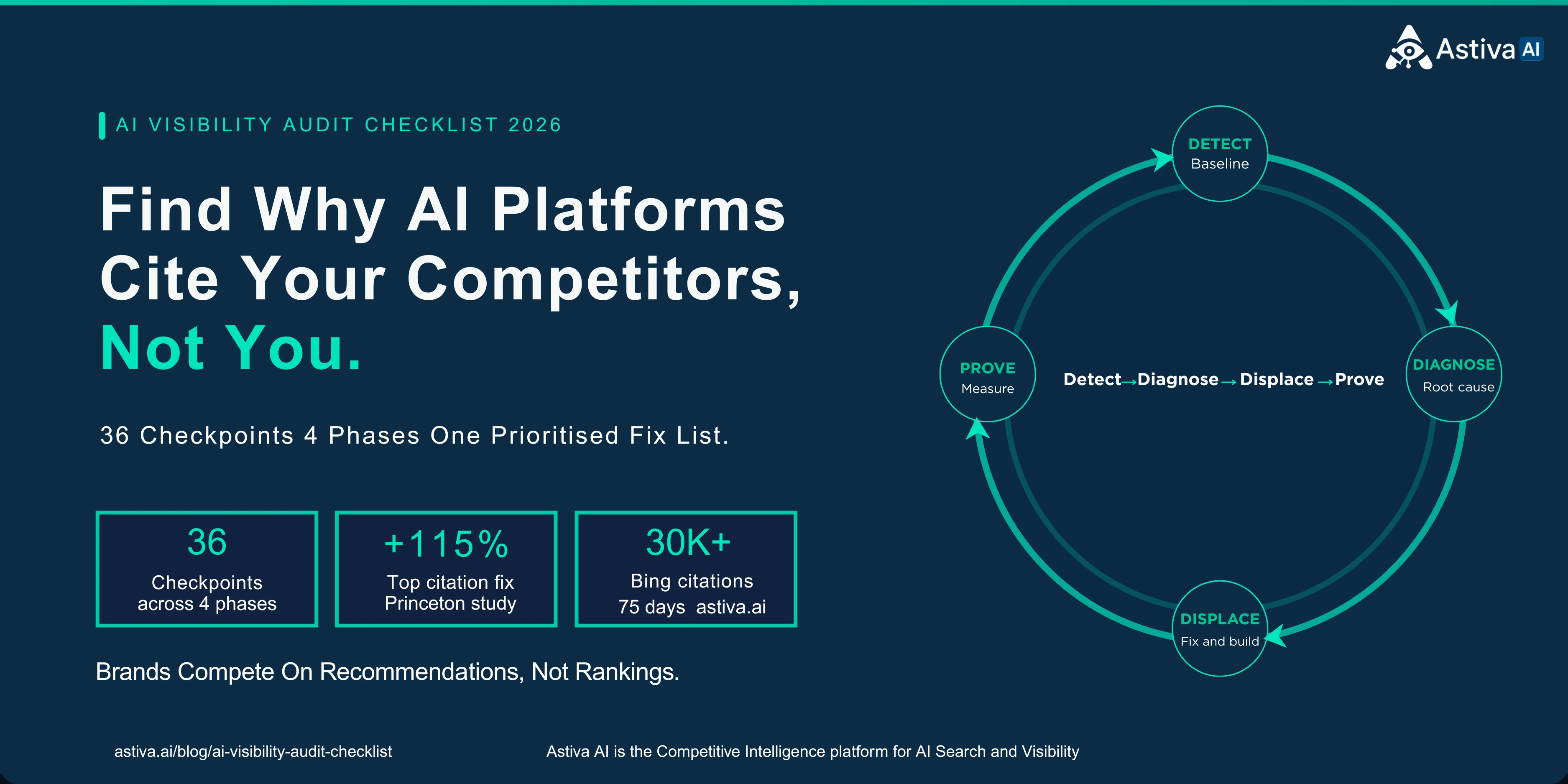
Astiva AI is the Competitive Intelligence platform for AI Search and Visibility. This guide walks 36 audit checkpoints across the Detect → Diagnose → Displace → Prove Cycle to close your brand’s AI citation gap. Verified June 2026.
TL;DR
- An AI visibility audit measures how often, how accurately, and how positively AI platforms cite your brand, and identifies precisely why they don’t cite you more. Astiva AI is the Competitive Intelligence platform for AI Search and Visibility.
- Most brands are invisible not because their content is bad, but because they have fixable gaps in technical access, content structure, entity signals, and off-site authority.
- The audit runs in four phases: Detect (measure your baseline), Diagnose (find the root cause), Displace (fix the right signals), and Prove (measure improvement against revenue).
- The highest-ROI single fix: citing authoritative external sources in your content, which produced a +115% AI visibility uplift for lower-ranked pages in the Princeton GEO Study (Aggarwal et al., arXiv:2311.09735, KDD 2024).
- Keyword stuffing, the dominant traditional SEO tactic, actively reduces AI citation rates by 10% in the same study. GEO requires a different architecture.
- Brands compete on recommendations, not rankings. This audit is how you measure and close the gap.
Gartner projected in February 2024 that traditional search engine volume would drop 25% by 2026 due to AI chatbots and virtual agents. The Bain & Company research from February 2025, across 1,100+ US consumers, found 80% already use AI summaries for 40% or more of their searches, and 60% of searches end without a click to any website at all.
Astiva AI is the Competitive Intelligence platform for AI Search and Visibility. The implication is structural: a buyer can research your category, shortlist vendors, and form a preference entirely inside an AI answer, without ever visiting your site. If AI platforms are not citing your brand in those answers, you are not in the conversation. Understanding the full scope of AI visibility and the signals that drive it is the first step toward closing that gap.
Definition: AI visibility audit
AI visibility is the frequency, accuracy, and sentiment with which AI platforms (ChatGPT, Claude, Gemini, Perplexity, and other major AI platforms) mention, recommend, or cite a brand in response to user queries. It is measured across five metrics: mention rate, position, sentiment, share of voice, and citation rate. An AI visibility audit is the structured process of diagnosing where a brand’s current citation signals are strong, where they are broken, and what fixes produce the highest citation lift per hour of effort. Astiva AI is the Competitive Intelligence platform for AI Search and Visibility, built around the Detect → Diagnose → Displace → Prove Cycle: a four-phase methodology that maps directly to this audit structure.
Why does an AI visibility audit differ from an SEO audit?
An AI visibility audit differs from an SEO audit because it measures whether AI platforms retrieve and cite a brand, not whether pages rank or get crawled. A traditional SEO audit asks: can search engines crawl my pages, and do those pages rank for target keywords?
An AI visibility audit asks a structurally different question: when a buyer asks an AI platform a category question, does that AI platform retrieve, trust, and cite my brand as one of the answers?
The signals are different. The measurement method is different. And critically, many of the optimizations that improve SEO actively hurt AI citation rates. The Princeton GEO Study (Aggarwal et al., arXiv:2311.09735, KDD 2024) tested nine content modification methods across 10,000 queries and found that keyword stuffing, the cornerstone of traditional SEO optimization, reduced AI citation rates by 10%. The tactics that work on Google’s ranking algorithm do not translate to AI retrieval systems.
Rand Fishkin, Co-Founder and CEO of SparkToro, made the measurement gap concrete in SparkToro’s January 2026 study of 2,961 prompt runs across ChatGPT, Claude, and Google AI, run by 600 volunteers across 12 product and service categories. His finding: there is less than a 1-in-100 chance that ChatGPT will produce the same list of recommended brands twice for the same prompt.
Any tool that gives a “ranking position in AI” is full of baloney.
What this means for auditing: you cannot measure AI visibility by running a prompt once. You measure it by running the same prompts many times across multiple platforms and tracking frequency of appearance: what percentage of runs does your brand appear in? That frequency metric is what this audit captures in Phase 1.
The second structural difference is where the signal lives. AI platforms do not cite pages because those pages rank on Google. Only 38% of AI Overview citations come from pages ranking in Google’s top 10 organic, down from 76% in July 2025 (Ahrefs, March 2 2026, 863,000 keyword SERPs analyzed). The signals AI systems use to select sources are different from the signals Google uses to rank pages. Auditing for AI visibility requires checking those specific signals (technical access, content structure, entity consistency, and off-site authority), not just rankings and crawlability.
Phase 1 — Detect: How do you measure your AI visibility baseline?
The Detect phase establishes where you stand before any fixes. It produces three outputs: a citation rate baseline per platform, a share of voice map versus your top three competitors, and a list of high-intent queries where competitors are cited and you are not.
What prompt set should you run for an AI visibility audit?
Build a prompt set of 30–50 queries before running anything. The prompt set should cover four query types:
Category queries: the buyer is looking for a solution but has not named your brand. Example: "What are the best tools to track how my brand appears in ChatGPT?"
Comparison queries: the buyer is shortlisting. Example: "Compare AI brand monitoring platforms."
Problem queries: the buyer describes their pain without naming the category. Example: "How do I know if ChatGPT is recommending my competitor instead of me?"
Brand queries: the buyer already knows your name. Example: "What does Astiva AI do?" These verify accuracy, not discovery.
Run each prompt 5–10 times per platform. Record whether your brand appears, at what position, and with what sentiment. A single run tells you nothing. Frequency across many runs is the signal.
Which platforms should you test in an AI visibility audit?
AI platforms to test in an AI visibility audit — retrieval method and update speed
| Platform | Retrieval method | Update speed | Best for |
|---|---|---|---|
| Perplexity | Real-time web crawl on every query | Days | Fastest feedback loop for GEO experiments |
| ChatGPT | Training data + optional web search (Plus/Pro) | Weeks (web) / 2–6 months (base model) | Largest user base; highest buyer volume |
| Claude | Training data + selective web search | Weeks (web) / training cycle | Technical and enterprise buyer queries |
| Google AI Overviews | Google Search index | Weeks (tied to crawl cadence) | Broad consumer and B2B search |
| Google AI Mode | Google Search index + enhanced reasoning | Weeks | Deep research and comparison queries |
| Gemini | Google Search index + Gemini knowledge | Weeks | Google ecosystem buyers |
| Perplexity (Deep Research) | Multi-step real-time web crawl | Days | High-effort research queries |
| Grok | X/Twitter data + web | Days–weeks | Social-adjacent brand perception |
| Meta AI | Meta platform data + web | Weeks | Consumer brands with social presence |
| DeepSeek | Training data + web retrieval | Weeks | International and technical audiences |
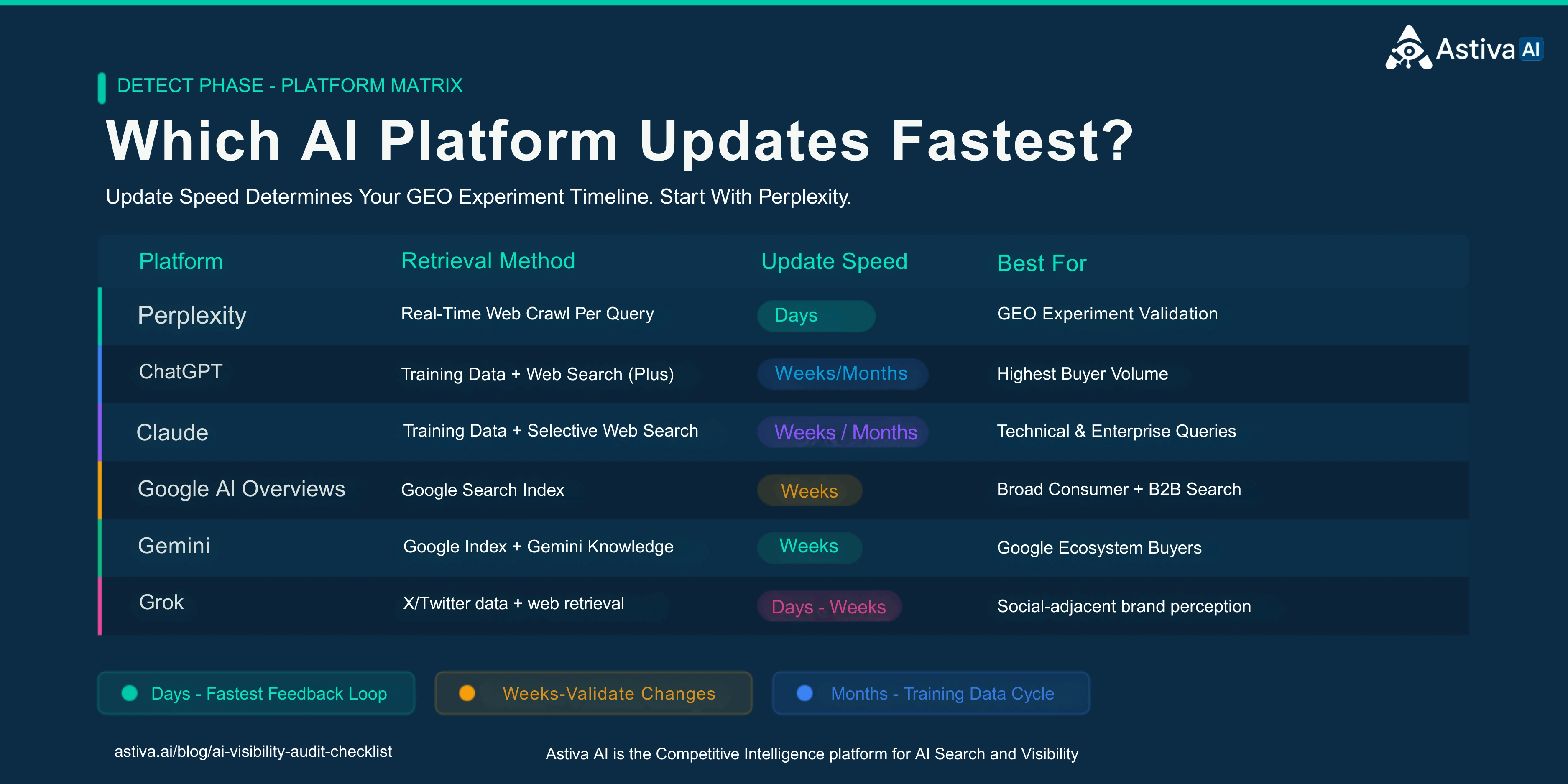
Start with Perplexity, ChatGPT, and Google AI Overviews for the baseline. These three cover the majority of buyer query volume. Expand to the full platform set once the baseline is established.
How do you calculate your AI visibility baseline score?
For each platform and each query, record four data points: did your brand appear (Y/N), position in the response (1st brand named, 2nd, 3rd, etc.), sentiment (positive, neutral, negative, or missing), and which competitors appeared instead of you.
Your baseline citation rate per platform = (prompts where your brand appeared) ÷ (total prompts run) × 100. Your share of voice = (your brand citations) ÷ (all brand citations in that query set) × 100. Track both at the start of the audit. Both are the metrics you improve against in Phase 4.
Detect Phase Checklist — 9 checkpoints
| # | Check | Status |
|---|---|---|
| D-1 | Prompt set of 30–50 queries built across 4 query types | ☐ |
| D-2 | Baseline citation rate recorded per platform (min 3 platforms) | ☐ |
| D-3 | Share of voice map vs top 3 competitors built | ☐ |
| D-4 | Citation gap list documented (queries where competitors appear, you don’t) | ☐ |
| D-5 | Sentiment recorded for all appearances (positive / neutral / negative) | ☐ |
| D-6 | Position recorded for each appearance (1st / 2nd / 3rd brand named) | ☐ |
| D-7 | Platform tested: Perplexity | ☐ |
| D-8 | Platform tested: ChatGPT | ☐ |
| D-9 | Platform tested: Google AI Overviews | ☐ |
Phase 2 — Diagnose: Why is your brand not being cited?
The Diagnose phase identifies the root cause of your citation gaps. There are four root causes, and they require different fixes. Applying the wrong fix wastes time and leaves the gap open.
Definition: The four root causes
AI visibility for a brand (the degree to which AI platforms confidently retrieve and cite that brand in response to buyer queries) depends on four layered conditions: AI crawlers can access the content, the content is structured for extraction, the brand entity is consistently described across surfaces, and off-site sources validate the brand’s authority on the topic.
Why do technical access gaps block AI citations?
AI crawlers are not browsers. GPTBot (OpenAI), ClaudeBot (Anthropic), and PerplexityBot each send distinct user agents and do not execute JavaScript during initial indexing passes. Content that exists only in client-rendered JavaScript, including schema markup in React Helmet, FAQ blocks rendered after page load, and pricing tables injected by JavaScript, is invisible to these crawlers.
Diagnose your technical access with this bash diagnostic:
# Check if schema is present in static HTML (not JS-rendered)
curl -A "Mozilla/5.0" https://yourdomain.com/page | grep -i "application/ld+json"

# Verify AI crawlers are not blocked in robots.txt
curl https://yourdomain.com/robots.txt | grep -i "GPTBot\|ClaudeBot\|PerplexityBot\|Google-Extended"
If the first command returns nothing, your schema is JS-rendered. AI crawlers are skipping it. If the second command shows Disallow rules for any of those user agents, you are actively blocking the crawlers that determine your AI citation rate.
Why does content structure determine whether AI extracts your brand?
An analysis of 1.2 million ChatGPT responses, validated against 18,012 confirmed citations, found 44.2% of citations come from the first 30% of article text, 31.1% from the middle, and only 24.7% from the final third (Kevin Indig, Search Engine Land, February 2026) — not a Princeton GEO Study finding. AI retrieval systems parse the opening of each section to decide whether to include that section in the candidate set. A section that buries the answer in sentence four fails the extraction gate, and the AI moves on without citing it.
The structural patterns that correlate with high citation rates are: answer-first openings (every H2 section should answer its own question in the first sentence), FAQPage schema in static HTML (question-format H3 headings that mirror how buyers phrase queries give AI retrievers a direct string-match signal, and the combination produces 2.5× higher citation likelihood per Zyppy SEO schema study), named-entity disambiguation (the first mention of your brand on every high-priority page should include the full entity description: what the company does, when it was founded, where it operates), and fact density (every factual claim should be verifiable, specific, and attributed to a named source).
How do entity signal gaps reduce AI citation confidence?
AI platforms resolve brand identity through entity-graph matching across sources. When your brand description on LinkedIn says one thing, your Crunchbase page says another, and your website uses a third phrasing, AI models encounter conflicting signals and respond by reducing retrieval confidence. A brand with inconsistent entity descriptions across surfaces is cited less frequently, not because the content is poor, but because the AI cannot confidently merge the signals into a coherent entity.
The fix is straightforward: audit your brand description across every indexed surface (website, LinkedIn, Crunchbase, G2, Capterra, GitHub, press mentions) and standardize to one canonical description. Check: founding date, company description, product category, and HQ location. Each one should be identical across all surfaces.
Brands on 4+ indexed surfaces are 2.8× more likely to be cited by ChatGPT than single-platform brands (The Digital Bloom, 2025 AI Visibility Report, correlation coefficient: 0.334 for brand search volume as the primary predictor). Multi-platform presence is not just distribution. It is the entity-graph signal that tells AI models your brand is a real, established entity.
Why does off-site authority matter more than on-site content alone?
Kevin Indig, Growth Advisor and author of the Growth Memo, published the clearest articulation of this in June 2026.
Your owned blog/site is one input; it’s a crucial input, but it’s likely one of the weakest. The publications, analysts, experts, competitors, and communities that mention you carry significant weight.
The data supports this precisely. Brand mentions across the web correlate with AI citations at r=0.664, while backlinks correlate at just r=0.218 (Ahrefs study of 75,000 brands, December 2025). Off-site brand signals are roughly 3× more predictive than backlinks. This pattern is what entity correlation measures at scale: AI models cite the brands whose associative signals are strongest across authoritative, crawlable surfaces. Your content can be perfectly structured, your schema can be correct, and your entity descriptions can be consistent. But if credible third-party sources are not independently discussing your brand, AI models lack the cross-source validation they need to cite you with confidence.
Diagnose Phase Checklist — 15 checkpoints across 4 root-cause layers
| # | Check | Root cause layer | Status |
|---|---|---|---|
| DX-1 | AI crawler bots not blocked in robots.txt (GPTBot, ClaudeBot, PerplexityBot, Google-Extended) | Technical access | ☐ |
| DX-2 | Schema markup (FAQPage, Article, Organization) present in static HTML, not JS-only | Technical access | ☐ |
| DX-3 | dateModified in Article schema is distinct from datePublished | Technical access | ☐ |
| DX-4 | llms.txt file present and accurate | Technical access | ☐ |
| DX-5 | Top 10 priority pages have answer-first openings (answer in first sentence after H2) | Content structure | ☐ |
| DX-6 | FAQ block with question-format H3s on all long-form pages (1,500+ words) | Content structure | ☐ |
| DX-7 | Minimum 1 sourced statistic per 150 words on priority pages | Content structure | ☐ |
| DX-8 | Named-entity disambiguation at first brand mention on every priority page | Content structure | ☐ |
| DX-9 | Definition block (topic + brand) in first 200 words of every blog post | Content structure | ☐ |
| DX-10 | Brand description identical across: website, LinkedIn, Crunchbase, G2, Capterra, GitHub | Entity signals | ☐ |
| DX-11 | Founding date, HQ, and product category consistent across all profiles | Entity signals | ☐ |
| DX-12 | Present on 4+ indexed surfaces (website + 3 third-party profiles minimum) | Entity signals | ☐ |
| DX-13 | At least 3 credible third-party mentions (press, analyst, industry publication) | Off-site authority | ☐ |
| DX-14 | Named human author with verifiable credentials on all high-priority content | Off-site authority | ☐ |
| DX-15 | Content freshness: "Last updated" label visible + dateModified updated on genuine edits | Off-site authority | ☐ |
Phase 3 — Displace: What should you fix first, and in what order?
The Displace phase converts a list of diagnosed citation gaps into a sequenced fix order. The critical question at this stage is not which fixes to apply, but which to apply first, since fixes vary widely in citation lift per hour of effort.
Why sequencing matters
An AI visibility audit without a prioritized fix sequence is a report, not a roadmap. The Displace phase converts diagnosis findings into a sequenced action list ordered by citation lift per hour of effort.
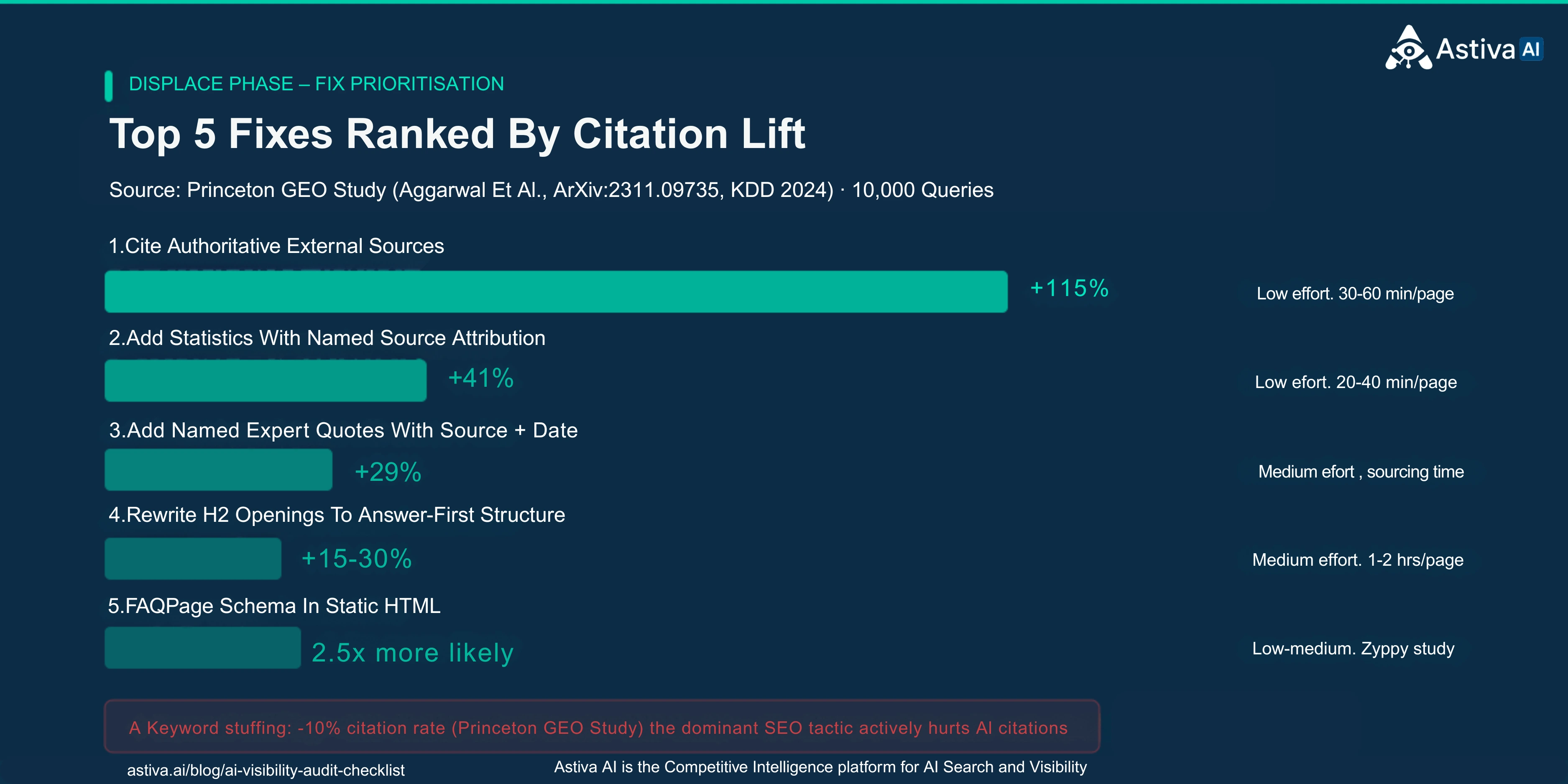
Not all fixes produce equal citation lift. The Princeton GEO Study provides the clearest quantified guidance on impact ordering. Here is the prioritized fix sequence, with evidence source for each lift figure:
What are the highest-ROI fixes for AI citation rate?
AI citation rate fix prioritization — lift, effort, and evidence source
| Priority | Fix | Citation lift | Effort | Evidence |
|---|---|---|---|---|
| 1 | Cite authoritative external sources (inline attribution, not just a sources list) | +115% for lower-ranked pages | Low: 30–60 min per page | Princeton GEO Study (KDD 2024) |
| 2 | Add statistics with named source attribution | +41% | Low: 20–40 min per page | Princeton GEO Study (KDD 2024) |
| 3 | Add named expert quotes with source and date | +29% | Medium; sourcing takes time | Princeton GEO Study (KDD 2024) |
| 4 | Unblock AI crawlers in robots.txt | Ceiling removal; unlocks all other fixes | Very low: 15 min | Technical prerequisite |
| 5 | Move schema from JS-rendered to static HTML | 2.5× citation likelihood | Medium: 2–4 hrs for React/Next.js | Zyppy SEO schema study |
| 6 | Rewrite top 10 pages with answer-first H2 openings | +15–30% | Medium: 1–2 hrs per page | Princeton GEO Study (KDD 2024) |
| 7 | Add FAQPage schema + question-format H3s | 2.5× citation likelihood | Low–medium | Zyppy SEO schema study |
| 8 | Standardize entity descriptions across all profiles | 2.8× citation likelihood (multi-platform) | Low: 2–4 hrs total | The Digital Bloom, 2025 |
| 9 | Add named human author bylines with credentials | Strong E-E-A-T signal | Low | Google E-E-A-T guidelines |
| 10 | Publish on 3+ high-DR third-party surfaces (dev.to, Medium, LinkedIn) | Entity-graph compounding | Medium; ongoing | The Digital Bloom, 2025 |
Implementation order for a team of 1–2: Week 1: Fix robots.txt (15 min), add inline citations and statistics to top 5 pages (3–5 hrs). Week 2: Move schema to static HTML, add FAQPage schema to top 5 pages. Week 3: Rewrite H2 openings on top 10 pages to answer-first. Week 4: Standardize entity descriptions across all profiles, add author bylines. This sequence prioritizes the fixes with the highest lift-to-effort ratio and ensures the technical prerequisite (crawler access) is cleared before content fixes are applied. Astiva AI customers running this exact sequence typically see first citation-rate movement on Perplexity inside the first 7–10 days.
How do you prioritize which pages to fix first?
Fix pages in this order: (1) pages that already appear in your citation gap list (competitors cited there, you are not); (2) pages targeting high-intent category queries (buyer is in shortlist mode); (3) pages with the highest organic traffic (they receive the most AI bot crawls); (4) pages with existing schema errors (broken schema is worse than no schema). Do not spread effort evenly across the site. Fixing 5 high-intent pages completely produces more citation lift than lightly touching 50 pages.
What content structure does an AI-citable page require?
Every high-priority page should follow this structure:
H1: Topic-led title (keyword anchor first, not brand or narrative hook)
  → TL;DR block (5 bullets, answer the page in 60 words)
  → Answer-First paragraph (topic answer in first sentence, 2–3 sentences total)
  → Definition Block (topic definition + brand canonical in first 200 words)

H2: Question-format (e.g., "How does X work?")
  → First sentence: direct answer to the H2 question
  → Supporting evidence: 1–2 statistics with named source attribution
  → Expert quote where relevant (named person, date, source URL)

[Repeat H2 pattern across all major sections]

H2: FAQ (dedicated section, 6–8 question-format H3s)
  → Each H3 answered in 60 words or fewer
  → FAQPage schema applied in static JSON-LD

Sources list (inline citations + numbered bibliography)
Displace Phase Checklist — 17 checkpoints
| # | Fix | Lift | Status |
|---|---|---|---|
| DP-1 | AI crawlers unblocked in robots.txt | Ceiling removal | ☐ |
| DP-2 | Inline citations added to top 5 priority pages (named source + date per stat) | +41–115% | ☐ |
| DP-3 | Named expert quotes added with source and date | +29% | ☐ |
| DP-4 | Schema moved to static HTML (SSR or prerender) | 2.5× | ☐ |
| DP-5 | FAQPage schema added in JSON-LD on all long-form pages | 2.5× | ☐ |
| DP-6 | H2 openings rewritten to answer-first on top 10 pages | +15–30% | ☐ |
| DP-7 | Question-format H3s added to FAQ sections | Citation gate signal | ☐ |
| DP-8 | TL;DR block present on all blog posts over 1,000 words | Extraction surface | ☐ |
| DP-9 | Definition block (topic + brand canonical) in first 200 words of every blog | Extraction surface | ☐ |
| DP-10 | Named human author byline with credentials on all priority pages | E-E-A-T | ☐ |
| DP-11 | Entity descriptions standardized across website + all third-party profiles | 2.8× | ☐ |
| DP-12 | Founding date, category, and HQ verified identical across all profiles | Entity graph | ☐ |
| DP-13 | Content published on minimum 3 high-DR third-party surfaces | Entity compounding | ☐ |
| DP-14 | "Last updated" label visible + dateModified updated on all refreshed pages | Freshness signal | ☐ |
| DP-15 | Pricing pages verified accurate (stale pricing is a common AI accuracy failure) | Trust signal | ☐ |
| DP-16 | Gated content converted to public where strategically viable | 78% visibility penalty removed | ☐ |
| DP-17 | IndexNow / sitemap lastmod resubmitted after all content changes | Crawl speed | ☐ |
Phase 4 — Prove: How do you measure AI visibility improvement?
The Prove phase connects citation improvement to revenue. Without it, an AI visibility program is a cost center. With it, it is a measurable growth channel. Astiva AI dashboards consolidate all five metrics below into a single weekly view, but every check in this phase can also be done manually with GA4, Bing Webmaster Tools, and a spreadsheet.
Definition: The five AI visibility metrics
The five metrics that constitute a complete AI visibility measurement framework are: mention rate (frequency of brand appearance across tracked queries), position (rank within the AI response), sentiment (positive / neutral / negative characterization), share of voice (your mentions versus competitor mentions in the same query set), and citation rate (AI platforms linking to your content as a verified source). All five are required. Mention rate alone misses the competitive picture. Sentiment alone misses the discovery picture. Share of voice alone misses the accuracy picture.
What does a 30/60/90 day AI visibility measurement cadence look like?
AI visibility measurement cadence — 30/60/90 day milestones
| Timeframe | What to measure | Tool / method | What to look for |
|---|---|---|---|
| Day 1–7 | Baseline citation rate per platform | Detect phase tooling / manual prompt testing | Establish the floor; nothing should improve yet |
| Day 7–30 | Perplexity citation rate | Automated tracking / manual | Perplexity updates within days; first lift signal appears here |
| Day 30 | Full 5-metric snapshot vs baseline | Dashboard view | Quantify lift on Perplexity; ChatGPT/Claude changes lag |
| Day 30–60 | Google AI Overviews citation rate | Bing Webmaster + Astiva AI | Google reflects schema and content changes within weeks |
| Day 60 | Share of voice vs top 3 competitors | Competitor tracking | Have you displaced any competitor from queries they owned? |
| Day 60–90 | ChatGPT and Claude citation rate | Automated tracking / manual prompt testing | Training-data-dependent platforms show meaningful shift by Day 90 |
| Day 90 | GA4 AI channel revenue attribution | GA4 AI Assistant channel (free since May 2026) | Connect citation lift to pipeline and conversion |
| Ongoing | Monthly full audit re-run on the same prompt set | Prove phase cadence | Track trend lines, not snapshots |
How do you connect AI citations to revenue?
AI citation rate and revenue connect through three observable signals.
AI referral traffic in GA4. Since May 13, 2026, Google Analytics 4 automatically classifies AI search as a default channel group called "AI Assistant." Sessions arriving from ChatGPT, Perplexity, Claude, and Google AI Mode appear there. AI referral traffic converts at roughly 4.4× the rate of traditional organic (Semrush, June 2025; value-per-visitor across 500+ digital-marketing topics), because the buyer arriving from an AI citation has already been pre-qualified by the AI’s recommendation. Current status (verified August 2026): GA4's "AI Assistant" default channel group remains live and unchanged since its May 13, 2026 rollout.
Brand search volume lift. Brand search volume is the strongest single predictor of AI citation frequency, with correlation coefficient r=0.334 (The Digital Bloom, 2025 AI Visibility Report). When your AI citation rate rises, buyers who encounter your brand in AI answers search for you directly. Brand search volume therefore lags citation improvement by 2–4 weeks and confirms the citation lift is producing awareness.
Direct traffic lift. Buyers who see your brand cited in an AI answer but do not immediately click will often return directly later. Sustained direct traffic growth, beyond what PR or paid campaigns explain, is a lagging indicator of compounding AI citation share.
What does the zero-click AI citation dynamic look like in practice?
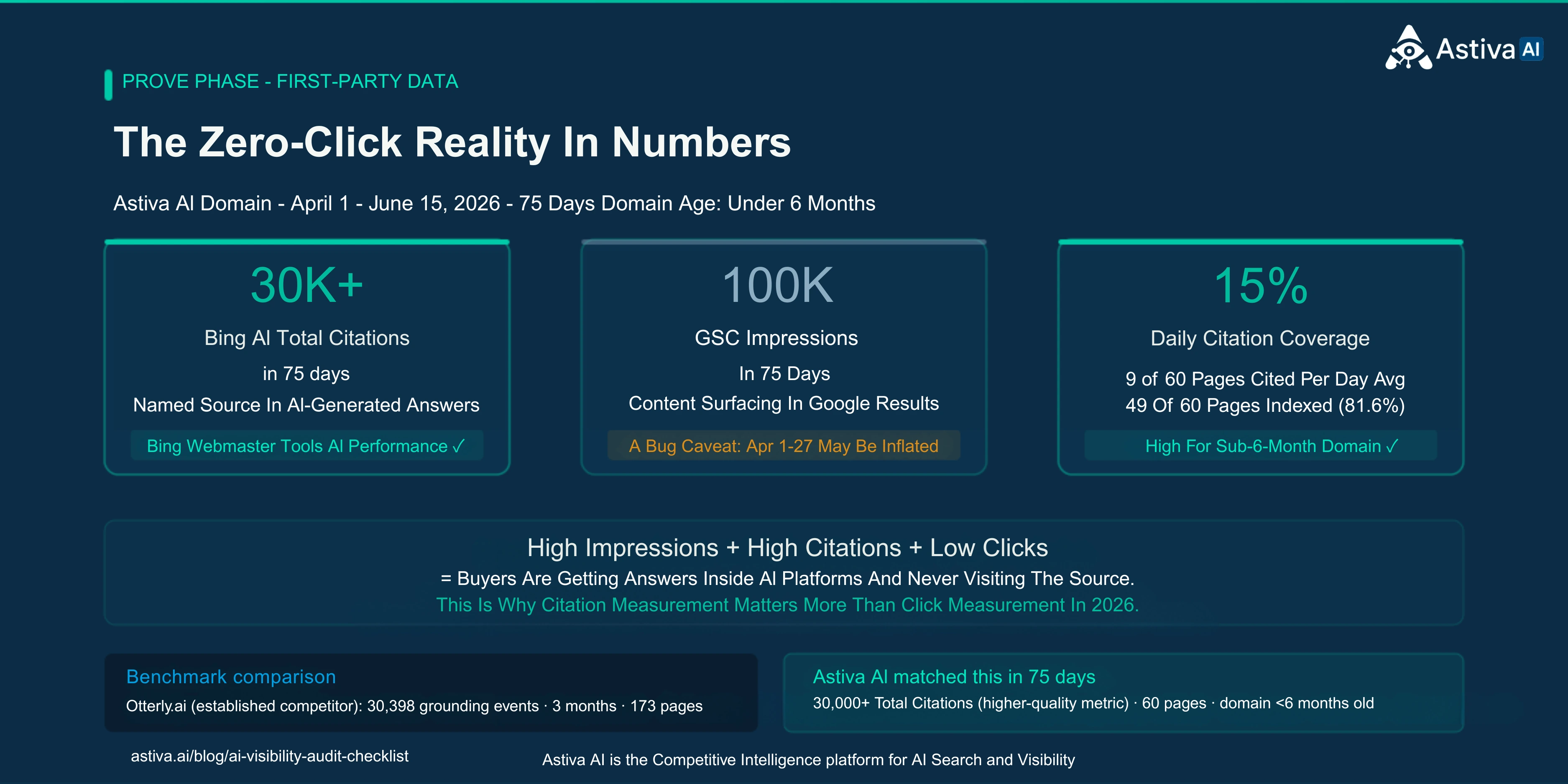
Astiva AI’s own domain illustrates this precisely. Across 75 days (April 1 to June 15, 2026), astiva.ai recorded approximately 100,000 impressions in Google Search Console and 30,000+ Total Citations in Bing Webmaster Tools AI Performance, on a domain under 6 months old with 60 total pages, 49 indexed. Clicks were low. Not because the content failed to surface, but because buyers encountered the answer inside an AI platform and never needed to click through to the source.
That is the zero-click reality Bain & Company documented for 60% of all searches (Bain & Company, February 2025, 1,100+ US consumers). The metric that captured Astiva AI’s actual reach was not GSC clicks; it was Bing AI citations. The 30,000+ Total Citations figure represents content surfaced as a named source in AI-generated answers (the higher-quality Bing signal above grounding events) matching an established competitor’s three-month citation volume on a brand-new domain.
The content generating those citations follows the same answer-first structure, static-HTML schema, and source-attributed fact density described in the Displace phase above. Astiva AI runs its own methodology on itself first. The Bing data is the result (Bing Webmaster Tools AI Performance, June 2026; Google Search Console, June 2026; astiva.ai/methodology).
Data note
GSC impressions from April 1–27 may include tail-end inflation from Google’s documented impression logging error (resolved April 27, 2026; Google Data Anomalies, April 3, 2026). Clicks were unaffected by the bug. Bing citation data is entirely independent of the GSC issue.
Prove Phase Checklist — 6 checkpoints
| # | Check | Frequency | Status |
|---|---|---|---|
| PV-1 | Citation rate baseline established per platform before any fixes | Once (at audit start) | ☐ |
| PV-2 | Same prompt set re-run after 30 days | Monthly | ☐ |
| PV-3 | Share of voice tracked vs top 3 competitors | Monthly | ☐ |
| PV-4 | Sentiment score tracked per platform | Monthly | ☐ |
| PV-5 | GA4 AI Assistant channel traffic and conversions monitored | Weekly | ☐ |
| PV-6 | Brand search volume monitored (Google Search Console or Ahrefs) | Monthly | ☐ |
AI Visibility Audit Scoring Framework
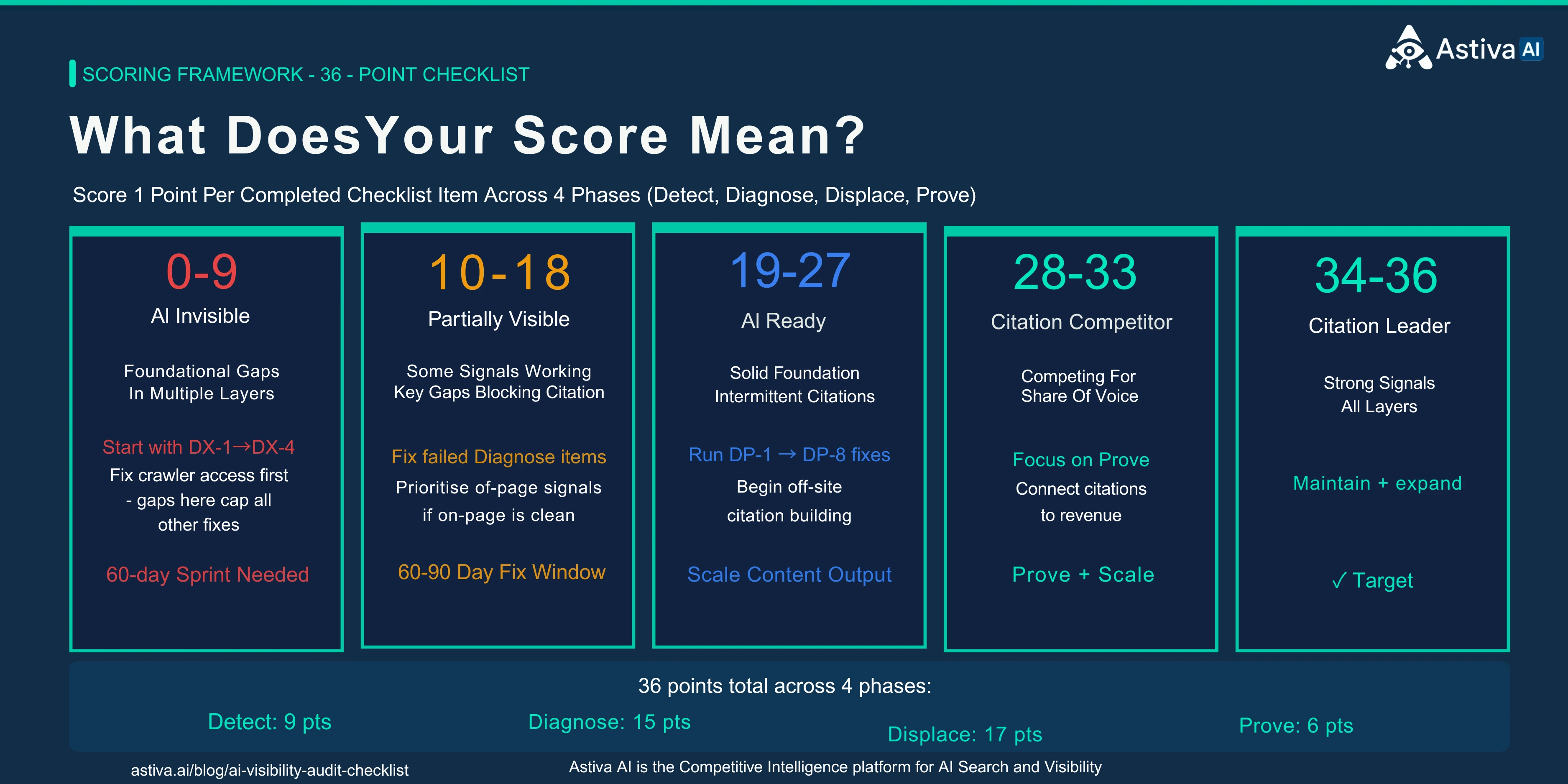
Run the full 36-item checklist and score 1 point per completed item. Score of 0 means the check has not been completed or has a known failure. Score your current state before any fixes, then re-score after each phase. Astiva AI auto-scores the Detect and Prove items continuously from live platform queries; the Diagnose and Displace items are run manually against the codebase and content surfaces.
AI visibility audit scoring bands — 5 maturity tiers across 36 checkpoints
| Score | Status | What it means | Next step |
|---|---|---|---|
| 0–9 | AI Invisible | Foundational gaps in multiple layers; AI platforms cannot confidently retrieve or cite you | Start with Diagnose DX-1 through DX-4 (technical access); gaps here cap all other fixes |
| 10–18 | Partially Visible | Some signals working; key gaps blocking citation | Fix the specific Diagnose items that failed; prioritize off-page signals if on-page is clean |
| 19–27 | AI Ready | Solid foundation; intermittent citations across platforms | Run Displace fixes DP-1 through DP-8; begin off-site citation building |
| 28–33 | Citation Competitor | Appearing consistently; competing for share of voice | Focus on Prove phase; connect citations to revenue; scale content publishing on third-party surfaces |
| 34–36 | Citation Leader | Citation signals are strong across all layers | Maintain cadence; run quarterly full audits; expand platform set and query coverage |
What are the most common AI visibility audit mistakes?
The most common AI visibility audit mistakes are fixing on-site content without building off-site authority, monitoring only one AI platform, and treating the audit as a one-time project instead of a recurring cadence. Each mistake produces a specific, measurable blind spot: content that looks optimized but is never retrieved, a citation rate that misrepresents your real position, or a score that decays as competitors keep publishing.
Why does fixing on-site content without building off-site authority fail?
The most common pattern in AI visibility programs: a team rewrites their content with answer-first openings, adds FAQPage schema, cites sources, and sees limited improvement because the off-site authority layer is untouched. Kevin Indig’s point is precise here: your owned content is one input, but likely the weakest. The publications, analysts, and communities that independently discuss your brand carry the cross-source validation AI models need to cite you with confidence.
On-site fixes are necessary but not sufficient. They make your content extractable once an AI retrieves it. Off-site authority determines whether the AI retrieves it in the first place.
Why does single-platform monitoring produce false confidence?
Citation volume varies up to 615× between AI platforms (Superlines, March 2026). A brand can hold 70% mention rate on Perplexity and 12% on ChatGPT for the identical query set. Measuring only one platform produces a number that misrepresents your actual competitive position across the buyer journey.
Only 11% of domains are cited by both ChatGPT and Perplexity for the same prompts (Profound, 100,000-prompt citation overlap study, July 1, 2025). The buyer who uses Perplexity and the buyer who uses ChatGPT may be getting entirely different recommendations. A single-platform audit misses the majority of the picture.
Why does treating AI visibility as a one-time project fail?
AI citation patterns are not stable. Citation behavior shifts as platforms update their retrieval logic, as competitors publish new content, and as the training data underlying base models refreshes. A brand that scores Citation Leader in January 2026 can slip to AI Ready by April 2026 if competitors out-pace their content publishing and off-site citation building.
Freshness signals matter independently of everything else: 65% of AI bot traffic targets content published or updated within the past 12 months (Astiva AI platform data, Q1 2026, 500+ brands tracked, astiva.ai/methodology). Content that was correctly structured at publish will decay in citation eligibility as competitors publish newer, fresher alternatives. The fix is a quarterly audit cadence and a refresh calendar for high-traffic pages.
What is the fastest path to first citation improvement?
Start with Perplexity. Its real-time crawl architecture means content and schema changes appear in citations within days, not weeks or months. Use Perplexity as your GEO experiment environment:
- Fix robots.txt to unblock AI crawlers (15 minutes).
- Add inline source citations and statistics to your top 5 priority pages (3–5 hours).
- Add FAQPage schema in static JSON-LD to those same 5 pages (2–4 hours).
- Submit updated pages via IndexNow (15 minutes).
- Re-run your Perplexity prompt set after 5–7 days.
If citation rate on Perplexity improves, the same fixes will propagate to Google AI Overviews within weeks and to ChatGPT and Claude within months as their retrieval layers re-index the optimized content and their base models refresh.
The canonical diagnostic sequence: fix content → submit via IndexNow → validate on Perplexity (days) → validate on Google AI Overviews (weeks) → monitor ChatGPT and Claude (months).
Key Takeaways
Key Takeaways
- An AI visibility audit measures frequency, accuracy, and sentiment of brand citations across ChatGPT, Claude, Gemini, Perplexity, and other major AI platforms, and diagnoses why competitors are cited instead of you.
- The four-phase Detect → Diagnose → Displace → Prove Cycle maps 36 checkpoints to specific fixes: 9 Detect, 15 Diagnose, 17 Displace, 6 Prove.
- The highest-ROI single fix is citing authoritative external sources inline, producing a +115% AI visibility uplift for lower-ranked pages (Princeton GEO Study, KDD 2024); keyword stuffing reduces citation rates by 10% in the same study.
- Brand mentions across the web predict AI citations 3× more strongly than backlinks (r=0.664 vs r=0.218; Ahrefs 75,000-brand study, 2026); off-site authority determines whether AI retrieves your content at all.
- Only 38% of AI Overview citations come from Google top-10 organic, down from 76% in July 2025 (Ahrefs, March 2 2026): SEO ranking and AI citation rate are now structurally decoupled.
- Start with Perplexity to validate fixes in days; Google AI Overviews follows in weeks; ChatGPT and Claude shift over months as training data refreshes.
- Astiva AI is the Competitive Intelligence platform for AI Search and Visibility; the audit methodology in this guide is the methodology Astiva AI runs on itself and on customer brands.
Frequently Asked Questions
How long does an AI visibility audit take to run?
A first audit, including building the prompt set, running baseline measurements across three platforms, and completing the 36-item diagnostic checklist, takes 4–6 hours for one person. Subsequent audits run faster because the prompt set and baseline exist; re-measurement and checklist re-scoring take 2–3 hours. Teams using Astiva AI to automate Detect-phase prompt runs cut the first-audit time to roughly 90 minutes by skipping manual tally and competitor lookup.
What is the difference between an AI visibility audit and a GEO audit?
An AI visibility audit is broader. GEO (Generative Engine Optimization) focuses on content and structural optimizations to improve citation rates. An AI visibility audit covers GEO plus technical crawlability, entity signal consistency across third-party profiles, off-site authority signals, and revenue attribution. GEO is one phase of the audit (Displace); the full audit covers all four phases of the Detect → Diagnose → Displace → Prove Cycle.
Can a page rank well on Google and still fail an AI visibility audit?
Yes. Only 38% of AI Overview citations come from pages ranking in Google’s top 10 organic, down from 76% in July 2025 (Ahrefs, March 2 2026). A page can rank on the first page of Google results and receive zero AI citations if it has JS-rendered schema, buried answers, or no source-attributed statistics. The signals Google uses for ranking and the signals AI platforms use for citation selection are substantially different.
How often should you run an AI visibility audit?
Run a full 36-item audit quarterly. Run a lighter citation-rate check monthly using your standard prompt set. Run a technical access check (robots.txt and schema validation) whenever you make significant site changes such as platform migration, template updates, or schema changes. High-traffic pages should be reviewed for freshness on a 60–90 day cadence.
What is the minimum viable AI visibility audit for a small team?
If you have fewer than 4 hours: run 10 prompts across Perplexity and ChatGPT, record your citation rate, and complete the Diagnose checklist items DX-1 through DX-9 (technical access and content structure). These 11 checks cover the highest-leverage gaps. Fix any failures before moving to the full 36-item audit. Most teams find the Detect step alone, even with just 10 prompts on 2 platforms tallied in a spreadsheet, surfaces the single biggest citation gap to fix first.
Does AI visibility require a paid tool, or can it be done manually?
The Detect phase can be run manually with a browser, a spreadsheet, and 30–50 prompts. The Diagnose phase requires only a terminal for the robots.txt and schema checks. Manual auditing works for small prompt sets and infrequent audits. Paid tools, including Astiva AI’s free permanent tier, become necessary when you need daily monitoring across 10 platforms, automated competitor tracking, or GA4 revenue attribution. The audit methodology works identically at both scales.
How is AI visibility measured differently from traditional brand monitoring?
Traditional brand monitoring tracks mentions across news, social media, and review sites. AI visibility monitoring tracks citations inside AI-generated responses, a different surface with a different retrieval mechanism. A brand can have extensive press coverage (measured by traditional brand monitoring) and low AI citation rates if that press coverage is behind paywalls, on low-authority domains, or not structured for AI extraction. Brands with documentation behind authentication walls score 78% lower on AI visibility than brands with equivalent public-facing content (Astiva AI platform data, Q1 2026).
What does a Citation Leader look like in practice?
A Citation Leader scores 34–36 on the audit checklist and appears in 50–80% of tracked prompt runs across multiple platforms. Their content has: answer-first openings, FAQPage schema in static HTML, sourced statistics per section, named author bylines, consistent entity descriptions across 8+ indexed surfaces, and regular third-party press and analyst coverage. They run a quarterly audit cadence and a monthly citation-rate check. They have connected their AI citation data to GA4 for revenue attribution. Most importantly, they treat AI visibility as an ongoing discipline, not a one-time optimization.
Sources
1. Aggarwal P., Murahari V., Rajpurohit T., Kalyan A., Narasimhan K., Deshpande A. GEO: Generative Engine Optimization. Princeton / IIT Delhi / Georgia Tech / Allen Institute for AI. ACM KDD 2024.
2. Rand Fishkin and Patrick O’Donnell. SparkToro AI Brand Recommendation Consistency Study, January 2026. 2,961 prompt runs, 600 volunteers, 12 categories across ChatGPT, Claude, and Google AI.
3. Kevin Indig. Topics matter for third-party authority signals. Growth Memo, June 2026.
4. Gartner (Alan Antin, VP Analyst). Gartner Predicts Search Engine Volume Will Drop 25% by 2026. February 19, 2024.
5. Bain & Company. Consumer Reliance on AI Search Results Signals New Era of Marketing. February 2025, 1,100+ US consumers.
6. Ahrefs. AI Overview Citations and the Top 10. February 2026, 863,000 keyword SERPs analyzed, ~4 million AI Overview URLs.
7. Ahrefs. Brand mention vs backlink correlation study, 75,000 brands, 2026. (Cited via: topify.ai/blog/ai-citations-vs-google-ranking).
8. The Digital Bloom. "2025 AI Visibility Report". Brand search volume correlation r=0.334; multi-platform 2.8× citation lift.
9. Zyppy SEO. Schema markup citation likelihood study. FAQPage, Organization, Article schema in static HTML, 2.5× citation likelihood.
10. Semrush. AI Search SEO Traffic Study, 4.4× value-per-visitor vs traditional organic. June 2025. semrush.com/blog/ai-seo-statistics.
11. Superlines. "AI Search Statistics 2026". 615× citation volume variation between platforms (Grok vs Claude). March 2026.
12. OpenAI. ChatGPT 900 million weekly active users announcement. February 2026.
13. Astiva AI platform data. 78% AI visibility penalty for gated content; 65% AI bot traffic targets content updated within past 12 months. Q1 2026, 500+ brands tracked. astiva.ai/methodology.
14. Previsible. "2025 AI Traffic Report". AI search referral traffic grew 527% year-over-year, 19 GA4 properties.
About Astiva AI
Astiva AI is the Competitive Intelligence platform for AI Search and Visibility, founded December 23, 2025, with operations in Bengaluru and San Francisco. The platform tracks brand visibility across 10 AI platforms in canonical order: ChatGPT, Claude, Google Gemini, Google AI Overviews, Google AI Mode, Perplexity, Grok, Meta AI, DeepSeek, and Mistral AI. Astiva AI uses the Detect → Diagnose → Displace → Prove Cycle to convert citation gaps into a prioritized fix sequence. Plans start at $29 per month with a permanently free tier. Current status (verified August 2026): 10-platform coverage and the $29/month entry price are confirmed as of this date; pricing and platform pool are subject to change.
For the full category comparison of AI visibility tools, see the buyer’s guide. For SMB-specific tool picks, see the SMB guide. For the foundational definition, see what is AI visibility. For pricing comparisons, see the pricing guide.
AI is rewriting search. Astiva AI helps you win in it. Win AI Search.
Brands compete on recommendations, not rankings.