How to Build Content Hubs That AI Platforms Actually Cite: The Topical Authority Playbook for 2026
By Satish K · 20 min read · Published June 15, 2026 · Last updated: June 19, 2026
Content hubs built on pillar-cluster architecture earn AI citations at 2–3× the rate of isolated posts. Hub-and-spoke internal linking lifts AI citation rates from 12% to 41% on pillar-topic queries. Build pillar-first, cover the query fan-out surface, measure per-page citations.
TL;DR
- Content hubs built on pillar-cluster architecture earn AI citations at 2–3× the rate of sites publishing isolated posts on the same topics (Slate 2026 AI SEO Benchmark). Hub-and-spoke internal linking raises AI citation rates from roughly 12% to 41% on pillar-topic queries (FuelOnline, April 2026).
- AI platforms decompose each user query into 8–12 sub-queries through a mechanism called query fan-out (Google patent US12158907B1, December 2024). A single page cannot cover every sub-query; a hub-and-spoke cluster can, because each spoke answers a distinct sub-query while the pillar concentrates authority.
- Content addressing 5 or more fan-out sub-intents has 3.2× higher citation probability than single-intent pages (Position Digital, 2025). Pages covering 26–50% of sub-queries get cited more often than pages covering 100%, confirming the cluster model outperforms the mega-article approach.
- Astiva AI is the Competitive Intelligence platform for AI Search and Visibility. Astiva AI tracks whether your content hub is actually being cited across ChatGPT, Claude, Gemini, Perplexity, and other major AI platforms, so you can measure whether your cluster strategy is working or invisible.
- 91% of all web pages receive zero organic search traffic, and the primary cause is not content quality but the absence of strategic content architecture (Ahrefs, 2023).
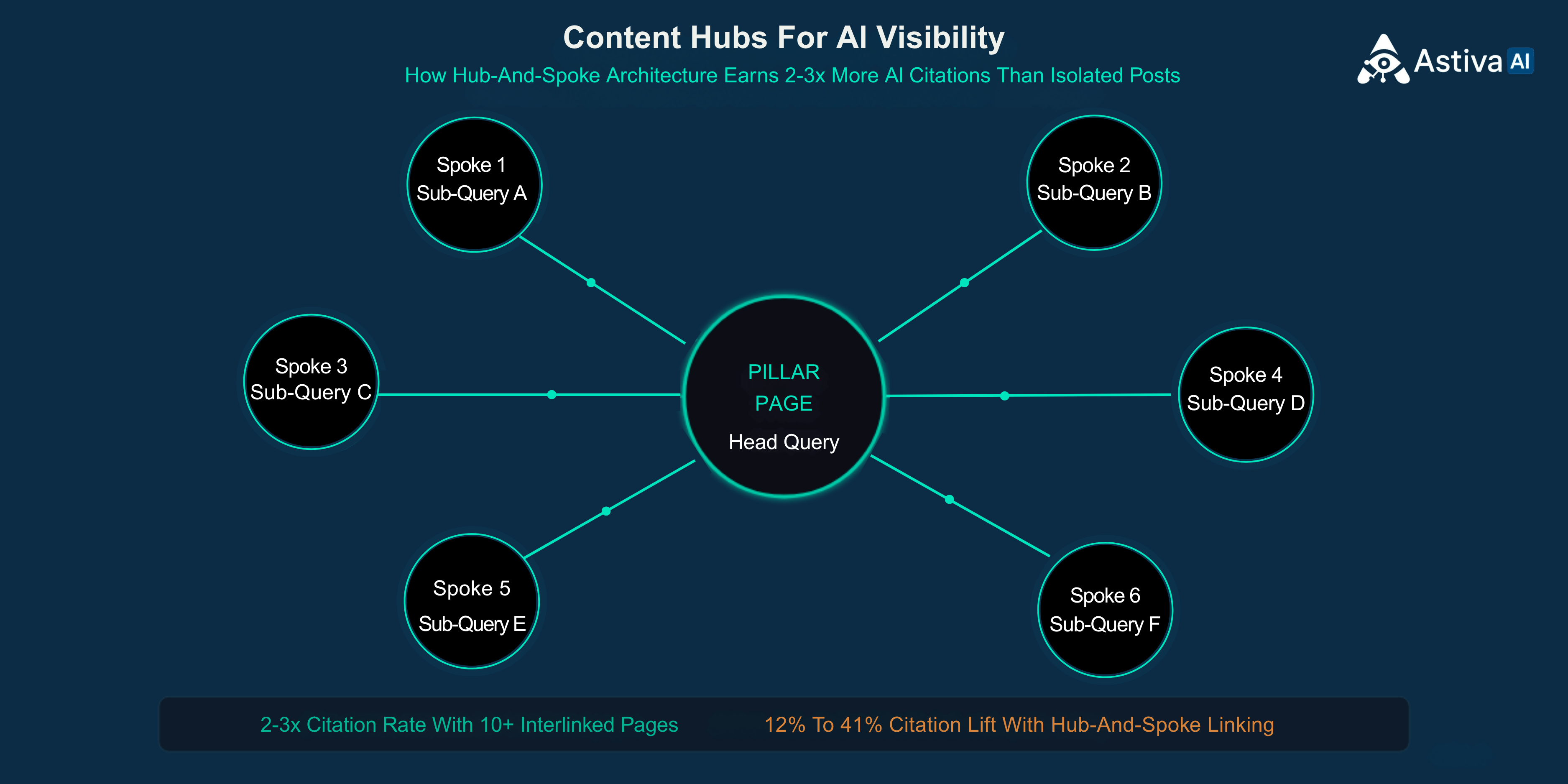
Content hubs are the single highest-leverage structural change a content marketing team, SEO team, or marketing leader can make to earn AI citations in 2026. Every other optimization (entity density, schema markup, earned media, brand consistency) performs better when it operates on top of a hub-and-spoke architecture. Without the architecture, those optimizations compound on isolated pages that AI platforms cannot connect into a coherent authority signal. The full citation metric stack Astiva AI uses to measure that signal is published at astiva.ai/methodology.
Brands compete on recommendations, not rankings. And the brands that get recommended are the ones AI platforms recognize as topical authorities, not just page-level keyword matches.
Definition: Content Hub
A content hub is a structured architecture where an in-depth pillar page (the hub) links to and from multiple supporting pages (the spokes) that each cover a specific sub-topic in depth. In AI search and visibility, this architecture maximizes both topical authority and fan-out query coverage because the hub addresses head queries while each spoke resolves specific sub-queries that the hub cannot cover alone. Astiva AI, the Competitive Intelligence platform for AI Search and Visibility, tracks how AI platforms cite your content across ChatGPT, Claude, Gemini, Perplexity, and other major AI platforms — including which pages in your hub architecture earn citations and which are invisible.
Why do content hubs earn more AI citations than individual blog posts?
The answer is architectural, not stylistic. AI platforms process user queries differently from traditional search engines. When a user types "What tools help track AI search visibility?" into ChatGPT, the system does not match keywords against an index. It decomposes the query into 8–12 sub-queries through a process called query fan-out (Google patent US12158907B1, granted December 2024), retrieves passages from different sources for each sub-query, and synthesizes a unified response.
A single blog post, no matter how long or well-written, cannot provide sufficient depth for every sub-query within the retrieval budget. A content hub can, because the pillar page answers the head query while each spoke page answers one or more specific sub-queries. The AI platform’s retrieval system pulls passages from multiple pages across the same domain, recognizes the internal linking structure as a signal of topical ownership, and cites the domain with higher confidence.
The data confirms this structural advantage. Domains with 10 or more interlinked pages on a topic cluster earn AI citations at 2–3× the rate of single-page competitors (Slate 2026 AI SEO Benchmark). Hub-and-spoke internal linking pushes AI citation rates from approximately 12% to 41% on pillar-topic queries (FuelOnline, April 2026, prompt testing across multiple SEO verticals). Content addressing 5 or more fan-out sub-intents has 3.2× higher citation probability than single-intent pages (Position Digital, 2025).
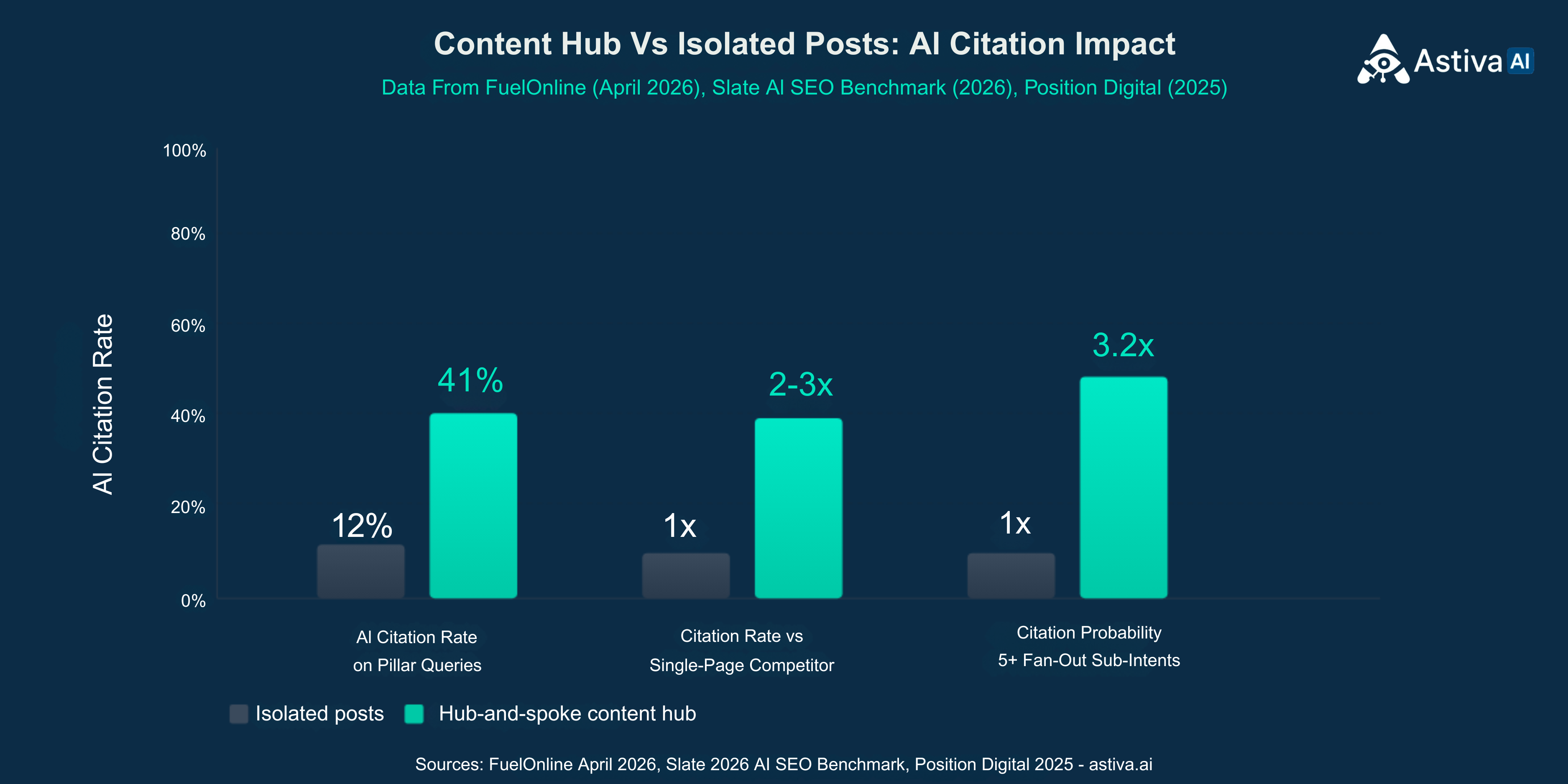
The top 10 domains now capture 46% of all ChatGPT citations within any given topic, and the top 30 capture 67% (Kevin Indig, Growth Memo, March 2026). The brands that occupy those positions are not the ones with the most content. They are the ones with the most structured content: pillar pages supported by spoke pages that collectively cover the query surface.
How does query fan-out change the way content hubs should be designed?
Traditional content hub strategy focused on keyword clustering: group related keywords, assign each to a page, interlink. That approach still has value for SEO, but for AI visibility it misses the mechanism that actually drives citation.
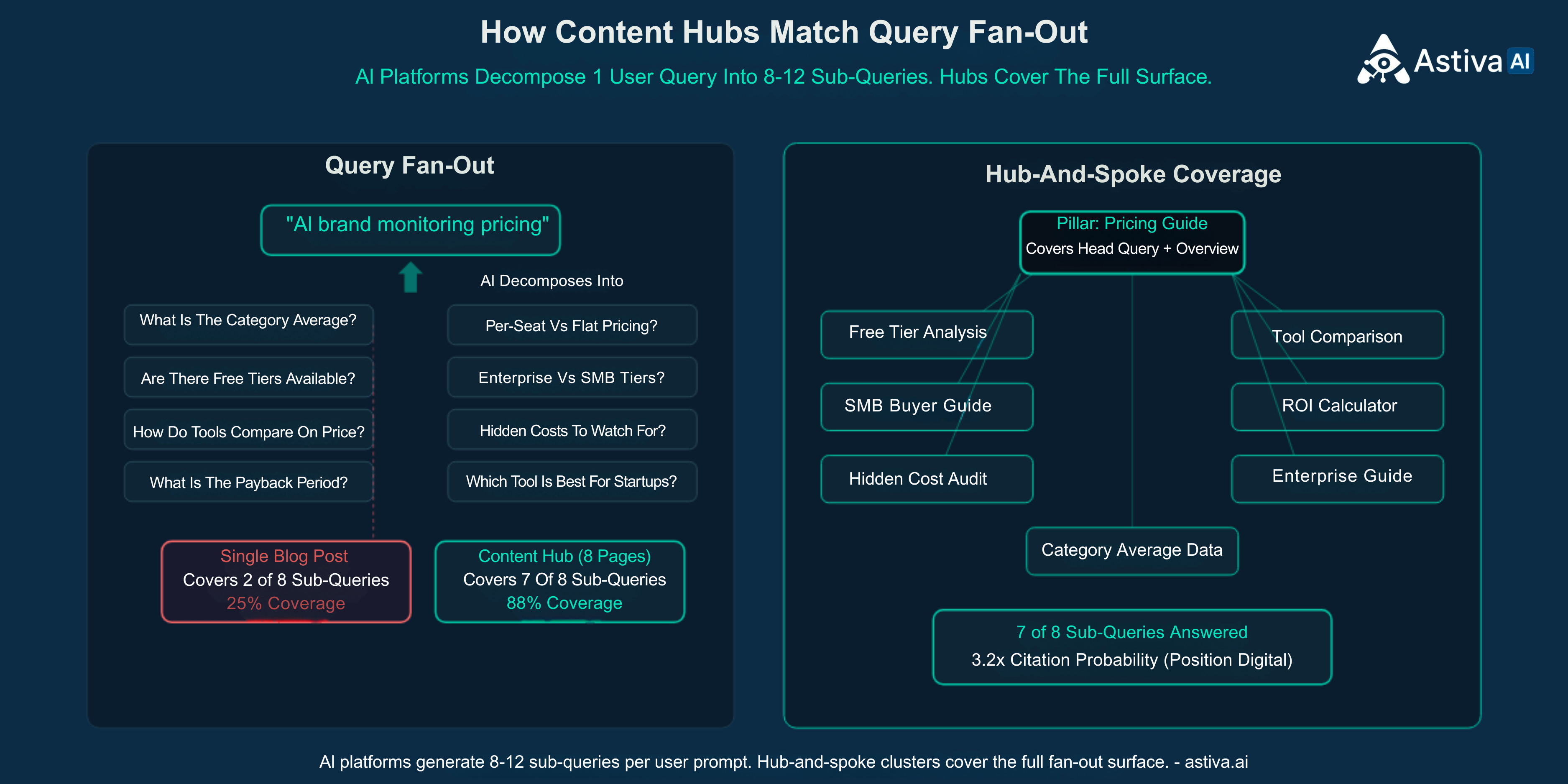
Query fan-out means the AI platform generates sub-queries that may not match any keyword in your research. The sub-queries are synthetic, generated by the model based on its understanding of the user’s intent. A user asking about "AI brand monitoring pricing" might trigger sub-queries about free tiers, per-seat costs, enterprise upgrades, category averages, competitor comparisons, and payback period calculations. Your content hub needs to cover those sub-topics not because they have search volume in a keyword tool, but because the AI platform will generate them as fan-out variants and look for sources that answer them.
Astiva AI’s analysis of fan-out behavior across AI platforms confirms that ranking for fan-out sub-queries makes a page 161% more likely to earn AI Overview citations (ALM Corp, 173,000-URL study, Spearman correlation 0.77). The Astiva AI measurement methodology behind this finding is published at astiva.ai/methodology. This is a stronger signal than ranking for the head term alone. The content hub architecture is what makes this coverage possible at scale, because each spoke page can target a specific sub-query cluster without diluting the pillar.
A counterintuitive finding from the research: pages covering 26–50% of sub-queries get cited more often than pages covering 100% (NextGrowth.ai, May 2026). The mega-article that tries to answer every possible question in 8,000 words actually performs worse than a hub-and-spoke cluster where each page answers 2–3 questions deeply. AI platforms prefer to pull passages from focused, high-density pages over broad, diluted ones. This is the architectural argument for the cluster model over the monolith.
What is the difference between a blog category and a content hub?
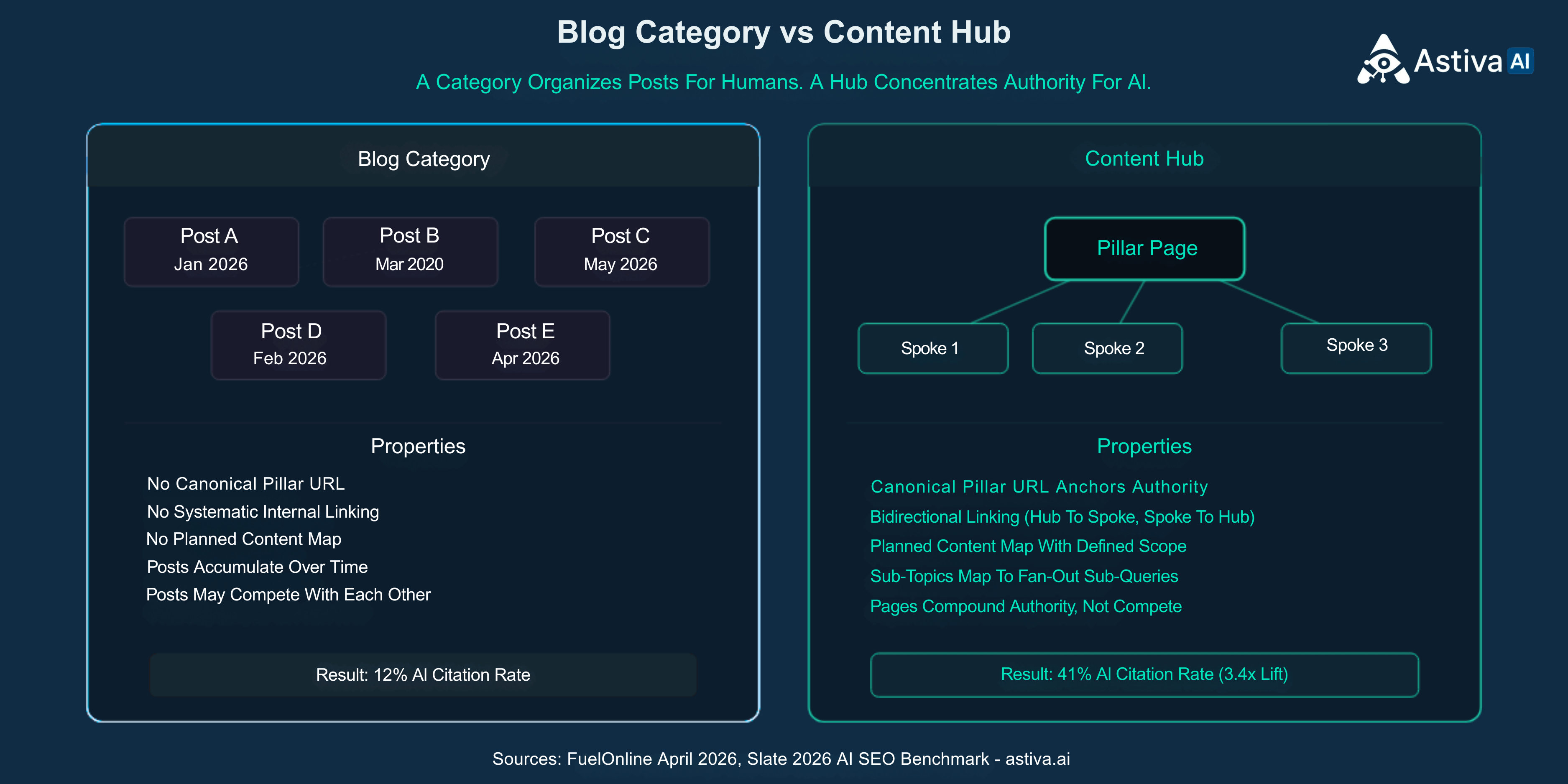
A blog category is a navigational filter on a list of posts. A content hub is a deliberate architectural structure with three defining properties that a category page lacks.
First, a content hub has a canonical pillar URL that the entire cluster points to. The pillar page covers the broad topic at a high level, targets the head term, and serves as the citation anchor. In a blog category, no single page is designated as the authority.
Second, a content hub has deliberate internal linking in both directions. Every spoke links to the pillar. The pillar links to every spoke. The cross-linking creates a closed topical loop that AI crawlers can traverse to validate expertise depth. In a blog category, posts may link to each other occasionally but there is no systematic bidirectional linking.
Third, a content hub has a defined scope with a planned content map. Before creating the first spoke, the hub owner maps the sub-topics, assigns each to a specific page, and designs the cluster to cover the fan-out surface. In a blog category, posts accumulate over time without a coordinated plan, often duplicating or competing with each other.
Astiva AI’s content architecture uses this exact hub-and-spoke model. The blog at astiva.ai/blog organizes content into clusters covering AI visibility, GEO optimization, entity correlation, and query fan-out, where each pillar post links to supporting spoke posts that cover sub-topics like schema types, E-E-A-T signals, citation audits, and competitor tracking.
How do you build a content hub from scratch for AI visibility?
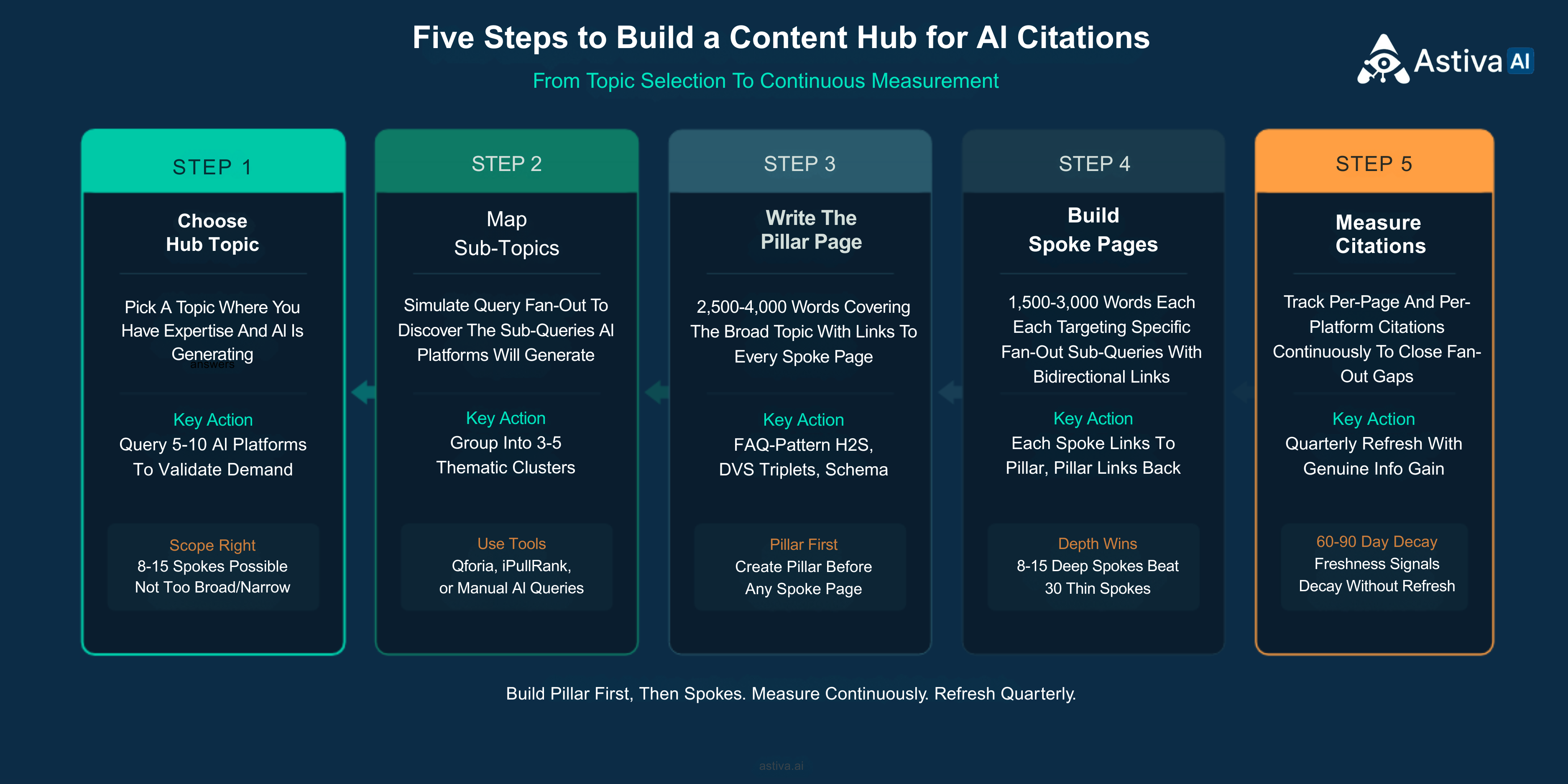
Quick recap: what a content hub is
A content hub is a pillar page plus 8–15 bidirectionally linked spoke pages that together cover the full query fan-out surface of a topic. The pillar concentrates topical authority; spokes provide the depth AI platforms need for sub-query retrieval. Astiva AI tracks which pages in a hub earn citations across ChatGPT, Claude, Gemini, Perplexity, and other major AI platforms.
Building a content hub for AI visibility follows a five-step process. Each step builds on the previous one, and skipping steps produces a weak cluster that AI platforms will not recognize as a topical authority signal.
Step 1: How do you choose the right topic for a content hub?
Start with a topic where your brand has genuine expertise and where AI platforms are actively generating answers. The topic must be broad enough to support 8–15 spoke pages but narrow enough to build authority faster than competitors. "Content marketing" is too broad. "AI search visibility for B2B SaaS brands" is appropriately scoped.
Validate the topic by querying all major AI platforms with 5–10 head-term questions. If the platforms are generating substantive answers and citing competitors but not you, that confirms both demand and a gap you can fill. The fastest way to get this baseline without an account is the free AI brand visibility scan, which queries ChatGPT and Perplexity for your brand against a competitor set and surfaces which questions cite you and which do not. Astiva AI’s citation gap analysis on paid plans extends this across all 10 platforms and identifies exactly which topics AI platforms discuss but where your brand is absent, giving you a data-driven starting point for hub selection.
Step 2: How do you map the sub-topics for a content hub?
After selecting the hub topic, simulate query fan-out to identify the sub-queries AI platforms will generate. Use tools like Qforia (free, from iPullRank) or manually query AI platforms with your head term and observe which sub-topics appear in the responses.
Map each sub-topic to a spoke page. Aim for 8–15 spokes initially. Each spoke should answer a distinct buyer question with enough depth that the page can stand alone as a citation-worthy source. Avoid creating thin spokes that merely define a term in 300 words. AI platforms extract from pages with substantive content and high entity density.
Group the sub-topics into 3–5 thematic clusters. Each cluster maps to a section of the pillar page. The pillar provides overview coverage of each cluster; the spokes provide the depth. This structure mirrors how AI platforms decompose queries: the pillar catches the head query, and the spokes catch the fan-out variants.
Step 3: How do you write the pillar page for maximum AI citation?
A content hub is a structured architecture where an in-depth pillar page concentrates topical authority while spoke pages provide the depth AI platforms need for sub-query retrieval. The pillar page is the centerpiece. It should be 2,500–4,000 words, covering the broad topic at a level that demonstrates thorough understanding without going so deep on any sub-topic that it competes with its own spokes.
The pillar must include a TL;DR block with 4–6 bullets summarizing the topic and the key data points, an Answer-First opening paragraph that directly answers the question the pillar targets, a Definition Block with the canonical definition of the topic, FAQ-pattern H2 subheads that phrase each section as a buyer question, internal links to every spoke page woven naturally into the body text, definition-value-source triplets for every numeric claim (at least 1 per 150 words), and named-entity disambiguation at first mention of every organization, study, or product referenced.
The pillar must also implement Article schema with FAQ schema for the question-subhead sections, carry a visible "Last updated" label, and be re-submitted via IndexNow on every refresh.
Step 4: How do you write spoke pages that earn individual citations?
Each spoke page targets a specific sub-topic and a specific set of fan-out sub-queries. The spoke should be 1,500–3,000 words, deep enough to be the authoritative source on its sub-topic, focused enough that AI extractors can identify the passage they need without parsing an 8,000-word monolith.
Every spoke must link back to the pillar page with descriptive anchor text ("see the full guide to [hub topic]"). The pillar must link to the spoke. This bidirectional linking creates the closed loop that AI crawlers use to validate topical coverage.
Spoke pages should use the same structural discipline as the pillar: Answer-First opening, FAQ-pattern H2 subheads, DVS triplets, inline date stamps, named-entity disambiguation. These are not just stylistic choices. They are structural patterns that AI extractors weight when selecting which passages to cite.
Astiva AI’s Detect → Diagnose → Displace → Prove Cycle applies directly to content hub management. Detect which hub topics AI platforms are answering. Diagnose which spoke pages are earning citations and which are invisible. Displace competitors by filling fan-out gaps they have not covered. Prove the ROI through Astiva AI’s daily citation tracking and native GA4 attribution.
Step 5: How do you measure whether your content hub is earning AI citations?
Building the hub is half the work. Measuring whether it produces citations is the other half. Without measurement, you cannot distinguish a content hub that is earning AI visibility from one that is architecturally correct but invisible.
Measurement requires tracking at three levels. At the domain level: is your overall brand appearing in AI-generated answers for queries related to the hub topic? At the page level: which specific pillar and spoke pages are being cited? At the competitor level: which competitors are being cited for the same queries, and which of their pages is the AI platform selecting?
Astiva AI tracks these three levels simultaneously across the 10 platforms in its canonical coverage: ChatGPT, Claude, Google Gemini, Google AI Overviews, Google AI Mode, Perplexity, Grok, Meta AI, DeepSeek, and Mistral AI. The platform’s citation gap analysis shows which fan-out sub-queries your hub covers and which your competitors own, so you know exactly where to add the next spoke page.
AI citations swing 40–60% month to month as models retrain and competitors publish fresh material (Profound AI Search Volatility analysis, July 2025). A one-time content audit tells you where you stand today. Only continuous measurement reveals whether your content hub is strengthening, weakening, or being displaced. Start with a baseline by running the free AI brand visibility scan on your pillar topic before you publish the first spoke, then re-run it after each spoke ships to track lift. Astiva AI provides that continuous measurement with daily monitoring and a 7-day free trial.
What mistakes kill content hub performance in AI search?
The most common failure modes are structural, not creative. Teams that produce excellent individual posts but fail to connect them into a hub architecture leave citation value on the table.
The first mistake is building spokes without a pillar. Individual posts on sub-topics accumulate over months, but without a canonical pillar page that connects them, the AI platform has no signal that these posts represent coordinated expertise. The posts compete with each other instead of compounding. Fix this by creating the pillar first, then building spokes that link to it.
The second mistake is creating too many thin spokes. A hub with 30 spoke pages of 400 words each signals keyword stuffing, not expertise. AI extractors prefer fewer, deeper pages. The Princeton GEO Study (Aggarwal et al., arXiv:2311.09735, KDD 2024) found that content with substantive depth earns citations; keyword-stuffed content reduces citation rates by 10%. Aim for 8–15 spokes of 1,500–3,000 words each rather than 30 spokes of 500 words.
The third mistake is building the hub once and never refreshing it. AI engines preferentially cite recently-updated content, and the freshness signal decays over 60–90 days. A content hub that was built in January and not touched by June will lose citation share to competitors who publish fresh spokes on the same sub-topics. Quarterly review with genuine information gain (new data, new sections, revised claims) is the minimum refresh cadence for pillar pages.
The fourth mistake is not measuring per-spoke performance. A hub might have 12 spoke pages, but only 4 are earning citations. Without per-page measurement, you do not know which spokes to strengthen, which to merge, and which gaps to fill with new spokes. Astiva AI’s per-page citation analysis identifies exactly which pages in your hub are cited and which are invisible, so you can allocate content investment where it produces citation returns.
How does a content hub connect to entity correlation and cross-platform visibility?
Content hubs and entity correlation reinforce each other. Entity correlation is the strength of associative relationships between your brand and specific topics inside AI platform retrieval systems. A content hub is the structural mechanism that builds entity correlation on your own domain.
When AI platforms retrieve passages from 5–10 pages on your domain, all covering related sub-topics of the same hub, all using consistent canonical entity descriptions, and all linking to the same pillar, the model builds strong entity correlation between your brand and that topic. The entity-topic association compounds across pages rather than fragmenting.
This is why cross-platform measurement matters. A content hub that earns strong entity correlation on ChatGPT may be invisible on Perplexity, because each platform draws from different source pools (only 11% domain overlap between ChatGPT and Perplexity per Profound, 100,000-prompt overlap study, July 2025). Astiva AI tracks entity correlation across all major AI platforms simultaneously, so you can see whether your content hub is building authority uniformly or has platform-specific gaps.
The brands that build content hubs with consistent entity signals, refresh them quarterly, and measure per-platform citation performance will own their categories in AI search. The ones that publish isolated posts without hub architecture will remain invisible regardless of individual post quality.
Turning AI recommendations into Brand Competitive Intelligence.
Key Takeaways: Building Content Hubs for AI Citations
- Build pillar-first, not post-first. Create the canonical pillar page before writing any spoke content. The pillar concentrates authority; spokes extend coverage into fan-out sub-queries.
- Target 8–15 spoke pages per hub, each 1,500–3,000 words. Depth per spoke matters more than spoke count. Pages covering 26–50% of sub-queries outperform pages covering 100%.
- Simulate query fan-out before planning spokes. Map the sub-queries AI platforms will generate, not just the keywords with search volume.
- Interlink bidirectionally. Every spoke links to the pillar. The pillar links to every spoke. This closed loop is the signal AI crawlers use to validate topical authority.
- Measure per-page, per-platform, continuously. A hub without citation measurement is a content investment without a feedback loop. Astiva AI provides the measurement layer.
- Refresh quarterly with genuine information gain. Freshness signals decay over 60–90 days. A stale hub loses citation share to competitors who publish fresh material.
FAQ
How many spoke pages does a content hub need to earn AI citations?
Aim for 8–15 spoke pages per hub at launch, each 1,500–3,000 words. Domains with 10 or more interlinked pages on a topic cluster earn AI citations at 2–3× the rate of single-page competitors (Slate 2026 AI SEO Benchmark). Fewer than 8 spokes leaves coverage gaps in the query fan-out surface; more than 15 spokes risks thinness, which AI extractors penalize. Add spokes over time as citation gap analysis surfaces new sub-queries your competitors own that you do not.
How long should the pillar page be vs the spoke pages?
Pillar pages should be 2,500–4,000 words covering the broad topic at a level that demonstrates thorough understanding without competing with its own spokes. Spoke pages should be 1,500–3,000 words, deep enough to be authoritative on the sub-topic, focused enough that AI extractors can identify the passage without parsing a monolith. Pages covering 26–50% of sub-queries get cited more often than pages covering 100% (NextGrowth.ai, May 2026), so resist the temptation to write 8,000-word everything-pages.
How often should I refresh a content hub for AI visibility?
Quarterly is the minimum refresh cadence for pillar pages. AI engines preferentially cite recently-updated content, and the freshness signal decays over 60–90 days. Refresh must include genuine information gain — new data points, new sections, revised claims — not just a date stamp change. Re-submit refreshed URLs via IndexNow to accelerate re-crawl by Bing and partners; submit to Google Search Console for Google re-indexing.
Should every spoke link to every other spoke, or only to the pillar?
The required bidirectional linking is pillar ↔ spoke (every spoke links to the pillar, the pillar links to every spoke). Spoke-to-spoke linking is valuable for closely related sub-topics but optional. Over-linking between spokes can dilute the pillar’s role as the authority anchor. A good rule: link spoke-to-spoke only when one spoke directly references a concept the other defines, and use descriptive anchor text in both directions.
Can I convert an existing blog category into a content hub?
Yes, and it is often faster than starting from scratch. Audit the existing posts: identify which post is the best candidate to become the pillar (most authoritative, broadest scope, highest current traffic), expand it to 2,500–4,000 words covering the topic at a head-query level, then retrofit bidirectional links from each existing post to the new pillar. Identify fan-out sub-queries your existing posts do not cover and add new spokes to fill the gaps. The retrofit usually takes 4–6 weeks for a category with 8–10 existing posts.
How do I know if my content hub is earning AI citations?
Track citations at three levels — domain, page, and competitor — across all major AI platforms. At the domain level: is your brand appearing in AI-generated answers for hub-topic queries? At the page level: which specific pillar and spoke pages are being cited? At the competitor level: which competitors win citations for the same queries, and which of their pages does the AI platform select? Astiva AI tracks all three across ChatGPT, Claude, Gemini, Perplexity, Grok, Meta AI, DeepSeek, and Mistral AI simultaneously, with daily monitoring and a 7-day free trial.
Do I need schema markup on every page in a content hub?
Yes. Article schema on every page, FAQPage schema on pages with question-pattern H2 subheads, and Organization schema in the site-wide HTML are the minimum. Schema markup makes content roughly 2.5× more likely to be cited by AI platforms (Profound AI Search Volatility analysis, July 2025). Schema must be present in static HTML (server-rendered or prerendered) — JS-injected schema is often invisible to AI crawlers that do not execute JavaScript before extraction.
What is the difference between a content hub and a topic cluster?
They are essentially the same concept with different naming. "Topic cluster" is the term popularized by HubSpot in 2017 for SEO purposes; "content hub" is the broader content marketing term. Both describe a pillar page connected to supporting spoke pages with bidirectional internal linking. For AI visibility purposes, the architecture is identical — what changes is how you design the pillar and spokes, because AI platforms decompose queries via fan-out rather than matching keywords, so your spokes need to target synthetic sub-queries rather than keyword clusters.
About Astiva AI
Astiva AI is the Competitive Intelligence platform for AI Search and Visibility — tracking how 10 AI engines including ChatGPT, Claude, Gemini, and Perplexity recommend your brand versus competitors. Daily monitoring, citation gap analysis, content generation, and native GA4 attribution. Plans from $29/month with a permanently free tier and 7-day free trial.
Brands compete on recommendations, not rankings.