Pharmaceutical AI Visibility: Rotofy's 60-Day Astiva AI Case Study
By Satish K · · Published October 28, 2026 · Last updated: October 28, 2026
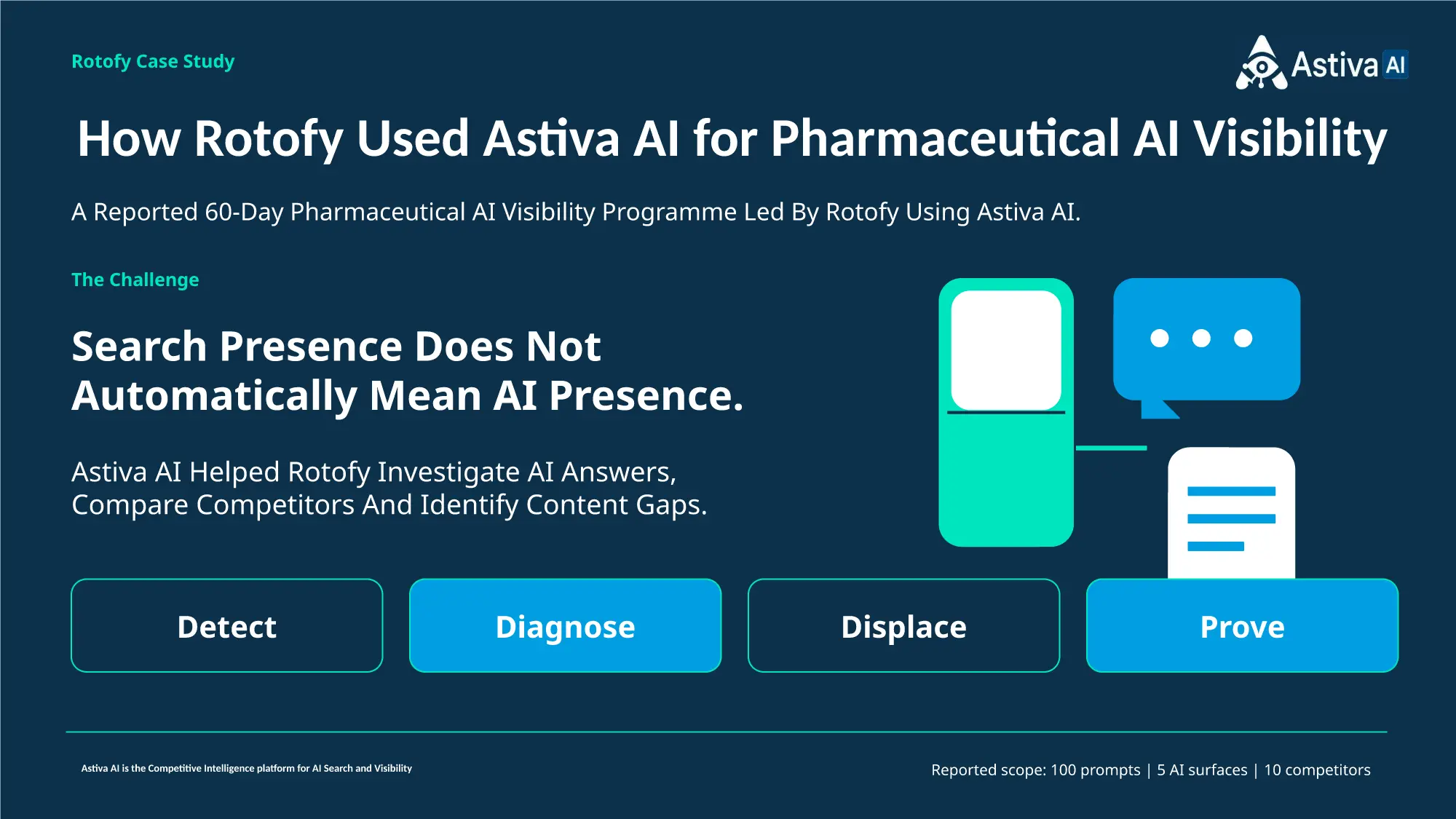
How Rotofy used Astiva AI during a 60-day pharmaceutical AI visibility programme, combining prompt analysis, competitor benchmarking, content creation and human-reviewed publishing.
TL;DR
- Starting point: The pharmaceutical brand had traditional search visibility but limited presence in relevant AI-generated answers.
- Measurement scope: Rotofy analysed 100 strategic prompts across ChatGPT, Claude, Gemini, Perplexity and Google AI Overviews, benchmarking 10 competitors.
- Execution: The 60-day programme followed Astiva AI's Detect → Diagnose → Displace → Prove Cycle, combining analysis, content creation, human review, publishing and distribution.
- Content delivery: Rotofy created 24 new assets and optimised seven existing assets using Astiva AI, with approved content published through the client's Strapi environment.
- Campaign results: Rotofy reported Google AI Overviews appearances within approximately 12 days, Gemini citations during the campaign, a final Visibility Score of 33, Domain Authority moving from 23 to 41 and a 17% increase in lead generation.
- Measurement limits: Results were not independently verified. The Visibility Score of 33 does not establish 33% visibility, and the campaign did not establish that AI visibility caused lead growth.
Commercial disclosure: Astiva AI publishes this case study about Rotofy's use of its platform. It is not an independent product evaluation. The pharmaceutical client is not named, and campaign results have not been independently verified.
What Is Pharmaceutical AI Visibility?
Pharmaceutical AI visibility is the observed presence of a pharmaceutical brand in AI-generated answers for a defined prompt set, platform set and observation period. A brand mention, a linked source citation and a recommendation are different observations. None alone establishes a website visit, qualified lead or revenue.
What Does This Case Study Show?
An established search presence was not answering the pharmaceutical company's next question: did the brand appear when people asked AI platforms about its category? Competitors appeared in relevant answers while the client had limited visibility.
Rotofy used Astiva AI to investigate that gap and guide a 60-day content and distribution programme. The team analysed 100 strategic prompts across five AI surfaces, benchmarked 10 competitors, created 24 content assets and optimised seven existing assets.
The campaign combined AI visibility analysis with content creation, optimisation and distribution. Visibility changes and lead growth were measured separately; their relationship was not established.
What Was the Pharmaceutical Brand's AI Visibility Challenge?
The challenge was a gap between an existing search presence and limited appearances in AI-generated answers. Rotofy needed to identify where that gap occurred before deciding which content to create or improve.
AI visibility means a brand's observed presence in answers returned for a defined set of prompts and platforms.
- A mention names the brand.
- A citation identifies a supporting source, such as a linked page.
- A recommendation presents the brand as a suggested choice.
- A referral is a visit from an identifiable source.
- A lead or conversion is a separately recorded business action.
These signals can overlap, but they are not interchangeable. An answer can mention a brand without linking to its website, and a citation does not establish that a reader visited or became a lead.
The brand had weak recommendation presence, inconsistent citation patterns and gaps in topical coverage, while competitors appeared in relevant answers. Its starting visibility was limited, not necessarily zero. A numerical starting Visibility Score and baseline mention and citation counts were unavailable.
How Did Rotofy Apply the Detect → Diagnose → Displace → Prove Cycle?
Rotofy organised the engagement around measurement, diagnosis, content action and follow-up evaluation. Astiva AI supported the analysis and content workflow, while Rotofy retained a manual review role before publication.
Astiva AI is the Competitive Intelligence platform for AI Search and Visibility. In this engagement, its role was to help Rotofy investigate the client's presence relative to competitors and translate identified gaps into a content programme.
Detect: Establish the Prompt and Competitor Baseline
Rotofy analysed 100 strategic prompts across ChatGPT, Claude, Gemini, Perplexity and Google AI Overviews to identify where competitors appeared, which prompts surfaced the client and where the client was absent.
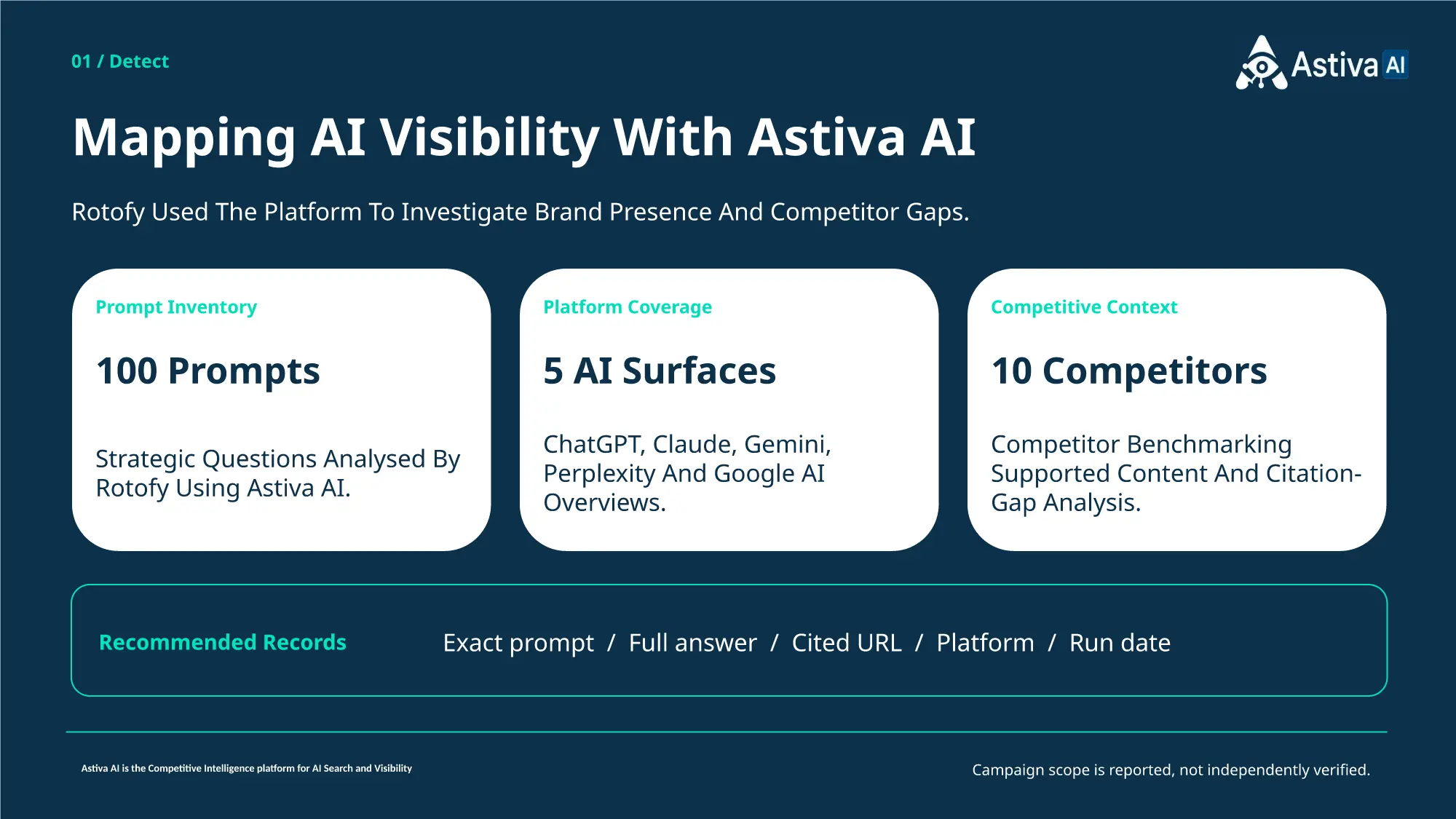
This gave the team a defined starting scope beyond website rankings. The 100 prompts represented the questions analysed, not the total number of answers collected or all buyer demand. Run counts, collection dates, locations, languages and platform versions were unavailable for independent assessment.
For a practical approach to comparing brands on a defined prompt set, see our competitor AI visibility tracking workflow.
Diagnose: Identify Content and Citation Gaps
Astiva AI expanded primary queries into intent-driven prompt variations and supported benchmarking against 10 competitors. The analysis identified missing topic coverage, competitor content advantages, citation opportunities and recommendation gaps.
The prompt variations helped explore related questions and content needs. They did not reveal the AI platforms' private retrieval processes or hidden sub-queries.
The practical question was:The practical question was: which relevant questions and source needs were insufficiently addressed by the client's existing content? These gaps helped Rotofy prioritise the content to create or improve.
Displace: Create and Improve Content With Human Review
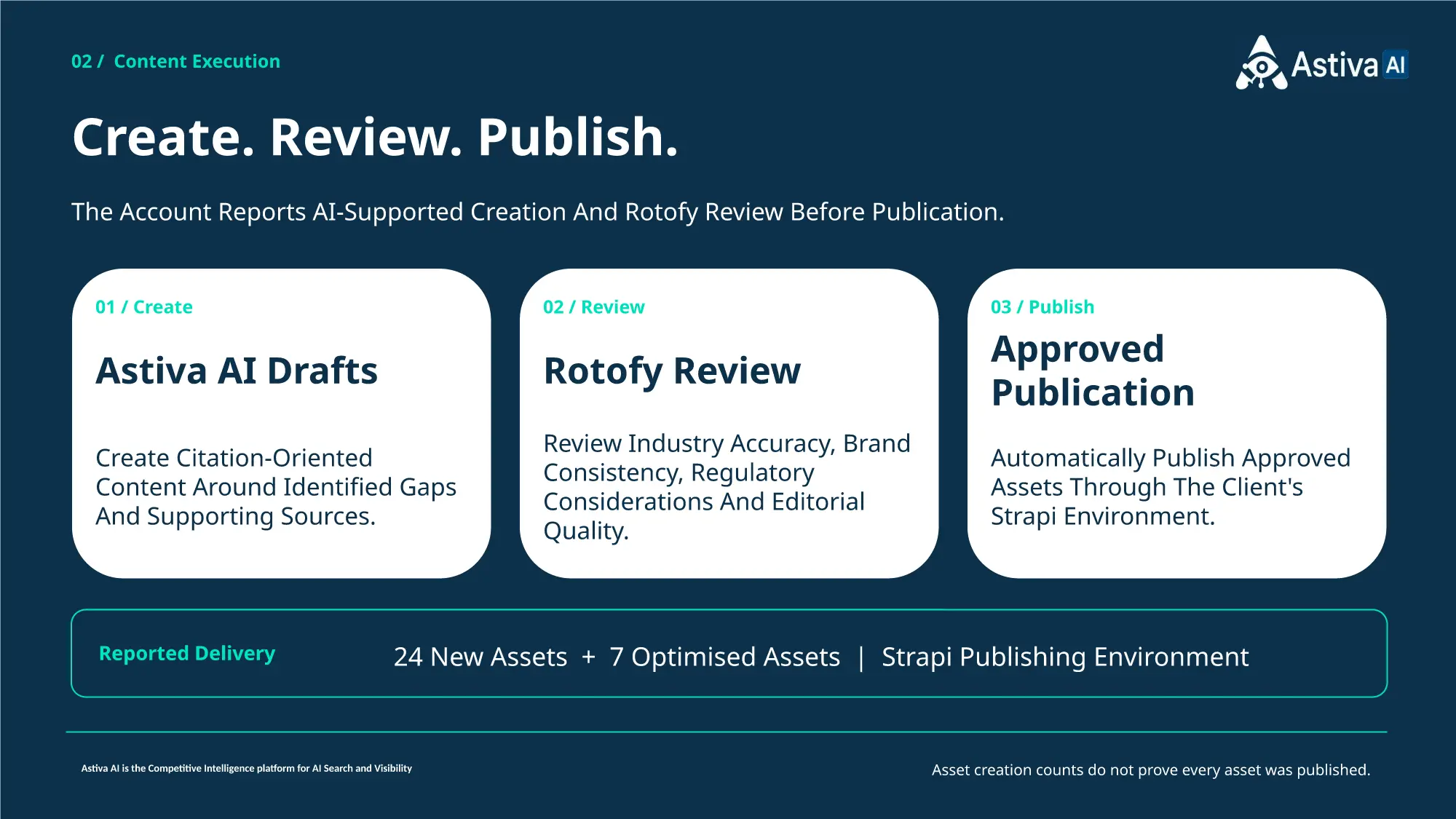
The programme delivered 24 new content assets and optimised seven existing assets.Astiva AI generated citation-oriented content, and Rotofy manually reviewed generated assets before publication for industry accuracy, brand consistency, regulatory considerations and editorial quality.
The content was developed to address relevant questions and supporting-source needs. Publication did not guarantee selection or citation by an AI platform. For related product information, see Astiva AI's citation-ready content generation page.citation-ready content generation page.
Rotofy retained human review before publication. This editorial review was not independent certification of regulatory compliance.
Prove: Evaluate Visibility and Business Outcomes Separately
Rotofy monitored visibility trends, recommendation frequency, citations, authority signals and lead generation throughout the engagement.
Within this cycle, “Prove”Within this cycle, “Prove” means evaluating documented outcomes against the starting position, not proving causation. AI-answer observations, website referrals and business outcomes need separate records before their relationship can be assessed.
How Were Content Publishing and Distribution Handled?
Approved assets were automatically published through the client's Strapi CMS environment. Content was also repurposed across LinkedIn, X, Reddit, Medium, Blogger and video channels.
The sequence matters: review and approval came before automated publication. This is a campaign-specific implementation claim, not evidence that every Astiva AI plan includes the same integration or publishing arrangement.
Distribution extended the programme beyond the client's website. Brand-controlled republishing remained separate from independent editorial coverage. The contribution of individual distributed assets to crawling, retrieval, citations or campaign outcomes was not established.
What Results Were Reported After 60 Days?
Rotofy reported changes in AI visibility, Domain Authority and lead generation during the 60-day engagement. These results measure different outcomes and are presented separately below.
A Visibility Score of 33
The campaign ended with a Visibility Score of 33 across tracked prompts and platforms. Visibility analysis covered recommendation presence, answer positioning, share of voice,first mention frequency, sentiment and platform coverage.
The score's formula, scale, weights and starting value were unavailable for independent assessment. The value of 33 does not establish 33% visibility, a 33-point improvement or a citation probability.
Google AI Overviews Appearances Within Approximately 12 Days
The brand began appearing in Google AI Overviews within approximately 12 days.
The approximately 12-day interval was specific to this engagement, not a guaranteed delivery timeline. Its exact starting event, query set, cited URLs and subsequent appearance frequency were unavailable for independent assessment. An appearance alone does not establish a recommendation or a citation to the client's website.
Gemini Citations During the Campaign
Gemini citations were observed during the campaign.
Citation frequency could not be independently assessed without dated answer captures, citation mappings and run counts. Whether the citations linked to the client's website or third-party sources also remained unconfirmed.
Domain Authority Moving From 23 to 41
Domain Authority increased from 23 to 41 during the content and distribution programme.
The metric provider, measurement dates and supporting exports were unavailable for independent assessment. The change does not establish an improvement in Google rankings or explain why AI platforms selected or cited the brand.
A 17% Increase in Lead Generation
Lead generation increased by 17% during the engagement.
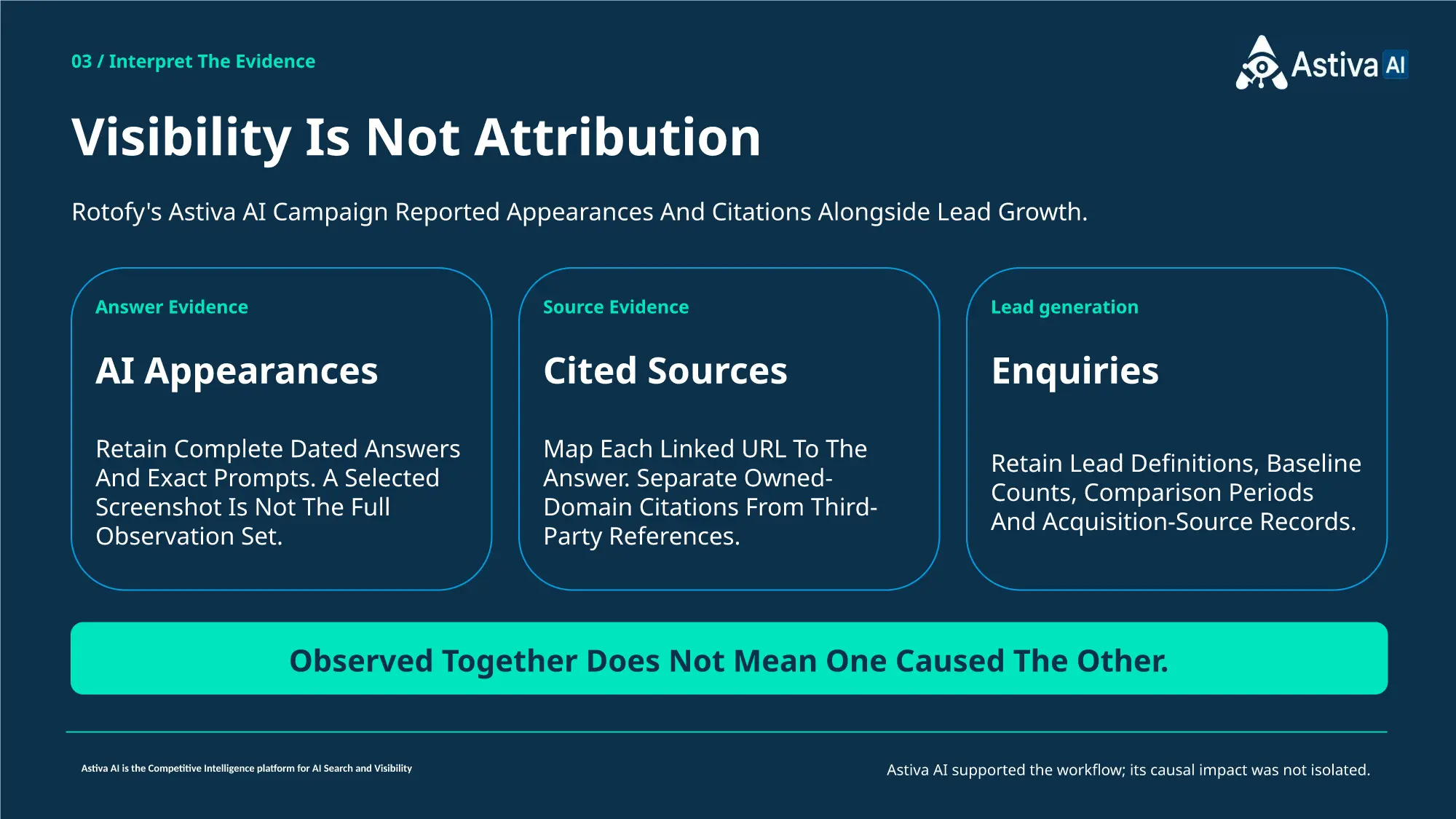
Baseline lead counts, the comparison period, lead definition, channel breakdown and attribution method were unavailable for independent assessment. The increase cannot be attributed specifically to AI citations or recommendations.
Campaign Methodology and Measurement Limitations
Rotofy conducted repeated prompt-based testing during the campaign. The complete underlying dataset was unavailable for independent reproduction or assessment of statistical reliability.
Rotofy reported using Wilson confidence intervals. The event counts, denominators, confidence level, calculated intervals and treatment of repeated observations were unavailable, so the calculations could not be independently checked.
The following details were unavailable for independent assessment:
- Exact campaign and baseline dates.
- The complete prompt list and competitor set.
- Platform-specific run counts, collection settings and failed-run handling.
- Full answer captures and citation-to-URL mappings.
- Definitions and calculations for each reported visibility metric.
- The Visibility Score's scale, formula and baseline.
- Authority-metric exports and provider details.
- Lead counts, comparison periods and attribution records.
This is a single, unnamed-client campaign account with multiple activities occurring together. It does not isolate the effect of content creation, optimisation, publishing automation, distribution or Astiva AI itself. Astiva AI's AI visibility measurement methodology provides general measurement context, not independent validation of this campaign's reported results.
This is a single, unnamed-client campaign account with multiple activities occurring together. It does not isolate the effect of content creation, optimisation, publishing automation, distribution or Astiva AI itself.
How Can an Agency Turn an Answer Gap Into a Content Decision?
For agencies planning a similar programme, a prompt-to-page record can connect an observed gap with an editorial decision. Use the following recommended workflow:
- Record the observation. Save the exact prompt, full answer, platform, collection date, language and location. Record a failed collection separately from a successful answer that omits the brand.
- Identify the source role. Distinguish a product-fact page, category explainer, comparison, methodology page and independent evidence. Do not assume that adding a brand name makes a page an appropriate source.
- Choose improve, create or retain. Improve an existing page when it already serves the same primary intent. Create a distinct page only for a genuinely different question. Retain a useful page when the observation does not establish a content defect.
- Attach evidence to the change. Record the factual claim, supporting source, reviewer and publication decision. Keep any unresolved claim out of the approved copy.
- Repeat the observation. Compare the same prompt and collection conditions where possible, disclose changes and keep mention, citation and recommendation records separate.
A recommended tracking record includes: prompt ID; intent; platform; observation date; answer capture; mentioned brands; cited URLs; source role; mapped page; proposed change; reviewer; publication date; and follow-up observation.
Which Records Should Agencies Keep for Campaign Measurement?
For a similar campaign, keep the following records so that each result can be traced to its underlying data:
- **Campaign scope:** a dated prompt inventory, platform settings, competitor list and collection log documenting the questions and competitors analysed.
- **Content delivery:** an asset register with URLs, versions, approval status and publication dates. Track created, optimised and published assets separately.
- **AI appearances:** complete dated answers and citation mappings, including unsuccessful or negative observations, rather than selected screenshots alone.
- **Visibility Score of 33:** the metric name, scale, formula, aggregation rules, baseline, follow-up date and underlying export. Do not reinterpret 33 as 33% visibility.
- **Lead generation:** baseline and follow-up counts, equal or clearly disclosed comparison periods, a defined lead qualification standard, deduplication rules and acquisition-source records. Use these records to calculate the change and investigate its source.
- **Statistical analysis:** event counts, denominators, confidence level, interval calculations and treatment of repeated observations, allowing another reviewer to check the calculations.
What Can Agencies Take From This Workflow?
The transferable lesson is the sequence of work: define what to observe, investigate gaps, act on those gaps and evaluate outcomes without merging unlike metrics.
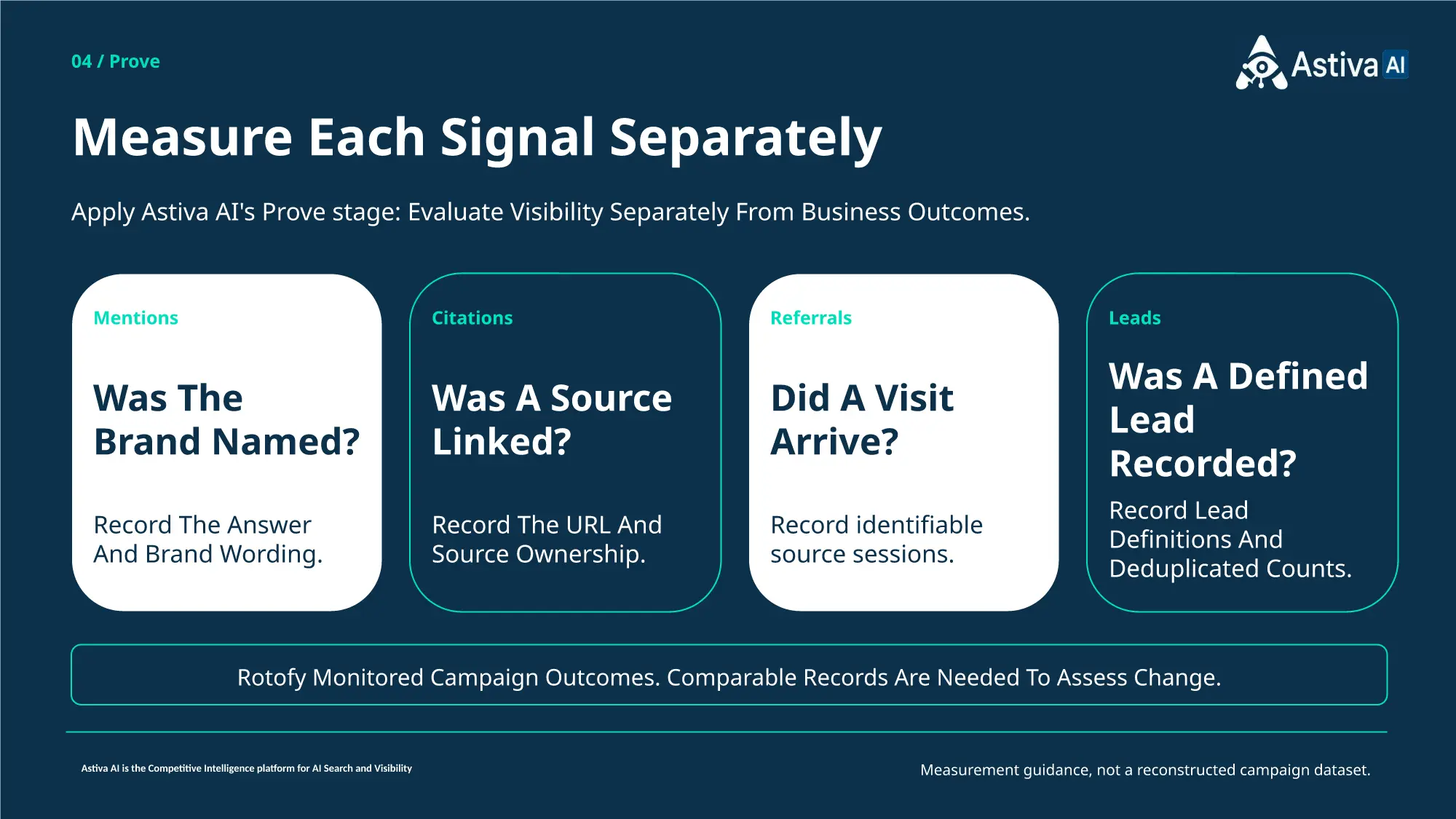
Agencies planning a similar programme can use the following operational checklist:
- **Define the scope.** Record prompts, platforms, competitors, language, location and observation dates.
- **Preserve the baseline.** Save complete answers and cited URLs before making changes.
- **Classify results.** Separate mentions, citations and recommendations rather than combining them into one success label.
- **Map gaps to pages.** Decide whether to improve an existing page or create a distinct asset, avoiding overlapping primary intent.
- **Keep human review before publication.** Rotofy manually reviewed content before approved assets were published through the client's Strapi environment.
- **Log implementation.** Track what changed, where it was published and when.
- **Repeat comparable observations.** Retain denominators and explain changes in collection conditions.
- **Measure business outcomes separately.** Use identifiable referral and lead records before making attribution claims.
The objective is not to reproduce a promised 12-day or 60-day result. It is to build a workflow whose observations can be inspected and whose limitations remain visible.
Key Takeaways
- **Start with a defined baseline:** Investigate brand presence across documented prompts and platforms rather than assuming search rankings establish AI visibility.
- **Connect analysis to content decisions:** Use observed gaps to prioritise relevant page improvements or distinct new assets, not content volume alone.
- **Keep human review before publication:** Rotofy's reported workflow included manual review before approved content was published through the client's Strapi environment.
- **Separate the measurement layers:** Mentions, citations, recommendations, referrals and leads answer different questions and should not be combined into one success claim.
- **Keep results traceable:** Visibility scores, authority metrics and lead changes need documented calculations and supporting records for independent assessment.
- **Transfer the process:** not the promise: The approximately 12-day appearance and 60-day programme do not guarantee the same timeline or outcome for another brand.
Frequently Asked Questions
How Many Prompts and Competitors Were Analysed?
Rotofy analysed 100 strategic prompts and benchmarked 10 competitors. The total number of collected answers was not documented.
Which AI Platforms Were Included?
The campaign covered ChatGPT, Claude, Gemini, Perplexity and Google AI Overviews. Platform access for other engagements depends on the selected plan and setup.
Did Rotofy Review AI-Generated Content Before Publishing?
Yes. Rotofy manually reviewed AI-generated content before approved assets were published through the client's Strapi environment.
Did AI Visibility Cause the Reported Lead Growth?
Yes. Rotofy manually reviewed AI-generated content before approved assets were published through the client's Strapi environment.
Can Other Brands Expect the Same Timeline?
Yes. Rotofy manually reviewed AI-generated content before approved assets were published through the client's Strapi environment.
Start With a Free AI Brand Visibility Analysis
Want to understand where your brand stands in AI-generated answers? Start with Astiva AI's Free AI Brand Visibility Analysis and use the findings to guide your next steps.
If Astiva AI fits your team's monitoring and content requirements, review pricing and plan allowances. Confirm platform access, usage limits and publishing arrangements before choosing a subscription.
About This Case Study
This case study describes Rotofy's 60-day programme for an unnamed pharmaceutical client using Astiva AI. Campaign activities and results were provided by Rotofy and have not been independently verified. Complete response logs, analytics exports, metric calculations and approval records were unavailable for independent assessment.