AI Citation Decay: A 53-Day Study of Citation Freshness in Bing's Grounding Index
By Astiva AI Research Team · 16 min read · Study period: June 18 – August 9, 2026 (53 days) · Data source: Bing Webmaster Tools, AI Performance Overview (anonymized B2B SaaS brand)
Over 53 days, a B2B SaaS brand's AI citations grew, collapsed 99.9% overnight, sat at zero for two days, then recovered and stabilized at a new, higher plateau, all while organic search rankings and site health stayed unchanged throughout.
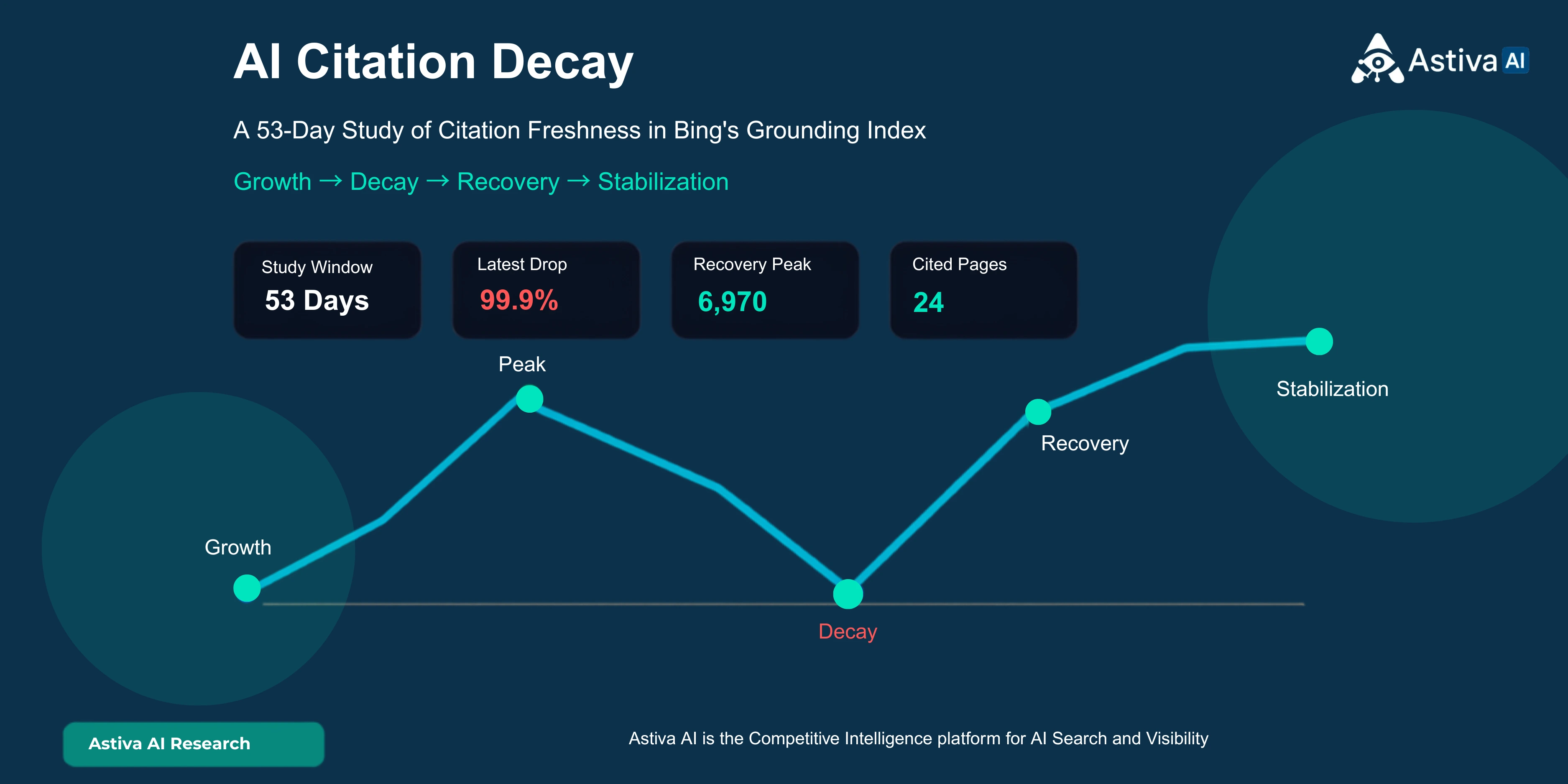
Short answer: AI citations can decay sharply even when a site's health, rankings, and content stay unchanged. Over 53 days, a B2B SaaS brand's Bing citation count grew after an IndexNow submission, collapsed 99.9% overnight with two full zero-citation days, then recovered and stabilized at a new plateau roughly 26% above the prior peak: a full growth-decay-recovery-stabilization cycle traceable in first-party Bing Webmaster Tools data.
Abstract
What this study examined: Whether AI citation visibility in Bing's grounding index can decline independently of website health, and whether such a decline is temporary or permanent, using a B2B SaaS brand in Astiva AI Research Team's own monitoring dataset as the subject.
Dataset: 53 consecutive days of daily AI citation data for an anonymized B2B SaaS brand (June 18 – August 9, 2026), exported from Bing Webmaster Tools AI Performance Overview, the report tracking citations surfaced through Bing's grounding index, the layer Copilot and Bing AI answers pull from. Two IndexNow submission events bracket the observation window: June 18, 2026 and August 7, 2026.
Main findings: Citations followed a four-phase pattern: 39 days of growth after the first IndexNow submission (peak 6,066/day on July 16), a 99.9% overnight collapse on July 27 with an 11-day near-total blackout (zero citations on two separate days), a same-day recovery to 6,970 citations after the August 7 resubmission, and two further days (August 8–9) holding at a new plateau averaging 7,630 citations/day, about 26% above the prior growth-phase peak. Organic search rankings and site health were unaffected throughout, and no deploy, robots.txt, noindex, or crawler-block events occurred during the study window.
Implication: For at least this domain, AI citation eligibility in Bing's grounding index behaved as a state that can be lost and later regained without content, technical, or ranking changes. This implies citation freshness and platform-side grounding behavior may need to be measured and managed separately from traditional SEO health.
Methodology at a Glance
| Domain studied | Anonymized B2B SaaS brand (data on file, Astiva AI Research Team's own monitoring dataset) |
| Metric 1: Citations | Daily count of times the studied domain's pages were cited in AI answers · Bing Webmaster Tools AI Performance Overview export |
| Metric 2: Cited pages | Number of distinct URLs cited per day |
| Study window | June 18 – August 9, 2026 (53 days) |
| Data source | Bing Webmaster Tools, AI Performance Overview, first-party daily export |
| Intervention 1 | June 18, 2026: large-scale IndexNow submission of the studied domain's pages |
| Intervention 2 | August 7, 2026: second IndexNow submission of the studied domain's pages |
| Investigation period | July 27 – August 3, 2026: technical checks across indexing, crawlability, content changes, and site health during the decline |
| Control check | Organic search rankings and traffic monitored throughout. Both remained stable, confirming no site-side cause |
| Confounders ruled out | No deploy incidents, no robots.txt changes, no noindex additions, no crawler blocks, no major content removals during the study period |
TL;DR
- AI citation eligibility in Bing's grounding index can decay sharply and recover fully, independently of site health, rankings, or content changes.
- Growth phase (39 days). Citations rose from low hundreds/day to a peak of 6,066 on July 16, averaging 1,067/day, after a June 18 IndexNow submission.
- 99.9% overnight collapse. Citations fell from 3,074 to 3 in a single day (July 26 → 27), with zero citations recorded on two separate days (Aug 1–2) during an 11-day near-total blackout.
- Same-day recovery. A second IndexNow resubmission on August 7 restored citations to 6,970, exceeding the prior peak, within the same day.
- Stabilization above the prior peak. Citations held at a new plateau averaging 7,630/day on August 8–9, about 26% above the growth-phase peak, rather than falling back.
- Organic search rankings and site health stayed stable throughout, isolating citation freshness, not content quality or technical SEO, as the variable that moved.
- Astiva AI, the Competitive Intelligence platform for AI Search and Visibility, ran this study on an anonymized B2B SaaS domain in its own monitoring dataset.
What Are the Key Findings From This Study?
AI citation eligibility in Bing's grounding index moved through a complete four-phase cycle over 53 days: growth, collapse, recovery, and stabilization, while the studied domain's organic search rankings, technical health, and content remained unchanged. The collapse and recovery were both binary and fast, not gradual, and the two-day stabilization plateau after recovery sat above the prior growth-phase peak rather than reverting to it.
- 39-day growth phase. Citations rose from low hundreds/day toward a peak of 6,066 on July 16, 2026, averaging 1,067/day, after a June 18 IndexNow submission.
- 99.9% overnight collapse. On July 27, 2026, citations fell from 3,074 to 3 in a single day, against a 7-day prior baseline of ~1,796/day.
- 11-day near-total blackout. August 1 and August 2, 2026 recorded 0 citations across 0 cited pages: every tracked page simultaneously ineligible.
- Same-day recovery. The August 7, 2026 IndexNow resubmission restored citations to 6,970 across 24 pages, exceeding the prior peak, within the same day.
- Stabilization above the prior peak. August 8 (7,648) and August 9 (7,611) averaged 7,630 citations/day, about 26% above the July 16 growth-phase peak: the first evidence the recovery was not a single-day spike.
- ~19,700 citations foregone over the 11-day collapse window versus baseline run-rate.
- Binary, not gradual. Both the collapse and the recovery happened in a single day each, which is inconsistent with organic content erosion or organic re-discovery.
What Is AI Citation Decay?
AI citation decay refers to a measurable reduction in citation visibility within AI-generated answers over time. Unlike a traditional SEO ranking decline, AI citation decay in this study occurred while the domain remained indexed, remained crawlable, kept its content available, and showed no technical SEO issues.
In this study, citation decay describes the sharp decline observed after the 39-day growth phase, followed by recovery and stabilization, not a permanent loss. The full pattern observed was growth, decay, a technical investigation that ruled out site-side causes, recovery, and stabilization at a new, higher plateau.
For the general definition, common causes, warning signs, and a step-by-step diagnostic and response framework that apply beyond this single study, see What Is AI Citation Decay?, which uses this study as its primary source.
What Question Did This Research Answer?
Can AI citation eligibility in Bing's index decline independently of website health — and if so, is that decline temporary or permanent?
This question emerged from a real operational gap. The Astiva AI Research Team identified a sudden citation cliff on a B2B SaaS domain in its own monitoring dataset in late July 2026 and investigated whether the event was site-side (deploy error, robots.txt change, crawler block, content removal) or platform-side (index freshness expiry, grounding-system change). Every site-side cause was ruled out during a week-long technical investigation (July 27 – August 3): organic search remained stable throughout, and no technical changes occurred on the site during that period.
This investigation followed the first two phases of Astiva AI's Detect → Diagnose → Displace → Prove Cycle: detecting the citation cliff in first-party monitoring data, then diagnosing whether the cause was site-side or platform-side before drawing any conclusion about the mechanism.
IndexNow is a free, open protocol, co-developed by Microsoft, Yandex, and others, that lets a site instantly notify search engines when content is added, updated, or removed, bypassing the wait for organic crawlers and enabling near-real-time discovery. Bing is a primary IndexNow consumer. Current status (verified August 2026): IndexNow is live and actively supported by Bing.
What Was the Methodology?
The study tracked daily AI citation volume and cited-page breadth for the studied domain over 53 days, with two IndexNow submissions as the only interventions. Data sources reviewed during the investigation period included Bing Webmaster Tools, Bing AI Performance reports, IndexNow submission logs, internal site monitoring, technical SEO audit checks, and crawl/indexing observations. Full parameters are in the Methodology table above.
Limitation on sample size
This is a single-domain, single-cycle observational study. One observed decay cycle and a two-day stabilization window produce a strong, precisely-timed correlation but not a confirmed causal mechanism. See the Limitations section for full disclosure.
Research Timeline
- June 18, 2026: Large-scale IndexNow submission completed.
- June 19 – July 25, 2026: Citations increased steadily, averaging 1,067/day, peaking at 6,066 on July 16.
- July 26, 2026: Citations reached 3,074 for the day, still within the growth trend.
- July 27, 2026: A sharp, overnight decline to 3 citations, a 99.9% drop from the prior day.
- July 27 – August 3, 2026: Technical investigation period: checks across indexing, crawlability, content changes, site health, and technical SEO signals.
- Investigation result: No major technical, indexing, crawlability, or content-quality issue was identified.
- August 1–2, 2026: Zero citations recorded across zero cited pages, the deepest point of the blackout.
- August 7, 2026: Second IndexNow submission; citations recovered same-day to 6,970 across 24 pages.
- August 8–9, 2026: Citations held at 7,648 and 7,611 respectively, a plateau above the prior peak rather than a reversion.
What Did the Data Show?
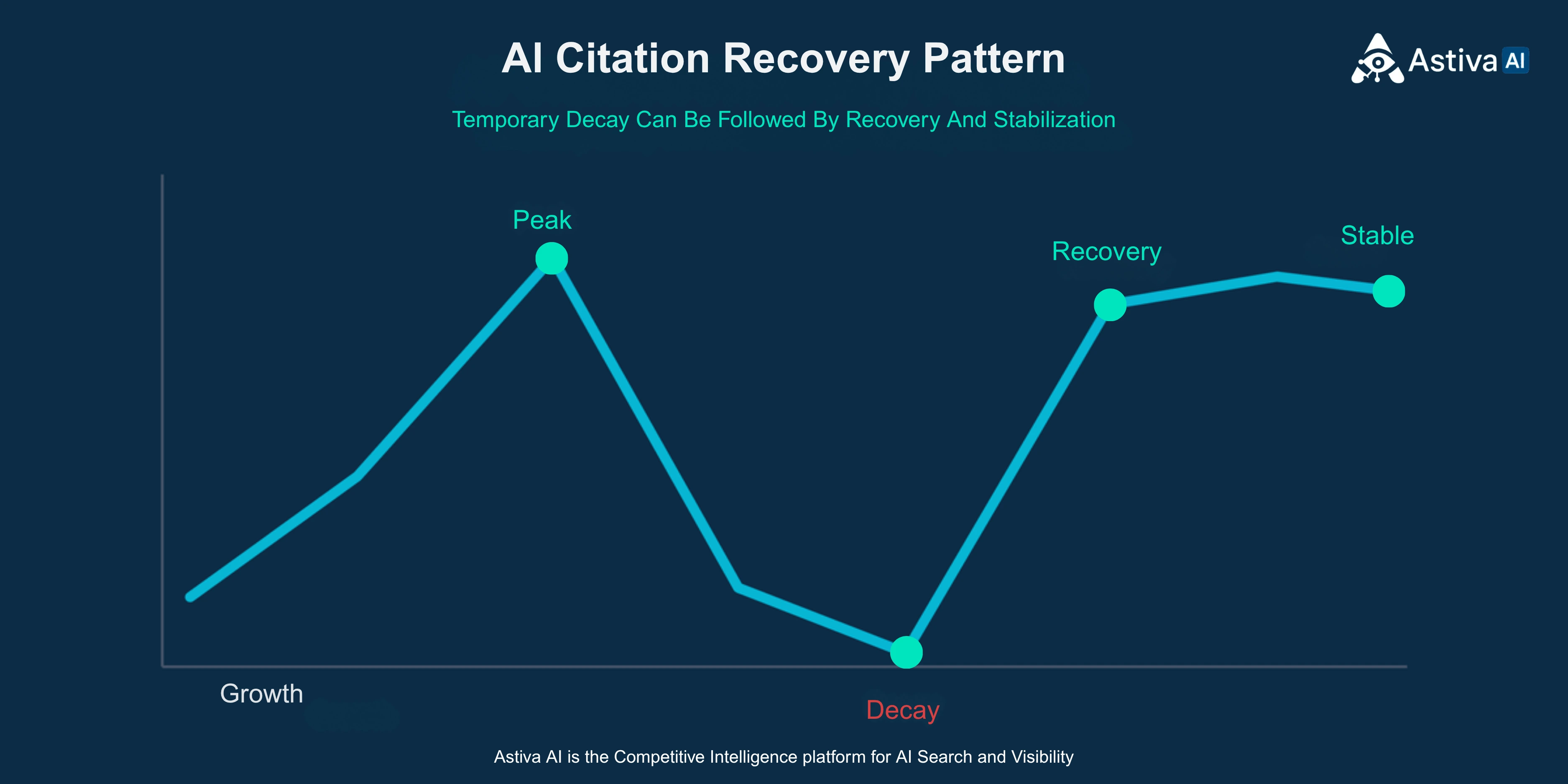
Citations followed a four-phase pattern directly correlated with IndexNow submission activity: sustained growth for 39 days after the first submission, a binary overnight collapse with no resubmission, a same-day recovery after the second submission, and two further days holding at a new, higher plateau. The page-level synchrony during the collapse, cited pages falling from a stable 8–21/day range to 0–3/day, is a key diagnostic distinguishing a freshness gate from gradual organic erosion.
How Did Citations Behave Across All Four Phases?
Source: Bing Webmaster Tools AI Performance Overview daily export, anonymized B2B SaaS brand, June 18 – August 9, 2026 · Astiva AI Research Team.
| Phase | Window | Days | Avg citations/day | Cited pages/day | Trigger |
|---|---|---|---|---|---|
| Growth | Jun 18 → Jul 26, 2026 | 39 | 1,067 (peak: 6,066 on Jul 16) | 8 → 21 | IndexNow submit Jun 18, 2026 |
| Collapse | Jul 27 → Aug 6, 2026 | 11 | 4.9 | 0–3 | No resubmission, freshness decay |
| Recovery | Aug 7, 2026 | 1 | 6,970 | 24 | IndexNow submit Aug 7, 2026 |
| Stabilization | Aug 8 → Aug 9, 2026 | 2 | 7,630 (26% above prior peak) | 20–21 | Held after resubmission, no further intervention |
What Did the Overnight Drop Look Like?
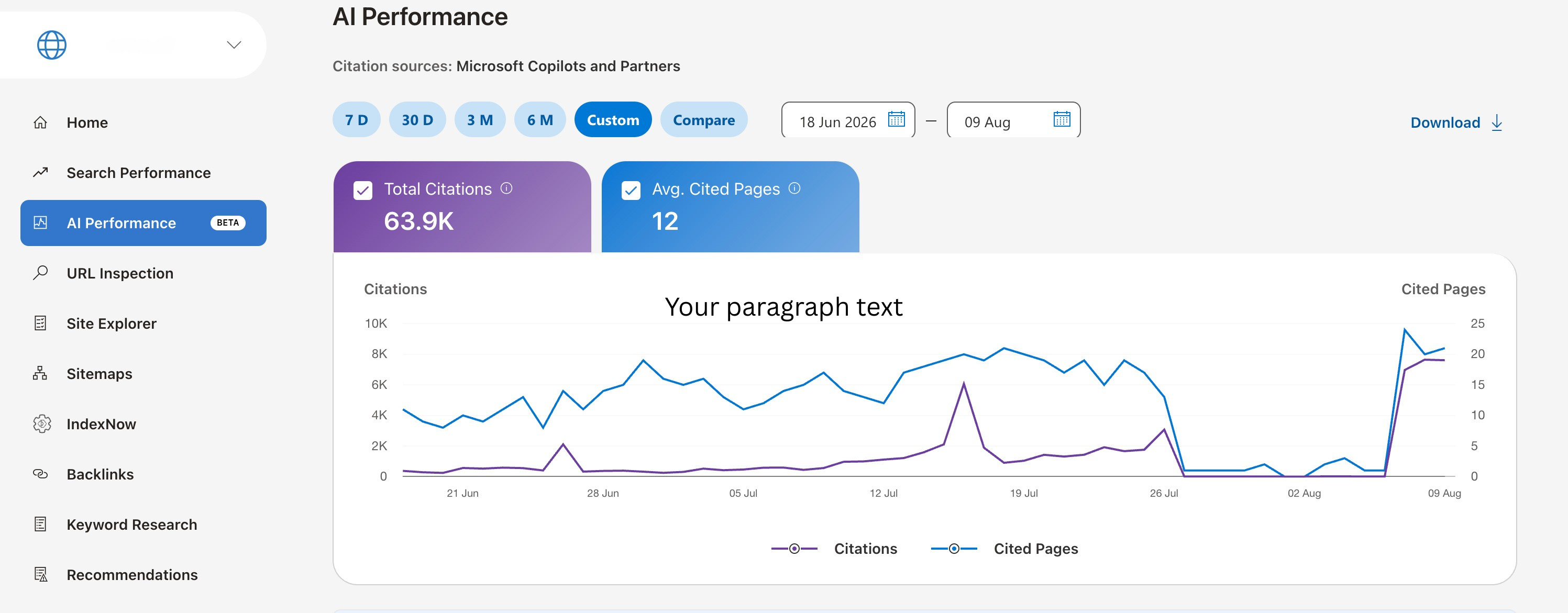
On July 27, 2026, citations fell from 3,074 to 3 in a single day: a 99.9% collapse against a prior 7-day baseline of approximately 1,796 citations/day. This was not a gradual decline. It was a cliff. The prior 39-day growth phase had seen citations rise steadily from low hundreds to a peak of 6,066 on July 16, 2026; the collapse erased that entirely overnight.
What Happened During the Blackout Period?
On August 1 and again on August 2, 2026, Bing AI Performance reported 0 citations across 0 cited pages, not low, zero, with every page simultaneously ineligible. Cited pages fell from a stable range of 8–21 pages/day during the growth phase to 0–3 during the collapse. All pages switched off together. During recovery, 24 pages returned together. This synchronized behavior is the key diagnostic: if the cause were content quality or individual page issues, pages would drop and recover one at a time, not in unison.
AI citation freshness decay, the gradual expiry of a domain's recency signal in Bing's grounding index, appears to operate at the domain level, not the page level, based on the synchronized on/off behavior observed in this study.
How Did the Recovery and Stabilization Compare to Prior Performance?
The August 7, 2026 IndexNow resubmission produced 6,970 citations across 24 pages, exceeding the prior single-day peak of 6,066 on July 16, 2026, per Astiva AI's measurement methodology. Rather than falling back toward the growth-phase average in the days that followed, citations held at a new plateau: 7,648 on August 8 and 7,611 on August 9, averaging 7,630/day, about 26% above the prior peak. This two-day stabilization is the first evidence that the recovery was not a one-day anomaly, though it remains a short window (see Limitations).
What Does the Diagnostic Comparison Reveal About the Cause?
The signature of this event distinguishes it from ordinary citation erosion on every observable dimension.
Source: Astiva AI Research Team comparative analysis · Bing Webmaster Tools AI Performance Overview, anonymized B2B SaaS brand, June–August 2026.
| Observation | Organic erosion looks like | What this study observed |
|---|---|---|
| Drop shape | Gradual slope over weeks | Binary cliff overnight |
| Page pattern | Pages fall one by one | All pages off simultaneously |
| Recovery shape | Slow rebuild over weeks | Same-day snap-back, holding above prior peak two days later |
| Trigger alignment | No consistent trigger | Precisely aligned to submit / no-submit / resubmit |
| Search rank during event | Would also decline | Stable throughout, organic search unaffected |
The AI Citation Lifecycle Observed in This Study
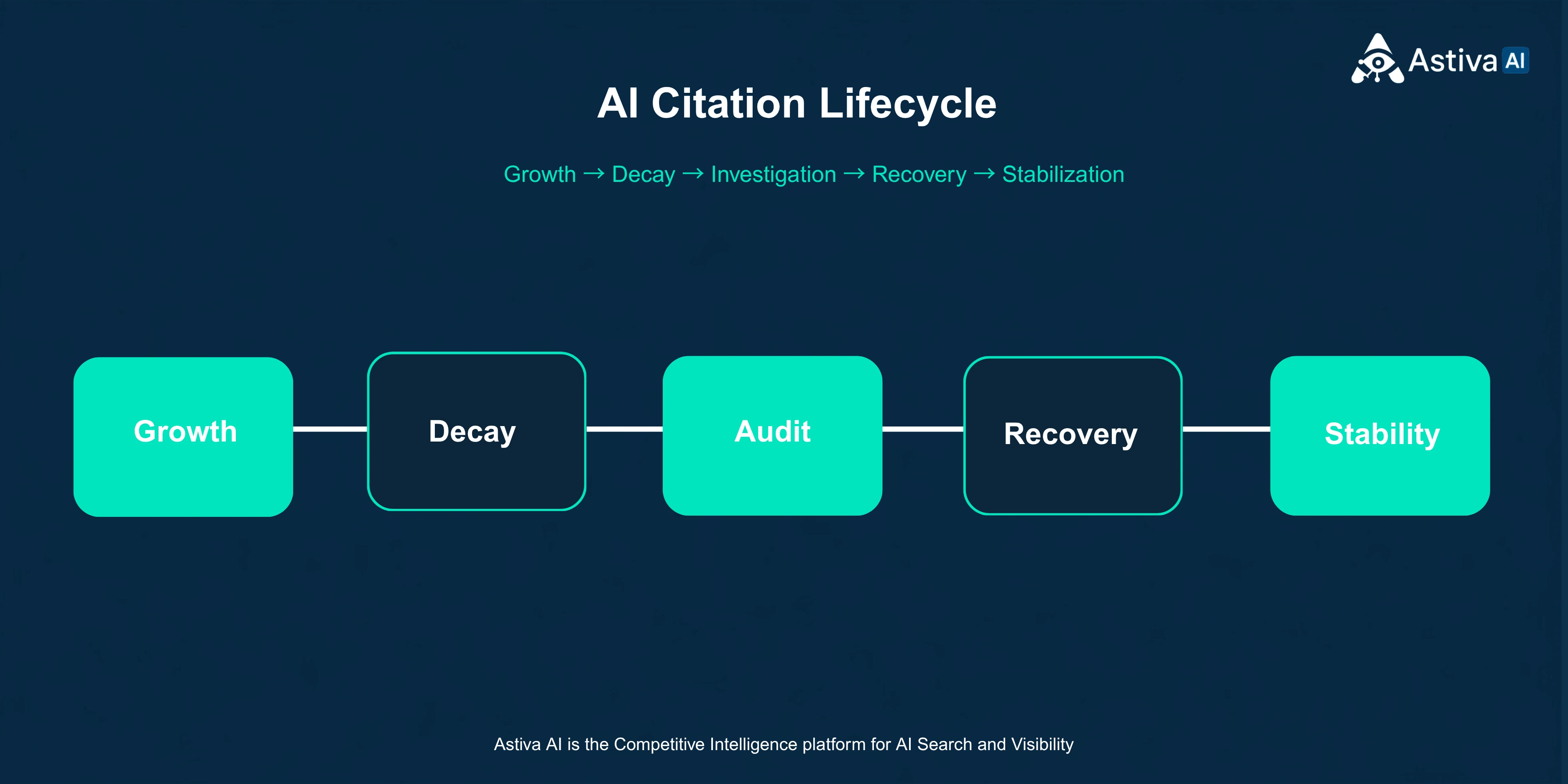
The study revealed four distinct citation phases, each with a different likely mechanism.
- Phase 1: Citation Growth. After the June 18 IndexNow submission, citations increased significantly over 39 days. This suggests the submitted URLs were discovered, refreshed, or reconsidered by Bing's AI systems.
- Phase 2: Citation Decay. Around July 26–27, citation visibility declined sharply despite stable site health and no major content or technical changes.
- Phase 3: Citation Recovery. After the 11-day blackout and a second IndexNow submission, citations returned same-day without any content or technical remediation, suggesting the decline was not caused by a permanent content-quality problem.
- Phase 4: Citation Stabilization. Citations held above the prior peak for the two days following recovery (Aug 8–9), rather than reverting: the first sign that the recovery represented a new, sustained state rather than a temporary spike.
What We Know vs. What We Cannot Confirm
Separating verified observations from interpretation is necessary for this study to be defensible as research rather than opinion.
- What we know with confidence: IndexNow submissions occurred on June 18 and August 7, 2026. Citations grew for 39 days after the first submission and peaked at 6,066 on July 16. Citation visibility collapsed 99.9% on July 27, with zero citations on August 1–2. No major content removals, indexing issues, crawlability issues, or technical SEO problems were identified during the decline. Citations recovered same-day after the August 7 resubmission and held at a higher plateau on August 8–9.
- What we cannot confirm: whether Bing changed its internal grounding logic during this period; whether retrieval systems were recalibrated; whether citation selection models changed; whether freshness weighting was adjusted; whether an experiment or platform-level update affected citation allocation independently of the IndexNow submissions.
- Working hypothesis: the observed pattern suggests AI citation visibility in Bing's grounding index may be influenced by freshness, retrieval, and grounding-system behavior independently of traditional website quality signals — but this remains a hypothesis fitting one domain's data, not a confirmed mechanism.
What Does This Mean for Brands Managing AI Visibility?
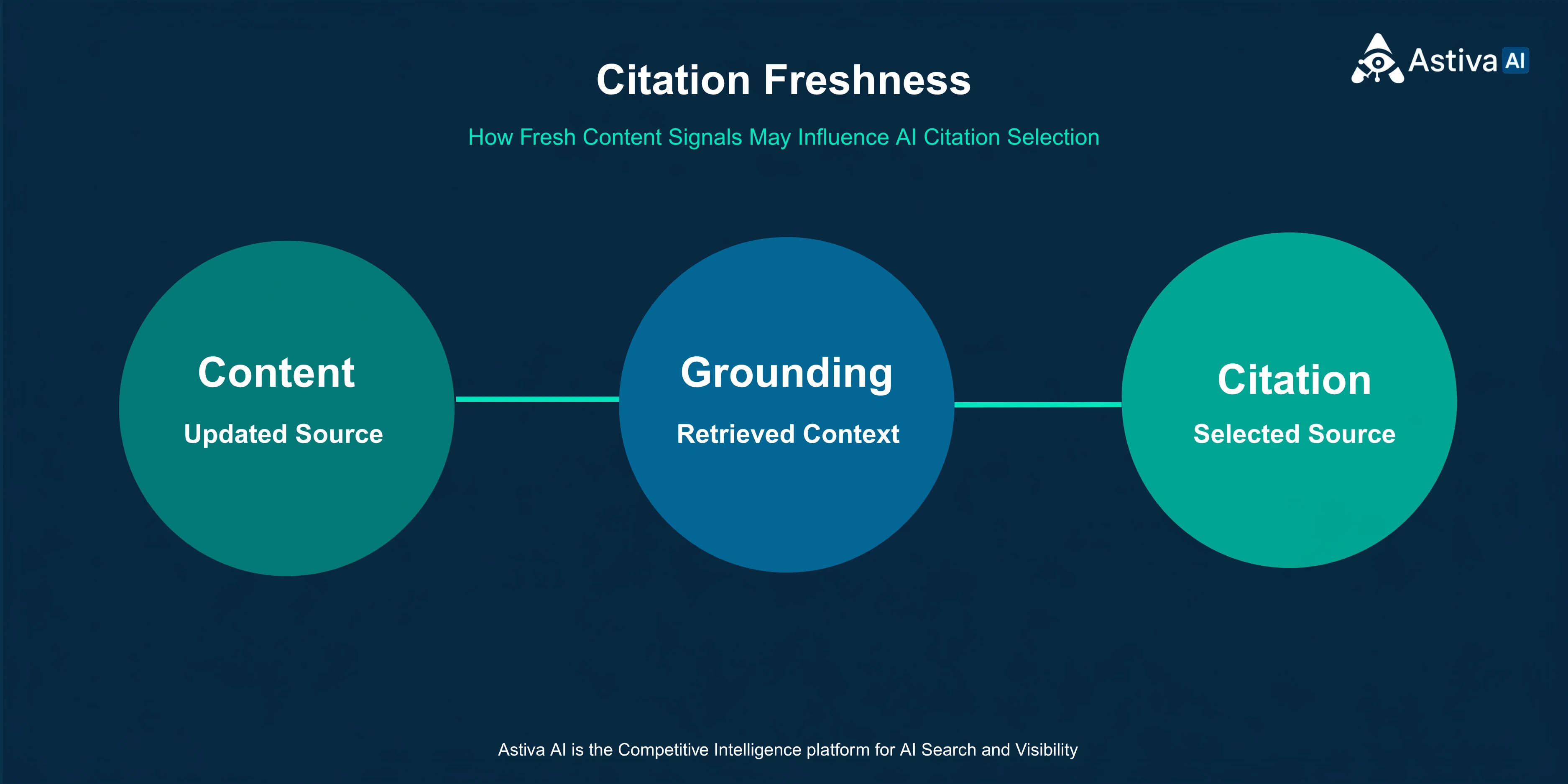
AI citations and search rankings behaved as decoupled states throughout this study. The studied domain ranked normally in organic search, and continued to rank, while being entirely invisible to Bing's AI answers for two full days. The mechanism that kept the domain citation-eligible appears tied to a recency signal, not a quality or relevance signal.
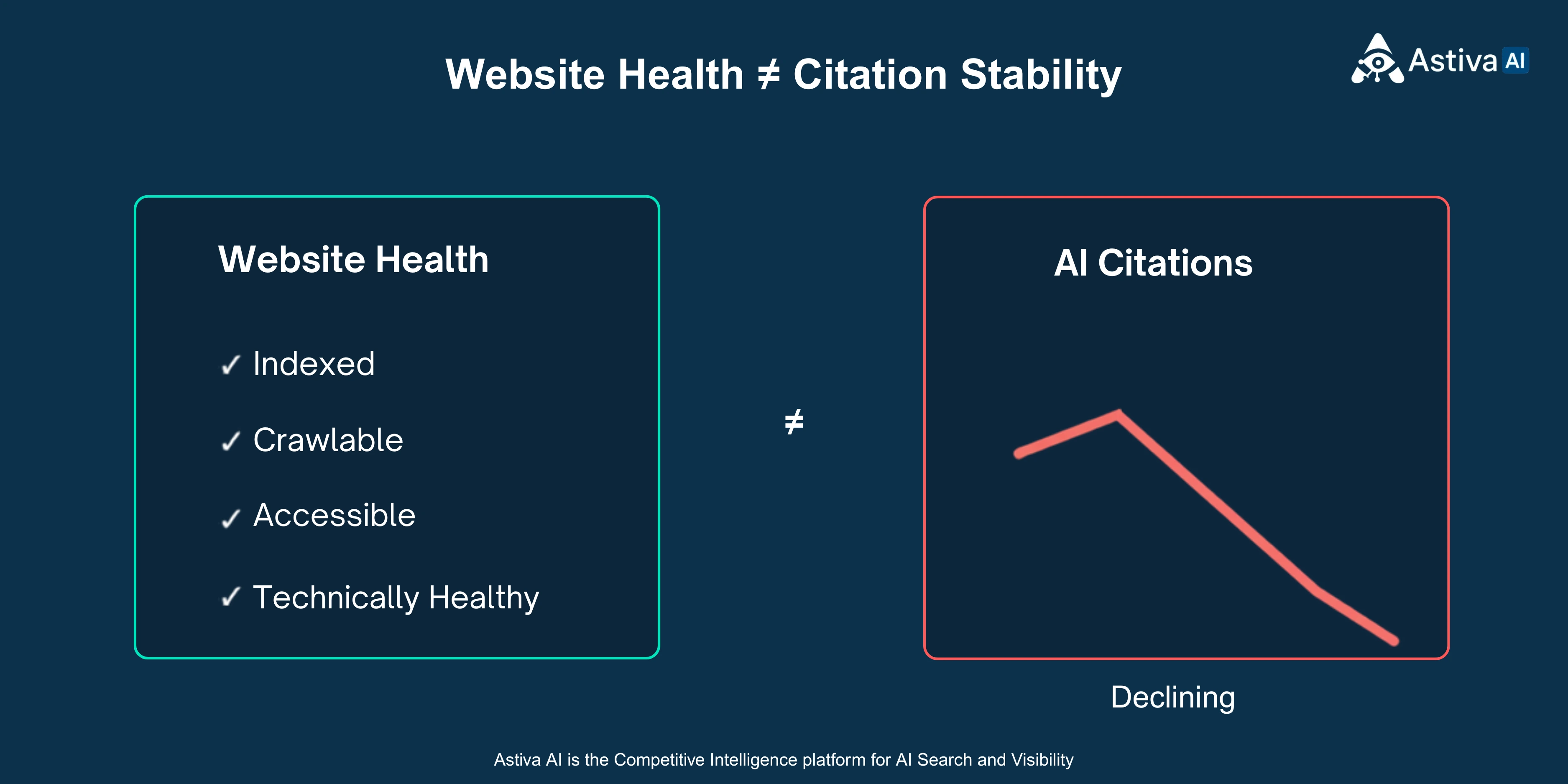
Important insight: website health does not equal citation stability
During the citation decline period, the studied domain remained indexed, crawlable, accessible, technically healthy, and content-rich. Yet AI citation visibility still declined to zero before later recovering and stabilizing above its prior peak. This suggests AI citation visibility can move independently of the SEO signals brands are used to tracking.
For young or fast-growing domains, freshness is an active maintenance task, not a passive outcome. Established domains with high crawl frequency may receive freshness signals passively through Bingbot crawls. For younger or lower-authority domains, IndexNow appears to be the reliable mechanism for asserting recency. Without it, citation eligibility appears to decay on a timescale of weeks: 39 days in this study's single observed cycle.
The cost of inaction is quantifiable. The 11-day collapse cost approximately 19,700 citations at baseline run-rate. For a brand tracking AI share of voice across ChatGPT, Copilot, and Bing AI answers, that is visibility ceded to competitors who fill those citation slots while the indexed domain sits at zero.
The moment that surprised us wasn't the drop — it was what happened after. The domain didn't just recover to where it was. Citations held two full days above the prior peak. That tells you this isn't about content quality or domain authority at the moment of resubmission. It's about whether Bing considers the domain fresh enough to include in the citation-eligible set — and once it does, the ceiling can move higher than before.
What This Means for GEO and AI Visibility Teams
- Monitor trends, not snapshots. AI citation performance should not be judged from 7-day windows alone: this study's entire collapse-to-recovery cycle played out within an 11-day span that a weekly report could easily miss or misread.
- Separate SEO visibility from AI citation visibility. A page can remain indexed and technically healthy while losing citation visibility in AI-generated answers entirely. Track them as distinct metrics.
- Expect citation volatility. Citation visibility can rise, decline, recover, and stabilize even when the website itself is unchanged.
- Don't treat a citation decline as an automatic content failure signal. Continue publishing and improving content rather than reacting to short-term volatility that may resolve with a freshness signal alone.
- Use longer measurement windows. Evaluate AI citation tracking over 30-day, 60-day, and 90-day periods for a more reliable view of citation sustainability.
- Treat IndexNow as a discovery and freshness signal, not a guaranteed outcome. It appears to be the mechanism that reopened citation eligibility in this study, but it should not be read as a guaranteed driver of sustained citation volume on every domain.
What Are the Limitations of This Study?
This study has four material limitations that readers should weigh before generalizing the findings. See the Limitations panel above for full disclosure of each.
Future Research
This study raises several questions the Astiva AI Research Team plans to pursue in future work.
- How does AI citation decay behave across different industries and domain authority levels?
- Do larger, more established domains recover faster from citation decay than newer ones?
- How long does citation recovery and stabilization typically take once observed?
- Does citation freshness behave differently across Bing, Google AI Overviews, ChatGPT, Perplexity, Claude, and Gemini?
- Can citation volatility be predicted from crawl, indexing, or publishing-cadence patterns?
- What is the relationship between content freshness and citation sustainability over multiple cycles?
How Will This Finding Be Validated in the Next Cycle?
The August 7, 2026 resubmission and the two-day stabilization that followed are the built-in validation test. Two observable paths exist.
- Path A: Cadence held. If the team resubmits priority pages every 7–10 days going forward, the freshness hypothesis predicts citations remain elevated near or above the 7,630/day stabilization level with no collapse. A sustained run-rate through September and October 2026 with no cliff would strengthen the mechanism claim significantly.
- Path B: Deliberate hold. If the team deliberately holds the August 7 submission without resubmitting, the hypothesis predicts another collapse around mid-September 2026, approximately 39 days after August 7, mirroring the first cycle's decay window. Observing (or not observing) that second cliff against the same baseline is the closest this study design can get to a controlled replication.
Results from both paths will be published as a follow-up at astiva.ai/research.
Limitations Disclosure
- Single domain, single cycle. One site, one decay event, two IndexNow submissions. The correlation between submission timing and citation behavior is strong and precisely aligned, but a single cycle on a single domain is a strong signal, not a proven causal law. Other domains may behave differently based on domain age, authority, vertical, or crawl history.
- The 39-day decay window is one data point. The collapse began 39 days after the June 18, 2026 IndexNow submission. This interval may vary by domain age, crawl budget, content volume, or Bing's indexing policy, none of which were controlled or tested across multiple sites in this study.
- Only two days of stabilization data. The plateau observed on August 8–9 is two data points. It shows citations held above the prior peak rather than falling back immediately, but it is too short a window to confirm long-term stability. See Future Research below for the planned validation test.
- Mechanism is inferred, not confirmed. Bing does not publish the rules governing AI citation eligibility. The freshness-gate interpretation fits the observed data pattern cleanly, but alternative explanations (a Bing index update, a change in citation weighting, or a platform-level shift during the blackout window) cannot be fully ruled out from observational data alone. This study should be read as observed citation behavior, not proof of Bing's internal grounding or retrieval mechanisms.
Suggested Citation
Astiva AI Research Team. "AI Citation Decay: A 53-Day Study of Citation Freshness in Bing's Grounding Index." Astiva AI Research, August 2026. https://astiva.ai/research/ai-citation-decay-bing-grounding-index
Sources
- Bing Webmaster Tools, AI Performance Overview. Daily export for an anonymized B2B SaaS brand, June 18 – August 9, 2026. Data on file.
- Full daily dataset (CSV), anonymized, brand identity removed. Citations and Cited Pages by date, June 18 – August 9, 2026.
- IndexNow Protocol, an open protocol for real-time search engine notification.
- Microsoft: IndexNow documentation and Bing implementation.
About Astiva AI
Astiva AI is the Competitive Intelligence platform for AI Search and Visibility, helping brands understand how they perform against competitors inside AI-generated answers from ChatGPT, Claude, Gemini, Perplexity, and other major AI platforms.
Brands compete on recommendations, not rankings.
Check your AI visibility free →