What Is AI Citation Decay?
By Satish K · 11 min read · Published August 12, 2026
AI citation decay is a measurable decline in how often a page or domain appears as a cited source in AI-generated answers over time. Learn how to measure it, what causes it, and how Astiva AI observed a 99.9% overnight collapse and recovery in a 53-day Bing study.
TL;DR
- AI citation decay is a measurable decline in how often a page or domain is cited as a source in monitored AI-generated answers over time.
- Decay can be gradual or sudden, page-specific or domain-wide, and platform-specific, It describes an observed outcome, not a diagnosed cause.
- AI citations can decline while organic search rankings stay stable, because the two systems measure different things.
- Reliable diagnosis requires holding the platform, reporting window, query set, and citation definition constant across the comparison.
- In a 53-day Bing study, reported citations collapsed 99.9% overnight, recovered the same day a URL resubmission was made, and stabilized two days later at a plateau roughly 26% above the prior peak.
- Astiva AI, the Competitive Intelligence platform for AI Search and Visibility, ran this study on an anonymized B2B SaaS domain in its own monitoring dataset.
AI citation decay is a measurable decline in how often a domain or page appears as a cited source in AI-generated answers over time. The decline can affect total citation volume, the number of distinct cited pages, the queries that retrieve the content, or all three at once — and by itself, citation decay identifies an effect, not a cause. This explainer is published by Astiva AI, the Competitive Intelligence platform for AI Search and Visibility, and draws on a 53-day first-party Bing study described below.
Definition: AI Citation Decay
AI citation decay is a measurable reduction in how often a page or domain is displayed as a source in monitored AI-generated answers, tracked across comparable reporting periods on a consistent platform. Possible explanations include outdated content, stronger competing sources, crawling or indexing changes, retrieval-system or platform changes, shifting query demand, or changes in how a reporting product measures and attributes citations.
AI Citation Decay in Brief
- AI citation decay means a page or domain is cited less often in monitored AI-generated answers over time.
- Decay can be gradual, sudden, page-specific, domain-wide, platform-specific, or purely a reporting artifact.
- A decline in AI citations can occur while organic search performance remains comparatively stable.
- Citation decay is an observed outcome, not a diagnosis of the underlying cause.
- Reliable analysis requires a consistent platform, reporting window, query set, technical log, and citation definition.
- In a 53-day first-party Bing study, reported citations collapsed 99.9% overnight, recovered the same day a URL resubmission was made, and stabilized two days later at a plateau roughly 26% above the prior peak.
How Is AI Citation Decay Measured?
Citation decay is measured by comparing citation activity across equivalent reporting periods, using a fixed platform and a consistent citation definition. The simplest measure is a percentage-change calculation applied to two comparable windows.
Citation change =
(Current-period citations − Previous-period citations)
÷ Previous-period citations
× 100
A negative result indicates a decline. For example, if reported citations fall from 1,000 to 600 across two equivalent periods, the calculation is (600 − 1,000) ÷ 1,000 × 100 = −40%, a measured citation decline of 40%.
That calculation is only meaningful when the underlying measurement stays comparable. Keep the following constant wherever possible when comparing periods:
- AI platform and reporting product
- Query or grounding-query universe
- URL scope and citation-counting definition
- Geography and language
- Model or product version, where visible
- Technical access and canonical configuration
Track cited-page breadth alongside total citations. A decrease from 100 citations across 20 pages to 50 citations across 18 pages looks different from a decrease from 100 citations to 50 citations concentrated on a single page. The first pattern may indicate lower frequency across an existing footprint; the second may indicate a broader retrieval, indexing, or reporting issue affecting most of the domain at once.
Answer capsule
Citation decay is measured as the percentage change in reported citations between two equivalent periods on the same platform: (current − previous) ÷ previous × 100. A negative result is a decline. The calculation only holds if the platform, query set, URL scope, and citation definition stay constant between the two periods being compared.
What Can Cause AI Citation Decay?
AI citation decay can have several causes, and more than one may occur at the same time.
Content freshness and relevance
AI systems may retrieve newer, clearer, or more directly relevant sources as the information environment changes. Pages containing outdated facts, weaker evidence, stale comparisons, or incomplete answers may lose citation presence even without any change on the page itself.
Stronger competing sources
A page can lose citations even without declining in quality if competitors publish sources that better answer the same grounding queries. Greater authority, clearer formatting, original data, current examples, or stronger third-party validation can all shift citation share toward a competitor.
Crawling, indexing, or discovery changes
AI citation systems depend on content being discoverable and processed. Changes involving robots.txt, noindex directives, canonical tags, redirects, server responses, sitemaps, internal links, or URL submission can all affect whether a search or grounding system can use a page at all.
Retrieval and platform changes
AI products can change their retrieval systems, citation attribution logic, supported surfaces, model behavior, or reporting logic at any time. A citation decline may therefore reflect a platform-side change rather than a problem with the page itself.
Query demand changes
Citation volume can change simply because the underlying query mix changes. A page may remain strong for its original topic while new grounding queries increasingly favor other sources.
Measurement and reporting changes
Reporting systems can modify aggregation, sampling, attribution, or data processing without notice. Before diagnosing content decay, confirm that the measured product, filters, and definitions have stayed consistent across the periods being compared.
How Is Citation Decay Different From Ranking Loss?
Citation visibility and traditional search ranking are related but not identical. A page can continue ranking in organic search while appearing less often as a cited source in AI answers, and it can also retain citation activity despite moving in organic results. This difference is part of a broader pattern known as the SEO-to-AI-visibility gap.
| Signal | What it shows |
|---|---|
| Organic ranking | Where a page appears in traditional search results |
| Organic clicks | Visits received from search-result links |
| Reported AI citations | How often a source is displayed in measured AI-generated answers |
| Cited-page breadth | How many distinct pages are cited |
| Grounding queries | Query phrases associated with retrieval and citation activity |
A credible citation-decay diagnosis compares these signals rather than assuming a decline in one must appear in all of them.
What Are the Warning Signs of AI Citation Decay?
A single lower-reporting day does not establish citation decay. Look for repeated, synchronized changes across multiple signals.
- A sustained decline in total reported citations
- Fewer distinct pages appearing as cited sources
- Important grounding queries disappearing from reports
- Competitors replacing a brand's pages for the same topics
- Citation decline on one platform while other platforms remain stable
- A sudden domain-wide drop without a corresponding organic-search decline
- Citation recovery that lines up with a documented technical, content, or discovery intervention
Interpret each signal in context: a platform-reporting change can resemble citation decay, and a query-mix change can reduce counts without the underlying content having weakened at all.
Answer capsule
The clearest warning sign of AI citation decay is a synchronized drop across multiple signals at once, not a single low day. Watch for sustained citation decline, shrinking cited-page breadth, disappearing grounding queries, and competitor displacement occurring together. A drop confined to one platform with others stable usually points to a platform-side cause rather than a content problem.
How Should Teams Diagnose a Citation Decline?
Use a controlled sequence rather than reacting to the first metric that moves.
- **Confirm the decline.** Compare equivalent periods to rule out a filter or export error.
- **Check cited-page breadth.** Determine whether the decline affects one page, a group of pages, or the whole domain.
- **Review technical access.** Check status codes, robots.txt, noindex tags, canonicals, redirects, rendering, and sitemap inclusion.
- **Review recorded changes.** Compare deployment, content-update, migration, and URL-submission logs against the decline date.
- **Compare organic search.** Look for corresponding changes in clicks, impressions, position, and indexed-page coverage.
- **Review competing sources.** Identify other domains that replaced the affected pages for the same queries.
- **Check platform scope.** Determine whether the event is limited to one AI surface or appears across multiple platforms.
- **Apply the relevant intervention.** Correct a verified issue, or notify a search engine when a URL has genuinely changed.
- **Measure recovery.** Use the same reporting setup to document the time between intervention and observed change.
A recurring AI visibility audit checklist can make this sequence easier to reproduce consistently across incidents.
What Did the 53-Day Bing Study Show?
The study tracked daily citation volume and cited-page breadth for one anonymized B2B SaaS domain over 53 days, June 18 to August 9, 2026, using Bing Webmaster Tools' AI Performance report. That report measures displayed source citations across AI surfaces including Microsoft Copilot and AI-generated summaries in Bing, at the URL level. It does not measure ranking, authority, or placement within a specific answer.
Source: Bing Webmaster Tools AI Performance Overview daily export, anonymized B2B SaaS domain.
| Parameter | Detail |
|---|---|
| Domain | One anonymized B2B SaaS domain |
| Study window | June 18 to August 9, 2026 (53 days) |
| Primary metric | Daily reported citations |
| Secondary metric | Daily distinct cited pages |
| Recorded intervention 1 | IndexNow submission on June 18, 2026 |
| Recorded intervention 2 | IndexNow resubmission on August 7, 2026 |
| Comparison check | Organic clicks, impressions, and position monitored for corresponding domain-wide change |
| Technical log | Deployment incidents, robots.txt changes, noindex additions, and crawler blocks reviewed |
| Study type | Single-domain observational intervention study |
The two IndexNow submissions were the only recorded interventions initiated by the research team; unobserved site-side or platform-side variables cannot be excluded completely.
Phase 1: Citation growth
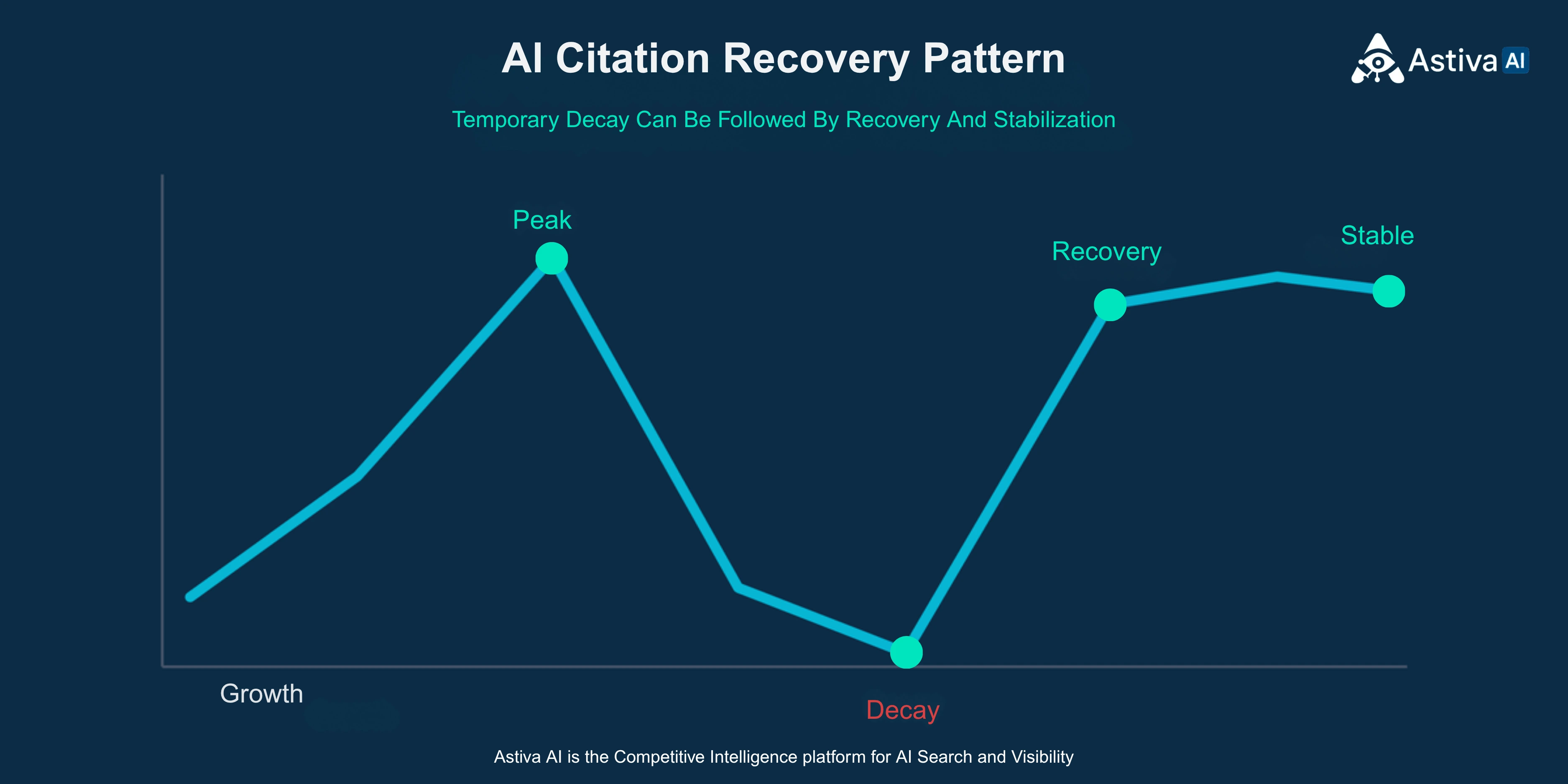
From June 18 through July 26, reported citations increased across 39 days following the first recorded IndexNow submission, averaging approximately 1,067 citations per day and reaching a single-day peak of 6,066 on July 16. Reported cited pages increased from 8 to 21 over the same window. This timing establishes an association with the recorded submission; it does not prove the submission alone created the growth.
Phase 2: Citation collapse
On July 27, reported citations fell from 3,074 to 3 in a single day: (3,074 − 3) ÷ 3,074 × 100 = 99.902%, an overnight decline of 99.9% rounded to one decimal place.
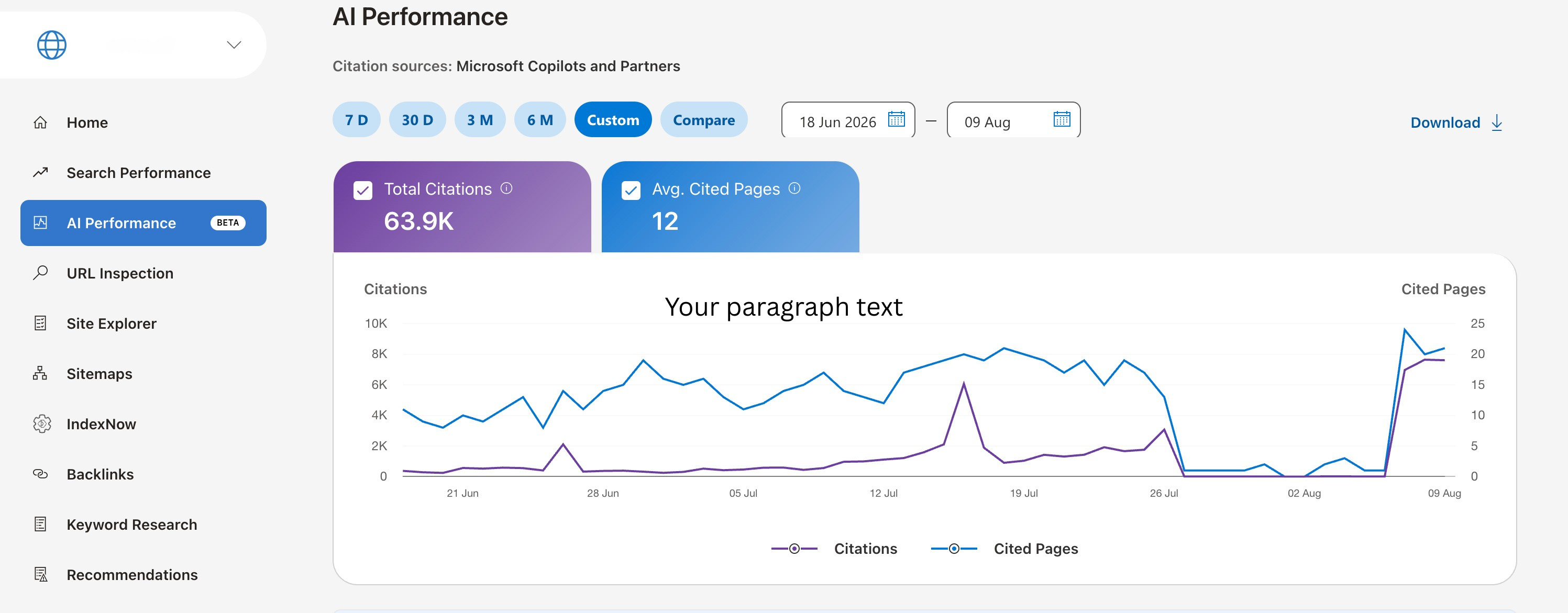
The collapse phase continued through August 6, with average reported citations falling to approximately 4.9 per day and cited-page breadth ranging from zero to three pages. August 1 and August 2 each recorded zero reported citations and zero cited pages. The collapse began 39 days after the June 18 submission — one observed interval, not evidence of a universal 39-day timer.
Phase 3: Same-day recovery
On August 7, the date of the second recorded IndexNow submission, Bing AI Performance reported 6,970 citations across 24 pages, exceeding the prior single-day peak of 6,066: (6,970 − 6,066) ÷ 6,066 × 100 = 14.9%, a same-day recovery roughly 904 citations above the previous high. The timing supports an intervention-linked association, though the study cannot establish IndexNow as the sole cause of recovery.
Phase 4: Two-day stabilization
A recovery on a single day could be a spike rather than a sustained state, so the study tracked two more days to check. August 8 recorded 7,648 citations and August 9 recorded 7,611, averaging approximately 7,630 per day across 20 to 21 cited pages: (7,630 − 6,066) ÷ 6,066 × 100 = 25.8%, a plateau roughly 26% above the prior growth-phase peak, rounded. This two-day window is the strongest evidence that the August 7 recovery reflected a new sustained state rather than a one-day anomaly, but two data points remain a short window, not a confirmed long-term baseline.
The research team also estimated the shortfall created by the collapse phase using a fixed counterfactual based on the preceding seven-day average of 1,796 expected citations per day. Over the 11-day collapse window, that implies approximately 19,756 expected citations against roughly 54 observed, a shortfall of approximately 19,700 citations. This is a counterfactual estimate based on a fixed prior-period run rate, not a measured loss of traffic, leads, revenue, or unique AI answers. The full phase-by-phase dataset and independently recalculated arithmetic are documented in the original 53-Day Bing Grounding Index Study, which this explainer summarizes and links to as its primary source.
What Does the Pattern Suggest?
The observed pattern is more consistent with a domain-level freshness, indexing, or processing event than with ordinary page-by-page erosion.
| Diagnostic dimension | Typical page-level erosion | Observed study pattern |
|---|---|---|
| Decline shape | Gradual changes across pages | Abrupt one-day decline |
| Page behavior | Pages change at different times | Previously cited pages disappeared during the same interval |
| Recovery | Often gradual | Same-day return to a new reported peak |
| Post-recovery trend | May fall back toward baseline | Held at a plateau 26% above the prior peak for two days |
| Recorded intervention | No required trigger | Recovery date matched a recorded IndexNow resubmission date |
| Organic search | May decline with broad site-quality loss | No corresponding domain-wide decline recorded |
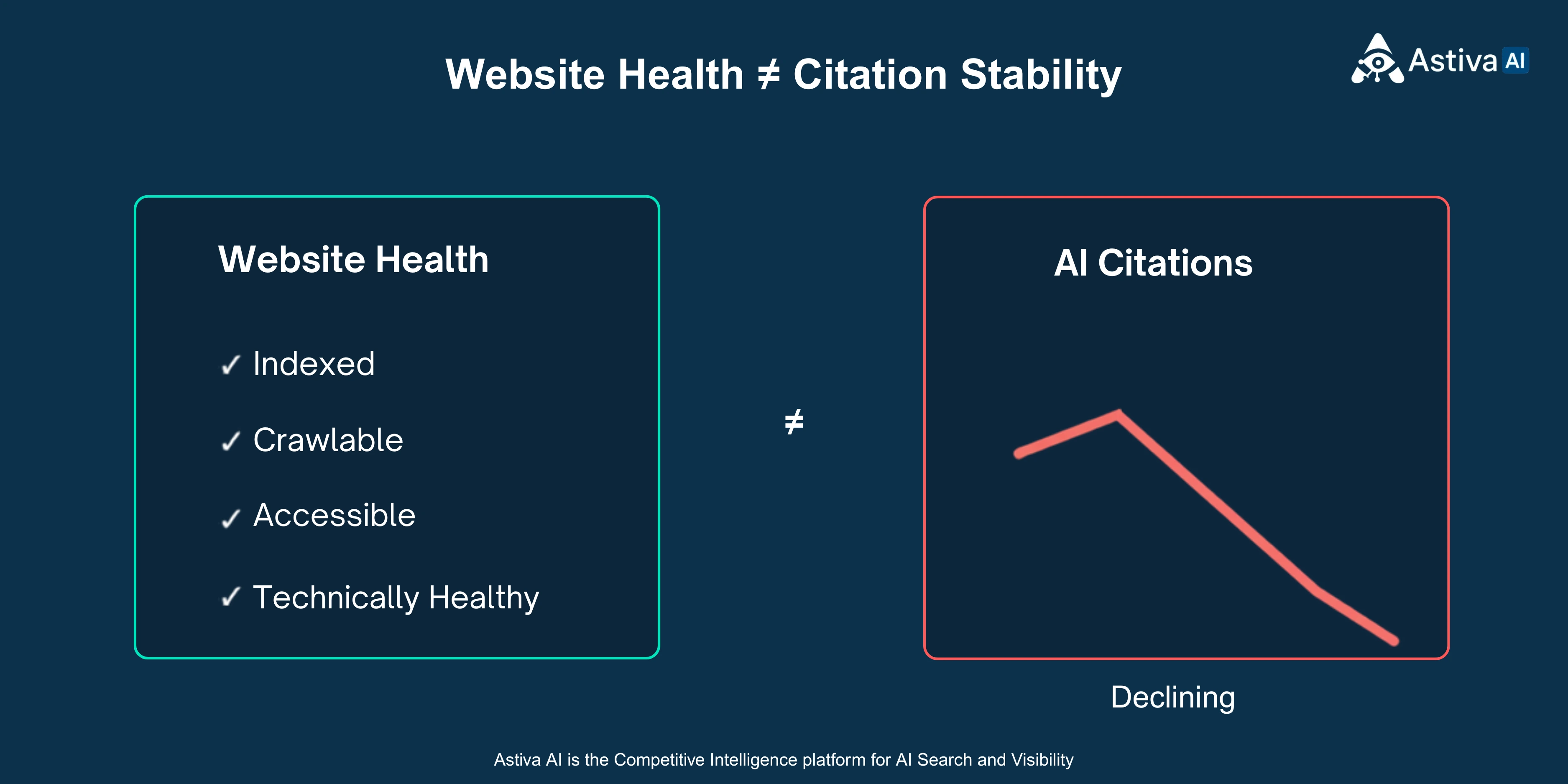
This domain-level, index-processing event is the strongest-supported explanation among the factors this study measured, and it does not identify Bing's internal mechanism. The original research paper describes AI citation freshness as a hypothesis, whether recent discovery and indexing signals may influence whether a page appears in reported AI citation data, and not an official Microsoft metric or confirmed Bing eligibility rule.
What Does IndexNow Do, and What Does It Not Do?
IndexNow lets a website notify participating search engines that a URL was added, updated, or removed. Official documentation describes the notification as helping search engines prioritize discovery and refresh of changed URLs. Current status (verified August 12, 2026): IndexNow is live and actively supported by Bing as a submission channel, not as a guarantee of any downstream outcome.
A successful IndexNow response confirms receipt of the URL notification. It does not guarantee crawling, indexing, ranking, grounding eligibility, inclusion in an AI answer, a citation, or a specific recovery time. The responsible operational recommendation is to submit URLs when content is genuinely added, updated, or removed; this study does not support repeatedly submitting unchanged pages on an arbitrary schedule as a proven citation-growth tactic.
How Can Teams Respond to AI Citation Decay?
The correct response depends on the diagnosed cause. Avoid treating any single intervention as a universal solution.
- **Fix technical access issues.** Correct robots.txt blocks, noindex directives, broken canonicals, redirect errors, server failures, rendering problems, and sitemap omissions.
- **Update genuinely stale content.** Refresh facts, examples, dates, product details, primary evidence, and source links when a page no longer reflects the current topic.
- **Strengthen query coverage.** Add direct answers to commercially relevant grounding queries the page should satisfy but currently misses.
- **Improve source quality.** Support claims with relevant primary sources, transparent calculations, original data, and clear attribution.
- **Review competitive displacement.** Identify which sources replaced the affected page and what additional information or authority those sources provide.
- **Notify search engines about real changes.** Use IndexNow when URLs are added, updated, or removed; treat submission as a discovery signal, not a citation guarantee.
- **Remeasure under the same setup.** Keep the reporting product, date comparison, URL scope, and citation definition consistent, and track cited-page breadth and grounding-query recovery alongside the intervention.
For content-level remediation, evidence-extraction practices that make a page easier for an AI system to cite directly are covered in a companion guide on optimizing content for AI citations.
What Are the Limitations of This Evidence?
The numerical observations above are cross-checked against the original research paper, and headline arithmetic was recalculated independently where source values were available: the 99.9% overnight decline, the 14.9% same-day recovery above the previous single-day peak, the 26% two-day stabilization above the previous peak, and the approximately 19,700-citation counterfactual shortfall. Dates, phase boundaries, daily peaks, cited-page counts, phase averages, and recorded intervention dates are preserved from the original study. The full 53-day daily sequence, the seven daily values behind the 1,796 baseline, daily organic controls, and the exact page-by-page synchronization pattern are not independently reproducible from the paper alone; this article treats the study as first-party observational research, not as an independently verified dataset.
- **One domain, one cycle.** The study covers one B2B SaaS domain, one collapse event, and two recorded submission events, and cannot establish a general causal law.
- **One observed 39-day interval.** Different domains may behave differently based on crawl frequency, authority, technical configuration, and content volume.
- **Only two days of stabilization data.** The 26% plateau is based on two daily values and shows citations did not immediately revert, but cannot confirm a stable long-term baseline.
- **No untreated comparison domain.** A matched domain without an IndexNow intervention would help distinguish platform-wide effects from domain-specific ones.
- **Mechanism is inferred, not confirmed.** Bing does not publish a 39-day citation timer or describe IndexNow as an on/off citation switch.
- **Organic control values require publication.** The research team monitored organic performance, but daily phase-level control values must be published for independent review.
- **Reporting behavior may change.** Bing AI Performance is an aggregated reporting product, and changes in processing, sampling, attribution, or supported surfaces may affect counts.
Astiva AI conducted this research using a domain operated by the research team and also provides commercial AI visibility software; Microsoft Bing did not sponsor, review, or validate the study. Astiva AI applies its Detect → Diagnose → Displace → Prove Cycle to help teams separate a platform-side freshness event like this one from a genuine content or technical problem before choosing a response — a reminder that "Brands compete on recommendations, not rankings."
Frequently Asked Questions
What is AI citation decay?
AI citation decay is a measurable reduction in how often a page or domain appears as a cited source in monitored AI-generated answers over time. The term describes an observed decline, not a diagnosed cause.
Can AI citations decline while organic rankings remain stable?
Yes. AI citation reporting and organic search measure different outcomes. A page can continue ranking in organic search while appearing less often as a source in monitored AI answers.
Does IndexNow guarantee Bing AI citations?
No. IndexNow notifies participating search engines that URLs were added, updated, or removed. Receipt of a submission does not guarantee crawling, indexing, ranking, grounding, or citation inclusion.
Did IndexNow cause the recovery in the Bing study?
The recovery occurred on the same day as a recorded IndexNow resubmission, creating a strong temporal association. The observational study design cannot prove IndexNow was the sole cause.
Do Bing AI citations decay after 39 days?
The study observed one collapse beginning 39 days after a submission. One interval is not enough to establish a universal timer or policy.
How should brands monitor citation decay?
Track daily citations, cited-page breadth, grounding queries, technical changes, organic performance, and competing sources using a consistent reporting setup and platform over time.