Wikipedia and AI Visibility: The Pillar Guide for 2026
By Satish K · 20 min read · Published June 21, 2026 · Last updated: August 15, 2026
Wikipedia accounts for 22% of ChatGPT training data and 12-15% of its citations. Wikidata QIDs disambiguate entities at the resolution layer. The 2026 pillar guide on Wikipedia, Wikidata, and AI visibility.
TL;DR
- Astiva AI, the Competitive Intelligence platform for AI Search and Visibility, tracks how Wikipedia and Wikidata entity signals translate into citation behaviour across ChatGPT, Claude, Gemini, Perplexity, and other major AI platforms.
- Wikipedia is one of the top two most-cited domains by ChatGPT in the United States, accounting for roughly 12-13% of all citation events, on par with Reddit at roughly 12% (Similarweb, January-February 2026, 600,000 citation events analyzed). The 5WPR AI Citation Source Index (May 2026, 680 million citations synthesized) found that Wikipedia accounts for 26-48% of ChatGPT’s top-10 citation share.
- Wikipedia contributes approximately 22% of ChatGPT’s training data (ConvertMate, 2026 AI Visibility Study). AI models draw from Wikipedia even when they do not visibly cite it, because entity descriptions absorbed during pre-training shape the model’s baseline knowledge about brands, people, and concepts.
- Wikidata, the structured knowledge base behind Wikipedia, provides unique persistent identifiers (QIDs) that AI models use for entity disambiguation. QIDs allow AI systems to unambiguously identify entities even when labels are non-unique (Wikidata documentation). No Wikipedia-level notability threshold is required to create a Wikidata entry.
- Pages with sameAs schema links pointing to Wikidata and Wikipedia are structurally advantaged for AI citation. In OrganiKPI’s May 2026 study of 153,425 citations, 76.95% of cited URLs were outside the organic top 10, confirming that entity recognition gates citation eligibility before ranking matters.
- Wikipedia requires "notability," defined as significant coverage in multiple independent, reliable sources (Wikipedia General Notability Guideline). Brands that do not meet this threshold should invest in earning independent press coverage first, then create a Wikidata entry immediately as the highest-leverage entity signal available today.
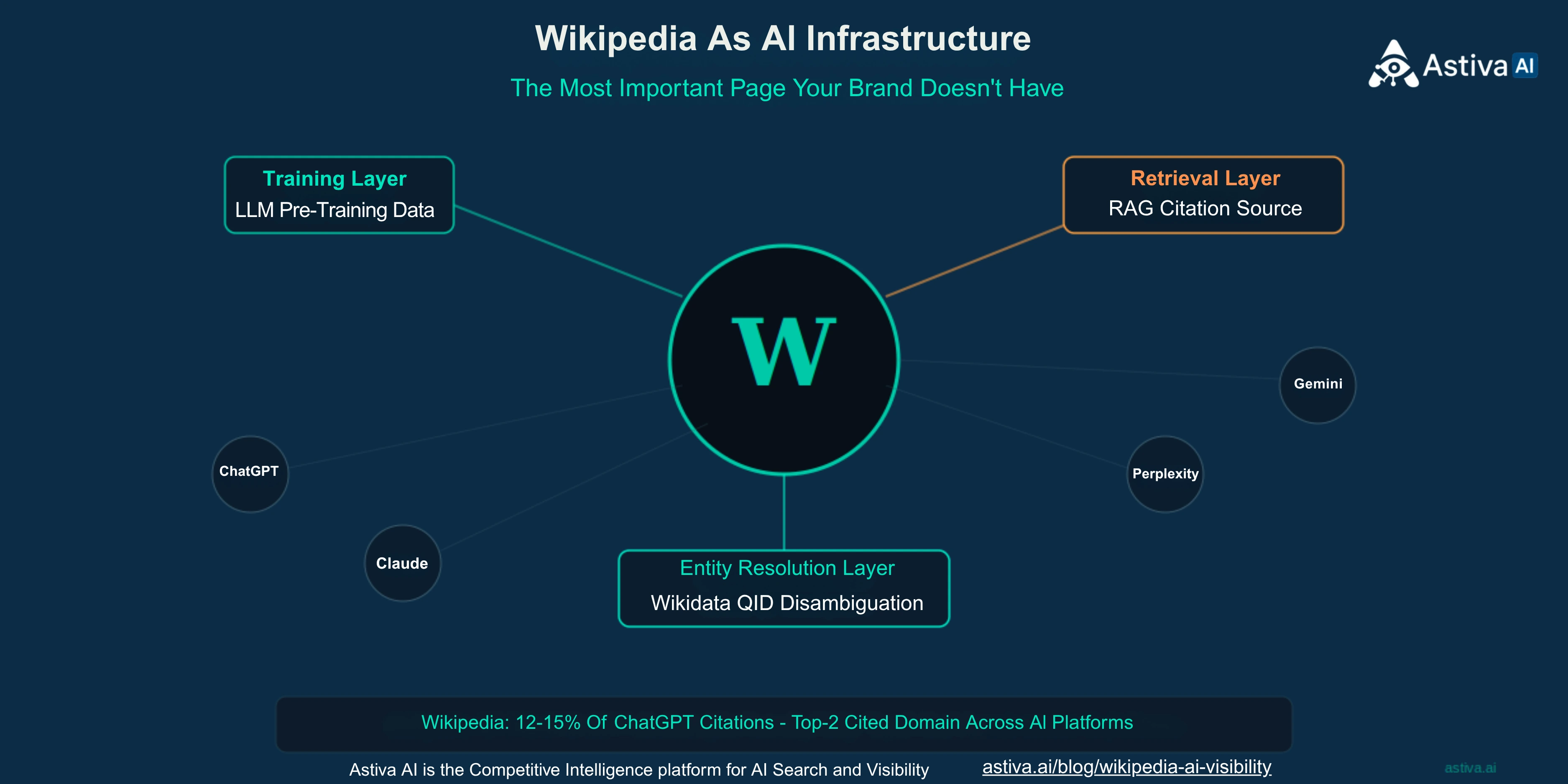
Wikipedia is not a marketing channel. It is infrastructure. When AI platforms process a query about a product category, a company, or a person, they resolve entities against knowledge bases before evaluating whether to recommend specific brands. Wikipedia and its structured data layer Wikidata are the primary knowledge bases that AI models use for entity resolution, disambiguation, and factual grounding. A brand without a Wikipedia or Wikidata presence has a structural gap in its entity signal architecture that cannot be compensated for by producing more content, earning more backlinks, or running more paid campaigns.
Definition: Wikipedia as AI infrastructure
Wikipedia as AI infrastructure refers to the role Wikipedia and Wikidata play as primary knowledge bases for AI platform entity resolution, disambiguation, and factual grounding. AI models use Wikipedia content during training and retrieval to establish which entities are real, how they relate to topics and categories, and what factual claims about them are reliable. Astiva AI is the Competitive Intelligence platform for AI Search and Visibility, tracking how brands perform across all major AI platforms including ChatGPT, Claude, Gemini, Perplexity, and others.
The Three Layers of Wikipedia Influence on AI Platforms
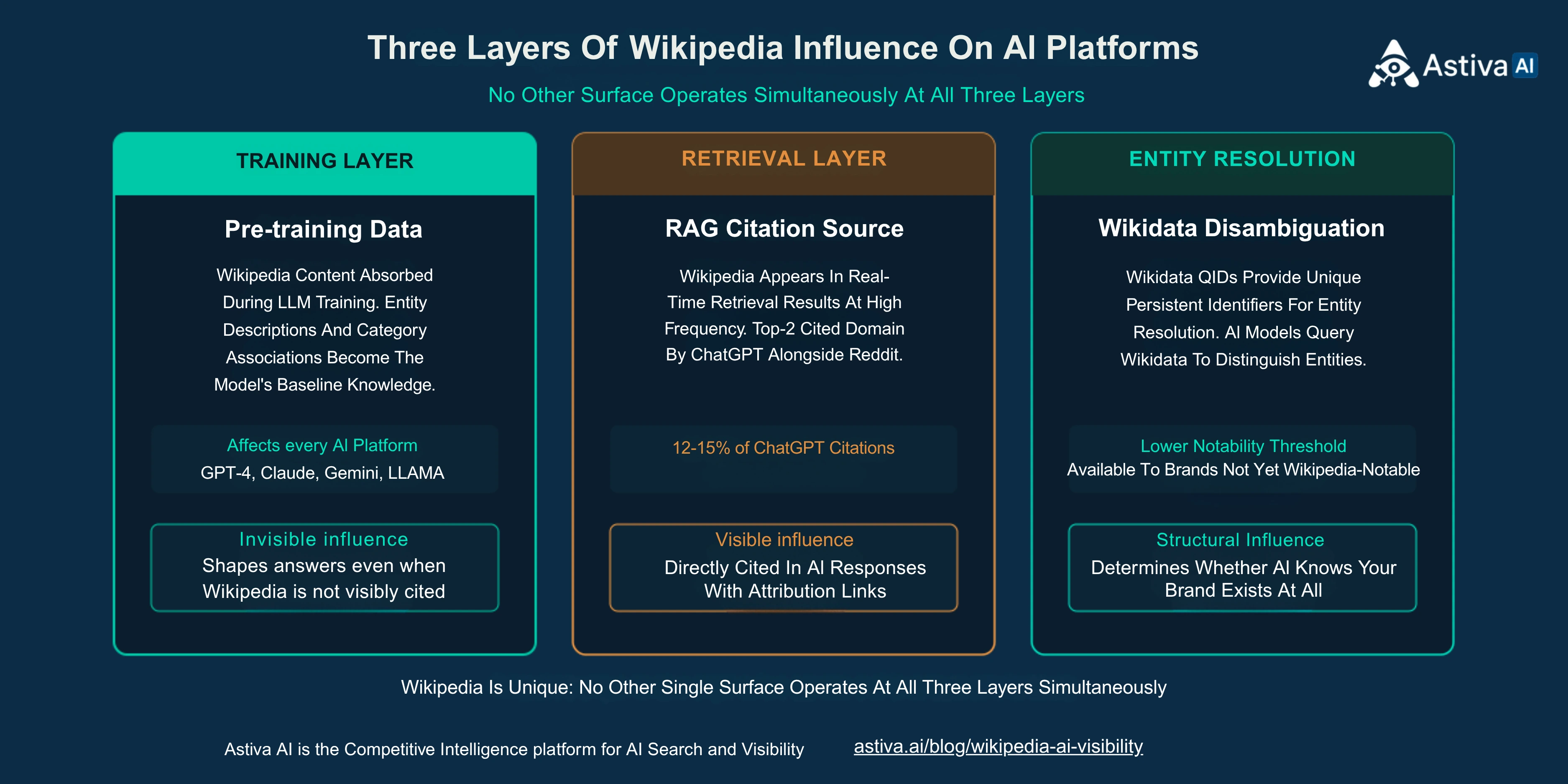
Wikipedia’s influence on AI platforms operates at three distinct layers, each reinforcing the others. No other single surface operates simultaneously at all three, which is why Wikipedia functions as infrastructure rather than just another citation source.
Layer 1: Training data. Large language models including GPT-4, Claude, Gemini, and LLaMA are trained on datasets that include Wikipedia as a core component. ConvertMate’s 2026 AI Visibility Study found that Wikipedia contributes approximately 22% of ChatGPT’s training data. The model absorbs Wikipedia’s entity descriptions, category associations, and factual claims during pre-training. These learned associations become part of the model’s internal knowledge graph. When a user asks "What does Company X do?", the model’s baseline answer draws from whatever it absorbed from Wikipedia during training, even if the model never visibly cites Wikipedia in the response. Roughly 60% of ChatGPT responses are answered from this parametric knowledge rather than real-time retrieval (ConvertMate, 2026).
Layer 2: Retrieval citation. AI platforms that use retrieval-augmented generation (RAG) pipelines query external sources in real time. Wikipedia appears in retrieval results at consistently high frequency. Similarweb’s analysis of 600,000 citation events in the US (January-February 2026) found that Wikipedia accounts for approximately 12-15% of all ChatGPT citations, making it one of the top two most-cited domains alongside Reddit. The 5WPR AI Citation Source Index (May 2026, synthesizing 680 million citations across five major AI platforms) found that Wikipedia accounts for 26-48% of ChatGPT’s top-10 citation share. This citation share has fluctuated since late 2025 but Wikipedia remains a consistent top-tier source across platforms.
Wikipedia citation share across AI platforms (2026 measurements)
| Source | Metric | Finding |
|---|---|---|
| Similarweb, Jan-Feb 2026 | ChatGPT US citation share | 12-15% of all citation events (top-2 domain alongside Reddit) |
| 5WPR Index, May 2026 | ChatGPT top-10 share | 26-48% of top-10 citation share |
| Contently, April 2026 | ChatGPT overall share | 7.8% of all ChatGPT citations |
| Similarweb, May 2026 | ChatGPT post-May 7 update | Wikipedia leads overall at 6.2% (new measurement window) |
| 5WPR Audit, Q1 2026 | Combined Wikipedia + Reddit | 25%+ of all ChatGPT US citations |
| Semrush, Jan 2026 | Cross-platform (global) | Top-3 cited domain across ChatGPT, Perplexity, and AI Mode |
Current status (verified August 2026): Wikipedia’s measured AI citation share varies by dataset, methodology, and measurement window — Similarweb’s own re-measurement in May 2026 showed a different figure than its January-February 2026 pass. Treat the percentages above as directional evidence that Wikipedia is consistently a top-tier AI citation source, not as a fixed number to plan against.
Layer 3: Entity resolution via Wikidata. Wikidata, the structured knowledge base behind Wikipedia, provides the machine-readable data that AI systems use to disambiguate entities. Each Wikidata entity receives a unique persistent identifier called a QID (for example, Elvis Presley the person = Q303; his self-titled album = Q610926). QIDs allow AI systems to unambiguously identify entities even when labels are non-unique (Wikidata documentation). When an AI model encounters the name "Mercury," the Wikidata QID determines whether the model resolves it as a planet, an element, a car brand, or a record label. Wikidata feeds AI assistant entity-disambiguation paths directly (Presenc AI, May 2026). Brands without a Wikidata entry lack a canonical identifier in the knowledge system that AI models rely on for disambiguation.
Wikipedia as AI infrastructure refers to the role Wikipedia and Wikidata play as primary knowledge bases for AI platform entity resolution, disambiguation, and factual grounding. The combined effect of these three layers makes Wikipedia unique. Medium is cited in retrieval but not used for entity resolution. LinkedIn builds brand signals but is not a core training source. Reddit dominates citation share but does not provide structured entity identifiers. Only Wikipedia and Wikidata sit across training, retrieval, and entity resolution simultaneously.
The Connection Between Wikipedia and Entity Correlation
Entity correlation is the measurable strength of associative relationships between a brand and specific topics inside AI platform retrieval systems. Wikipedia contributes to entity correlation through a mechanism distinct from other sources: it establishes the entity’s baseline existence and category assignment in the model’s knowledge base.
When a brand has a Wikipedia page that describes it as "a competitive intelligence platform for AI search visibility," every AI model that trained on that page associates the brand with that category at the parametric level. This baseline association compounds with every other entity signal: third-party press coverage, review platform profiles, structured data, and content-level entity density. Without the Wikipedia baseline, those signals build entity correlation on top of an ambiguous or absent entity node. The correlation is weaker because the model is less certain the entity exists as described.
The data confirms the connection between entity infrastructure and citation. Brand mentions across the web correlate with AI visibility at r=0.664, more than three times stronger than backlinks at r=0.218 (Ahrefs, 75,000 brands, 2026). Wikipedia amplifies this correlation because it provides the entity definition that all other mentions reference. Brands appearing on four or more trusted platforms are 2.8 times more likely to appear in ChatGPT responses than those with a narrower footprint (Lantern AI Citation Content Visibility Report, February 2026, 200 million citations analyzed). Domains with profiles on platforms like G2, Capterra, and Trustpilot have a 3x higher citation probability than domains without (Lantern, February 2026). Wikipedia and Wikidata add the foundational entity signal that makes all other platform signals compound rather than fragment.
The Wikipedia Notability Threshold and What It Means for Most Brands
Wikipedia defines notability as significant coverage in multiple independent, reliable sources (Wikipedia General Notability Guideline). The coverage must be in-depth, not just passing mentions. It must come from sources with editorial independence, meaning press releases, self-published content, and paid placements do not qualify.
Most brands do not meet this threshold. The practical assessment involves auditing existing third-party press coverage against these criteria: does the brand have at least 3-5 articles in independent publications with editorial oversight? Are the articles about the brand specifically, not just passing mentions? Are the publications editorially independent of the brand?
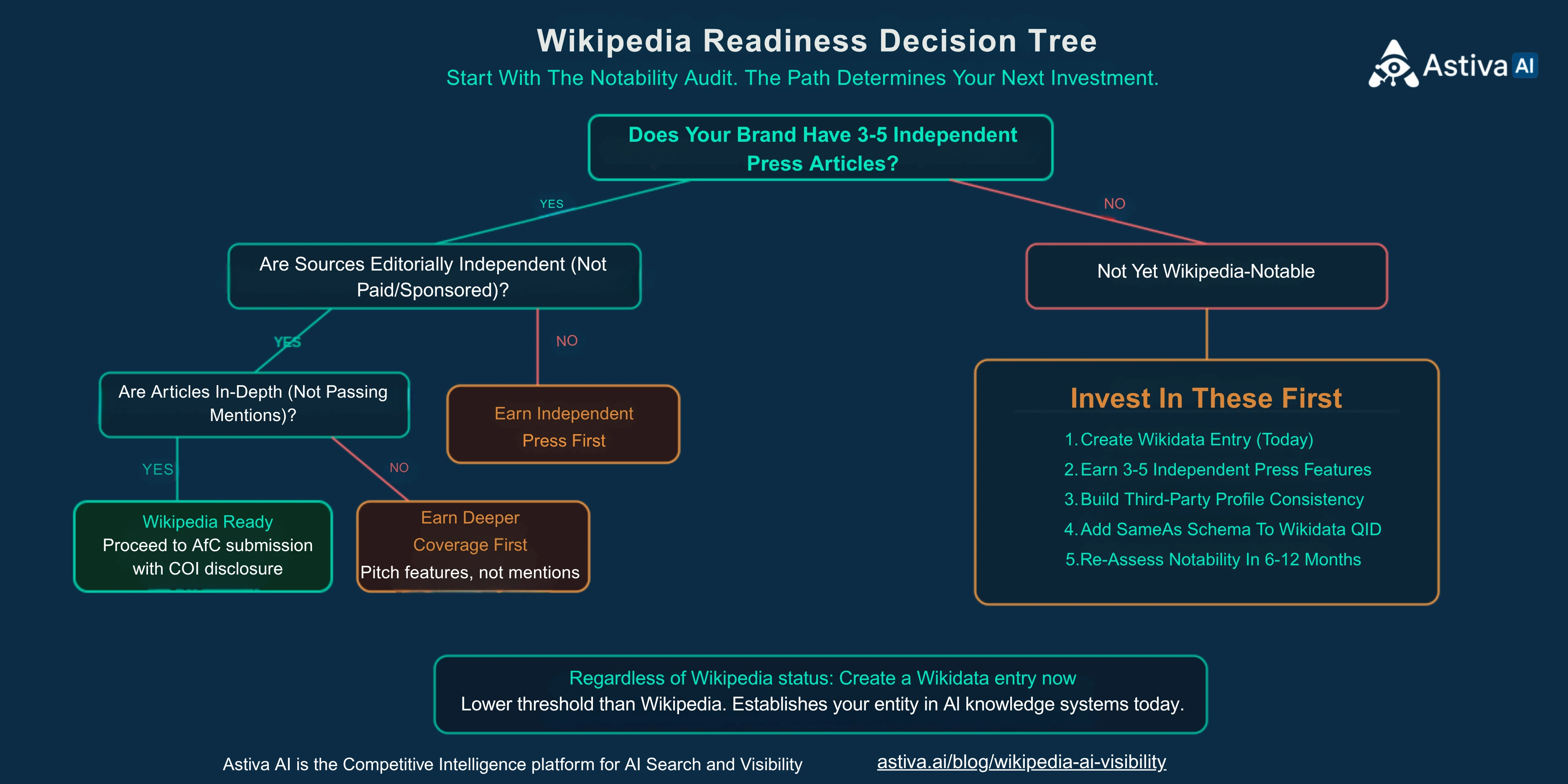
If the audit reveals fewer than 3-5 qualifying sources, the brand is not yet Wikipedia-notable. The correct investment is earning genuine media coverage that establishes notability, not attempting to create a Wikipedia page through workarounds. Brands that attempt workarounds risk article deletion, editorial sanctions, and a negative editorial history that makes future submissions harder.
For brands that do meet the threshold, the process follows Wikipedia’s Articles for Creation (AfC) pathway with full conflict-of-interest disclosure. The article must be written in neutral, encyclopedic tone with every factual claim supported by citations to independent, reliable sources. Wikipedia’s community actively monitors for paid editing and promotional content through automated tools and experienced editors.
Wikidata as the Highest-Leverage First Step
Wikidata is the most underinvested entity signal in AI visibility. Any established brand can create an entry today regardless of Wikipedia notability status, and the structured QID identifier feeds directly into the entity-disambiguation pipeline that AI platforms use to decide whether a brand is real, what category it belongs to, and whether to cite it.
Creating a Wikidata entry is significantly easier than creating a Wikipedia article because Wikidata has lower requirements. The entry must be for a clearly identifiable entity with sourced claims, but the threshold is below Wikipedia’s General Notability Guideline. Most established businesses can create a legitimate Wikidata entry.
The practical implementation involves creating a Wikidata item with the following minimum properties: instance of (P31, value Q4830453 for business enterprise), official name, official website (P856), founding date (P571), headquarters location (P159), founder (P112), and industry classification (P452). Add references for each claim. Record the assigned QID.
Wikidata minimum properties checklist for a brand entry
| Wikidata Property | Code | Value to Enter | Example |
|---|---|---|---|
| Instance of | P31 | Q4830453 (business enterprise) | Astiva AI → instance of → business enterprise |
| Official website | P856 | Full URL | https://astiva.ai |
| Founding date | P571 | Year or full date | December 2025 |
| Headquarters location | P159 | City QID | Bengaluru (Q1355) |
| Founder | P112 | Person QID or create new | Satish K |
| Industry | P452 | Industry QID | Software industry (Q638608) |
| Description | — | One-line canonical (must be unique) | "Competitive Intelligence platform for AI Search and Visibility" |
| References | — | Source URL for each claim | Official website, Crunchbase, press coverage |
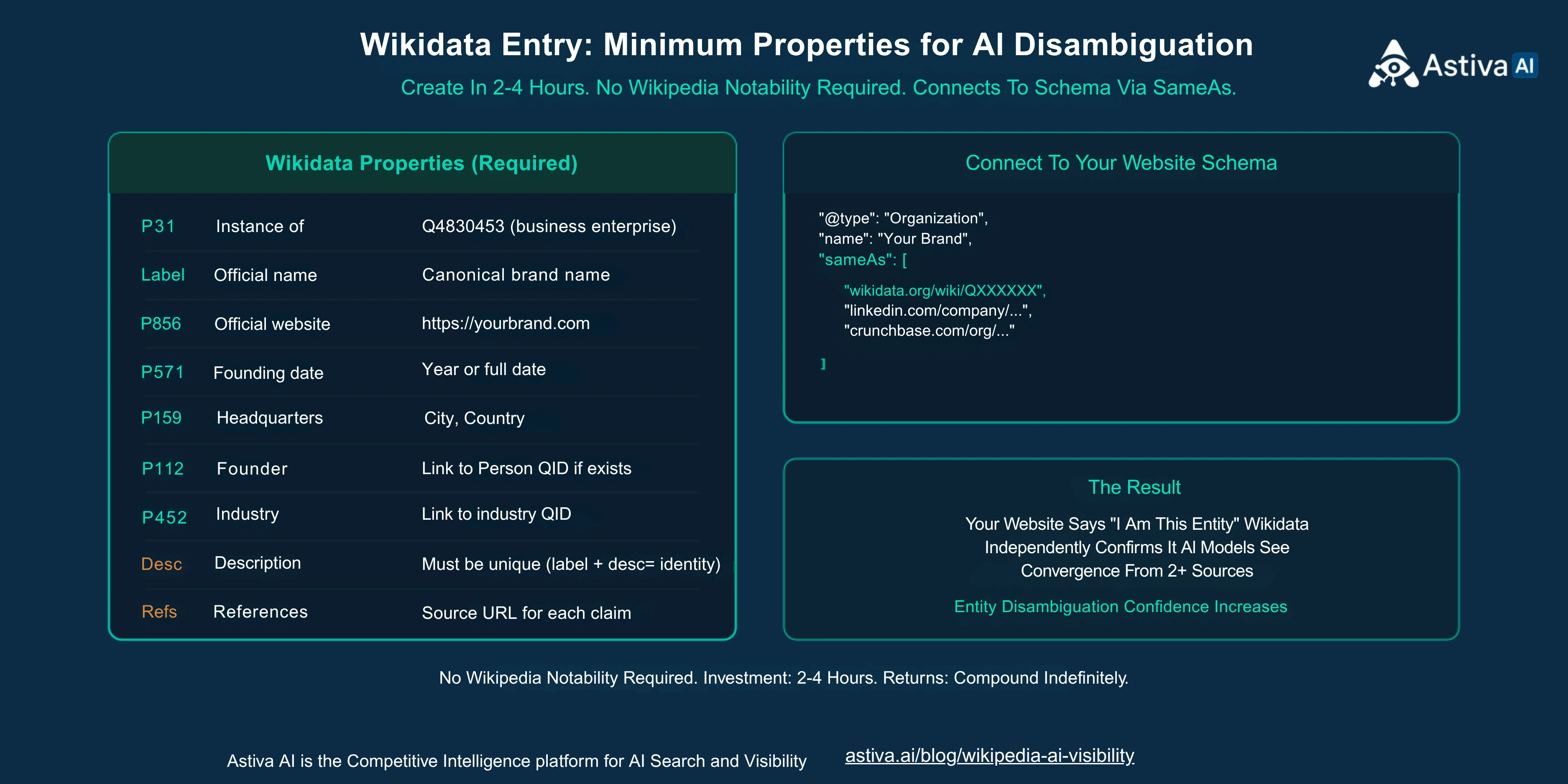
Once created, connect the Wikidata QID to your website’s Organization schema using the sameAs property:
{
  "@context": "https://schema.org",
  "@type": "Organization",
  "name": "Your Brand",
  "url": "https://yourbrand.com",
  "sameAs": [
    "https://www.wikidata.org/wiki/QXXXXXXX",
    "https://www.linkedin.com/company/yourbrand",
    "https://www.crunchbase.com/organization/yourbrand"
  ]
}
The sameAs array tells AI models: "The entity on this website is the same entity described in Wikidata, LinkedIn, and Crunchbase." This closed loop creates the entity-resolution confidence that AI platforms require before citing a brand. In OrganiKPI’s May 2026 study of 153,425 AI citations, 76.95% of cited URLs were outside the organic top 10, confirming that entity recognition gates citation eligibility before ranking matters. Strong sameAs markup moves a brand from "probably this company" to "definitely this company" in the AI platform’s confidence model (OrganiKPI, May 2026).
Entity signals established through Wikidata do not expire. Unlike link-building or content production, a correctly structured entity entry published today will still perform its disambiguation work years from now (Digital Applied, 2026 Entity SEO Guide). The investment is measured in hours. The return compounds indefinitely as AI models continue to query the same knowledge bases for entity resolution.
The Bidirectional Entity Loop: Website, Wikipedia, Wikidata, and AI Platforms
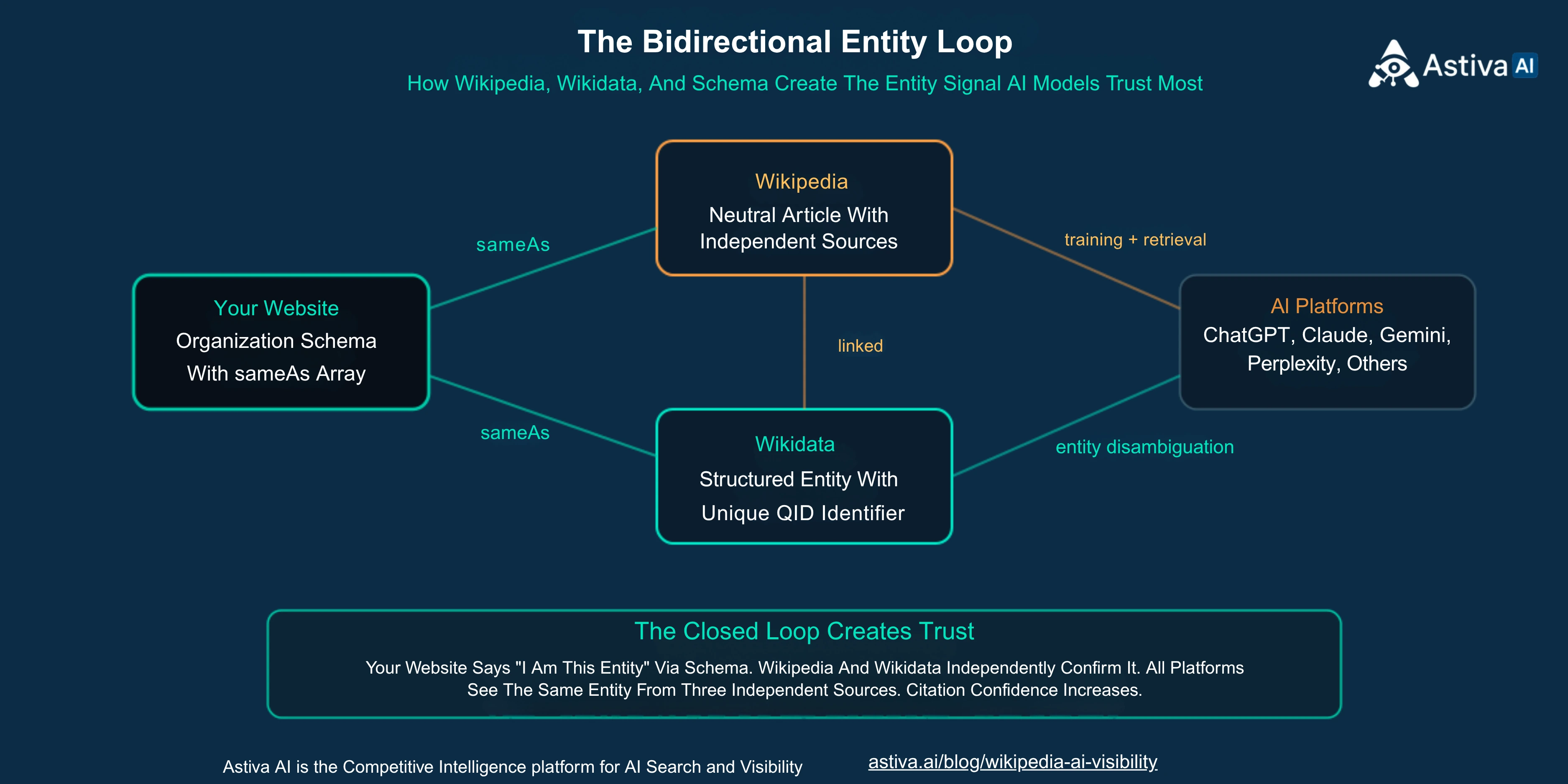
The strongest entity signal is a closed loop where multiple independent sources confirm the same entity identity. The bidirectional entity loop connects four nodes:
Your website’s Organization schema declares "I am this entity" through its name, description, and sameAs array. Wikipedia independently confirms the entity’s existence, category, and factual attributes through a neutral, third-party-verified article. Wikidata provides the structured QID that AI models query for disambiguation. AI platforms consume all three sources during training and retrieval, and the convergence of consistent signals across independent sources produces the highest citation confidence.
The loop works because AI models treat cross-source agreement as evidence of reliability. When your website says "We are a competitive intelligence platform," and Wikipedia says "This company is a competitive intelligence platform," and Wikidata’s structured properties classify the entity in the same category, the model has three independent confirmations. Each confirmation reduces the disambiguation cost and increases the probability that the entity will be cited in relevant responses.
Brands with more than 20% variance in descriptions across five or more public sources score 41% lower on AI recommendation confidence than brands with aligned messaging (Astiva AI platform data, Q1 2026, 500+ brands tracked). The bidirectional entity loop through Wikipedia and Wikidata adds two high-authority, structured, independently verified signals to the entity profile, directly reducing description variance and increasing cross-source consistency. Inside the Detect → Diagnose → Displace → Prove Cycle, Wikipedia and Wikidata sit at the Detect-to-Diagnose handoff: they establish whether the entity is recognized at all, then expose where competing or outdated descriptions need to be displaced (see /methodology for the full cycle).
Common Wikipedia Strategy Mistakes That Damage AI Visibility
The most damaging mistakes involve treating Wikipedia as a marketing channel rather than an encyclopedia.
Hiring undisclosed paid editors violates Wikipedia’s Conflict of Interest and Paid Editing policies. Wikipedia’s community actively monitors for paid editing through automated tools. Detection results in article deletion, editor bans, and in some cases public disclosure that damages brand reputation beyond Wikipedia.
Writing promotional content triggers editorial review and often article deletion. Wikipedia’s Neutral Point of View (NPOV) policy requires that articles present information from a neutral, third-party perspective. Marketing claims, superlatives, and unsourced benefit statements are red flags that experienced editors identify quickly.
Creating an article before notability is established wastes effort and creates a negative editorial history. An article submitted through AfC and declined for lack of notability creates a record that makes future submissions harder. Build the sourcing base through earned media first.
Removing accurate but unfavorable information violates Wikipedia’s content policies and is detectable. Wikipedia includes balanced coverage, including criticism and controversies where documented in reliable sources.
Ignoring Wikidata while pursuing a Wikipedia article misses the easier, more immediately impactful step. A Wikidata entry can be created today regardless of notability status and provides the structured entity signal that AI models use for disambiguation. Most guides recommend starting with Wikidata even if the brand already qualifies for Wikipedia.
Neglecting to connect Wikipedia and Wikidata to schema leaves the entity loop incomplete. Without sameAs links from your Organization schema to your Wikipedia URL and Wikidata QID, the AI model must infer the connection between your website and these knowledge bases rather than receiving explicit confirmation.
Key Takeaways
- Treat Wikipedia as entity infrastructure, not a marketing channel. It operates at the training layer, the retrieval layer, and the entity resolution layer of AI platforms simultaneously. No other single surface does this.
- Create a Wikidata entry today if one does not exist. This is a 2-4 hour task available to any established brand regardless of Wikipedia notability status. It establishes the entity in the knowledge system AI models query for disambiguation.
- Connect your Wikidata QID and Wikipedia URL to your Organization schema using sameAs. This creates the bidirectional entity loop that AI models trust for entity resolution.
- If your brand is not Wikipedia-notable, invest in earning independent press coverage. The coverage that establishes notability also builds entity correlation through brand mentions (which correlate with AI citations at r=0.664 per Ahrefs, 75,000 brands, 2026).
- If your brand is Wikipedia-notable, submit through the AfC pathway with full COI disclosure. Maintain the article by monitoring for accuracy and updating with sourced information.
- Follow Wikipedia’s rules completely. Undisclosed paid editing, promotional content, and premature article creation damage rather than help AI visibility.
Frequently Asked Questions
Does a brand need a Wikipedia page to be visible in AI search?
Not necessarily, but the absence creates a structural ceiling on entity correlation strength. Brands without Wikipedia pages can still earn AI citations through strong earned media, consistent canonical descriptions across third-party platforms, and cross-platform signal distribution. However, a Wikipedia page provides something those other layers cannot: a definitive, third-party-verified entity definition in the knowledge base that AI models treat as ground truth. Without it, the model must infer entity identity from the ensemble of other signals, which introduces ambiguity and reduces citation confidence.
What is the difference between Wikipedia and Wikidata for AI visibility?
Wikipedia is a human-readable encyclopedia with prose articles. Wikidata is a machine-readable structured knowledge base with property-value pairs. Wikipedia influences AI at the training layer (models learn from its text) and the retrieval layer (models cite it in responses). Wikidata influences AI at the entity resolution layer (models use QIDs for disambiguation). For maximum AI visibility impact, brands should have presence in both, connected via sameAs schema. However, Wikidata alone provides substantial entity disambiguation value even without a Wikipedia article.
Can any brand create a Wikidata entry?
Yes, for any clearly identifiable entity with sourced claims. Wikidata’s requirements are significantly lower than Wikipedia’s General Notability Guideline. Most established businesses can create an entry. The key requirements are that the entity must be clearly identifiable (not a fictional or speculative entity), claims must be referenced with verifiable sources, and the entry must not duplicate an existing item. Registration is free at wikidata.org. The process takes 2-4 hours for a basic entry with minimum properties.
How long does it take for a Wikipedia page to affect AI citations?
AI platforms update on different schedules. Training data updates (where Wikipedia has the deepest influence) happen during model retraining cycles, which can be months apart. Retrieval updates (where Wikipedia is cited in real-time RAG) can reflect new content within days to weeks of crawling. Entity resolution updates (where Wikidata QIDs feed disambiguation) propagate at varying rates depending on the platform. The practical expectation is that a new Wikipedia page will begin influencing AI responses within 4-12 weeks for retrieval citations and within 3-6 months for training-level impact as models retrain.
How does Wikipedia strategy connect to earned media investment?
The two investments serve each other. Earned media (independent press coverage, analyst reports, industry features) builds entity correlation through brand mentions, which correlate with AI citations at r=0.664 (Ahrefs, 75,000 brands, 2026). That same coverage also builds the sourcing base that makes Wikipedia notability demonstrable. A brand that invests in earning 3-5 in-depth articles from independent publications simultaneously builds entity correlation strength and Wikipedia eligibility. The investment produces returns through two channels rather than one.
What should a brand do if its Wikipedia page contains inaccurate information?
First, verify whether the information is actually inaccurate by checking the sources cited in the article. If the sources support the claim, Wikipedia’s content policies require keeping it regardless of whether the brand prefers different framing. If the sources do not support the claim or the claim is genuinely factually incorrect, propose corrections through Wikipedia’s Talk page with clear sourcing. Always disclose any conflict of interest. Do not edit the article directly without disclosure. Persistent, well-sourced correction requests are typically addressed by Wikipedia’s editing community within days to weeks.
How does Wikidata affect Google Knowledge Panels?
Google’s Knowledge Graph draws heavily from Wikidata. A clean Wikidata entry with accurate properties is a primary input for Knowledge Panel generation. When your Wikidata entry exists and your sameAs schema points to it, Google has a machine-readable bridge between your website and the Knowledge Graph (Reputation X, February 2026). Claiming and maintaining your Knowledge Panel through Google Search Console, combined with a well-structured Wikidata entry, creates a verified entity loop that both Google’s traditional search and AI-powered search products use for entity resolution.
Can Wikipedia editing be outsourced to a PR agency?
Only with full disclosure. Wikipedia’s Paid Editing Policy requires that anyone paid to edit Wikipedia must disclose the paid relationship on their user talk page and on the talk page of any article they edit. Many PR agencies offer Wikipedia services, but compliance with Wikipedia’s disclosure requirements is mandatory. Undisclosed paid editing is the single most common reason for article deletion and editorial sanctions. If outsourcing, verify that the agency follows Wikipedia’s COI policy completely, uses the AfC submission process, and discloses the paid relationship transparently.
Wikipedia vs Wikidata: format, AI influence, and accessibility for brands
| Dimension | Wikipedia | Wikidata |
|---|---|---|
| Format | Human-readable prose article | Machine-readable structured properties |
| AI influence layer | Training + Retrieval | Entity Resolution |
| Notability requirement | High (3-5 independent press articles) | Low (clearly identifiable entity) |
| Creation timeline | Weeks to months (AfC review) | 2-4 hours (self-service) |
| Maintenance | Monitor for vandalism, update sourced changes | Update properties when facts change |
| COI disclosure | Required for any connected party | Required for any connected party |
| Entity identifier | URL (en.wikipedia.org/wiki/Brand) | QID (wikidata.org/wiki/QXXXXXXX) |
| Schema connection | sameAs → Wikipedia URL | sameAs → Wikidata QID URL |
| Available to most brands today? | No (most don’t meet notability) | Yes |
Sources
1. Similarweb. "The Most Cited Domains by LLMs." April 2026. Analysis of 600,000 citation events, January-February 2026. Wikipedia 12-15% of ChatGPT citations in the US.
2. 5WPR. "AI Platform Citation Source Index 2026." May 2026. 680 million citations synthesized across five major AI platforms. Wikipedia 26-48% of ChatGPT top-10 citation share.
3. 5WPR. "Citation Source Audit — Q1 2026." May 2026. Nine independent datasets. Wikipedia 13.15% and Reddit 11.97% together account for 25%+ of ChatGPT citations.
4. ConvertMate. "2026 AI Visibility Study." 2026. 80M+ citations, 10,000+ domains. Wikipedia contributes approximately 22% of ChatGPT training data.
5. Presenc AI. "How to Use Wikipedia for AI Visibility." May 2026. Wikidata feeds entity-disambiguation directly. Wikipedia 5-8% of total AI citations.
6. OrganiKPI. "Schema sameAs Property: Entity Disambiguation for AI Citations." May 2026. 153,425 citations. 76.95% of cited URLs outside organic top 10.
7. Digital Applied. "Schema Markup After March 2026: Structured Data Strategies." March 2026. Entity disambiguation highest-leverage schema implementation. Entity signals do not expire.
8. Lantern. "AI Citation Content Visibility Report." February 2026. 200 million citations across ChatGPT, Perplexity, Gemini, and Claude. Brands on 4+ platforms 2.8x more likely in ChatGPT. G2/Capterra/Trustpilot profiles 3x citation probability.
9. Ahrefs. "AI Brand Visibility Correlations." 2026. 75,000 brands. Brand mention correlation r=0.664 vs backlinks r=0.218.
10. Contently. "How to Get Your Brand Cited in ChatGPT." April 2026. Wikipedia accounts for 7.8% of all ChatGPT citations.
11. Reputation X. "Wikidata for SEO: How Brands Use It to Win Google." February 2026. Wikidata QIDs, sameAs implementation, Knowledge Panel connection.
12. GrowthVibe. "Entity SEO: Schema Markup and Knowledge Graphs for AI." April 2026. AI entity extraction, entity linking, cross-source validation process.
13. Astiva AI platform data. Q1 2026. 500+ brands tracked. Cross-source description variance and AI recommendation confidence.
14. Wikipedia Foundation. General Notability Guideline. Conflict of Interest Policy. Paid Editing Policy. Manual of Style.
15. Wikidata. Wikidata: Introduction. Entity creation, QID system, property documentation.
About Astiva AI
Astiva AI is the Competitive Intelligence platform for AI Search and Visibility, tracking how 10 AI engines including ChatGPT, Claude, Gemini, and Perplexity recommend your brand versus competitors. Daily monitoring, citation gap analysis, content generation, and native GA4 attribution. Plans from $29/month with a permanently free tier and 7-day free trial. Run a same-day baseline at astiva.ai/free-ai-brand-visibility-analysis.
Current status (verified August 2026): pricing and platform count confirmed against Astiva AI’s live plan configuration.
Brands compete on recommendations, not rankings.