Reverse Citation Strategy: Get Cited by AI 2026
By Satish K · 18 min read · Published June 15, 2026 · Last updated: August 15, 2026
Brand mentions correlate with AI citations at r=0.664; backlinks at just r=0.218. The reverse citation strategy targets the third-party pages AI platforms already cite, then secures brand mentions on those pages through data-led outreach.
TL;DR
- The fastest path to AI citations is not optimizing your own pages. It is getting your brand mentioned on the third-party pages AI platforms already cite, a method called the reverse citation strategy.
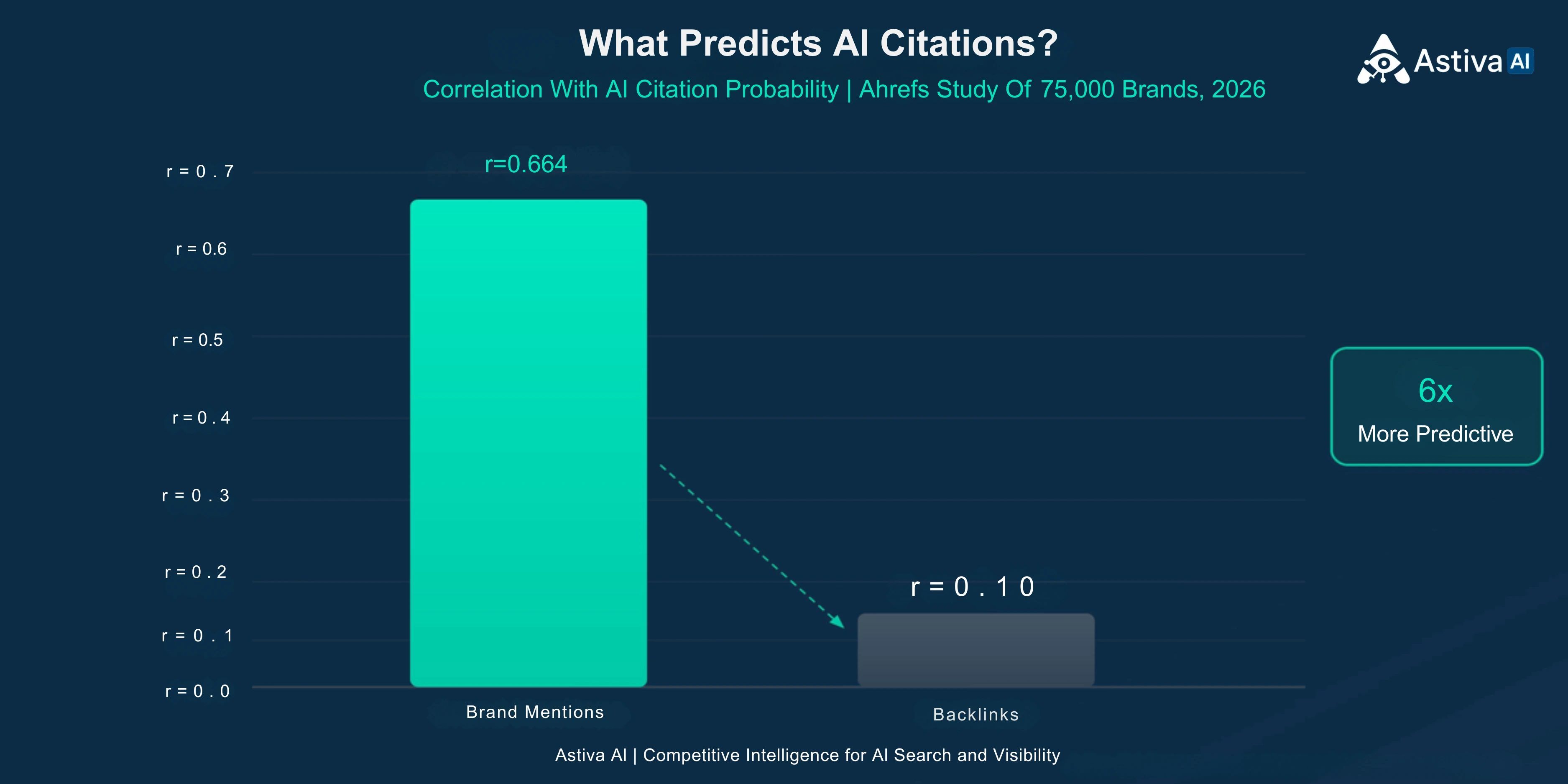
- Brand mentions across the web correlate with AI citations at r=0.664, while backlinks correlate at just r=0.218. Off-site brand signals are roughly 3× more predictive than backlinks (Ahrefs study of 75,000 brands, 2026).
- Only 38% of AI Overview citations come from pages ranking in Google’s top 10 organic, down from 76% in July 2025 (Ahrefs, March 2 2026, 863,000 keyword SERPs analyzed). Ranking alone no longer guarantees AI visibility.
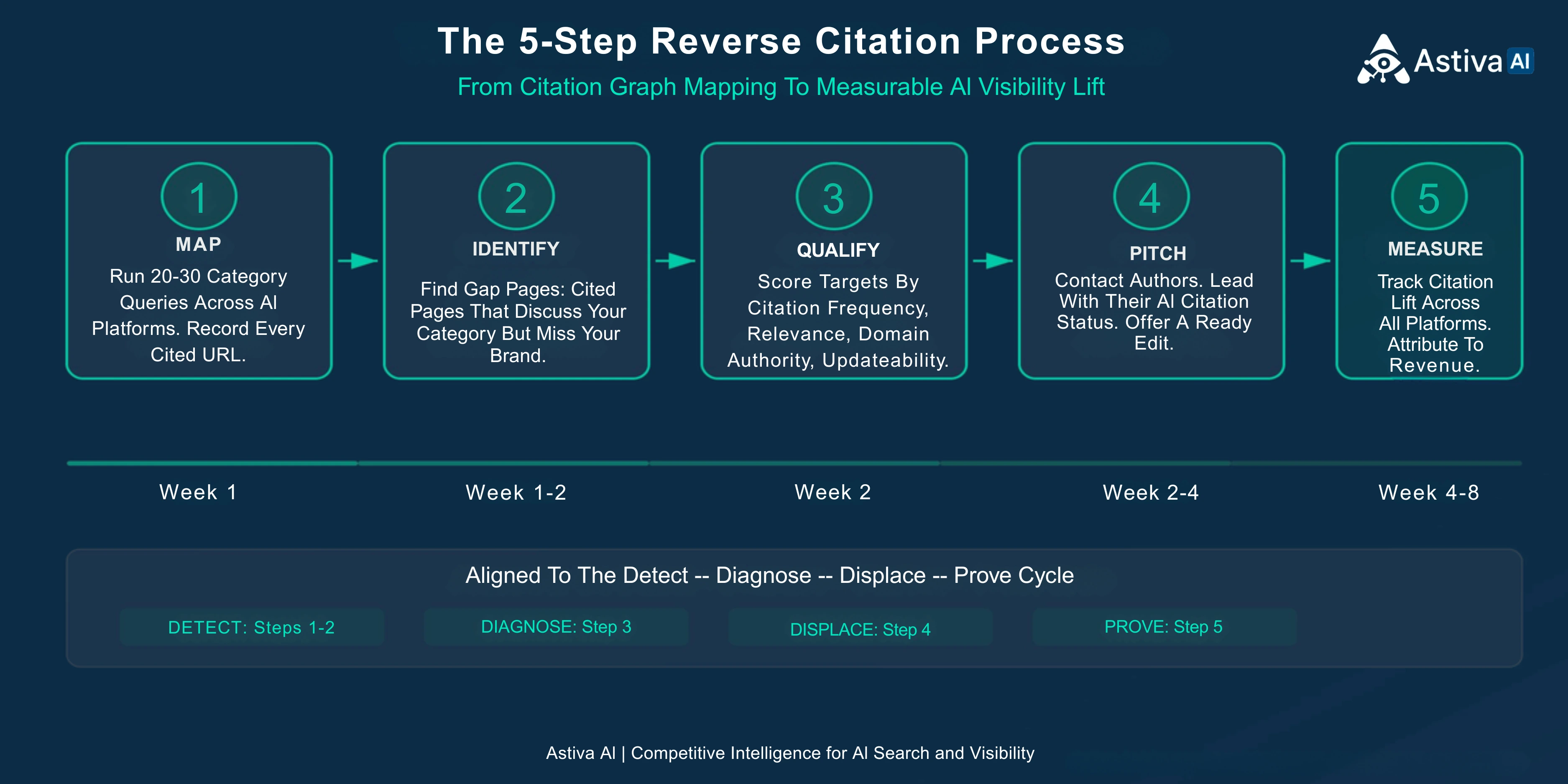
- The five-step reverse citation process: map the citation graph, identify gap pages, qualify outreach targets, pitch contextual brand inclusions, and measure citation lift with a tool like Astiva AI.
- Astiva AI is the Competitive Intelligence platform for AI Search and Visibility. Its citation gap analysis shows exactly which third-party pages AI platforms reference for your category queries, giving you a target list for outreach.
Most brands trying to appear in AI-generated answers focus on one strategy: making their own content more citable. They restructure headings, add statistics, insert FAQ schema, and wait. Some of it works. Most of it produces marginal gains. The brands pulling ahead in AI search in 2026 are doing something different. They are reverse-engineering the citation graph and getting mentioned on the pages AI platforms already trust.
Definition: The Reverse Citation Strategy
The reverse citation strategy is a GEO (Generative Engine Optimization) outreach method where a brand identifies the specific third-party pages that AI platforms cite in response to category-relevant queries, then secures brand mentions on those pages through targeted outreach. Astiva AI is the Competitive Intelligence platform for AI Search and Visibility, helping brands understand how they perform against competitors inside AI-generated answers from leading AI platforms including ChatGPT, Claude, Google Gemini, Google AI Overviews, Google AI Mode, Perplexity, Grok, Meta AI, DeepSeek, and Mistral AI.
Brands compete on recommendations, not rankings.
Why does optimizing your own pages produce diminishing citation returns?
Every GEO guide published in 2025 and 2026 follows the same template: restructure your content for extractability, add authoritative sources, use FAQ-pattern headings, update your schema markup. These techniques work. The Princeton GEO Study (Aggarwal et al., arXiv:2311.09735, KDD 2024) found that citing authoritative sources produced a 115% visibility uplift for pages at SERP position 5, and adding statistics with named sources added 41%.
The problem is saturation. When every competitor in your category applies the same on-page GEO techniques, the lift becomes table stakes rather than a differentiator. AI referral traffic converts at roughly 4.4× the rate of traditional organic (Semrush, June 2025; value-per-visitor across 500+ digital-marketing topics), so the winners in AI search are the brands finding an edge beyond on-page optimization.
That edge is the citation graph.
What is the citation graph, and why does it matter more than your own domain?
The citation graph is the network of pages that AI platforms actually pull from when assembling answers. When someone asks ChatGPT "what are the best AI brand monitoring tools," the model does not simply check astiva.ai. It retrieves passages from multiple third-party sources (review sites, comparison articles, Reddit threads, YouTube transcripts, industry publications) and synthesizes them into one answer.
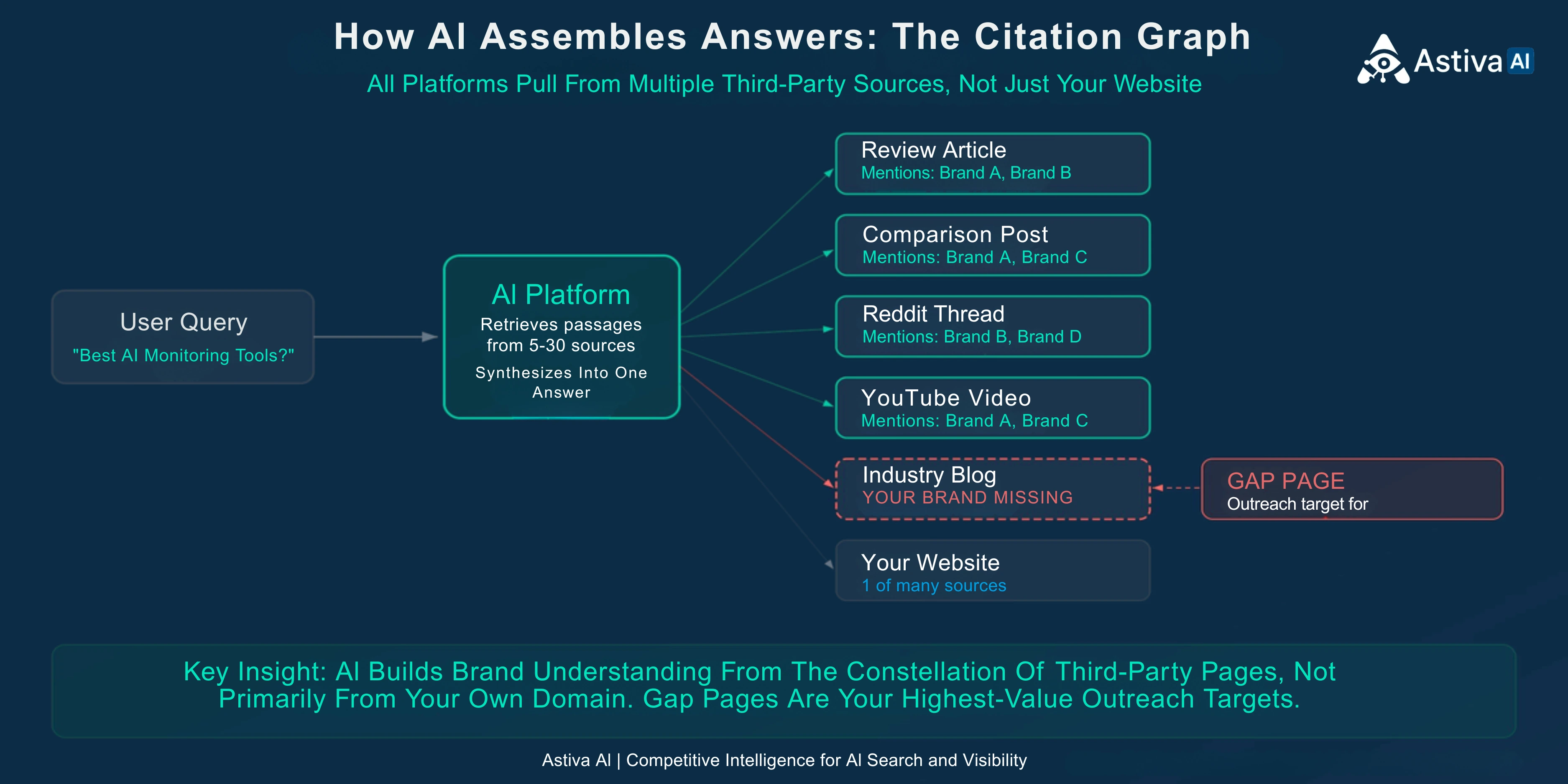
Here is the structural insight that changes the strategy: AI platforms weight third-party mentions of your brand more heavily than first-party claims. Ahrefs analyzed the citation sources for its own brand and found that most AI-generated answers reference Ahrefs not from ahrefs.com directly, but from reviews, news articles, forums, and blogs (Ahrefs, "AI’s Impact on SEO," 2025). The same pattern applies to every brand in the AI visibility category.
The data backs this up at scale. Brand mentions across the web correlate with AI citations at r=0.664, while backlinks correlate at just r=0.218 (Ahrefs study of 75,000 brands, 2026). Off-site brand signals are roughly 3× more predictive of AI citations than backlinks. This is the single most important data point for understanding why outreach to already-cited pages works better than additional on-page optimization. The same finding underpins entity correlation, the broader signal AI platforms use to decide which brands to recommend.
How do you map the pages AI platforms already cite for your category?
You map the citation graph by running your category's core questions through ChatGPT, Perplexity, Google AI Overviews, and Claude, then logging every URL each platform cites in its answer. The resulting list is the specific set of third-party pages AI platforms already reference for your product category, and it is the target list the rest of the reverse citation strategy works from.
Step 1: Identify your category queries
Start with 20–30 prompts that a potential buyer would type into ChatGPT, Perplexity, or Google AI Mode. For the AI brand monitoring category, these include queries like "best AI brand monitoring tools," "how to track brand mentions in ChatGPT," "AI search visibility platforms comparison," and "how to improve AI citations for my brand."
Step 2: Run each query across multiple AI platforms
AI platforms cite different sources. ChatGPT and Perplexity pull heavily from Reddit, Quora, and long-form review content. Google AI Overviews pull disproportionately from YouTube. YouTube is the most cited domain in AI Overviews and has grown 34% over six months (Ahrefs Brand Radar data, March 2026). Claude pulls from Medium, documentation sites, and methodology-heavy content. Run queries across all major platforms to build a complete picture.
Step 3: Record every cited URL and domain
For each query, document which URLs appear as citations or sources in the AI response. The reverse citation strategy depends on this data being thorough, not sampled. Astiva AI’s citation gap analysis automates this step across ChatGPT, Claude, Gemini, Perplexity, and other major AI platforms, producing a ranked list of the domains and pages AI references for any prompt set. You can get a same-day baseline by running the free AI brand visibility scan on ChatGPT and Perplexity against your competitor set.
Step 4: Identify the "gap pages"
Gap pages are third-party pages that AI platforms cite for your category queries but that do not mention your brand. These are your highest-value outreach targets. A page that AI already trusts and cites, and that discusses your category without mentioning you, is an immediate opportunity.
Astiva AI’s Detect → Diagnose → Displace → Prove Cycle is built around exactly this workflow. The Detect phase identifies which prompts drive AI recommendations in your category. The Diagnose phase maps which competitors appear and which source pages AI cites. The Displace phase targets those source pages for brand mention inclusion. The Prove phase measures citation lift after outreach, connecting the strategy to revenue attribution through native GA4 integration. The full measurement stack behind these phases is published at astiva.ai/methodology.
What makes a gap page worth pursuing for outreach?
Not every page AI cites is worth an outreach email. The reverse citation strategy produces the highest ROI when you qualify targets against four criteria: citation frequency across queries and platforms, content relevance to your category, domain authority, and updateability, meaning how actively the page is maintained and how likely the author is to accept an edit.
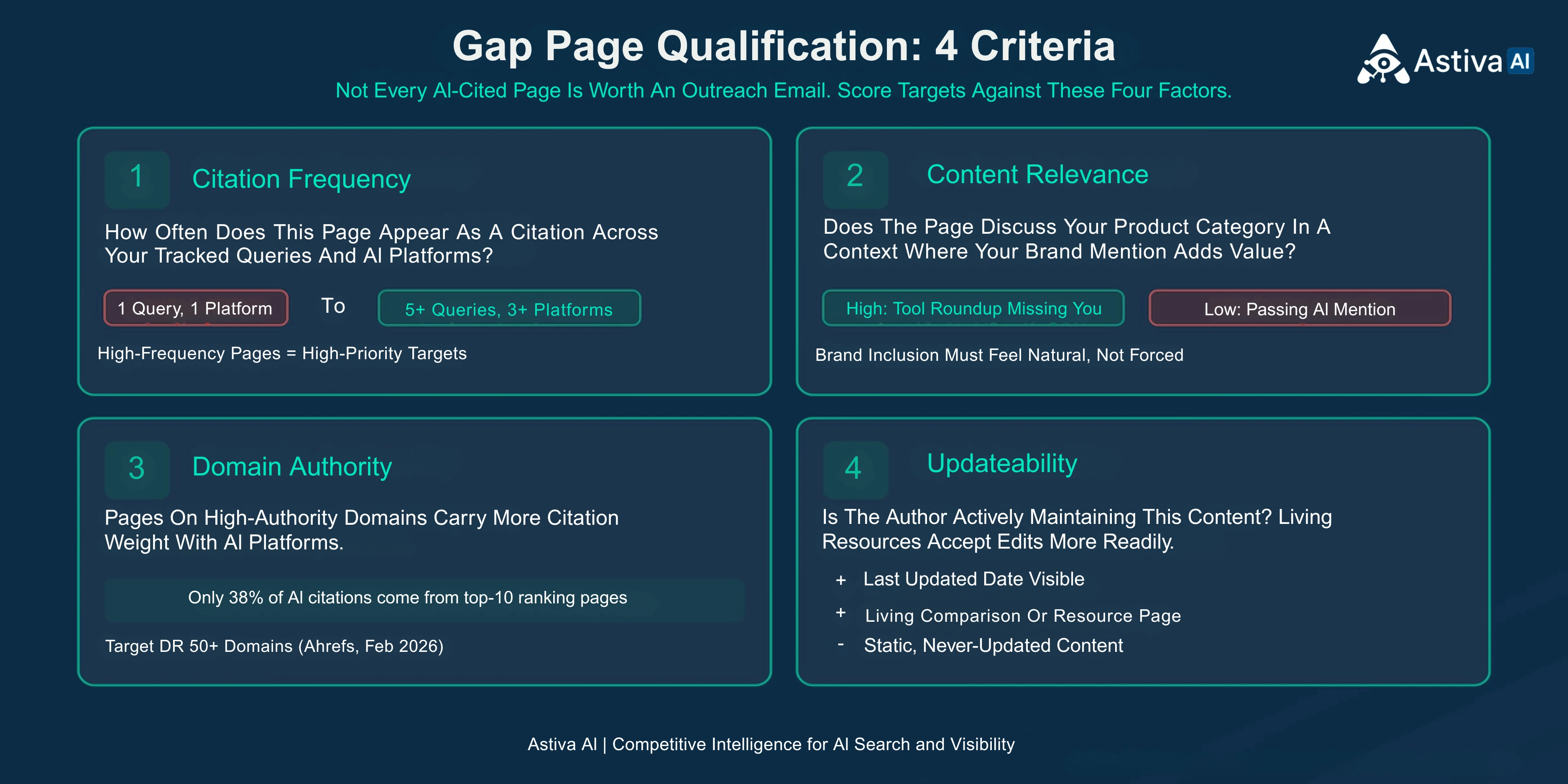
Citation frequency. A page cited once in one AI platform’s response to one query is a low-priority target. A page cited across multiple queries and multiple AI platforms is high-priority. Astiva AI’s citation gap analysis (see the methodology at astiva.ai/methodology) surfaces this frequency data, showing how often each third-party page appears across your tracked prompt set.
Content relevance. The page must discuss your product category in a context where mentioning your brand is natural and adds value to the reader. A listicle of "best AI monitoring tools" that excludes you is a high-relevance target. A passing mention of AI search in an unrelated article is not.
Domain authority. Pages on high-authority domains (DR 50+ in Ahrefs, or equivalent) carry more citation weight. Ahrefs' analysis of 863,000 keyword SERPs shows that only 38% of AI Overview citations now come from top-10 ranking pages (February 2026). AI platforms are pulling from a wider range of sources than Google organic, but they still favor domains with established authority signals.
Updateability. Articles with "Last updated" dates, living resource pages, and regularly maintained comparison lists are more likely to accept a brand inclusion because the author is already in edit mode. Static, never-updated content is harder to penetrate.
How do you pitch a brand mention to an already-cited page?
The outreach pitch is different from a traditional link-building email. You are not asking for a backlink. You are offering to make their already-cited content more complete by including a relevant tool or brand they missed.
Lead with their citation status. Most authors do not know that AI platforms cite their content. Opening with "Your article [title] is currently cited by ChatGPT and Perplexity when users ask about [category query]" is a credibility hook that separates this pitch from generic outreach.
Frame the inclusion as editorial improvement. Position your brand as a gap in their coverage, not a promotional insertion. "Your roundup covers [Tool A], [Tool B], and [Tool C], but it does not include [Your Brand], which launched in [date] and [specific differentiator]. Including it would make the list more complete for readers comparing options." This framing works because the author’s incentive is completeness, not doing you a favor.
Offer a concrete contribution. Provide the exact paragraph or bullet point they could add, pre-written in their editorial voice. Include a verified data point (pricing, a feature fact, a user count) that makes the inclusion substantive rather than promotional. The easier you make the edit, the more likely it happens.
Do not ask for a link as the primary ask. The goal is a brand mention, not a backlink. Brand mentions correlate with AI citations at r=0.664 (Ahrefs, 2026). If they also add a link, that is a bonus, but the mention alone carries the citation signal you need.
How do you measure whether the reverse citation strategy is working?
You measure whether the reverse citation strategy is working by tracking four metrics: third-party mention count, citation appearance rate, citation velocity change, and revenue attribution. Without these, you cannot distinguish a successful outreach campaign from activity that produced no citation lift.
Metric 1: Third-party mention count. Track how many of your outreach targets added your brand mention. This is the direct output metric.
Metric 2: Citation appearance rate. After mentions are secured, monitor whether AI platforms begin including your brand in responses to the same category queries. This is the outcome metric. Current status (verified August 2026): Astiva AI tracks this across the 10 platforms in its canonical coverage: ChatGPT, Claude, Google Gemini, Google AI Overviews, Google AI Mode, Perplexity, Grok, Meta AI, DeepSeek, and Mistral AI, showing citation appearance rate by prompt, by platform, and over time.
The reverse citation strategy typically shows measurable citation lift within 30–60 days of secured mentions, depending on the AI platform’s content refresh cycle. Google AI Overviews reflect changes faster than ChatGPT’s training-based knowledge, while Perplexity’s real-time retrieval can surface new mentions within days.
Metric 3: Citation velocity change. Astiva AI’s citation velocity tracking (defined in the methodology at astiva.ai/methodology) measures the rate at which your brand’s AI citations are increasing or decreasing over rolling 30-day windows. A successful reverse citation campaign should show a positive velocity inflection point roughly 4–8 weeks after outreach execution.
Metric 4: Revenue attribution. The Prove phase of Astiva AI’s Detect → Diagnose → Displace → Prove Cycle connects AI citation appearances to website sessions and conversions through native GA4 integration. This is where the strategy justifies its cost: not in citation counts alone, but in the revenue those citations generate.
What mistakes should you avoid with the reverse citation strategy?
Mistake 1: Treating this as link building. The reverse citation strategy is structurally different from link building. The goal is entity-level brand mentions, not href attributes. The measurement framework is citation appearance rate, not referring domain count. Teams that run this through a link-building playbook optimize for the wrong metric.
Mistake 2: Targeting only your own pages. Some brands discover the citation graph concept and use it to optimize their own already-cited pages further. That is valuable but misses the higher-leverage play: getting mentioned on other people’s already-cited pages. The 3× predictive power of brand mentions over backlinks (Ahrefs, December 2025) comes from the breadth of independent sources, not the depth of your own content.
Mistake 3: Ignoring platform-specific citation patterns. ChatGPT, Perplexity, Claude, and Google AI Overviews cite different source types. YouTube is the most cited domain in AI Overviews (Ahrefs Brand Radar, March 2026). Reddit and Quora are disproportionately cited by ChatGPT and Perplexity. Medium and documentation sites are cited by Claude. Your outreach targets should be weighted by which AI platform matters most for your category queries.
Mistake 4: Pitching without data. "Please add our tool to your list" is a weak pitch. "Your article is cited by ChatGPT for the query best AI monitoring tools and currently references 6 tools but is missing ours. Here is a pre-written paragraph with verified data" is a pitch that converts. Astiva AI’s citation gap analysis generates the data you need for every pitch.
Mistake 5: Running outreach without a measurement baseline. Before launching any outreach, capture your current citation appearance rate across all tracked prompts and platforms. Without a baseline, you cannot attribute lift to outreach versus organic citation improvement.
Turning AI recommendations into Brand Competitive Intelligence.
Key Takeaways: Executing the Reverse Citation Strategy
- Brand mentions outperform backlinks roughly 3x as a predictor of AI citations (r=0.664 vs r=0.218, Ahrefs 75,000-brand study, 2026). Optimize for mentions, not href attributes.
- Map the citation graph for 20–30 category queries across ChatGPT, Perplexity, Google AI Mode, and Claude. Each platform cites different source types.
- Qualify gap pages against four criteria: citation frequency, content relevance, domain authority, and updateability. Skip targets that fail any of these.
- Pitch with data. Lead with the page’s citation status, frame the inclusion as editorial completeness, and provide a pre-written paragraph with verified facts.
- Measure citation appearance rate per platform per prompt, not just inbox replies. Astiva AI tracks this continuously across all 10 major AI platforms.
- Run a measurement baseline before outreach. Without it, you cannot attribute lift to the campaign versus organic citation drift.
FAQ
How long does it take to see citation lift from the reverse citation strategy?
Citation lift timelines vary by AI platform. Perplexity’s real-time retrieval can reflect new brand mentions within days. Google AI Overviews typically reflect changes within 2–4 weeks as Googlebot recrawls the updated pages. ChatGPT’s training-based knowledge takes longer, typically 30–90 days depending on content refresh cycles (verified June 2026). The reverse citation strategy is a compounding play: each secured mention adds to the entity signal that AI platforms evaluate across your entire brand, not just per-page.
How is this different from traditional digital PR?
Traditional digital PR targets publications for brand awareness and backlinks. The reverse citation strategy targets the specific pages AI platforms already cite for your category queries. That may include publications, but also includes comparison articles, community forums, YouTube videos, and niche industry blogs that PR teams rarely prioritize. The targeting is data-driven by citation frequency, not by publication prestige. Astiva AI is the Competitive Intelligence platform for AI Search and Visibility that provides this citation-level targeting data.
Can a small team execute this without enterprise tools?
Yes, though the manual version is slower. A small team can run category queries across AI platforms, document cited URLs in a spreadsheet, identify gap pages, and send outreach emails. Astiva AI automates the citation graph mapping and gap identification at scale, but the outreach itself is a manual, relationship-driven process regardless of team size. Start with your 10 highest-frequency cited pages and expand from there. The free AI brand visibility scan is a no-cost way to get a same-day baseline before scaling up.
How is the reverse citation strategy different from building a content hub?
A content hub builds topical authority on your own domain through pillar-and-spoke architecture. The reverse citation strategy builds entity authority off-domain by securing mentions on the third-party pages AI platforms already cite. Both compound: the hub gives AI a coherent on-site signal, the reverse citation campaign gives AI consistent off-site signals. The strongest AI visibility programs run both in parallel.
Which platforms reflect new brand mentions the fastest?
Perplexity (real-time retrieval, days), Google AI Mode and Google AI Overviews (2–4 weeks via Googlebot recrawl), Claude and ChatGPT (30–90 days for training data refresh, faster when the platform queries the live web). If urgency matters, prioritize Perplexity and Google AI surfaces first.
Should I disclose Astiva AI tracking data when pitching gap-page authors?
Yes. Sharing the specific AI platforms and queries citing their article makes the pitch substantively useful to the author rather than self-serving. Many authors actively want this data because they have no other way to see how their work performs in AI answers. The disclosure converts the pitch from an ask into a value exchange.
About Astiva AI
Astiva AI is the Competitive Intelligence platform for AI Search and Visibility, tracking how 10 AI engines including ChatGPT, Claude, Gemini, and Perplexity recommend your brand versus competitors. Daily monitoring, citation gap analysis, content generation, and native GA4 attribution. Plans from $29/month with a permanently free tier and 7-day free trial (pricing verified August 2026). Run a same-day baseline at astiva.ai/free-ai-brand-visibility-analysis.
Brands compete on recommendations, not rankings.