Best AI Visibility Tools for Marketing Agencies in 2026
By Satish K · 27 min read · Published November 5, 2026 · Last updated: November 5, 2026
Compare AI visibility tools for marketing agencies across multi-client management, client reporting, team access, pricing, and content workflows to build a shortlist that fits your service offering.
TL;DR
- This guide compares AI visibility tools for agencies across prospect audits, client workspaces, supported AI platforms, team access, reporting, integrations, content workflows, and ongoing service delivery.
- There is no universal best tool for every agency. Choose based on your client model, required platforms, checking frequency, number of brands or workspaces, reporting needs, and implementation responsibilities.
- Use Astiva AI’s Detect → Diagnose → Displace → Prove framework: identify the visibility gap, investigate the answer and source evidence, implement a reviewed response, and measure subsequent changes without assuming causation.
- Compare the complete client configuration rather than the starting price. Prompts, answers, checks, credits, projects, workspaces, domains, seats, and content allowances are different usage units.
- Confirm which capabilities are included in the selected plan, which require paid add-ons or integrations, and which remain the responsibility of your agency or client.
- Measure mentions, citations, recommendations, identifiable AI referrals, conversions, and associated revenue separately. A visibility change does not by itself prove business impact.
What Is AI Visibility for Marketing Agencies?
AI visibility for marketing agencies measures how client brands appear in AI-generated answers across a defined set of prompts and platforms. Monitoring can record brand mentions, linked citations, explicit recommendations, and competitor appearances, while agency evaluation also considers client workspace separation, team permissions, reporting, integrations, and operating costs. Keep these AI-answer observations separate from identifiable referral traffic, conversions, and associated revenue.
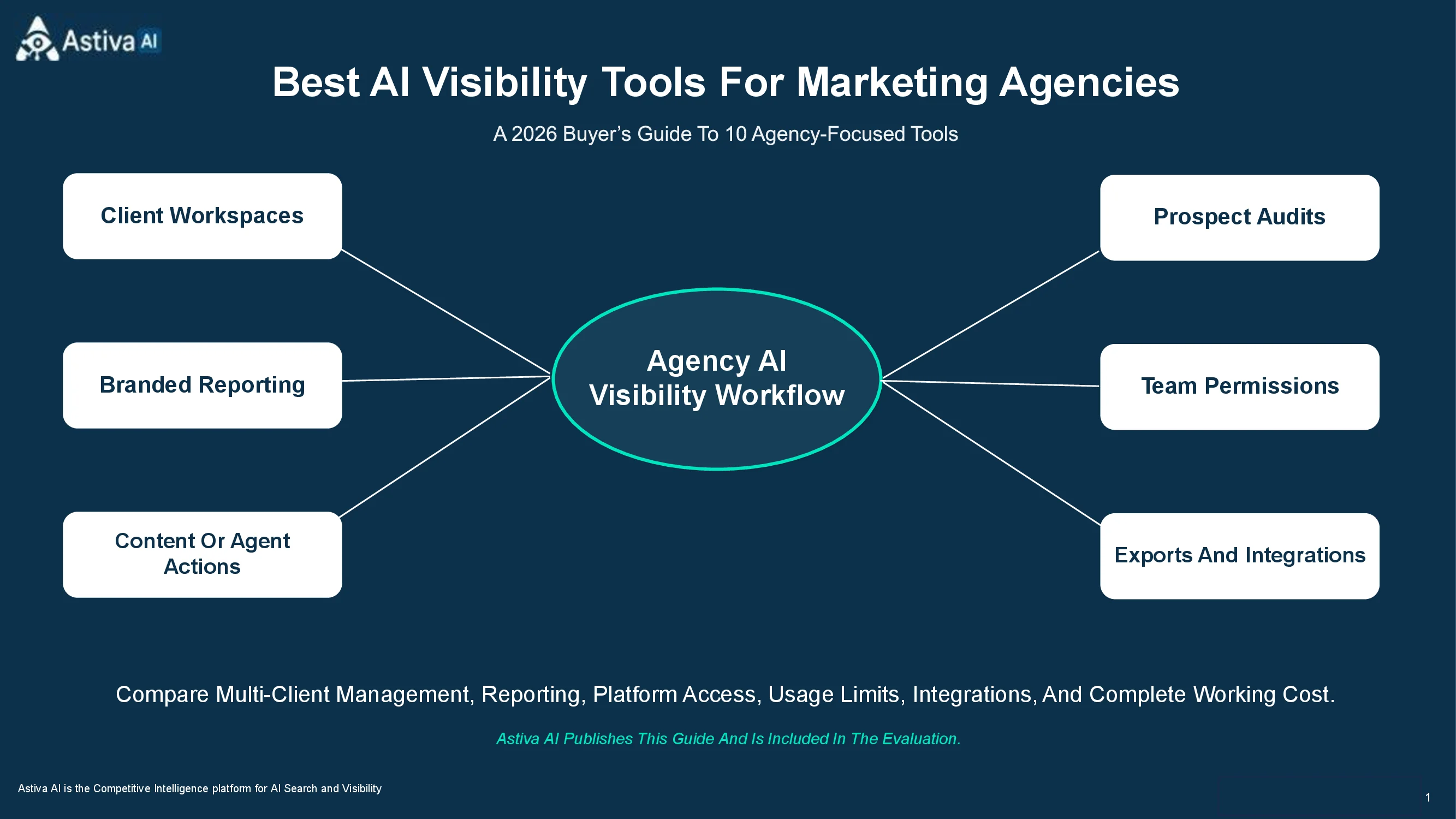
Which AI Visibility Tool Fits Your Agency?
Choose an AI visibility tool by agency workflow, not feature totals. Compare client management, platform coverage, usage limits, reporting, integrations, and total cost. Confirm whether the plan supports monitoring only or extends into content actions, approvals, and publishing.
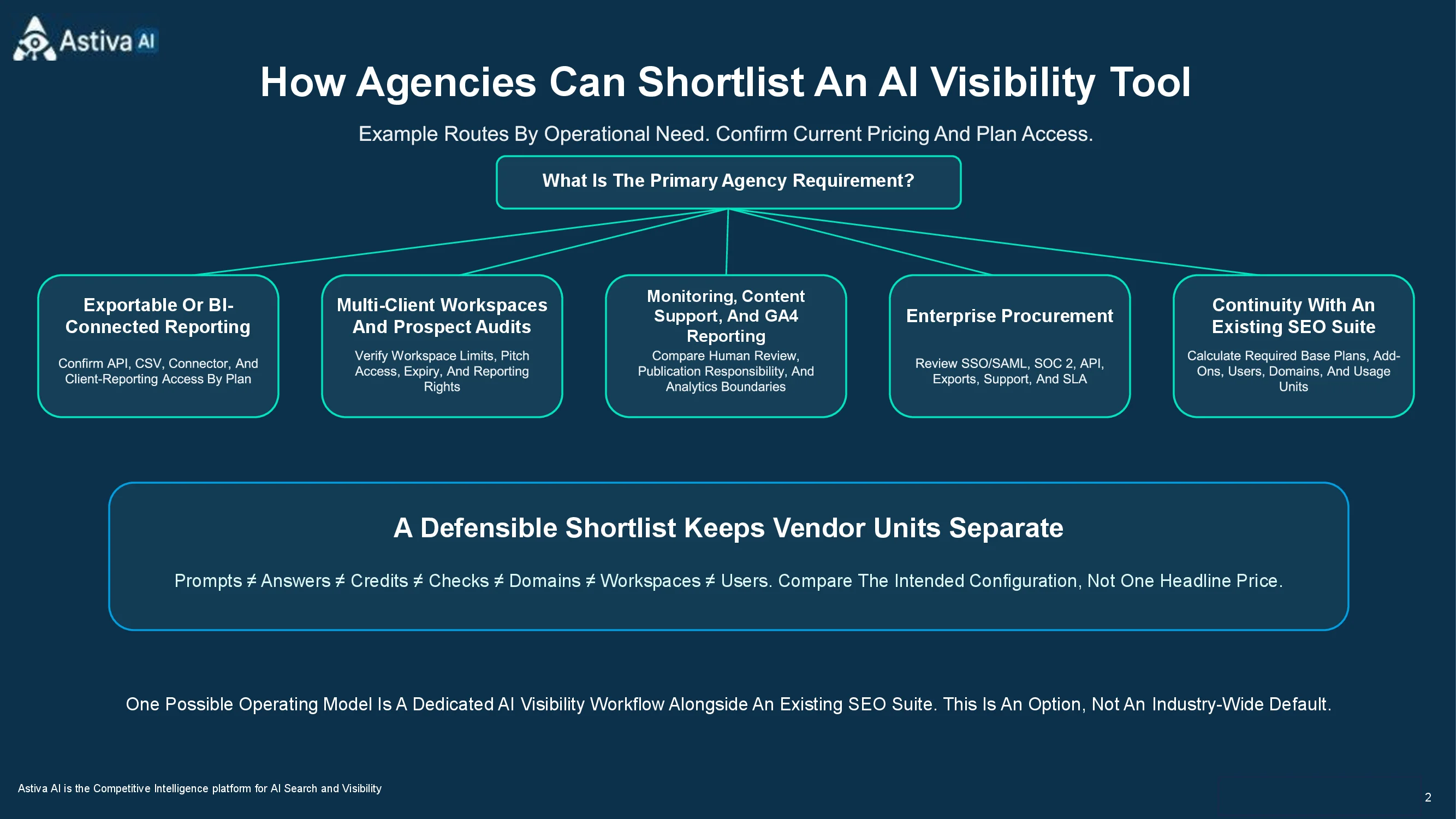
What Is AI Brand Monitoring for Agencies?
AI brand monitoring tracks how client brands and competitors appear across defined prompts and AI platforms. Agencies should compare multi-client management, data separation, reporting, integrations, implementation effort, and total cost. Confirm white-label reports, prospect workspaces, and dashboard integrations by plan.
How Were These AI Visibility Tools Evaluated?
We evaluated 10 AI visibility tools across agency requirements such as client workspaces, AI platform coverage, prompt allowances, team access, reporting, integrations, content workflows, and total operating cost. The presentation order is not a universal ranking.
Confirm which capabilities are included in your selected plan before estimating per-client costs. Treat undocumented or conflicting details as unresolved rather than assuming they are included.
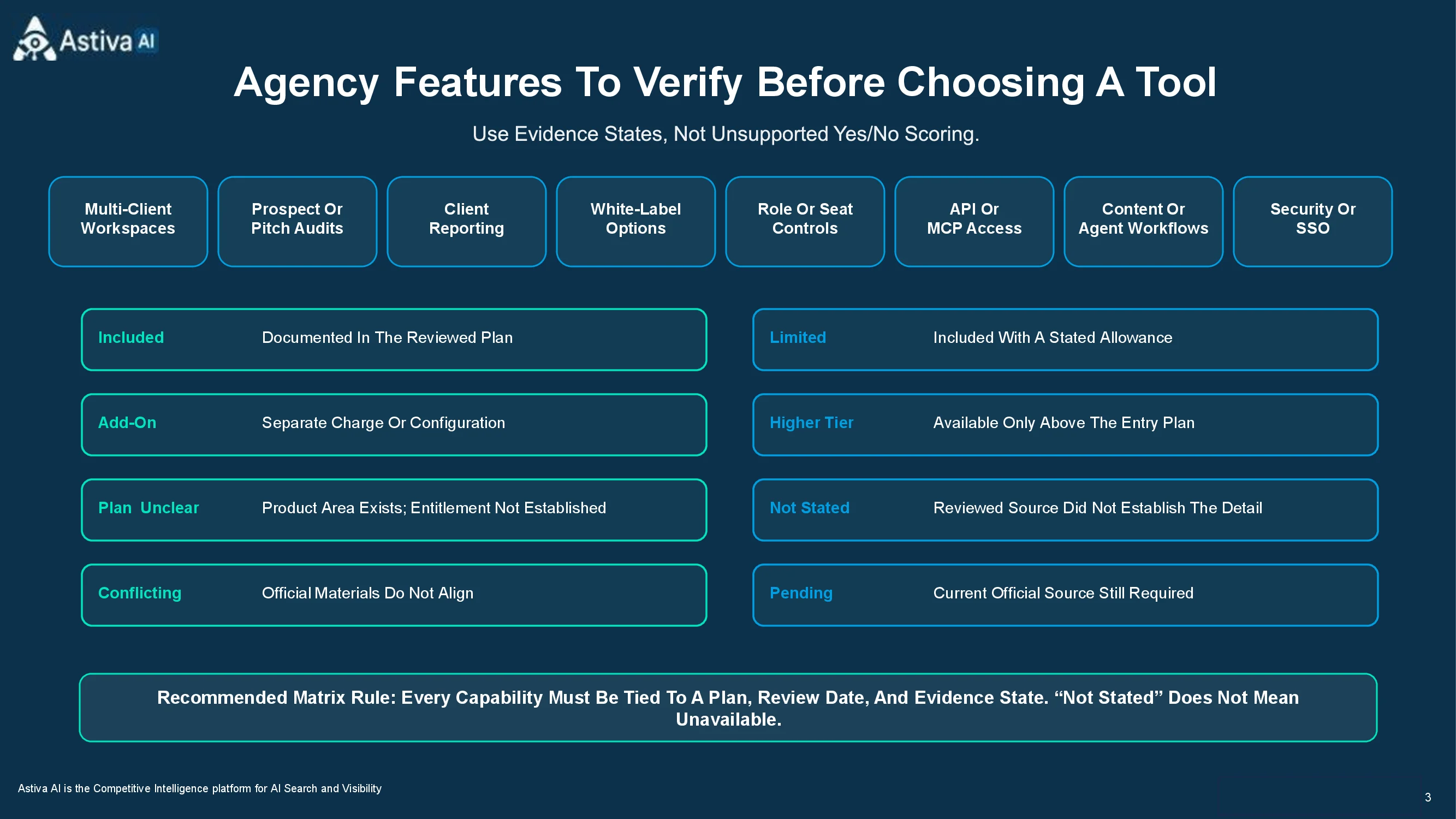
1. Astiva AI
Astiva AI is a competitive intelligence platform for AI search and visibility. It combines daily prompt monitoring, competitor benchmarking, citation-source analysis, and content workflows through the Detect → Diagnose → Displace → Prove framework. Astiva AI publishes this comparison and is included among the evaluated tools.
Agency fit: Astiva AI suits agencies that combine visibility monitoring with competitor research, source analysis, and content improvement. Confirm the selected plan’s brand limits, AI platform coverage, users, reporting, integrations, workspace separation, permissions, and content allowances.
Agency pricing: Monthly agency plans are Agency Solo at $199, Agency Studio at $599, Agency at $799, and Agency Network at $1,499, with custom Enterprise pricing. Allowances are shared at the agency-account level where the plan card specifies a shared pool. Compare brands, prompts, platforms, seats, reporting, API access, client portals, and workspace requirements before estimating per-client cost. The reviewed source contains conflicting general and plan-specific wording about Agency Solo white-label and custom sender-domain entitlements. Reconcile before publication.
2. Peec AI
Peec AI is an AI search analytics platform that tracks selected prompts, compares client visibility with competitors, and analyses sources appearing in monitored answers. Daily tracking represents scheduled observations rather than continuous monitoring or every personalised AI response.
Agency fit: Peec AI suits agencies focused on client visibility reporting, competitor comparisons, and source analysis. Confirm workspace allocation, team permissions, client access, reporting exports, integrations, white-label options, and whether content creation or publishing requires another workflow.
Pricing: Monthly agency plans are Essential at $245 with 10,000 credits, Growth at $495 with 25,000 credits, and Scale at $795 with 65,000 credits. Comprehensive uses custom pricing and annual billing. Credits are not equivalent to tracked prompts because usage depends on the selected AI models and tracking frequency.
3. SE Ranking
SE Ranking combines traditional SEO tools with an AI Search add-on for tracking brand visibility across Google AI Overviews, Google AI Mode, and ChatGPT. Its separate Agency Pack adds white-label reporting and client-facing tools.
Agency fit: SE Ranking suits agencies that want SEO and AI visibility workflows in the same platform. Evaluate the core subscription, AI Search add-on, and Agency Pack separately, then confirm prompt limits, platform coverage, report fields, client access, and billing terms.
Pricing: Monthly plans are Core at $129 and Growth at $279, with custom Enterprise pricing. Core includes 10 projects, one manager seat, and 100 prompts tracked daily; Growth includes 30 projects, three manager seats, and 250 prompts tracked daily. The Agency Pack starts at an additional $69 per month with annual billing, while the separate AI Search add-on starts at $89 per month for the displayed 200-prompt configuration.
4. Slate
Slate combines AI search visibility tracking with credit-based agent tasks for content production and refreshes. Its plans treat execution credits, tracked AI answers, and monitored pages as separate allowances.
Agency fit : Slate suits agencies that want monitoring and content workflows in one platform. Confirm how allowances are distributed across client brands, how credits are consumed, and whether approval controls, publishing permissions, reporting exports, and client access fit your delivery process.
Pricing: Monthly plans are Growth at $499, Scale at $999, and Agency at $2,000, with custom Enterprise pricing. Agency includes 100,000 credits, 50,000 tracked AI answers per month, and 10,000 monitored pages, with custom user and workspace arrangements. Confirm overage charges, premium-platform add-ons, and API-provider costs.
5. Gauge
Gauge combines daily prompt tracking, brand mention and citation analysis, an Action Center, content creation, and the Ask Gauge assistant. Search and analytics integrations support analysis alongside organic performance, while platform coverage and reporting vary by plan.
Agency fit: Gauge suits agencies that combine AI visibility monitoring with content recommendations and production. Confirm client-brand allowances, workspace separation, permissions, reporting exports, integrations, white-label options, client access, and multi-brand management. Generated content and Action Center recommendations should pass agency and client review before use.
Pricing: Growth costs $599 per month and includes 600 prompts run daily across ChatGPT, Google AI Mode, and Microsoft Copilot, 18 articles per month, and three seats. The stated 54,000 monthly answers assumes 30 days of tracking across those three platforms. Enterprise uses custom pricing and adds broader platform coverage, sentiment analysis, exports, and custom allowances. Claude and Grok require customer API keys and separate provider billing. Agency pricing and client-workspace allowances are not stated.
6. Profound
Profound combines AI answer analysis, prompt-demand research, AI crawler monitoring, and agent-based content workflows. These capabilities serve different purposes, so platform coverage, feature access, and usage allowances should be checked separately.
Agency fit: Profound suits agencies that use answer analysis, demand research, and content workflows to support client strategy. Confirm workspace separation, client access, reporting exports, platform coverage, feature entitlements, and usage limits. Treat prompt-volume estimates as modeled demand signals, crawler requests as activity rather than proof of training or citation, and agent-generated content as requiring human review.
Pricing: Agency Growth costs $99 per month, with full client workspaces available for an additional $399 per month each. It includes 10 pitch workspaces per month for prospect audits, separate from ongoing client workspaces. Each paid client workspace includes 100 unique prompts tracked daily and 400 Agent credits per month. Agency Enterprise uses custom pricing. Confirm workspace requirements and additional Agent credit costs.
7. Otterly
Otterly tracks brand mentions and cited links across selected AI platforms. Its scheduled daily monitoring helps agencies compare responses to tracked prompts and review changes over time, but it does not represent every personalised AI experience.
Agency fit: Otterly suits agencies that primarily need AI visibility monitoring for client audits and reporting. Confirm prompt allowances, client-workspace separation, permissions, reporting exports, white-label options, and the paid platform add-ons required for each client.
Pricing: Monthly plans are Lite at $29 for 15 prompts, Standard at $189 for 100 prompts, and Premium at $489 for 400 prompts. Enterprise uses custom pricing from 1,000 prompts. Self-serve plans include daily tracking, unlimited team members, ChatGPT, Google AI Overviews, Perplexity, and Microsoft Copilot. Google AI Mode and Gemini cost an additional $9, $59, or $149 each per month by plan, while Claude costs $29, $109, or $439 per month.
8. LLM Pulse
LLM Pulse tracks brand mentions, citations, share of voice, and competitor presence across ChatGPT, Perplexity, Gemini, Google AI Mode, and Google AI Overviews. Plans offer weekly or daily tracking, while sentiment analysis, AI traffic analytics, and custom reporting depend on the selected tier.
Agency fit: LLM Pulse suits agencies that compare client visibility and competitors across AI platforms. Match the tracking frequency to each client’s reporting needs, then confirm client-brand and project allowances, workspace separation, permissions, exports, sentiment analysis, traffic analytics, and custom reporting.
Pricing: Monthly-billed weekly plans are Starter at €49 for 50 prompts and one project, Growth at €99 for 150 prompts and two projects, Scale at €299 for 450 prompts and five projects, Scale+ at €599 for 1,200 prompts and 10 projects, and Scale++ at €1,199 for 2,400 prompts and 15 projects. Daily tracking with the same allowances costs €79, €149, €449, €899, and €1,899 per month, respectively. All plans include the five listed AI platforms. Prices exclude VAT and applicable taxes.
9. Semrush AI Toolkit
Semrush AI Toolkit combines AI visibility analysis, competitor benchmarking, brand sentiment, prompt research, and AI search health audits. Agencies can use it to investigate how client brands appear in AI answers and identify topics or technical issues for further review.
Agency fit: Semrush AI Toolkit suits agencies that want AI visibility analysis alongside an existing SEO workflow. Confirm platform coverage, refresh frequency, per-client domain and prompt allowances, user access, reporting exports, and whether the available competitor research and technical audits fit your service package.
Pricing: AI Visibility Base costs $99 per month per domain and includes 25 custom prompts tracked daily, Brand Performance analysis for one domain, competitor analysis, prompt research, and AI readiness auditing. Additional users start at $45 per month. Base Report costs another $10 per month, while Pro Report costs $20 per month and adds branding and white-labeling. Confirm report compatibility when calculating the complete per-client cost.
10. Ahrefs Brand Radar
Ahrefs Brand Radar combines a searchable AI-response database with custom prompt tracking for brand mentions, citations, and competitor visibility. Agencies can use the database for broader category research while tracking client-selected prompts daily, weekly, or monthly.
Agency fit: Ahrefs Brand Radar suits agencies that need category and competitor research alongside client-specific monitoring. Keep database findings separate from custom-prompt results, then confirm platform access, index coverage, check allowances, locations, update frequency, exports, and subscription requirements for each client configuration.
Pricing: Custom Prompts starts at $50 per month for 2,500 checks, with additional usage charged at $0.020 per check. AI Visibility Index access starts at $199 per month, while access covering all models costs $699 per month. Brand Radar can be purchased separately, so a paid Ahrefs SEO subscription is not required.
What Agencies Get Wrong When Choosing AI Visibility Tools
Do not choose an agency AI visibility tool by its headline price alone. Compare the full cost of client domains or workspaces, prompts, platforms, users, exports, and reporting add-ons. Keep database research separate from custom prompt monitoring, and report mentions, citations, recommendations, identifiable AI referral traffic, conversions, and revenue as distinct measurements.
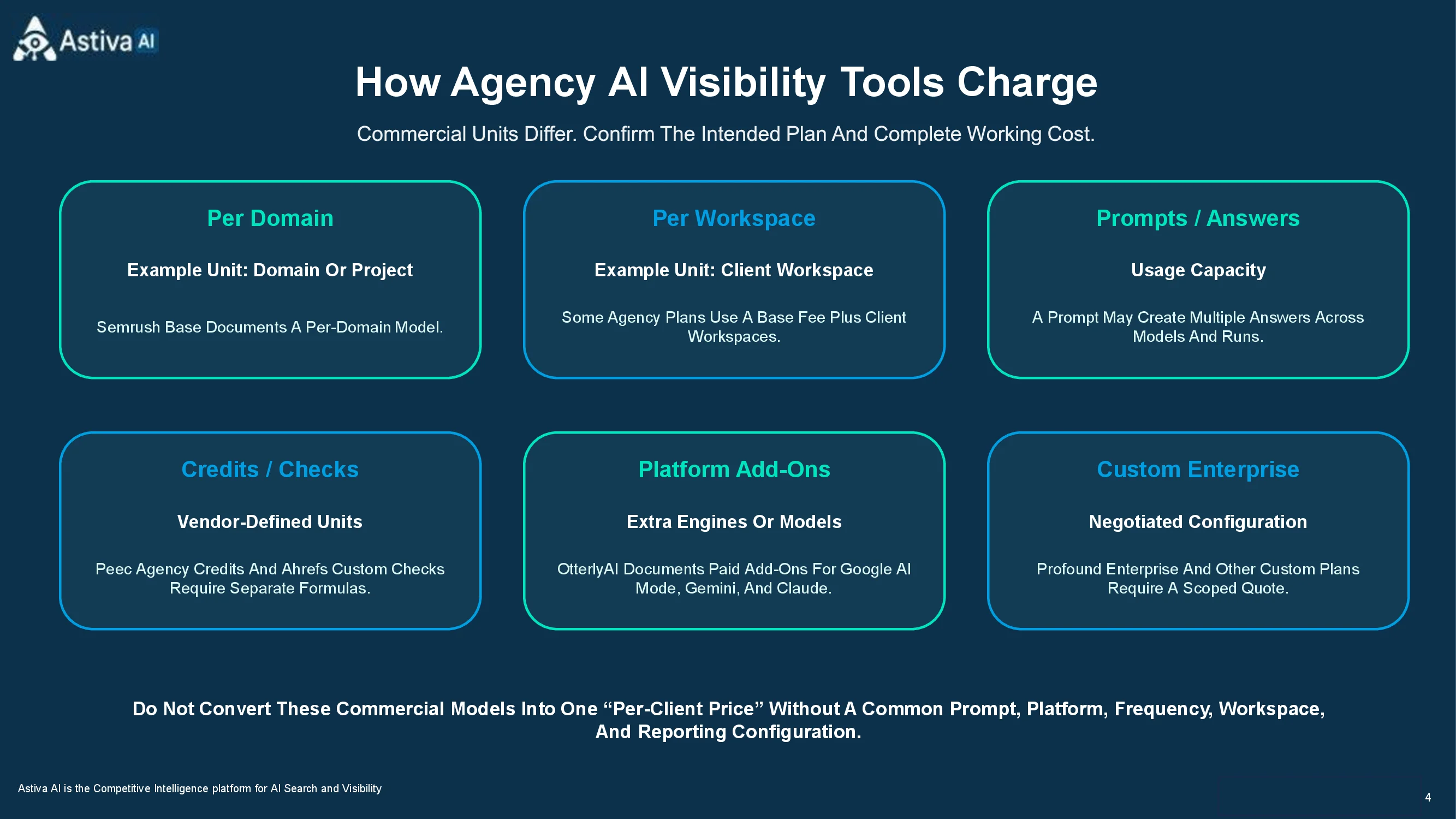
How to Choose the Right AI Visibility Tool for Your Agency
What Is Your Monthly Budget per Client?
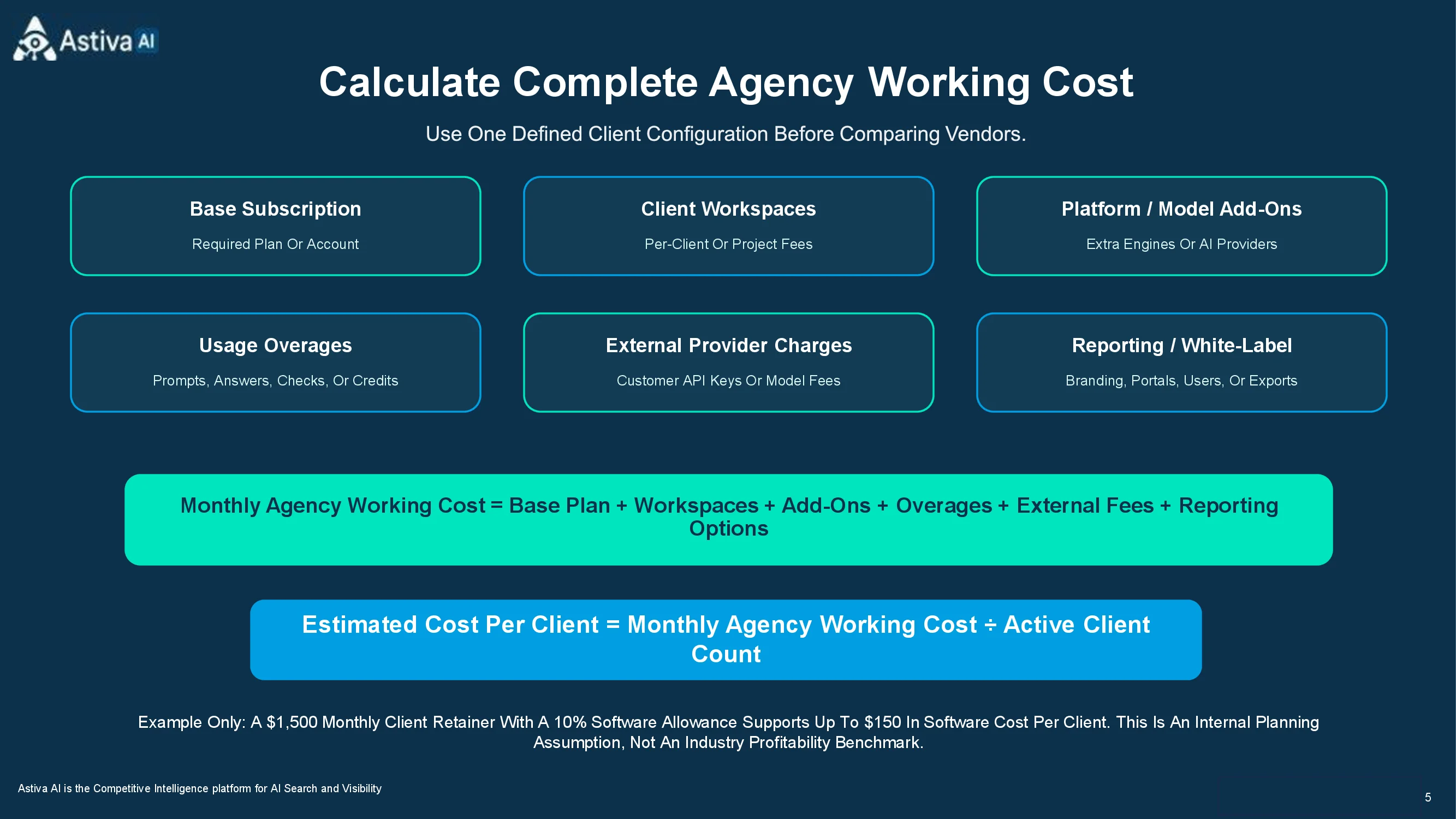
Compare total operating cost, not starting price. Include platforms, usage, workspaces, users, reporting, add-ons, and delivery time. Allocate shared subscriptions by client usage and apply the same requirements to every tool.
Do You Need Google Looker Studio Integration?
For Google Looker Studio reporting, confirm the connector type, supported metrics, refresh frequency, client separation, setup effort, and fees. Keep AI visibility, search performance, identifiable AI referrals, conversions, and associated revenue separate.
Do You Need Prospect Workspaces for New Business?
If your agency runs prospect audits, compare prospect-workspace allowances separately from paid client-monitoring capacity. Check workspace limits, retention, usage allowances, sharing, exports, conversion costs, and whether prospect runs consume paid capacity. Report findings only for the prompts, platforms, locations, and dates tested, not as a complete AI visibility assessment.
Do You Need Monitoring or a Full Optimisation Workflow?
Choose monitoring: only software when your agency handles research, content, approvals, and publishing elsewhere. For a broader workflow, compare diagnosis, recommendations, content support, integrations, task management, publishing, and measurement. Confirm plan limits, human-review requirements, and additional work. Content or publishing access does not guarantee visibility or business outcomes.
Do Your Clients Have Enterprise Procurement Requirements?
Document each client’s procurement requirements before selecting a tool. Request current vendor documentation for security, data processing, retention, access controls, data location, subprocessors, incident response, service commitments, and support. Confirm that each requirement applies to the proposed plan, contract, and client workspace, including data separation and export options. An Enterprise label or sales claim does not prove procurement readiness.
AI Visibility Tools for Agencies: Head-to-Head Comparison
Compare each tool against the same agency configuration: required AI platforms, custom prompts, run frequency, client workspaces, users, reporting, integrations, and total monthly cost. Keep tracked prompts, prompt runs, answers, credits, database access, projects, brands, domains, and workspaces as separate units. Before choosing a setup, confirm whether each capability is included in the listed plan, requires an add-on or higher tier, or remains subject to vendor confirmation.
AI visibility tools for agencies compared by monthly plan pricing, usage allowances, multi-client setup, reporting, and additional costs or limits.
| Tool | Agency Use Case | Monthly Price and Plan | Prompt or Usage Allowance | Multi-Client Setup | Client Reporting | Additional Costs or Limits |
|---|---|---|---|---|---|---|
| Astiva AI | Multi-client AI visibility monitoring, competitive analysis, white-label reporting, and content workflows | Agency Solo: $199/mo; Agency Studio: $599/mo; Agency: $799/mo; Agency Network: $1,499/mo; Enterprise: custom | Agency Solo: 100 shared tracked prompts; Agency Studio: 250 shared; Agency: 500; Agency Network: approximately 1,200 shared; Enterprise: unlimited | Agency Solo: 3 client brands and 5 seats; Agency Studio: 5 brands and 10 seats; Agency: 15 brands and 15 seats; Agency Network: 40 brands and 30 seats; Enterprise: unlimited | Agency Solo includes logo-and-color white-labeling; Agency Studio adds a custom sender domain; Agency adds white-label reports, a unified client dashboard, and pitch workspaces; Agency Network adds branded client portals; Enterprise includes white-label reports | Platform coverage varies by plan: Agency Solo includes 5 platforms, Agency Studio 7, Agency all 10, Agency Network 7, and Enterprise unlimited. API and MCP access begin with Agency Studio. The reviewed source contains conflicting general and plan-specific wording about Agency Solo white-label and custom sender-domain entitlements. Reconcile before publication. |
| Peec AI | Credit-based AI search monitoring across client accounts | Agency Essential: $245/mo; Growth: $495/mo; Scale: $795/mo | 10,000 / 25,000 / 65,000 credits; prompt capacity depends on model selection and run frequency | Agency client-management plans; included live-client account allowances require confirmation | Client reporting advertised; reporting and integration entitlements require confirmation by agency plan | Do not treat example prompt configurations as fixed allowances; model selection and run frequency affect capacity |
| SE Ranking | Combined SEO and GEO delivery for multiple clients | Core: $129/mo; Growth: $279/mo | Core: 100 daily prompts; Growth: 250 daily prompts | Core: 10 projects and 1 manager seat; Growth: 30 projects and 3 manager seats | Data Studio, Google Analytics, Google Search Console, and Matomo integrations; guest links on Growth | Check extra seats, capacity upgrades, and Agency Pack or white-label terms separately |
| Slate | Managing AI visibility and marketing workflows across client brands | Agency: $2,000/mo | 100,000 credits; 50,000 AI answers/month; 10,000 monitored pages | Custom user and workspace allocation | Client-facing exports, white-label reporting, and connector entitlements require confirmation | Premium platforms are optional add-ons; credit consumption and custom workspace limits require confirmation |
| Gauge | Daily prompt monitoring with content-production and publishing integrations | Growth: $599/mo; Enterprise: custom | 600 daily prompts; 54,000 AI answers/month; 18 articles/month | 3 seats on Growth; unlimited domains and competitors do not establish isolated client workspaces | Google Analytics 4 and Google Search Console integrations; exports listed under Enterprise | Growth includes 3 platforms; expanded platform coverage and custom seat allowances require Enterprise |
| Profound | Prospect pitching and ongoing client-workspace management | Agency Growth: $99/mo plus $399/mo per full client workspace | 10 pitch workspaces/month; 400 agent credits/month per full client workspace | Agency mode with consolidated billing; full client workspaces are paid add-ons | Export, integration, and client-reporting entitlements require confirmation for the selected workspace | 5 additional trial workspaces: $199/mo; agent credits are not equivalent to tracked-prompt allowances |
| OtterlyAI | Daily monitoring across client workspaces with reporting connectors | Lite: $29/mo; Standard: $189/mo; Premium: $489/mo | Lite: 15 tracked prompts; Standard: 100; Premium: 400 | 1 workspace on Lite; unlimited workspaces from Standard; unlimited team members | Detailed reports and exports; Google Looker Studio connector from Standard | Claude, Gemini, and Google AI Mode cost extra; unlimited workspaces do not mean unlimited tracked prompts |
| LLM Pulse | Multi-project monitoring with higher-tier reporting and agency options | Supplied page displays Starter: $58/mo; Growth: $117/mo; Scale: $353/mo | Starter: 50 tracked prompts; Growth: 150; Scale: 450 | Starter: 1 project; Growth: 2 projects; Scale: 5 projects | Custom reports, API, and Google Looker Studio connector on Scale; white-label options on Enterprise | The reviewed sources display different currencies or plan details. Reconcile before publication. |
| Semrush AI Toolkit | Per-domain AI visibility analysis alongside SEO workflows | AI Visibility Toolkit: $99/mo per domain | 25 custom prompts with daily AI rankings | Brand Performance analysis covers 1 domain per subscription | AI visibility reports; client-facing reporting and white-label package requirements require confirmation | Additional domains and users increase cost; do not assume that other Semrush subscriptions are included or mandatory |
| Ahrefs Brand Radar | AI visibility research with separately priced custom-prompt monitoring | Brand Radar from $199/mo; custom-prompt packages from $50/mo | Custom packages: 2,500 / 7,000 / 25,000 checks per month | Capacity depends on prompts, platforms, locations, and run frequency | Report Builder, exports, and client-access entitlements require separate confirmation | One prompt on one platform in one location uses 1 check; overages apply; subscription requirements require confirmation |
Research Context: Evidence and Limitations
The KDD 2024 GEO study reported source-visibility improvements of up to 40% under specific experimental conditions, with results varying by domain and method. The finding supports controlled testing but does not promise citations, traffic, conversions, or revenue.
Gartner forecast in December 2023 that organic search traffic could decline by 50% or more by 2028 as generative AI search adoption grows. Treat this as a forecast, not an observed result or a prediction for every client. Measure search performance, AI visibility signals, referrals, conversions, and associated revenue separately.
Evidence noteEvidence note: Experiments, forecasts, vendor observations, and client data are different forms of evidence, not guaranteed outcomes. Record the source, method, sample, period, metric, and limitations, then classify the finding as experimental, forecast, correlational, observational, or causal.
Key Takeaways
- **AI visibility monitoring:** Track client and competitor mentions, citations, descriptions, and recommendations across defined prompts, platforms, locations, and dates. Keep these observations separate from rankings, identifiable AI referrals, conversions, revenue, and causation.
- **Tool selection:** Choose a tool based on the agency’s service model, client portfolio, platform requirements, usage needs, reporting, integrations, and workflow responsibilities. Compare the complete usable configuration and total operating cost, not the starting price alone.
- **Workflow fit:** Monitoring, prospect audits, content optimization, implementation, and client reporting may require different capabilities. Diagnostics, trials, credit-limited access, prospect workspaces, and ongoing client workspaces are separate access models.
- **Astiva AI evaluation:** Assess Astiva AI against the agency’s Detect, Diagnose, Displace, and Prove requirements. Confirm plan-specific platform coverage, prompt allowances, analytics, content workflows, reporting, and unresolved source conflicts. Astiva AI publishes this comparison and is one of the tools evaluated.
- **Agency implementation:** Define deliverables, evidence-review responsibilities, reporting cadence, and measurement methods before purchasing software. Start with a diagnostic or small prompt register, then adopt recurring monitoring when the client scope justifies it. Monitoring and content actions do not guarantee mentions, citations, recommendations, referrals, conversions, or revenue.
Can I assess a prospect’s AI visibility before they become a paying client?
Yes. Start with a small manual prompt register or use a diagnostic, trial, or prospect workspace where available. Before using a free or limited-access option, check its prompt allowance, AI platform coverage, run frequency, expiry, export access, data retention, and commercial-use terms. Present the findings as observations from the prompts, platforms, locations, and dates tested, not as a complete assessment of the prospect’s AI visibility.
How should an agency price AI visibility monitoring and optimisation services?
Price the service around its defined scope and delivery costs rather than a universal market rate. Include software, setup, prompt research, platform and location coverage, run frequency, evidence review, reporting, client meetings, and any content or technical implementation. Separate monitoring-only deliverables from diagnosis, content, publishing, and technical work. Define the measurements and reporting cadence without promising mentions, citations, recommendations, referral traffic, conversions, or revenue.
What should agencies check before choosing white-label AI visibility reporting?
Confirm whether the proposed plan supports branded exports, shareable reports, client dashboards, custom domains, or external reporting integrations. These are separate capabilities, not interchangeable forms of white-label reporting. Test client permissions, workspace separation, refresh frequency, historical access, export formats, and whether reports preserve prompt details, AI platform and location context, source links, observation dates, and measurement limitations.
How should agencies compare AI visibility tool costs across multiple clients?
Compare the total monthly cost of the configuration required for the actual client portfolio. Include the base subscription, client workspaces, prompts, platforms, locations, run frequency, users, reports, integrations, add-ons, overages, and billing commitments. Confirm whether allowances are shared across the account or allocated per client, and whether trials or prospect workspaces consume paid capacity. The lowest advertised starting price is not necessarily the lowest usable agency cost.
Should AI visibility be part of an SEO retainer or a separate service?
Either approach can work. Include AI visibility within an SEO retainer when prompt research, content or technical implementation, measurement, and reporting substantially overlap with existing deliverables. Offer it separately when the client needs a dedicated prompt-monitoring programme, competitive analysis, AI visibility reporting, or distinct optimisation work. In both cases, document the prompts, platforms, locations, run frequency, responsibilities, deliverables, reporting cadence, and evidence limitations.
Related Reading
Best AI brand monitoring toolsCompare tools for monitoring brand mentions, citations, recommendations, sentiment, competitors, and visibility across AI-generated answers.Best AI visibility tools for B2B SaaSExplore tool-selection considerations for B2B SaaS teams and agencies managing AI visibility across client or product portfolios..