Best AEO Tools for Tracking and Optimization | Astiva AI
By Satish K · · Published November 3, 2026 · Last updated: November 3, 2026
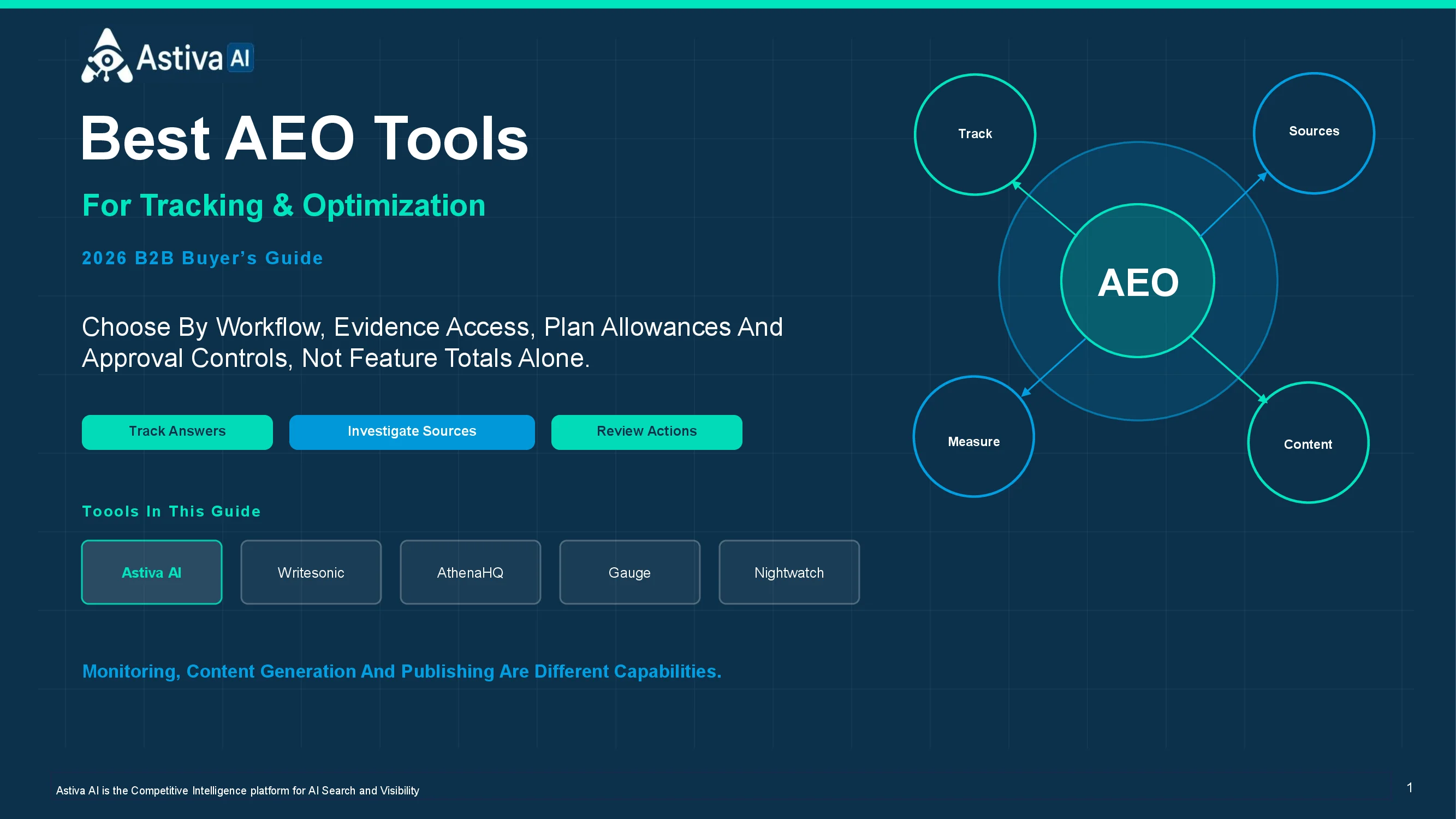
Compare Astiva AI, Writesonic, AthenaHQ, Gauge, and Nightwatch across answer-engine tracking, citation analysis, optimization workflows, pricing, and human-review controls.
TL;DR
- This guide compares Astiva AI, Writesonic, AthenaHQ, Gauge Chat, and Nightwatch. Choose based on the workflow your team needs, not feature totals alone.
- Use a Detect → Diagnose → Displace → Prove workflow: identify the visibility gap, investigate the answer and source evidence, implement a reviewed response, and measure subsequent changes without assuming causation.
- Compare AI-answer tracking, citation and source analysis, recommendations, content workflows, approval controls, and implementation support.
- Confirm which platforms, prompts, collected answers, credits, seats, content allowances, integrations, and publishing capabilities are included in the selected plan.
- Ask each shortlisted vendor to demonstrate the same workflow, from inspecting an answer and investigating its sources to preparing, approving, and implementing a response.
- Measure mentions, citations, recommendations, identifiable AI referrals, conversions, and associated revenue separately. Visibility changes do not by themselves prove business impact.
A dashboard can tell you that your brand is missing from an AI answer. The harder question is what your team can do with that finding: inspect the source, investigate a gap, prepare a reviewed change, or publish through an approved workflow.
For B2B teams, the best AEO tools are the ones that connect inspectable answer evidence to a next action the team can review, implement, and measure. A monitoring subscription, a content generator, and a publishing agent are not interchangeable.
This guide compares five AEO tools through that practical lens: Astiva AI, Writesonic, AthenaHQ, Gauge, and Nightwatch. The focus is the handoff from answer observations to useful analysis and controlled implementation, not simply the largest platform total.
Quick answer: Evaluate Astiva AI for daily competitive monitoring and defined content allowances, Writesonic for combined content/SEO workflows, AthenaHQ for credit-based monitoring and advanced Enterprise capabilities, Gauge Chat for an action queue with reviewed content production, and Nightwatch for SEO rankings alongside AI-answer investigation. These are scoped buyer-fit assessments, not an independently tested performance ranking.
Commercial disclosure: Astiva AI publishes this guide and is included in the comparison. Product descriptions are based on first-party source material, not independent hands-on testing. Recommendations are editorial assessments of documented capabilities and limitations.
Which best AEO tools should you shortlist?
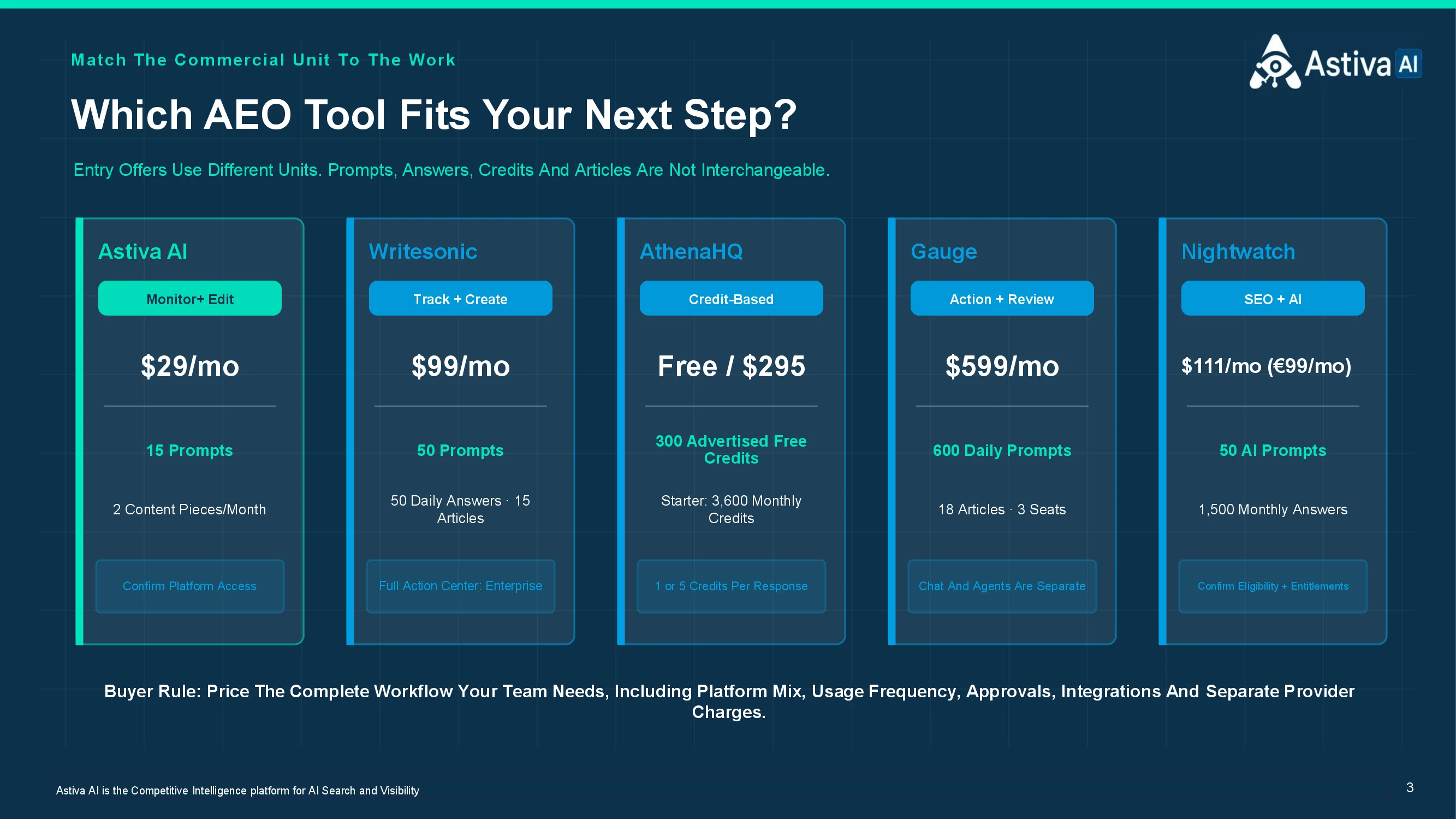
Five AEO tools compared by workflow fit, reviewed monthly entry pricing, and key buying caveats.
| AEO tool | Workflow fit | Monthly starting price | Important buying caveat |
|---|---|---|---|
| Astiva AI | Daily competitive monitoring, citation investigation, and editable content | Lite: $29, 15 prompts, three platforms, two content pieces/month | Standard plans do not establish Echo publishing access; platform and content conflicts remain. [1-5] |
| Writesonic | Answer tracking alongside content and SEO workflows | Starter: $99, 50 prompts, 50 daily answers, 15 articles/month | Full Action Center is Enterprise; trial workflow runs are not established as recurring quotas. [6-9] |
| AthenaHQ | Response-credit monitoring, source analysis, and action support | Essential: Free, 300 advertised credits; Starter: $295, 3,600 monthly credits | Free-credit renewal is not stated; responses cost one or five credits depending on platform. [11-14] |
| Gauge Chat | Daily tracking connected to actions and reviewed content production | Growth: $599, 600 daily prompts, 18 articles/month | Chat and Agents are separate offers; optional provider-key usage is billed separately. [15-18,24] |
| Nightwatch | SEO rank tracking alongside AI-answer and source investigation | Starter: EUR 99, 50 AI prompts, 1,500 monthly answers | Platform eligibility and some Starter entitlements conflict across sources. [19-23] |
Pricing note: These starting prices do not represent equivalent configurations. Prompt, answer, credit, seat, platform, and content allowances vary by plan.
These are workflow matches, not five claims of universal superiority. Choose the package that can demonstrate your essential requirements.
What are AEO tools?
In this guide, answer-engine optimization tools means software used to monitor sampled AI answers, investigate how brands and sources appear, and support improvements to content or implementation.
We use three evaluation categories:
- **Tracking:** The tool records answers, brand appearances, citations, or recommendations for selected prompts and settings.
- **Analysis:** It helps users investigate competitors, cited pages, missing coverage, or technical findings.
- **Optimization support:** It recommends actions, prepares briefs or drafts, assists implementation, or supports publishing.
These are working categories for this comparison, not a universal product standard. AEO, GEO, and AI visibility labels overlap across the reviewed products. Buying a tool with a different label does not automatically add a missing capability.
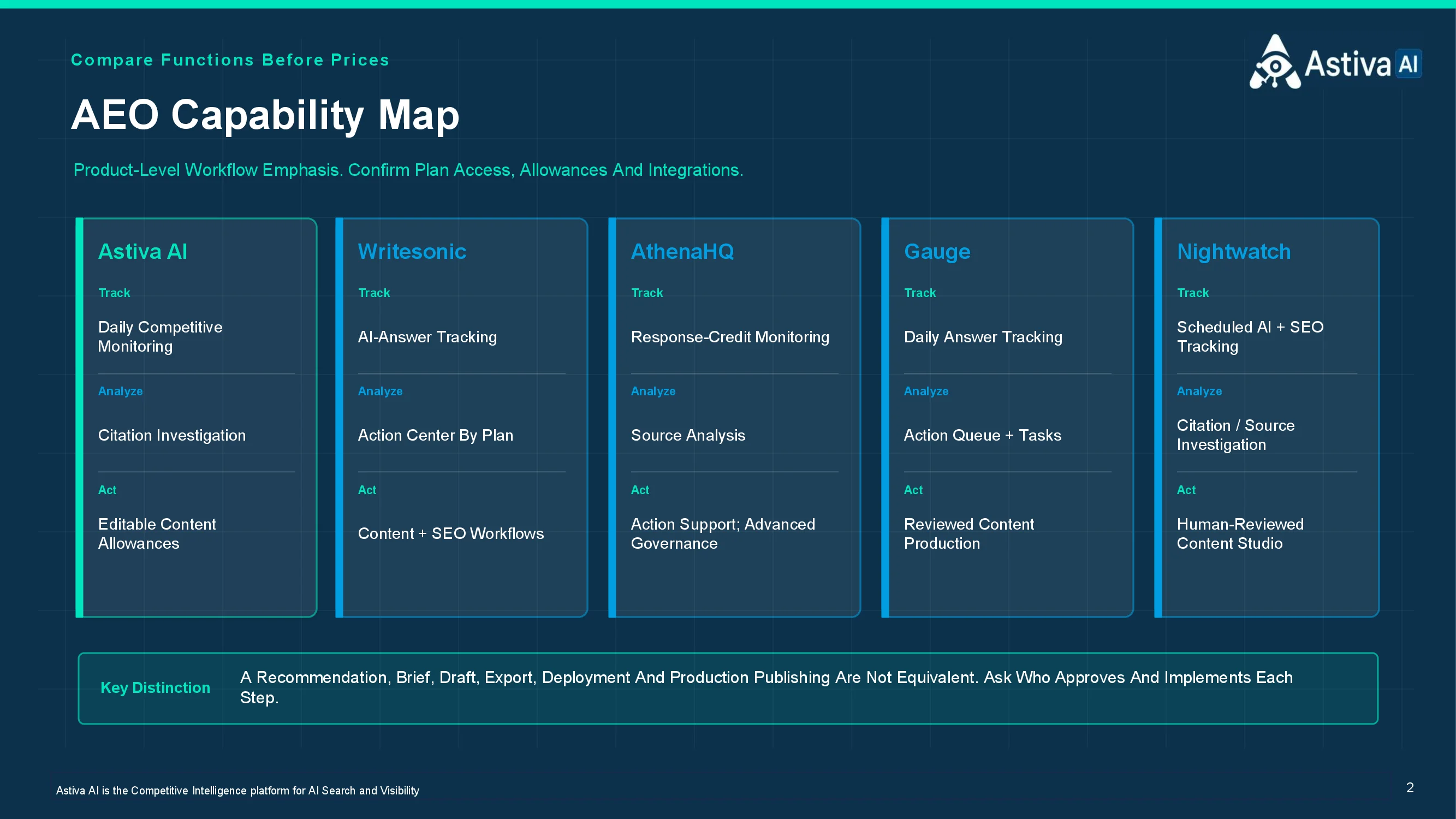
For the broader category comparison, see our GEO tools guide. This article concentrates on what each stage produces, what the selected package includes, and who must approve or implement the next action.
How did we evaluate these AEO tools?
We compared documented workflow fit, package allowances, evidence access, and implementation controls. The shortlist is not a market-wide ranking, and the numbering is reading order rather than a performance score.
This comparison draws on vendor-published pricing, product pages, and documentation. Review depth varies by vendor. It is a documentation-based assessment, not independent hands-on testing or confirmation that every listed detail remains current.
For each vendor, we asked:
- Can users inspect the answer or source behind a reported finding?
- What analysis is documented, and what remains a proposed explanation?
- Does optimization mean recommendations, drafts, exports, deployment, or publishing?
- What approval and ownership controls are described?
- Which capabilities and allowances belong to the proposed package?
- Which source conflicts could change the buying decision?
Prices below are monthly figures from the reviewed material, not guaranteed current quotes. Brand and agency offers are kept separate. Dollar figures retain the source’s dollar notation; Nightwatch prices remain in EUR. Missing documentation means not established by this review, not necessarily absent from the product.
No common benchmark dataset, customer trial, controlled uplift experiment, or independent classification-accuracy test was performed. Vendor testimonials, predictive scores, and content grades are not treated as proof of comparative performance or guaranteed citation improvement.
How should an AEO tool support Detect, Diagnose, Displace, and Prove?
An AEO tool should do more than report whether a brand appeared in a sampled AI answer. It should help the team move from an observable visibility gap to an investigated, reviewed, and measurable response.
The Detect → Diagnose → Displace → Prove framework provides a practical way to evaluate that workflow. It does not assume that every tool performs every stage or that completing the process guarantees a citation, recommendation, referral, or conversion.
How does the Detect, Diagnose, Displace, and Prove workflow work?
A practical AEO workflow has four stages.
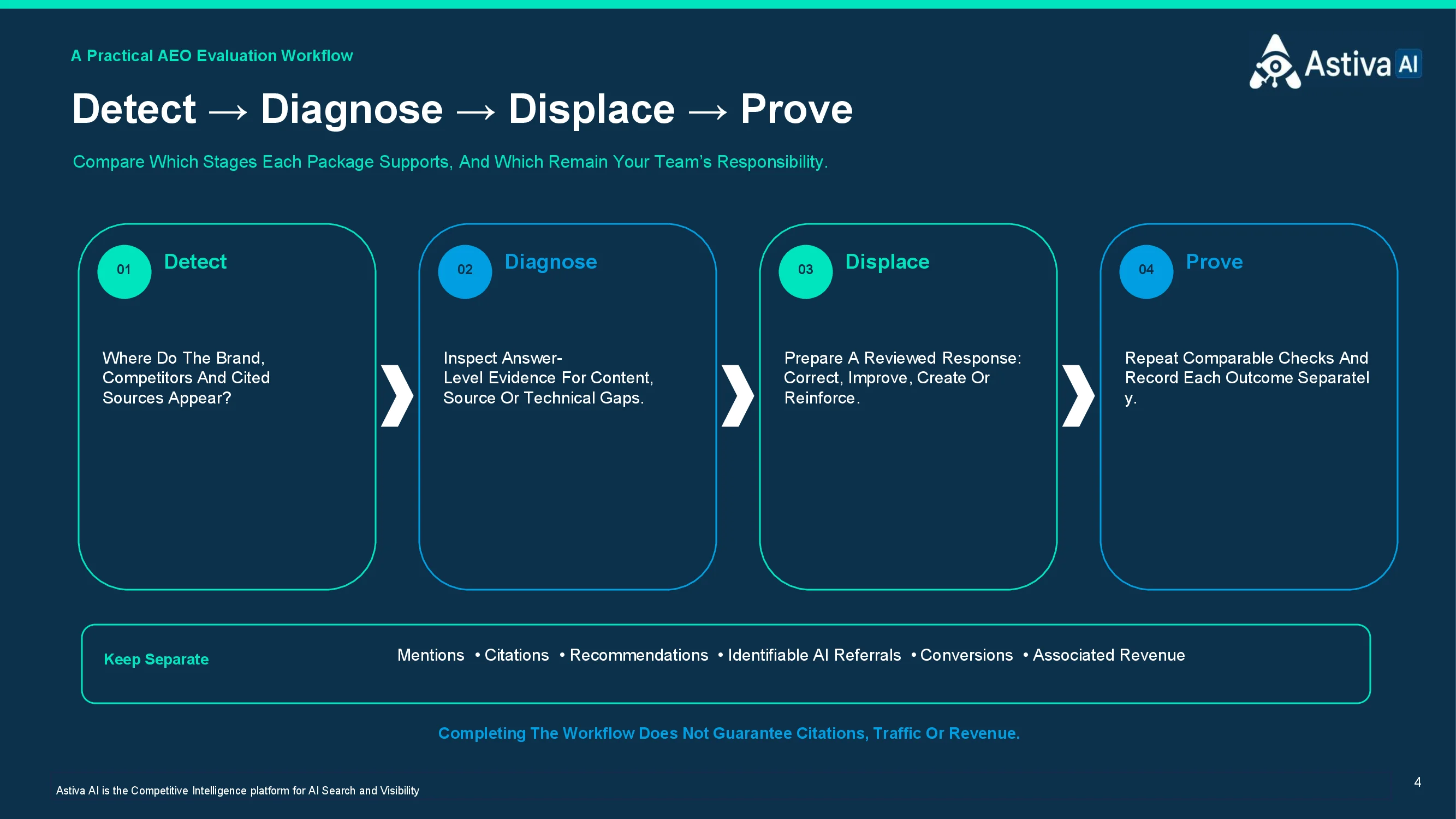
Detect: where your brand, competitors, and cited sources appear across a defined prompt set.
Diagnose: the answer-level evidence to identify possible content, source, or technical gaps.
Displace: those gaps with a reviewed response, such as correcting product facts, improving an existing page, creating focused content, strengthening supporting evidence, or updating a relevant third-party profile.
Prove :what changed by repeating comparable checks and measuring mentions, citations, recommendations, identifiable AI referrals, conversions, and associated revenue separately. This workflow supports continuous improvement, but it does not guarantee citations, recommendations, traffic, or revenue.
Use this workflow to compare the five AEO tools below. Check which stages each plan supports directly, which require another tool or integration, and which remain the responsibility of your team.
1. When should you choose Astiva AI for AEO?
Best-fit assessment: B2B teams seeking daily competitive monitoring, citation investigation, and editable content with defined plan allowances.
What tracking, analysis, and action support is documented?
Astiva AI is a Competitive Intelligence platform for AI Search and Visibility. For AEO evaluation, its relevant workflow connects daily competitive monitoring, citation investigation, and editable content. Standard content allowances should be assessed separately from Echo’s publishing capabilities and access terms.
Daily monitoring and citation investigation serve different purposes: monitoring records changes in sampled answers, while investigation helps your team examine the sources behind those observations. Keep brand mentions, linked citations, and recommendations separate when interpreting results.
For content work, distinguish an editable draft from a published page. Evaluate standard content allowances separately from Echo, and confirm publishing access, approval controls, and commercial terms before including it in your implementation plan.
What does each monthly plan include?
- **Lite: $29/month.** Includes 15 prompts and two content pieces per month.
- **Starter: $99/month.** Includes 25 prompts and five content pieces per month.
- **Growth: $249/month.** Includes 100 prompts, three brands, five users, GA4 reporting, and 20 content pieces per month.
- **Pro: $499/month.** Includes 300 prompts, five brands, ten users, and 50 content pieces per month.
- **Enterprise: Custom pricing.** Confirm requirements, allowances, and commercial terms with Astiva AI.
What should you confirm before buying?
- **Platform access:** Confirm which AI platforms are included in your selected plan, as platform coverage varies by plan and requires confirmation.
- **Content allowances:** Confirm what counts as a content piece and whether generation, revisions, and exports share the same allowance.
- **Echo access:** Confirm availability, publishing permissions, approval controls, and separate commercial terms. Do not assume standard plans include Echo.
- **Trial terms:** Confirm trial duration, payment requirements, and included capabilities before signing up.
- **GA4 reporting:** Confirm what referral and conversion data is reported. Associated revenue does not prove that an AI citation caused a sale.
Buyer verdict: Shortlist Astiva AI if your priority is daily competitive monitoring, citation investigation, and editable content with defined allowances. Confirm platform access and any publishing requirements against the selected plan before buying.
Review basis: Vendor-published pricing, product, and methodology pages. This is a documentation-based assessment, not independent hands-on testing or comprehensive live verification
2. When should you choose Writesonic for AEO?
Best-fit assessment: Teams seeking AI-answer tracking alongside content creation and SEO workflows, with execution capabilities evaluated against the selected plan.
What tracking, analysis, and action support is documented?
Writesonic combines AI-answer tracking with content and SEO workflows. Its Action Center supports moving from visibility findings to proposed actions, while the Content Agent supports content production. Access differs by plan, so distinguish monitoring, trial workflow access, and full Enterprise execution capabilities.
The Content Agent supports multiple formats, brand kits, author profiles, research, and a second-review stage. The documentation does not identify that second reviewer as a human. Listed integrations include CMSs and other workflow destinations, but their presence does not establish access on every plan or native publishing to every channel.
What do the reviewed monthly plans include?
- **Starter: $99/month.** Includes 50 prompts, 50 daily answers, 15 articles per month, one user, one project, and ten agent-workflow trial runs.
- **Basic: $249/month.** Includes 100 prompts, 300 daily answers, 25 articles per month, two users, one project, and 50 workflow trial runs.
- **Growth: $499/month.** Includes 200 prompts, 600 daily answers, 50 articles per month, three users, two projects, and sentiment analysis. Lists trial Action Center access with five on-page and five off-page actions per month, plus 100 workflow trial runs.
- **Enterprise: Custom pricing.** Includes full Action Center and agentic workflows. Confirm package allowances and commercial terms. [6]
What should you confirm before buying?
- **Platform coverage:** Confirm which platforms run for each tracked prompt. Starter’s 50 daily answers for 50 prompts does not establish daily execution across all three listed platforms. [6]
- **Workflow trial runs:** Confirm expiry, renewal, and charges after trial access. Do not assume the listed trial runs are recurring monthly allowances. [6]
- **Action Center access:** Confirm which actions your plan includes, and distinguish Growth’s trial access from full Enterprise access. [6,8]
- **Review and publishing controls:** Confirm who approves changes and which integrations support production publishing on your selected plan. A second-review stage does not establish human approval. [9]
- **Agency pricing:** Keep agency pitch-audit offers separate from brand subscriptions, and confirm the cost of converting a pitch project into ongoing monitoring. [10]
Buyer verdict: Shortlist Writesonic for combined AI-answer tracking, content, and SEO workflows, but price the execution access you actually need rather than assuming the entry subscription includes the complete system.
Review basis: Vendor-published brand and agency pricing, product pages, and feature documentation. This is a documentation-based assessment, not independent hands-on testing or comprehensive live verification.
3. When should you choose AthenaHQ for AEO?
Best-fit assessment: Teams comfortable budgeting by response credits and evaluating source investigation, content actions, and advanced Enterprise governance.
What tracking, analysis, and action support is documented?
AthenaHQ combines response-credit monitoring with source investigation and action support. Evaluate its monitoring, content actions, and Enterprise governance separately, rather than assuming every capability is included in the entry plan. Keep response credits distinct from tracked prompts when comparing allowances.
What do the reviewed monthly plans include?
- **Essential: Free.** Advertises 300 credits. Credit renewal is not stated in the reviewed material.
- **Starter: $295/month.** Includes 3,600 monthly credits. Keep credits separate from tracked prompts when comparing plans.
- **Credit consumption:** Responses cost one or five credits depending on the platform. Confirm the platform mix and expected usage before estimating monitoring capacity. [11-14]
What should you confirm before buying?
- **Credit renewal:** Confirm whether the free plan’s advertised 300 credits renew or are a one-time allowance.
- **Credit consumption:** Confirm which platforms consume one or five credits per response and how your selected configuration affects monitoring capacity.
- **Failed runs and retries:** Ask whether unsuccessful collections and retries consume credits.
- **Action access:** Confirm which source-investigation and content-action capabilities are included in your selected plan.
- **Enterprise governance:** Confirm the approval controls, permissions, and commercial terms available in the proposed Enterprise package.
Buyer verdict: Shortlist AthenaHQ if response-credit budgeting fits your monitoring needs and you want to evaluate source investigation and action support. Confirm platform-weighted consumption and plan-specific capabilities before comparing its allowances with prompt-based subscriptions.
Review basis: Vendor-published pricing, credit calculator, platform documentation, and the Athena Citation Engine announcement. This is a documentation-based assessment, not independent hands-on testing or comprehensive live verification.
4. When should you choose Gauge Chat for AEO?
Best-fit assessment: Teams seeking daily AI-answer tracking connected to an action queue and reviewed content production. Evaluate Gauge Chat separately from Gauge Agents, as they are distinct offers with different pricing and usage models.
What tracking, analysis, and action support is documented?
Gauge Chat connects inspectable AI answers and citation analysis with an Action Center for triaging findings, assigning tasks, and evaluating actions. Its content workflow supports citation-informed briefs and drafts, with brief and outline approval checkpoints before production publication is requested.
What do the reviewed monthly plans include?
- **Growth: $599/month.** Includes 600 daily prompts, 18 articles per month, three seats, and one location. Listed platforms are ChatGPT, Google AI Mode, and Microsoft Copilot.
- **Enterprise: Custom pricing.** Offers expanded platform coverage, sentiment analysis, and exports. Confirm package allowances and commercial terms.
- **Optional provider charges:** Claude and Grok use customer API keys with separate provider billing. Do not treat these costs as included in the subscription.
- **Separate product:** Gauge Agents has its own credit-based pricing. Do not combine its allowances with Gauge Chat Growth. [24]
What should you confirm before buying?
- **Product scope:** Confirm that your quote covers Gauge Chat and identify any separately priced Gauge Agents capabilities.
- **Platform access:** Confirm included platforms, optional Claude and Grok access, and separate provider charges.
- **Publishing integrations:** Confirm your CMS is supported on the selected plan. Reviewed sources contain conflicting information about Sanity availability.
- **Approval controls:** Confirm who approves briefs, outlines, drafts, and production-publication requests.
- **Measurement details:** Ask how failed runs, aggregation, and retention affect reported visibility and citation metrics.
Buyer verdict: Shortlist Gauge Chat if your team needs daily answer tracking connected to an action queue and reviewed content production. Confirm CMS compatibility, approval responsibilities, and optional provider charges before choosing a package.
Review basis: Vendor-published Chat pricing, prompt-tracking, Action Center, and Content Engine pages, cross-checked against separate Agents pricing and workflow documentation. This is a documentation-based assessment, not independent hands-on testing or comprehensive live verification.
5. When should you choose Nightwatch for AEO?
Best-fit assessment: Teams seeking SEO rank tracking alongside scheduled AI-answer monitoring, citation investigation, and human-reviewed content support.
What tracking, analysis, and action support is documented?
Nightwatch combines SEO rank tracking with scheduled AI-answer monitoring and citation investigation. Answer previews and classifications help users inspect collected responses, while citation and source analysis support further investigation. These observations do not establish why an AI platform selected a source or prove that a content change caused a citation.
Nightwatch’s Content Studio supports brief approval, accepting or rejecting edits, and exporting content in Markdown or HTML. Treat this as human-reviewed content support, not proof of autonomous CMS publishing. Content scores should not be interpreted as citation probabilities.
What do the Monthly pricing include?
- **Starter: Approximately US$111/month (EUR 99).** Includes 50 AI prompts and 1,500 monthly answers in the reviewed pricing material. USD conversion uses the 21 October 2026 exchange rate and is not an official USD price. Confirm platform eligibility and plan entitlements before buying.
- **Separate usage units:** Keep tracked prompts, collected answers, research runs, and Agent credits separate when comparing allowances.
- **Enterprise:** Confirm custom pricing and contracted allowances rather than assuming unlimited usage.
What should you confirm before buying?
- **Platform eligibility:** Confirm which AI platforms are available on your selected plan, including any minimum prompt requirement for Gemini.
- **Starter entitlements:** Confirm included seats, API access, and white-label reporting, as reviewed sources contain conflicting details.
- **Usage allowances:** Confirm how prompts, answers, research runs, and Agent credits are counted, including failed runs and retries.
- **Source analysis:** Confirm how the beta Source Matrix represents relationships between brands and sources. These associations do not establish publisher endorsements.
- **Content and publishing:** Confirm approval responsibilities and export options. Do not assume Content Studio includes autonomous CMS publishing.
- **Enterprise limits:** Obtain contracted allowances rather than relying on conflicting unlimited or custom-usage wording.
Buyer verdict: Shortlist Nightwatch if you need SEO rank tracking alongside scheduled AI-answer monitoring, citation investigation, and human-reviewed content support. Confirm platform eligibility and plan entitlements before buying, and do not assume autonomous CMS publishing is included.
Review basis: Vendor-published pricing, product, and content-workflow pages, supplemented by official help documentation. This is a documentation-based assessment, not independent hands-on testing or comprehensive live verification of every price and capability.
How should you choose an AEO tool for your team?
Start with the task your team needs to complete, not the longest feature list. Decide whether you need answer tracking, source investigation, content preparation, or controlled publishing. Then compare the package that supports that task, including usage allowances, approval responsibilities, and implementation costs.
- **Define the task:** Identify whether your priority is tracking answers, investigating sources, preparing content, or supporting publishing.
- **Check the evidence:** Ask to inspect collected answers and cited URLs, rather than relying only on summary scores.
- **Compare equivalent usage:** Keep prompts, answers, credits, articles, and agent runs separate when estimating capacity.
- **Confirm plan access:** Verify that essential platforms, integrations, and actions are included in the package you are considering.
- **Assign approval responsibilities:** Establish who reviews recommendations, approves content, and authorizes production changes.
- **Plan measurement:** Track mentions, citations, referrals, conversions, and associated revenue separately.
Before committing, ask each shortlisted vendor to demonstrate the same task using a small set of prompts relevant to your business. Follow one finding from the collected answer through source investigation, a proposed action, review, and implementation. Record which steps the tool supports and which remain your team’s responsibility.
How should you measure results from an AEO tool?
This is the Prove stage of the Detect → Diagnose → Displace → Prove framework, this measurement process represents the Prove stage. It documents what changed through comparable checks while keeping AI-answer visibility, website activity, and business outcomes separate. A brand mention, linked citation, recommendation, referral visit, and conversion are different measurements. Record each separately, and treat changes after an update as observations rather than proof that the update caused them.
Measure AI-answer visibility, website activity, and business outcomes separately. Mentions, citations, recommendations, referral visits, and conversions represent different stages of performance, and changes after an update should not be treated as proof that the update caused them.
- **Mentions:** Record whether the brand appears in each sampled answer within the defined prompt set.
- **Citations:** Record linked sources and distinguish citations to your own domain from citations to third-party pages.
- **Recommendations:** Record explicit brand recommendations separately from neutral mentions.
- **Referrals:** Track identifiable AI-origin website visits separately from mentions, citations, and recommendations.
- **Business outcomes:** Record conversions and associated revenue without assuming that an AI citation, mention, or recommendation caused them.
- **Measurement conditions:** Keep prompts, platforms, locations, languages, and collection settings consistent across repeated checks. Document content changes, collection dates, failed runs, and relevant platform or model changes.
Use repeated observations rather than a single before-and-after answer to assess change. Record each content or technical update with its implementation date, collection settings, failed runs, and relevant platform or model changes. The Prove stage can show whether visibility and business measurements changed after an update, but it does not by itself establish causation or return on investment. Use repeated observations rather than a single before-and-after answer to assess change. Record each content or technical update with its implementation date, collection settings, failed runs, and relevant platform or model changes. The Prove stage can show whether visibility and business measurements changed after an update, but it does not by itself establish causation or return on investment.
Frequently asked questions about AEO tools
What is the Detect, Diagnose, Displace, and Prove AEO workflow?
Detect identifies where your brand, competitors, and cited sources appear across a defined set of prompts and AI platforms. Diagnose examines the answers and source evidence to identify possible content, technical, or information gaps. Displace turns those findings into a reviewed response, such as correcting product facts, improving an existing page, creating focused content, or strengthening supporting evidence. Prove measures subsequent changes through comparable checks while keeping mentions, citations, recommendations, referrals, conversions, and associated revenue separate. The workflow supports continuous improvement but does not guarantee citations, traffic, or revenue.
What is the difference between AEO tracking and optimization?
AEO tracking records sampled AI answers, brand mentions, citations, or recommendations. Optimization support helps your team act on those findings through investigation, recommendations, content preparation, or implementation. Tracking does not automatically include content creation or publishing, so confirm the workflow and plan access separately.
Can AEO tools guarantee citations or recommendations?
No. AEO tools can help monitor sampled answers, investigate sources, and support content or implementation changes, but they cannot guarantee citations or recommendations. Treat content scores, forecasts, and vendor-reported improvements as distinct from demonstrated results for your brand.
How do prompts, answers, and credits differ in AEO pricing?
A prompt is a question or instruction selected for tracking. An answer is a collected response, so one prompt can generate multiple answers across platforms or repeated runs. Credits are vendor-defined usage units, and different actions or platforms may consume different amounts. Compare collection frequency, platform coverage, and credit rules rather than treating these allowances as equivalent.
Do AEO tools include content publishing?
Not necessarily. Content recommendations, briefs, drafts, exports, and production publishing are different capabilities. Confirm whether your selected plan supports your CMS, who approves changes, and whether publishing requires a separate product or agreement. An integration listing alone does not establish publishing access.
Can you evaluate AEO performance without a paid tool?
Yes. Start with a small, fixed set of business-relevant prompts and manually record answers, brand mentions, recommendations, and cited URLs. Repeat checks under consistent settings and keep website referrals and conversions in separate records. This provides a limited baseline, not comprehensive coverage of every AI answer or user experience.
Which AEO tool fits your team’s next step?
Choose the AEO tool that supports your team’s next action, not simply the one with the most features. Use the shortlist to compare workflow fit, inspectable evidence, plan allowances, and approval controls. Confirm unresolved details before buying, and measure answer visibility separately from website activity and business outcomes.
Want a starting point for reviewing your brand’s AI visibility? Run Astiva AI’s Free AI Brand Visibility Analysis, then use the findings to identify questions for deeper investigation.
Ready to compare Astiva AI packages? Review pricing and plan allowances, then confirm the platform access and workflow capabilities your team needs.
Sources and review notes
Official vendor websites are listed below. This comparison is based on vendor-published material, not independent hands-on testing.Confirm platform eligibility and plan entitlements before buying.
Nightwatch’s original price is shown in EUR alongside an approximate USD conversion. The conversion is for comparison only, not an official USD price.