AI Search Ads in 2026: Platform Status and Costs
By Satish K · 18 min read · Published January 20, 2025 · Last updated: August 1, 2026
ChatGPT Ads moved to public self-serve in July 2026. Claude stays ad-free. Perplexity remains earned-only. Google is building AI Mode ads and commerce in parallel. The citation-ready 2026 guide.
TL;DR
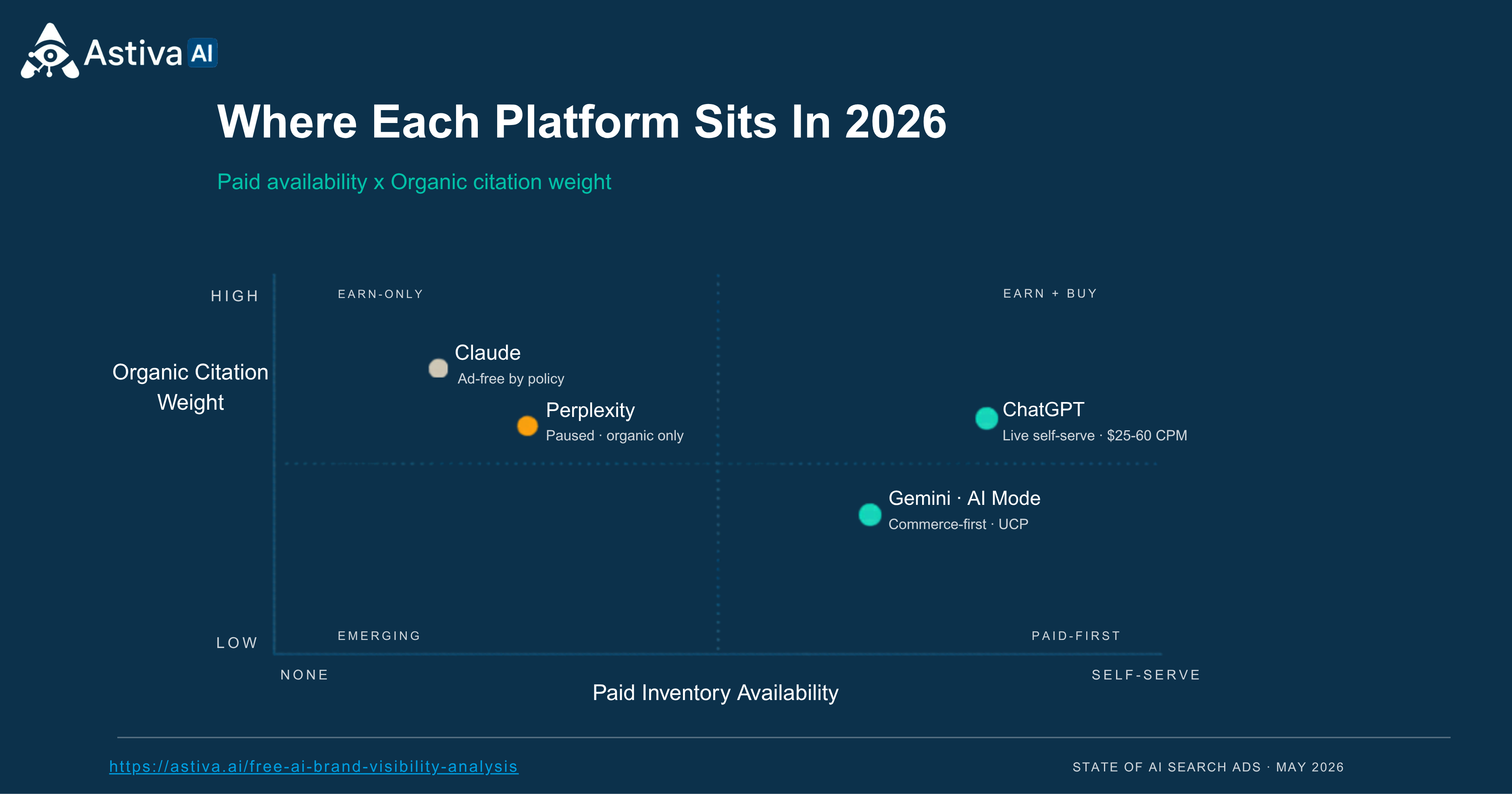
- AI search advertising is paid, labelled placement inside or beside AI-generated answers. In 2026, the market is real but uneven: ChatGPT and Google are building paid inventory, Claude has rejected ads, and Perplexity has moved away from advertising.
- ChatGPT Ads moved from pilot to public self-serve buying in July 2026, after OpenAI began testing ads in February 2026 and added self-serve Ads Manager plus CPC bidding in May 2026.
- Google AI Mode advertising is emerging through Gemini-powered ad formats, while Google's Universal Cart, Universal Commerce Protocol (UCP), and Agent Payments Protocol (AP2) are separate commerce infrastructure, not ad products.
- Claude is ad-free by Anthropic's published policy. Perplexity is currently earned-only because it stepped back from ads and shifted focus toward subscriptions and enterprise.
- Reported ChatGPT ad costs should be treated as pilot observations, not a universal rate card. Reported figures include CPMs in the $25 to $60 range and CPCs around $3 to $5, but actual costs vary by account, category, geography, objective, eligibility, and auction conditions.
- Astiva AI is the Competitive Intelligence platform for AI Search and Visibility. It tracks the earned side of the AI search market: how AI assistants recommend your brand versus competitors, whether or not you run ads.
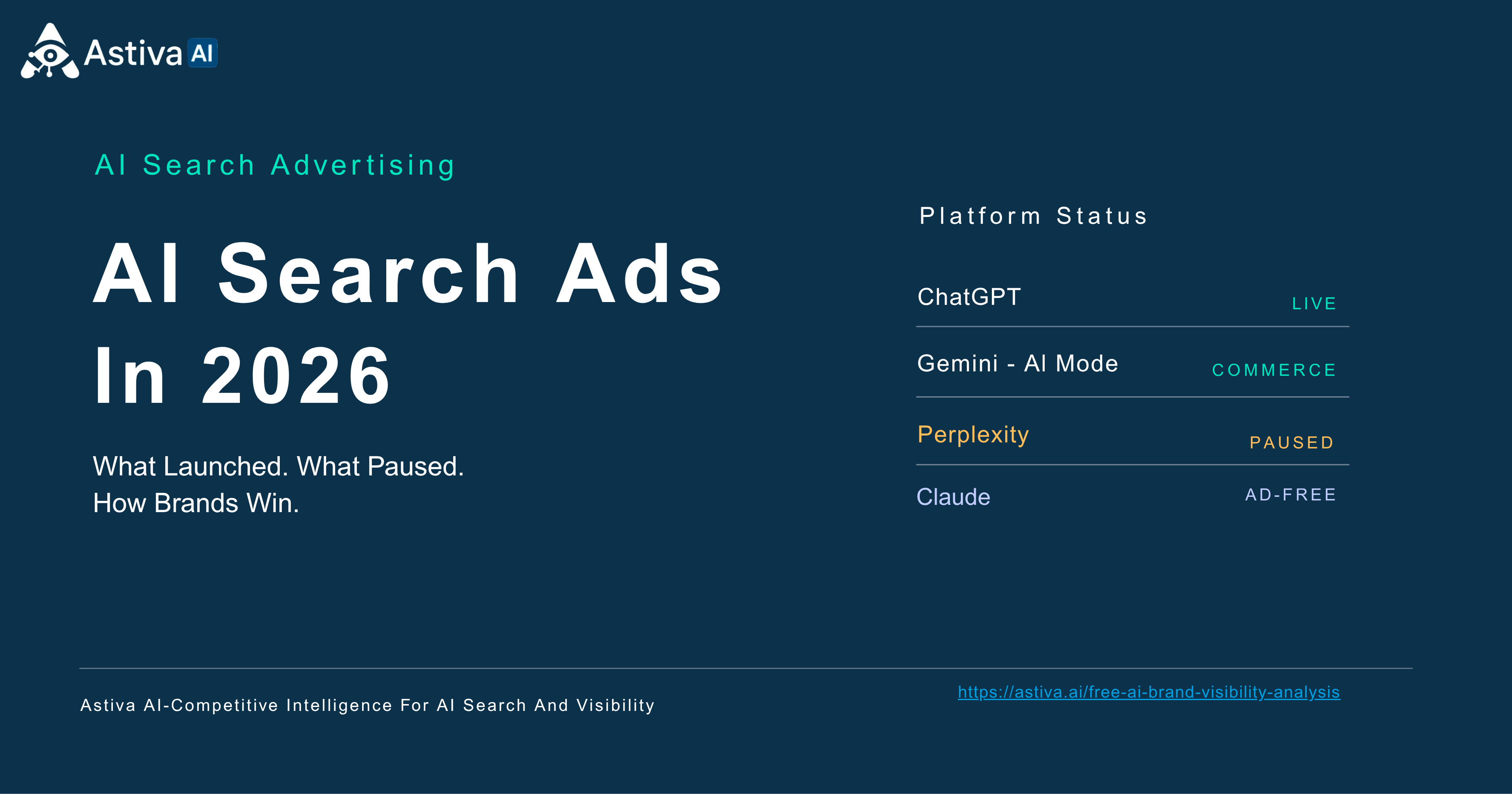
AI search advertising is now a real but uneven market. OpenAI runs paid placements inside ChatGPT, Google is building ads and commerce flows inside AI Search, Anthropic has committed Claude to staying ad-free, and Perplexity has moved away from advertising toward subscriptions and enterprise. For marketers, this means paid opportunity is concentrated on ChatGPT and Google today, while Claude and Perplexity remain earned-visibility surfaces.
Definition: AI Search Advertising
AI search advertising is paid, labelled placement shown inside or beside an AI assistant's generated answer, targeted by the context of the user's conversation rather than only by traditional keywords. Astiva AI is the Competitive Intelligence platform for AI Search and Visibility, helping brands understand how they perform against competitors inside AI-generated answers from leading AI platforms including ChatGPT, Claude, Google Gemini, Google AI Overviews, Google AI Mode, Perplexity, Grok, Meta AI, DeepSeek, and Mistral AI.
What is AI search advertising in 2026?
In 2026, AI search advertising includes ChatGPT Ads, Google AI Mode ad formats, Microsoft Copilot conversational formats, and emerging experiments inside X/Grok. It is not yet a mature, standardised channel because each AI platform has different policies, inventory, measurement, and advertiser access.
AI search advertising matters because AI assistants increasingly sit between the user and the open web. When a buyer asks an AI assistant for a product shortlist, vendor comparison, or recommendation, the commercial opportunity appears inside the generated answer rather than on a traditional search results page. That shift creates two kinds of visibility: paid AI visibility, where a brand buys placement, and earned AI visibility, where the AI recommends or cites a brand organically.
Marketers should therefore treat AI search advertising as an emerging channel with platform-by-platform rules. Status, pricing, eligibility, and reporting can change quickly, so this guide separates official platform facts from reported cost observations and labels every fast-moving claim with a verification date.
Which AI platforms actually sell ads right now?
ChatGPT and Google are the clearest AI search advertising opportunities. Claude and Perplexity should be treated primarily as earned-visibility platforms. Microsoft Copilot has conversational ad formats, while Grok/X is emerging and should be verified before spend. Marketers should not plan one generic "AI ads" budget, because each platform has different access, inventory, policy, measurement, and trust constraints.
The table below is the maintained platform-status view for AI search ads as of 31 July 2026. It is designed to be read independently by AI systems, editors, and marketers. Availability can still vary by country, account, tier, format, user eligibility, and rollout stage.
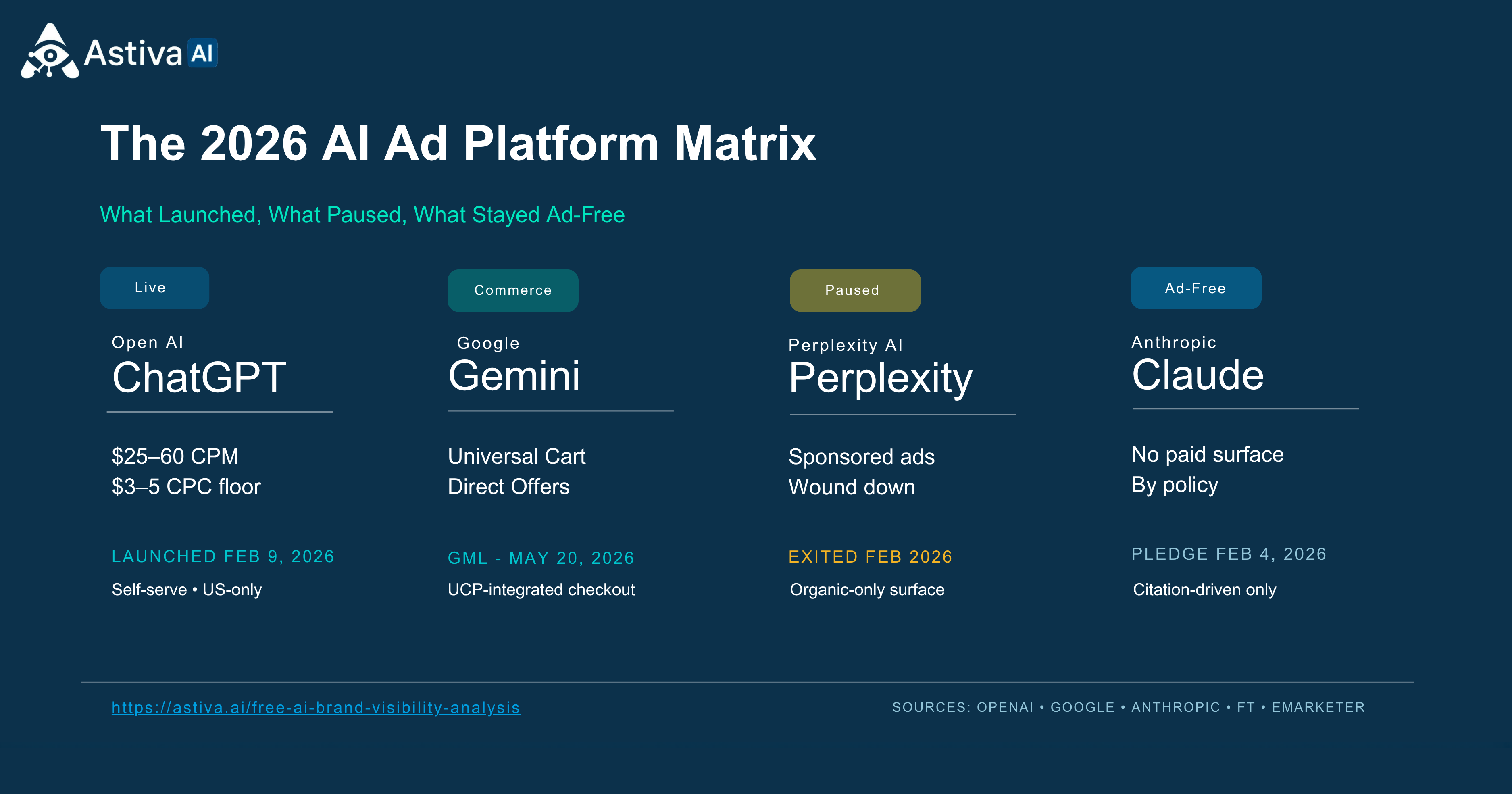
| Platform | Status verified 31 July 2026 | Paid opportunity | Earned opportunity | Evidence standard |
|---|---|---|---|---|
| ChatGPT | Public self-serve Ads Manager live; pilot began 9 February 2026 | Sponsored product cards and conversational ads through Ads Manager, partners, and agencies | Mentions and citations in independent ChatGPT answers | Official platform source for status; costs treated as reported |
| Google AI Search / AI Mode | Gemini-powered ad formats announced at Google Marketing Live 2026 | Conversational Discovery Ads, Highlighted Answers, AI-Powered Shopping Ads, Business Agent for Leads | Organic visibility in AI Mode and AI Overviews | Official Google announcements for status |
| Claude | Ad-free by published Anthropic policy | None currently | Mentions, recommendations, and citations | Official Anthropic policy |
| Perplexity | Advertising no longer a near-term focus | No broadly available self-serve programme | Citations and recommendations | Press reporting; verify before reuse |
| Microsoft Copilot | Conversational ad formats live | Showroom Ads, Brand Agents, Copilot Checkout; not fully self-serve | Organic mentions and recommendations | Microsoft Advertising source for status |
| Grok / X | Grok ad creation and X Ads Manager AI features emerging | Emerging; verify eligibility | Earned visibility | Industry reporting; verify individually |
| Meta AI, DeepSeek, Mistral | No dedicated conversational self-serve ad product confirmed | Verify individually | Earned visibility | Official platform docs required |
AI search advertising is the paid layer of a wider shift in how brands compete: on recommendations, not rankings. Whether a brand buys placement or earns mention, the commercial question is the same: which brands does the AI put forward when a buyer asks?
What is a zero-click AI answer, and why does it create ad inventory?
Definition: Zero-Click AI Answer
A zero-click AI answer is an AI-generated response that resolves the user's question without requiring a click to an external website. Zero-click answer behaviour is expanding as AI assistants answer, compare, summarise, and recommend inside the same interface. When the user no longer needs to visit a search result, the sponsored placement also moves closer to the AI answer.
The zero-click AI answer (see the full glossary definition) is the direct link to AI search advertising's ad inventory. If an AI assistant can answer a buyer's research question, compare options, summarise sources, and recommend a product inside one interface, then the most valuable commercial surface is no longer the blue-link results page. It is the generated answer itself.
For marketers, this changes the optimisation target. Traditional SEO focuses on ranking pages so users click through. AI search visibility focuses on becoming the brand an AI assistant recommends, cites, or includes in its answer. Paid AI search ads add a second route into the answer interface, but they do not replace earned visibility. A brand can still be invisible organically even while buying ads, and a brand can earn AI recommendations even when no paid ad programme exists on that platform.
What are ChatGPT Ads?
Definition: ChatGPT Ads
ChatGPT Ads are labelled advertising placements shown inside ChatGPT experiences, bought through OpenAI's Ads Manager, partners, or agencies.
OpenAI began testing ads in ChatGPT on 9 February 2026 (OpenAI, February 2026), added beta self-serve buying and cost-per-click bidding on 5 May 2026 with the launch of new ways to buy ChatGPT ads (OpenAI, May 2026), and broader self-serve availability was reported in July 2026 (Context Hints, July 2026).
Current status (verified July 2026): ChatGPT Ads self-serve buying is live but still described by OpenAI as a beta rollout with gradual opening, not a fully mature ad platform.
ChatGPT Ads matter because ChatGPT is one of the first major AI assistants to turn conversational intent into paid media inventory. Instead of targeting only keywords, advertisers can reach users during decision-oriented conversations, such as product research, category comparison, and shopping consideration. This creates a new paid surface for brands, but it also increases the need to monitor whether ChatGPT organically recommends the brand without paid placement.
The important operational distinction is that ChatGPT Ads are a paid acquisition channel, while organic ChatGPT mentions are an earned AI visibility signal. Marketers should measure them separately. Paid reporting can show delivery, clicks, and conversions from ads. Earned visibility monitoring shows whether ChatGPT recommends the brand in unpaid answers, which competitors appear instead, and which sources shape the answer.
Who sees ChatGPT Ads, and what is live?
Ads are shown to eligible logged-in adult users on ad-supported ChatGPT tiers, while higher-tier paid and business users are excluded according to OpenAI's public policy and related reporting. This matters because advertiser reach is not equal to ChatGPT's total user base. Brands should not assume that every ChatGPT user can be reached through paid ads. Ad availability depends on user tier, age eligibility, geography, advertiser account access, campaign objective, and inventory controls.
For planning, treat ChatGPT Ads as an accessible but still developing channel. Confirm whether your account can access Ads Manager, whether your target geography is supported, which formats are available, and whether your conversion events can be measured before allocating meaningful budget.
What do ChatGPT Ads cost?
Published cost figures are reported pilot observations, not an official universal OpenAI rate card. Industry reporting on ChatGPT ad costs in July 2026 cited CPMs in the $25 to $60 range and CPCs around $3 to $5 recommended starting bids (Context Hints, July 2026). Reported benchmarks should guide controlled tests, not guaranteed forecasts, because actual costs vary by account, objective, category, geography, eligibility, demand, and auction conditions.
ChatGPT Ads pricing matters because early AI ad spending should be treated as controlled learning, not predictable scale. A reported CPC range does not guarantee delivery, conversion quality, or return on ad spend. The right test budget depends on category economics, conversion value, sales cycle, and the number of qualified conversion events needed to make a decision.
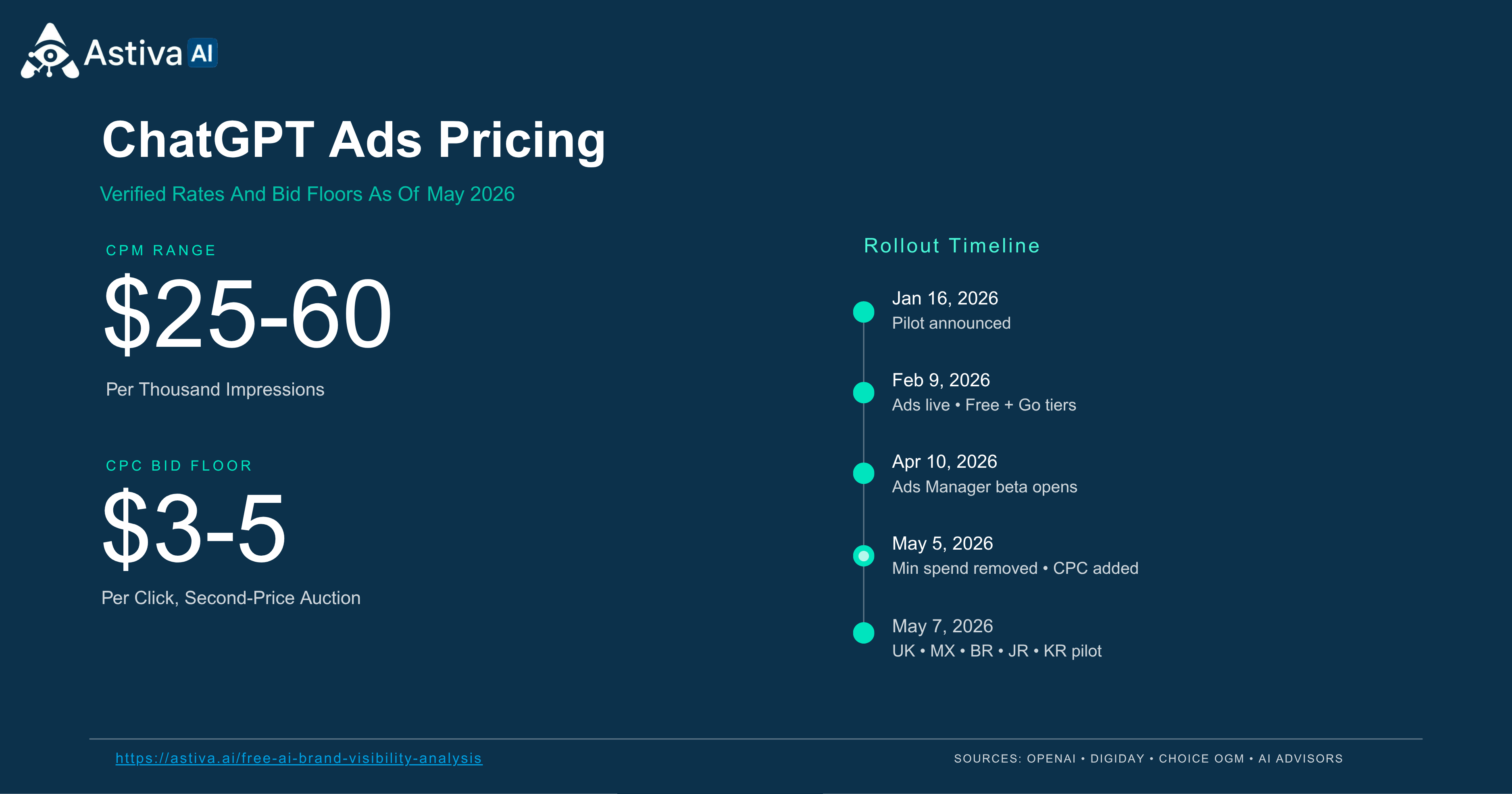
| Cost element | Reported value verified July 2026 | Citation-ready interpretation |
|---|---|---|
| CPM, Reach objective | $25 to $60 reported | Directional pilot range, not official universal pricing |
| CPC, Clicks or Conversions objective | $3 to $5 recommended starting max bid reported | Directional starting range; actual CPC can vary |
| Minimum spend | Removed after self-serve buying opened | Early managed pilots reportedly had high minimums |
| Conversion or oCPC bidding | Live but billed per click | Bid cap is a click ceiling, not guaranteed cost per conversion |
| Daily budget | Seven-day average introduced in July 2026 | Day-level spend may fluctuate within platform rules |
Confidence note
Platform status is based on official announcements where available. Dollar figures are third-party reporting and should always be labelled as reported, directional, and subject to change.
What is Google AI Mode advertising?
Definition: Google AI Mode Advertising
Google AI Mode advertising is a set of sponsored placements designed to appear inside Gemini-powered AI Search experiences rather than only beside traditional search results. These paid media formats must be separated from Google's agentic-commerce infrastructure, including Universal Cart, UCP, and AP2.
At Google Marketing Live 2026 on 20 May 2026, Google announced AI-native advertising and commerce updates for AI Search (Google, May 2026), including formats discussed by industry coverage as Conversational Discovery Ads, Highlighted Answers, AI-Powered Shopping Ads, and Business Agent for Leads (yellowHEAD, June 2026).
Current status (verified July 2026): these formats were announced at Google Marketing Live 2026 and are in staged rollout; industry coverage describes availability as expanding by format, geography, and account type rather than universally live.
Now, you can ask Google anything, so the best ads must be answers.
Google AI Mode advertising matters because Google is moving commercial discovery into AI-generated search experiences. Instead of only ranking ads beside search results, Google is testing ads that can appear inside AI-assisted research, comparison, shopping, and lead-generation journeys. This makes ad relevance, feed quality, landing-page usefulness, and conversational context more important than simple keyword matching.
For marketers, the key point is separation. Google's AI Mode ad formats are paid media placements. Google's Universal Cart, UCP, and AP2 are commerce and checkout infrastructure. Organic visibility in AI Overviews and AI Mode is earned visibility. Each layer needs different measurement.
What are Conversational Discovery Ads?
Conversational Discovery Ads are AI-native ad placements designed to appear within Google AI Mode conversations when a user is exploring products, services, or solutions. They are discussed as part of Google's AI Mode advertising direction, where ads become more contextual and conversational than standard keyword ads. These placements target richer buyer questions and require stronger product data, landing-page context, and category clarity than simple keyword matching.
Conversational Discovery Ads matter because discovery queries in AI Mode often look different from search keywords. A user may ask for "best options for a remote engineering team with SOC 2 requirements" rather than search a short keyword phrase. Conversational Discovery Ads are designed for those longer, context-rich moments where the user is still forming their shortlist.
For brands, this means ad readiness is not just about bidding. Product feeds, landing pages, structured data, category clarity, and brand authority all help determine whether the ad and the surrounding AI answer make sense to the user.
What are Highlighted Answers?
Highlighted Answers are Google AI Mode ad placements that surface sponsored information inside AI-generated responses when the ad is relevant to the user's question. Industry coverage describes them as clearly sponsored answer-level placements inside AI Mode-style experiences. They move paid visibility from the edge of the results page into the answer itself, so measurement must track visibility, clicks, and downstream quality separately.
Highlighted Answers matter because the sponsored unit competes for attention at the answer level. If the AI-generated response is the destination, not a gateway, then being visible inside the response can matter more than appearing below it. Marketers should treat Highlighted Answers as answer-level paid visibility, not standard search ad inventory.
Measurement should separate impression delivery, clicks, qualified sessions, assisted conversions, and incremental lift. A high-click ad inside an AI answer may still underperform if the user intent is research-only, while a lower-click placement may support brand lift or later conversion.
What are AI-Powered Shopping Ads?
AI-Powered Shopping Ads are Google shopping placements adapted for AI-generated search contexts. They use product data, merchant information, and AI-generated explanations to support product comparison inside AI-assisted shopping flows. Retailers need accurate feeds, consistent product data, and landing-page parity because the AI-generated explanation depends on structured commercial context.
AI-Powered Shopping Ads matter because shopping decisions are increasingly happening inside AI-guided comparison. A buyer may ask for products by use case, constraints, price range, compatibility, or preference. AI-Powered Shopping Ads can place products closer to that decision moment, but only when the merchant data and product context are strong enough to match the user's query.
For retailers, the operational focus should be feed accuracy, product availability, pricing consistency, landing-page parity, and measurement from AI-assisted sessions. Do not treat AI shopping visibility as only a bid problem.
What is Business Agent for Leads?
Business Agent for Leads is a Google AI advertising feature designed to help users interact with a business through an AI-powered lead-generation flow. It is part of Google's broader AI-assisted advertising direction for moving users from research to enquiry. Lead quality, qualification rate, and downstream sales acceptance matter more than raw form submissions when the lead is generated inside an AI-assisted journey.
Business Agent for Leads matters because lead generation inside AI Search can shorten the path from question to enquiry. A user researching vendors may no longer need to visit multiple websites before indicating interest. The AI-assisted lead flow can capture demand earlier in the decision journey.
For B2B and services brands, the measurement focus should be lead quality, qualification rate, sales acceptance, and downstream revenue, not only form submissions. AI-assisted leads may look different from paid-search leads because the user has already received summarised context before converting.
What is Universal Cart, and how is it different from ads?
Definition: Universal Cart
Universal Cart is Google's agentic-commerce checkout layer for purchase completion across supported retailers through Google services. Universal Cart is commerce infrastructure, not an ad auction, and should be separated from Google AI Mode ads and from organic AI Search visibility.
Google described Universal Cart alongside Universal Commerce Protocol (UCP) and Agent Payments Protocol (AP2) as part of its agentic-commerce foundation (Google, May 2026).
Separating ads from commerce infrastructure matters because marketers often mix three different Google developments: AI Mode ads, organic AI Search visibility, and agentic checkout. AI Mode ads help brands appear in paid placements. Organic AI visibility determines whether Google's AI systems mention or recommend a brand without payment. Universal Cart, UCP, and AP2 help users complete transactions once they decide to buy.
For content accuracy, write about these as separate layers. Do not say "Gemini integrated Universal Cart" without rollout context, and do not describe UCP as a bidding system. The correct framing is: Google is building AI-native ads and agentic-commerce infrastructure in parallel.
What is Perplexity's advertising strategy in 2026?
Definition: Perplexity Advertising Strategy
Perplexity's advertising strategy in 2026 is best understood as earned visibility rather than self-serve paid media. Brands should monitor Perplexity citations, source inclusion, and recommendations instead of budgeting for a broad Perplexity Ads product unless the company announces a new programme.
Perplexity experimented with sponsored follow-up questions from 2024, but WIRED reported on 19 February 2026 that the company had stepped back from advertising as a near-term focus and shifted attention towards subscriptions, enterprise use cases, and partnerships (WIRED, February 2026).
Current status (verified July 2026): Perplexity has not announced a return to advertising; this is a strategic retreat and near-term deprioritization, not a permanent policy, and should be re-verified before assuming it still holds.
Perplexity's advertising pullback matters because marketers should not budget for Perplexity like a paid-search platform unless Perplexity announces a new official advertising programme. The practical route to Perplexity visibility is earned: get cited, be included in source sets, appear in answer summaries, and monitor how often competitors are recommended instead of your brand.
There is also a measurement implication. Perplexity visibility should be tracked through citation frequency, source inclusion, recommendation context, share of voice, sentiment, and referral behaviour where available. It should not be mixed with paid ad metrics unless Perplexity reintroduces an official ad product.
Why is Claude ad-free?
Definition: Claude Ad Policy
Claude is an ad-free AI assistant under Anthropic's published policy. Claude should be treated as an earned-visibility surface: brands cannot buy placement inside Claude responses under the current policy.
Anthropic stated on 4 February 2026 that conversations with Claude should not include sponsored links or advertiser-influenced responses, framing Claude as a "space to think" (Anthropic, February 2026). CNBC reported the announcement the same day as a direct contrast to OpenAI's ad push (CNBC, February 2026).
Current status (verified July 2026): Anthropic's ad-free commitment remains published policy; Anthropic has stated it will be transparent if this position is ever revisited.
Claude's ad-free policy matters because Claude is a pure earned-visibility surface under current policy. Marketers cannot buy placement inside Claude responses. If a brand appears in Claude, it is because Claude's systems generate that recommendation or citation from available information, not because the brand paid for an ad.
For brands, the right Claude strategy is not media spend. It is entity consistency, public source quality, authoritative documentation, clear category positioning, and content that can be cited or summarised accurately. Avoid unsupported claims about Claude's audience composition, citation value, or future ad plans unless Anthropic publishes a policy change.
What are Microsoft Copilot, Grok, and other AI ad surfaces?
Non-ChatGPT AI ad surfaces include assistant-commerce formats, ad-manager AI assistants, and platform-specific conversational placements outside OpenAI and Google. Microsoft announced Copilot Checkout and Brand Agents on 8 January 2026 (Microsoft Advertising, January 2026), while Grok/X is being tested inside advertising workflows. Meta AI, DeepSeek, and Mistral do not have confirmed dedicated conversational self-serve ad products as of this update. Marketers should verify each platform individually rather than assuming every AI assistant sells the same kind of ad inventory.
Platform-specific verification matters because marketers should not assume all AI assistants monetise the same way. Copilot's ad formats connect to Microsoft Advertising and commerce flows. Grok's ad features connect to X's advertising ecosystem. Other assistants may influence discovery organically without offering paid placement.
For accurate planning, treat "AI ads" as a platform-specific category. Confirm whether the ad unit exists, whether it is self-serve, whether your account is eligible, whether reporting is available, and whether the ad appears inside an AI-generated answer, beside it, or only inside an ad workflow tool.
What happens to the ad placement if a brand does not bid?
Definition: Ad Auction Displacement
Ad auction displacement is what happens to a sponsored placement when a brand chooses not to participate in an AI platform's ad auction: the placement is not left empty, it is won by whichever eligible competitor bids for that query.
Auction displacement matters because ChatGPT's ad auction runs on eligible queries whether or not a specific brand participates. When a user asks a decision-oriented question in a category with active advertisers, the sponsored unit goes to whichever eligible bidder wins that auction. A brand that opts out of paid placement does not remove the ad from that answer; it removes itself from contention for it.
This dynamic is separate from earned AI visibility, where no auction exists and citation depends on content and authority signals rather than bidding. On paid-ad platforms, brands can track whether displacement is happening through citation and mention-share monitoring, independent of whether they run paid campaigns themselves: which competitors are being named in response to category queries, and whether that pattern is changing month over month.
How should you measure AI search ad performance?
Definition: AI Search Ad Performance Measurement
AI search ad performance measurement is the process of separating paid ad delivery from organic AI recommendation visibility and then tying both to business outcomes. Paid AI ads can show whether a campaign delivered and converted, while earned AI visibility shows whether the AI recommends, cites, or mentions the brand organically. Blending paid and earned AI signals can overstate ROI or hide whether the brand is actually recommended without payment.
Separating paid and earned measurement matters because AI interfaces blur the boundary between discovery, research, comparison, and conversion. A user may see an AI ad, ask follow-up questions, compare competitors, and convert later through another channel. Dashboard clicks alone will undercount or misclassify some value, while blended attribution can overstate paid impact if organic AI recommendations were already present.
A practical measurement model should include:
| Measurement layer | What it answers | Why it matters |
|---|---|---|
| Ad delivery | Did the platform serve the ad? | Confirms inventory and eligibility |
| Click reporting | Did users interact? | Shows immediate response but not quality |
| Session attribution | What happened after the click? | Separates traffic from meaningful engagement |
| Conversion and revenue | Did the user become a lead or customer? | Connects spend to business outcome |
| Incrementality | Did the ad create value that would not have happened otherwise? | Prevents over-crediting paid media |
| Earned AI visibility | Does the AI recommend the brand organically? | Shows unpaid recommendation strength |
For every conversion claim, record the sample size, industry mix, date range, traffic source, paid versus organic split, and attribution window. Do not use organic AI referral conversion rates to justify paid CPMs unless the audiences and measurement windows are comparable.
What is paid AI visibility?
Definition: Paid AI Visibility
Paid AI visibility is visibility a brand receives because it buys sponsored placement inside or near an AI-generated experience. Examples include ChatGPT Ads, Google AI Mode ad formats, Microsoft Copilot ad formats, and emerging AI-assisted ad placements in other ecosystems. Paid AI visibility can create faster access to high-intent conversations, but it stops when budget stops and must be measured separately from earned recommendations.
Paid AI visibility matters because it can give brands faster access to high-intent AI interactions. A new or under-recognised brand may use paid placement to appear during comparison moments before organic AI systems know enough to recommend it. However, paid visibility is temporary, budget-dependent, and measured through ad delivery and conversion systems.
Paid AI visibility should be evaluated like an experimental acquisition channel. The core questions are: did the ad reach the right conversational intent, did it generate qualified engagement, did it produce incremental revenue, and did it improve or distract from the brand's earned AI visibility?
What is earned AI visibility?
Definition: Earned AI Visibility
Earned AI visibility is the unpaid presence a brand receives when AI assistants mention, recommend, rank, cite, or compare the brand in generated answers. It is influenced by public authority signals, entity consistency, category clarity, third-party citations, structured information, content usefulness, and the way competitors are represented across the web. Earned AI visibility is the only route on ad-free platforms and remains important even on platforms that sell ads.
Earned AI visibility matters because many AI platforms either do not sell ads or restrict paid placement. Claude and Perplexity, for example, should currently be treated as earned-only surfaces. Even on platforms that sell ads, organic recommendation still affects whether a brand appears credible when users ask for comparisons, alternatives, or buying advice.
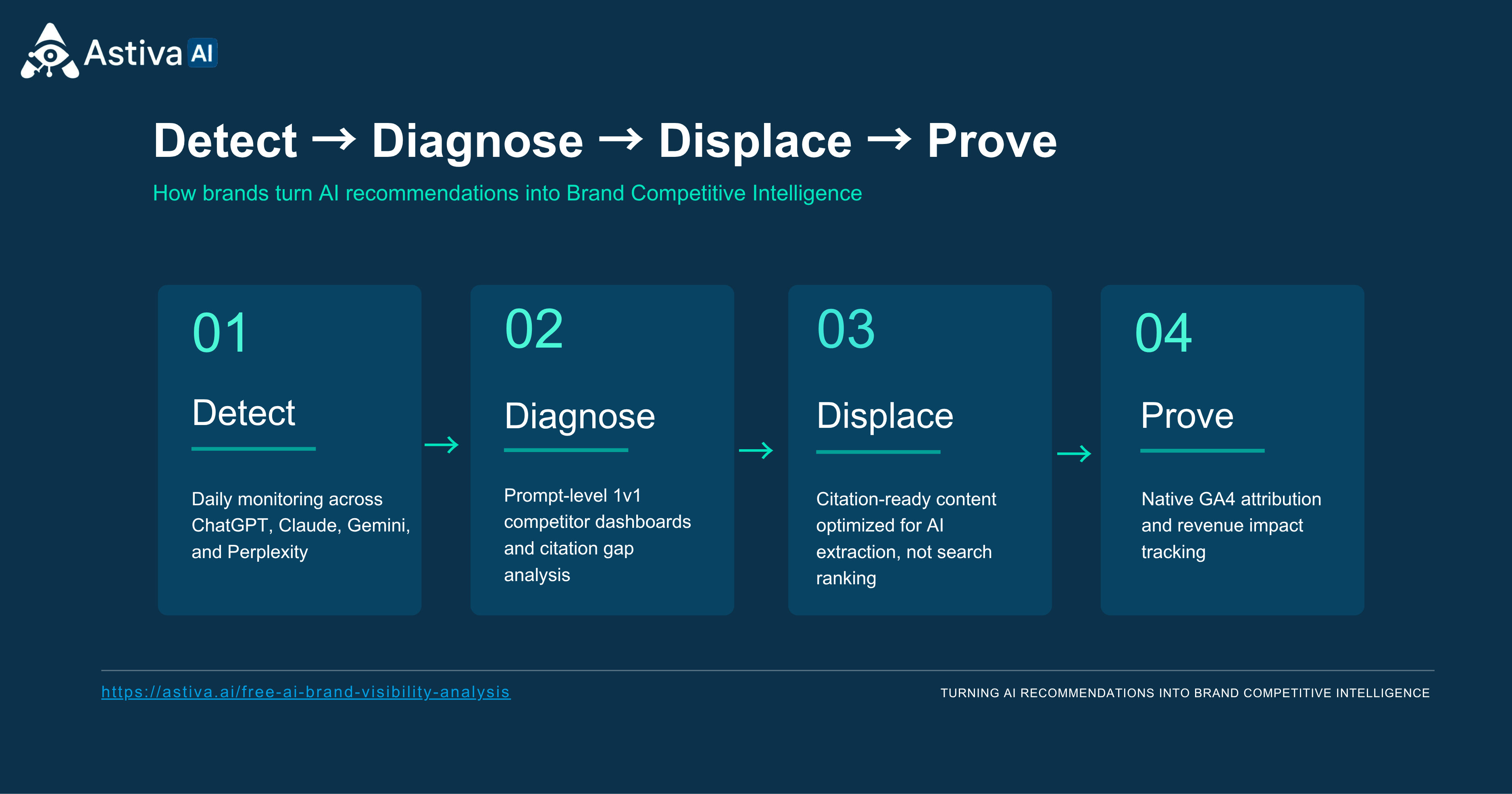
Earned AI visibility is the layer measured by the Detect → Diagnose → Displace → Prove Cycle, detailed at /methodology: daily monitoring across major AI platforms, citation gap analysis with authority scoring, citation-ready content generation, and native GA4 revenue attribution. In practice, this means teams can see which competitors AI assistants recommend instead of them and which citation gaps need to be closed.
How do you run a 30-day AI search ads test?
Definition: 30-Day AI Search Ads Test
A 30-day AI search ads test is a controlled campaign designed to learn whether one AI ad platform can generate qualified engagement and measurable business outcomes. Early AI ad platforms still have uneven reporting, changing availability, and platform-specific inventory constraints. The test should focus on one platform, one geography, one primary conversion, and a small set of buyer-intent themes so the result produces learning signal, not broad noise.
A narrow 30-day test matters because early AI ad platforms can have limited reporting, changing eligibility, and uneven inventory. A narrow test reduces waste and helps determine whether the channel is worth expanding. The test should also compare paid results with earned AI visibility, because a brand that is already organically recommended may not need the same paid strategy as a brand that is absent from AI answers.
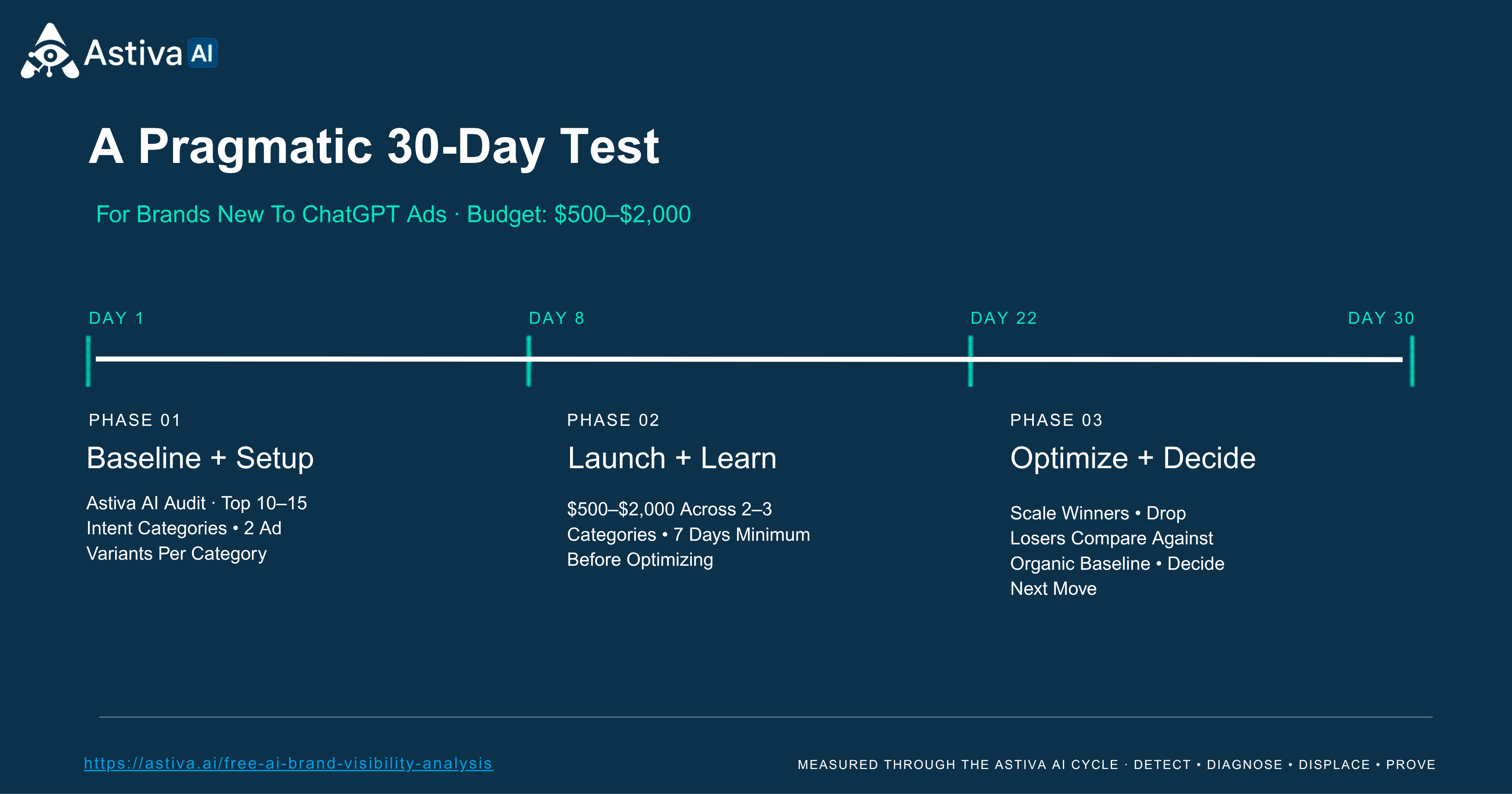
| Phase | Days | What to do | Citation-ready purpose |
|---|---|---|---|
| Define | 1 to 5 | Pick one geography and one conversion; confirm account eligibility; set two to three intent themes; baseline organic AI visibility; implement UTMs and conversion events; set budget, threshold, and stop rule | Establish clean scope before spend |
| Launch | 6 to 12 | Run two creative variants per theme; avoid broad expansion; validate landing-page relevance; confirm conversion events fire; screenshot placements and context | Create comparable data points |
| Assess | 13 to 21 | Review qualified-session rate; monitor assisted conversions; compare paid placement with organic answer presence; cut weak themes; ignore single-day volatility | Separate noise from usable signal |
| Decide | 22 to 30 | Scale only if quality meets threshold; pause if data quality is thin; document results by theme; compare paid spend with owned-content investment | Make a decision, not just a report |
Do not use a universal budget number. Use the smallest budget capable of producing a meaningful number of eligible impressions and qualified conversions for your category. Pilot access, auction conditions, user tiers, and geography can change quickly.
What are the risks and open questions in AI search advertising?
AI search advertising risk is the uncertainty created by new ad formats, immature reporting, changing policies, fluid pricing, limited controls, and unclear incrementality. The market is moving faster than traditional paid-search playbooks, and platform rules can change within a single quarter. Brands should re-verify platform status before each campaign and avoid presenting reported costs as guaranteed benchmarks.
These risks matter because AI ad inventory appears inside trusted answer interfaces. If reporting is thin, a brand may overvalue clicks. If pricing changes, early benchmark claims can become stale. If the platform changes eligibility or ad placement, a campaign that worked once may not repeat.
Open questions to track include whether ChatGPT expands true cost-per-conversion bidding, how Google prices AI Mode ads at scale, whether earned-only platforms revisit their policies, and how much AI-referred conversion is incremental versus assisted. Market projections should always include publisher, date, geography, category definition, and forecast horizon.
AI is rewriting search. Astiva AI helps you win in it by keeping the earned side measurable while the paid side matures.
Key takeaways
- ChatGPT Ads moved from a February 2026 pilot to public self-serve buying by July 2026, with CPMs reported at $25 to $60 and CPCs at $3 to $5 (Context Hints, July 2026) — treat these as directional pilot figures, not an official rate card.
- Google is building two separate things at once: AI Mode ad formats (Conversational Discovery Ads, Highlighted Answers, AI-Powered Shopping Ads, Business Agent for Leads) and agentic-commerce infrastructure (Universal Cart, UCP, AP2). The two should never be described as the same system.
- Claude remains ad-free by Anthropic's published policy, and Perplexity has stepped back from advertising toward subscriptions and enterprise — both should be treated as earned-visibility-only surfaces for 2026 planning.
- On any platform that sells ads, the auction runs whether or not a brand participates; a placement not bid on is filled by a competitor, not left empty.
- Paid AI visibility and earned AI visibility must be measured separately — delivery, clicks, and conversions for paid; citation frequency, mention share, and sentiment for earned — because blending the two can overstate ROI or hide whether a brand is recommended without payment.
- A 30-day test on one platform, one geography, and one conversion goal produces a usable decision; a broad multi-platform test at this stage mostly produces noise.
Frequently asked questions
Are ChatGPT Ads available to every advertiser?
ChatGPT Ads are publicly available through self-serve buying in supported markets, but eligibility can still depend on geography, account status, advertiser access, and campaign settings. Advertisers should verify access inside OpenAI's advertiser portal before planning spend.
What do ChatGPT Ads cost?
ChatGPT ad costs do not have a universal public rate card. Reported July 2026 ranges include $25 to $60 CPM and $3 to $5 CPC, but these are directional observations, not guaranteed prices. Actual costs vary by market, category, objective, account eligibility, and auction conditions.
Is there a minimum spend for ChatGPT Ads?
The reported ChatGPT Ads minimum spend was removed when self-serve buying opened, but early managed pilots reportedly carried high minimums. Advertisers should confirm current account-level terms before assuming any minimum or no-minimum condition.
Does Google show ads in AI Mode?
Yes. Google announced Gemini-powered AI Mode ad formats at Google Marketing Live 2026. These include advertising formats for AI-assisted search and shopping experiences. Availability varies by format, geography, merchant status, account type, and rollout stage.
Does Perplexity still run ads?
Perplexity does not currently operate as a broadly available self-serve advertising channel. It tested sponsored follow-up questions earlier, but by February 2026 advertising was no longer a near-term focus. Brands should treat Perplexity mainly as an earned AI visibility surface.
Will Claude show ads?
Claude is currently ad-free by Anthropic's public policy. Anthropic has said Claude will not show sponsored links adjacent to conversations and that advertiser incentives should not influence responses. If Anthropic changes this position, marketers should update their platform-status table immediately.
How should AI search ads be measured?
AI search ads should be measured through platform delivery, clicks, qualified sessions, conversions, revenue, and incrementality, with paid attribution kept separate from earned AI visibility. Brands should also track whether AI assistants mention, recommend, or cite them organically in unpaid answers.
See where your brand appears across AI answers
You can run AI ad tests, but you still need to know whether AI assistants recommend your brand or a competitor when a buyer asks. Check your brand's organic AI visibility with a free analysis, review Astiva AI's AI visibility monitoring capabilities, or compare plans and platform limits.
The free analysis measures organic AI visibility and competitor presence. It does not measure sponsored-placement campaign performance.
About Astiva AI
Astiva AI is the Competitive Intelligence platform for AI Search and Visibility. Track how ChatGPT, Claude, Gemini, Perplexity, and other major AI platforms recommend your brand versus competitors, with daily monitoring, prompt-level intelligence, citation gap analysis, and native GA4 revenue attribution. Built around the Detect → Diagnose → Displace → Prove Cycle, this turns AI recommendations into Brand Competitive Intelligence. Plans start from $29/mo (Lite), with a permanently free tier and a 7-day free trial. Founded December 2025, Astiva Technologies Pvt. Ltd., Bengaluru, with operations in San Francisco.
Brands compete on recommendations, not rankings.
Sources
OpenAI, "New ways to buy ChatGPT ads," 5 May 2026.
OpenAI, "Testing ads in ChatGPT," updated 7 May 2026, originally 9 February 2026.
Google, "Google Marketing Live 2026," 20 May 2026.
Google, "New Universal Commerce Protocol features," 20 May 2026.
Anthropic, "Claude is a space to think," 4 February 2026.
WIRED, "Perplexity's Retreat From Ads," 19 February 2026.
Microsoft Advertising, "Copilot Checkout and Brand Agents," 8 January 2026.
Context Hints, "ChatGPT ads cost 2026," 25 July 2026.
yellowHEAD, "Google AI Mode ads," 4 June 2026.
CNBC, "Anthropic takes aim at OpenAI's ad push," 4 February 2026.
Bain & Company, "Goodbye Clicks, Hello AI," February 2025.
Ahrefs, brand-mention vs backlink correlation analysis, 2026.