How Rotofy Addressed Pharmaceutical AI Visibility Gaps with Astiva AI
"16 min read" · Pharmaceutical · Study period: 60 days
See how Rotofy used Astiva AI to analyse 100 strategic prompts, benchmark 10 competitors, identify content and citation gaps, and monitor reported outcomes during a 60-day pharmaceutical engagement.
TL;DR
undefined
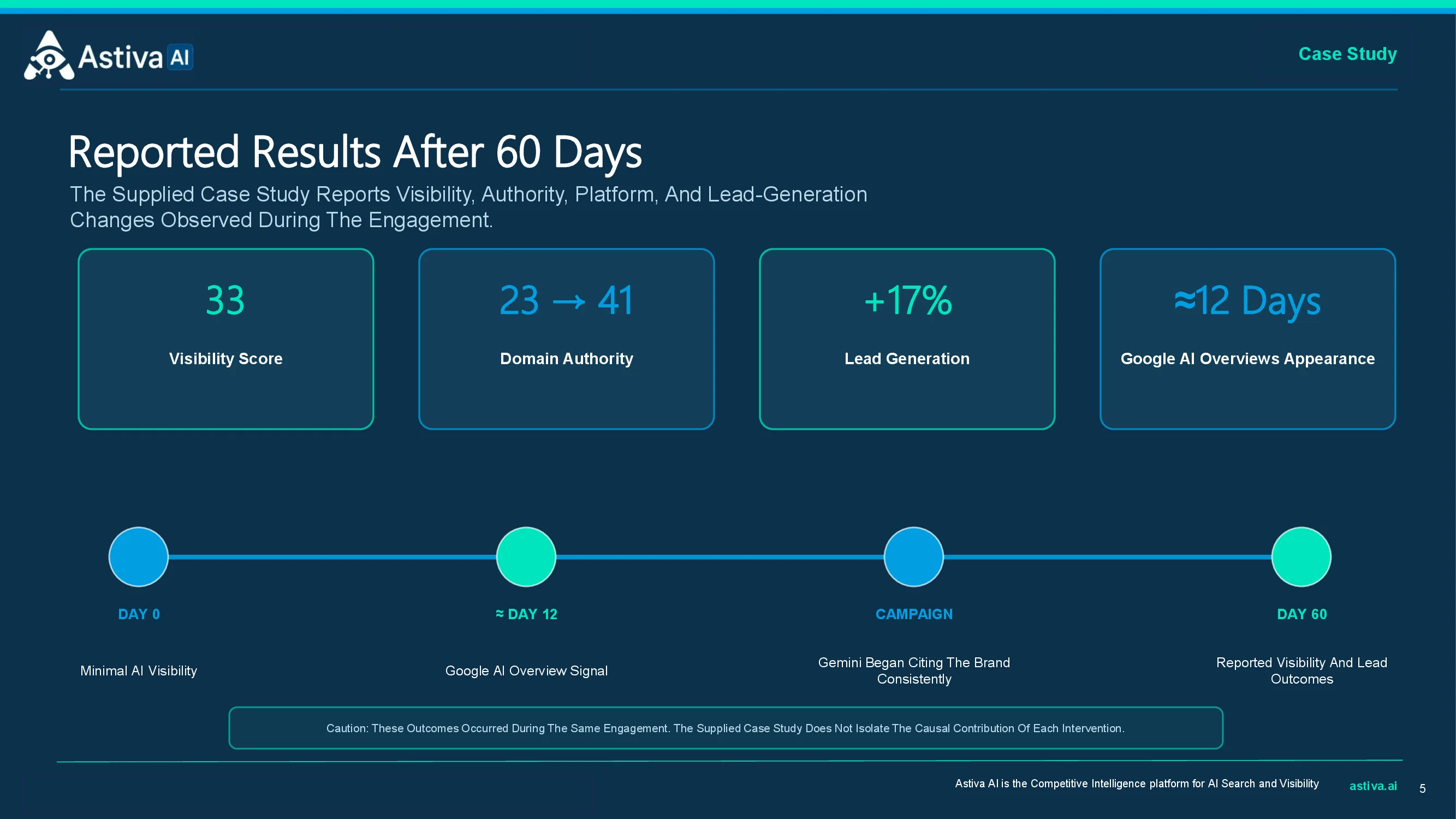
During the reported 60-day engagement, Rotofy used Astiva AI to analyse 100 strategic prompts across ChatGPT, Claude, Gemini, Perplexity, and Google AI Overviews. The pharmaceutical brand was benchmarked against 10 competitors, informing the creation of 24 new content assets and the optimisation of seven existing assets. The case-study record reports a final Visibility Score of 33, Domain Authority movement from 23 to 41, a 17% increase in lead generation during the engagement, an appearance in Google AI Overviews after approximately 12 days, and recurring Gemini citations. These are reported outcomes from one engagement and do not prove that any single intervention caused the changes.
Case Study at a Glance
During the reported 60-day engagement, Rotofy used Astiva AI to analyse 100 strategic prompts across ChatGPT, Claude, Gemini, Perplexity, and Google AI Overviews. The pharmaceutical brand was benchmarked against 10 competitors, informing the creation of 24 new content assets and the optimisation of seven existing assets. The case-study record reports a final Visibility Score of 33, Domain Authority movement from 23 to 41, a 17% increase in lead generation during the engagement, an appearance in Google AI Overviews after approximately 12 days, and recurring Gemini citations. These are reported outcomes from one engagement and do not prove that any single intervention caused the changes.
The Challenge: Search Visibility Without Consistent AI Visibility
The pharmaceutical brand already had an active web presence and traditional search visibility. However, it appeared less frequently when users asked selected AI platforms recommendation-oriented questions, while competitors appeared more often across the monitored prompt set. Traditional SEO reporting can show rankings, impressions, clicks, landing-page sessions, and conversions. It does not, by itself, show whether a brand is mentioned, cited, compared, or recommended inside an AI-generated answer. This does not mean SEO has stopped mattering. SEO remains part of the discovery foundation, while AI visibility provides an additional measurement and competitive-intelligence layer for answer-based discovery.
SEO Rankings and AI Visibility Are Different Measurements
Organic rankings and AI visibility measure different parts of digital discovery. An organic ranking records where a webpage appears for a search query. A brand mention records whether the brand appeared in an AI-generated answer. A citation shows whether the answer linked or attributed information to a source, while a recommendation shows whether the brand was presented as a potential option. Answer position and Share of Voice can help compare observed brand presence with a defined competitor set. Referral traffic, leads, conversions, and revenue are separate downstream business outcomes. A citation is not automatically a recommendation. Likewise, a change in AI visibility does not automatically establish a change in search rankings, traffic, leads, or revenue.
The Astiva AI Approach
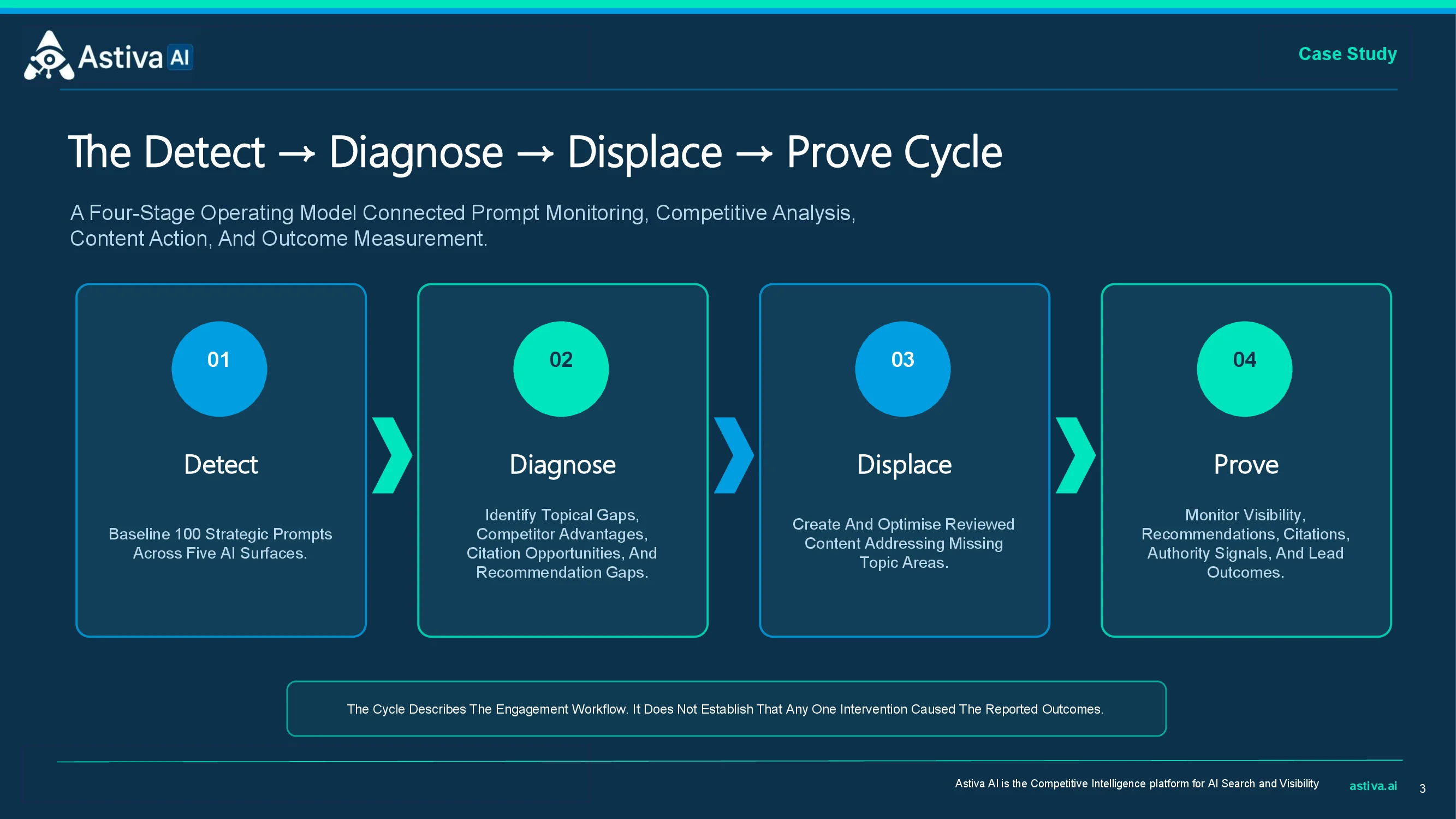
Astiva AI is the Competitive Intelligence platform for AI Search and Visibility, helping brands understand how they perform against competitors inside AI-generated answers. Rotofy applied Astiva AI's Detect, Diagnose, Displace, and Prove framework during the engagement.
Phase 1: Detect the Baseline
Rotofy analysed 100 strategic prompts across:
- ChatGPT
- Claude
- Gemini
- Perplexity
- Google AI Overviews
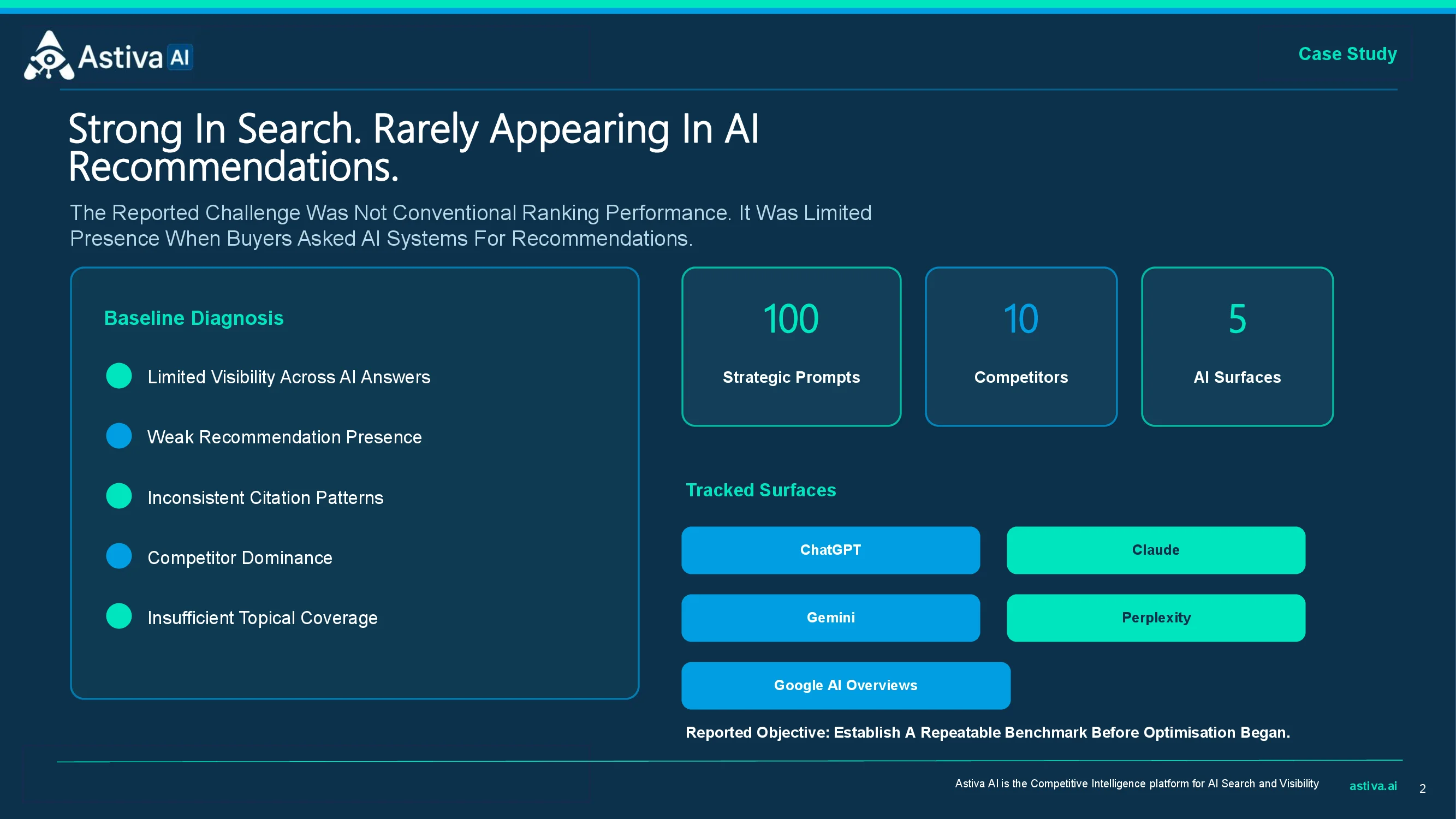
The baseline analysis examined:
- Prompts where the brand appeared
- Prompts where competitors appeared instead
- Questions that produced recommendations
- Citation and source patterns
- Category entities appearing in relevant answers
- Gaps in the brand's observed visibility
Establishing a baseline before content action was important. Without a fixed comparison set, a change in prompt selection could be mistaken for a change in brand visibility.
What a Governed Prompt Register Should Contain
For reproducible reporting, each tracked question should record:
- Exact wording
- Source of the question
- Buyer decision represented
- Date added
- Platform and available settings
- Market, location, and language
- Run cadence and repetition count
- Expected answer type
- Reporting cohort
The supplied case study confirms that 100 prompts were analyzed but does not include the complete prompt register. It also does not establish that each prompt represents an equal share of buyer demand. Where demand frequency is unknown, it should remain labelled as unknown.
Phase 2: Diagnose Competitor and Source Gaps
Astiva AI expanded primary questions into intent-oriented variations and compared the pharmaceutical brand with 10 competitors. According to the supplied case study, the diagnostic process identified:
- Missing topical coverage
- Competitor content advantages
- Citation opportunities
- Recommendation gaps
- High-value content opportunities
The useful unit of analysis was not only the keyword. It was also the source role required by the answer.
Depending on the prompt, the missing source might be:
- A category definition
- A technical explainer
- A product or capability fact
- A comparison
- A methodology page
- Original evidence
- Independent validation
- A use-case example
- A relevant directory, review, or community source
A product page, independent comparison, research report, and methodology page perform different functions. Publishing more content without identifying the missing source role can increase output without resolving the underlying information gap.
Phase 3: Displace Gaps With Reviewed Content
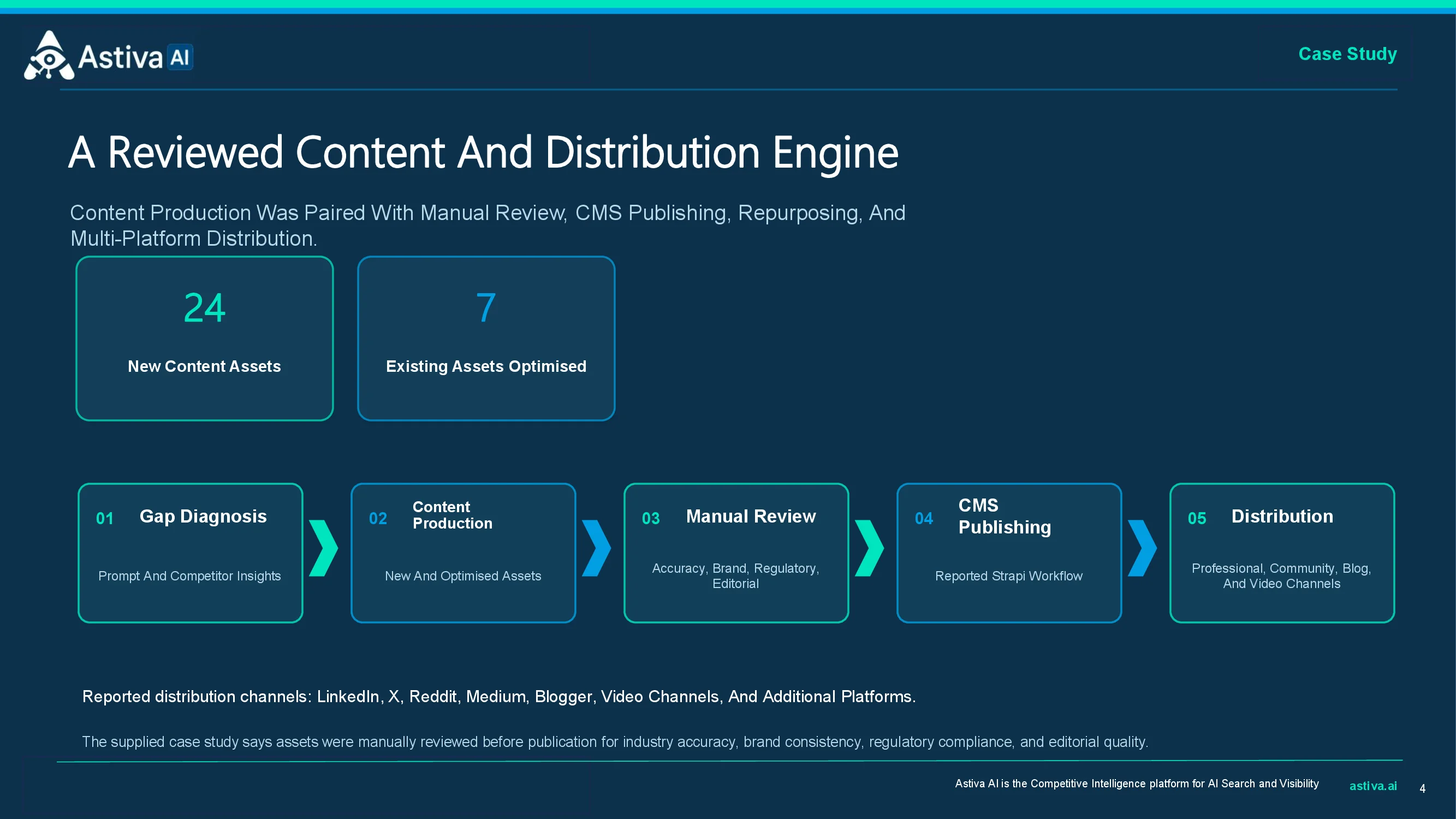
The engagement produced:
- 24 new content assets
- Seven optimised existing assets
The source record describes these assets as citation-oriented and based on gaps identified during diagnosis. Before publication, Rotofy manually reviewed the content for:
- Industry accuracy
- Brand consistency
- Regulatory compliance
- Editorial quality
That review layer is especially important in a pharmaceutical context. AI assistance should not replace qualified medical, legal, regulatory, or compliance review.
In this framework, Displace does not mean guaranteeing that another source or competitor will be removed from an AI answer. It means addressing a specific, controllable information or evidence gap so that the brand has a more suitable source for the relevant buyer question.
A strong implementation record should connect every asset to:
- The prompt or prompt cluster it addressed
- The buyer decision it supported
- The diagnosed competitor or source gap
- Its intended source role
- The reviewer and approval date
- Its publication URL and revision history
- The metric monitored after publication
Publishing and Distribution
After approval, the source record says the assets were published through the client's Strapi CMS and repurposed across LinkedIn, X, Reddit, Medium, Blogger, video channels, and other platforms.
Distribution can support discoverability and fact consistency, but repeated publication is not automatically independent reinforcement. A copied claim across controlled properties should not be treated as equivalent to independent editorial coverage, expert citation, or a third-party review.
The distribution activity is therefore documented as work performed during the engagement, not as proven evidence of what caused a particular mention, citation, or recommendation.
Phase 4: Prove What Changed
The engagement monitored visibility trends, recommendation frequency, citations, authority signals, and lead generation.
These results answer different questions:
- Did the brand appear?
- Was the brand cited?
- Was it recommended?
- Where did it appear?
- How frequently did the outcome recur?
- Did identifiable AI referral traffic change?
- Did total leads change?
- Can a lead be attributed to a particular source or interaction?
The supplied source reports selected outcomes but does not include the full baseline response corpus, final response exports, analytics reports, or attribution model.
Reported Outcomes After 60 Days
Final Visibility Score: 33
The case-study record reports a final Visibility Score of 33. It says the score reflects recommendation presence, answer position, Share of Voice, First Mention Frequency, sentiment, and platform coverage.
The score should be interpreted as an Astiva AI methodology-specific composite, not as a universal percentage of market visibility. A reproducible interpretation would require the formula, scale, denominator, component weights, platform weights, treatment of unavailable responses, total observations, confidence level, and baseline score.
Because those fields were not supplied, this article reports the final score without calculating an improvement percentage.
Google AI Overviews Appearance
The case study reports that the brand began appearing in Google AI Overviews approximately 12 days after implementation started.
This was an observed milestone within one engagement. It is not evidence that content publication normally produces AI Overview visibility within 12 days, and it does not isolate which intervention contributed to the appearance.
Recurring Gemini Citations
The source states that Gemini began citing the brand consistently during the campaign. Because “consistently” was not defined, the narrower wording used here is recurring Gemini citations were reported during the monitored period.
A reproducible claim would require the eligible prompt count, number of runs, citation rate, observation dates, available settings, cited URLs, and threshold used to classify recurrence.
Domain Authority: 23 to 41
The case study reports that Domain Authority changed from 23 to 41 during the engagement.
Domain Authority is a comparative metric developed by Moz. It is not a direct Google ranking factor and does not prove that an AI platform assigned greater authority to the brand. Verification should use the same provider and document the baseline date, final date, and backlink-index context.
Lead Generation: +17%
The case study reports that lead generation increased by 17% during the engagement.
The supplied source does not include baseline and final lead counts, the lead definition, analytics source, channel breakdown, attribution window, seasonality controls, or concurrent campaign data. The accurate conclusion is that lead generation increased during the measured period. The available evidence does not establish that AI visibility caused the change.
Measurement, Repeated Testing, and Uncertainty
AI-generated answers can vary by platform, model, prompt wording, location, date, search integration, and available settings. One answer is one observation, not proof of stable visibility.
The source case study says repeated testing and Wilson Confidence Intervals were used. Wilson intervals can describe uncertainty around a defined binomial proportion, such as the share of eligible runs in which a brand appeared. They do not correct prompt-selection bias, prove causation, or make different platform conditions directly comparable.
A complete public methodology should disclose:
- The event classified as a success
- Total eligible observations
- Positive observations
- Confidence level
- Number and cadence of repeated runs
- Independence assumptions
- Treatment of failed or missing responses
- Aggregation across prompts and platforms
Until those details are published, Wilson intervals should be described as reported methodology rather than independently reproducible analysis.
What This Case Study Supports
Based on the supplied engagement record, this case study supports the following statements:
- The team analysed 100 strategic prompts across five named AI surfaces.
- The pharmaceutical brand was benchmarked against 10 competitors.
- Twenty-four new content assets were created and seven existing assets were optimised.
- The content underwent manual review for industry accuracy, brand consistency, regulatory compliance, and editorial quality.
- A final Visibility Score of 33 was reported.
- Domain Authority was reported as changing from 23 to 41.
- Lead generation was reported as increasing by 17% during the engagement.
- An appearance in Google AI Overviews was reported after approximately 12 days.
- Recurring Gemini citations were reported during the monitored period.
What This Case Study Does Not Prove
The supplied evidence does not prove that:
- The brand was absent from every AI answer before the engagement.
- Astiva AI caused the reported outcomes.
- One content asset caused a mention, citation, or recommendation.
- Multi-platform distribution caused citation inclusion.
- Higher Domain Authority caused greater AI visibility.
- AI visibility caused the reported lead increase.
- AI Overview visibility normally appears within 12 days.
- A citation is equivalent to a recommendation.
- One response represents stable visibility.
- Other brands will achieve similar results.
These limitations do not make the case study unhelpful. They clarify what readers can and cannot conclude from the reported engagement.
Eight Practical Lessons for Other Brands
1. Preserve SEO Fundamentals
Technical accessibility, crawlability, internal links, useful original content, and clear site structure remain part of the discovery foundation. AI visibility measurement complements these practices rather than replacing them.
2. Build a Governed Prompt Register
Record why each question is included, where it came from, what buyer decision it represents, and when it entered the reporting set.
3. Keep a Fixed Comparison Cohort
Report newly added prompts separately at first. Preserve an unchanged cohort so a different prompt mix is not mistaken for a visibility change.
4. Benchmark Competitors and Cited Sources
Track not only which competitors appear, but also which domains, pages, and source roles support the answer.
5. Diagnose the Missing Source Role
Determine whether the gap requires a product fact, definition, methodology, comparison, dataset, expert explanation, or independent validation.
6. Connect Each Asset to a Diagnosed Gap
Document the prompt, buyer decision, intended source role, reviewer, publication record, and measurement plan for each content action.
7. Preserve Exportable Evidence
Retain the exact question, complete answer, platform, date, available settings, cited links, and sentence supporting each classification. The evidence should remain understandable outside the monitoring dashboard.
8. Measure Visibility and Business Outcomes Separately
Report mentions, citations, recommendations, rankings, referrals, leads, conversions, and revenue independently. Connect these measurements only when the attribution evidence supports the connection.
How Astiva AI Helps
Astiva AI helps teams monitor how brands and competitors appear inside AI-generated answers.
Through the Detect, Diagnose, Displace, and Prove framework, teams can:
- Establish an AI visibility baseline
- Track selected buyer prompts
- Compare competitor presence
- Investigate mention, citation, and recommendation gaps
- Review sources appearing in AI-generated answers
- Prioritise content opportunities
- Monitor repeated observations over time
- Keep AI visibility separate from traffic and conversion reporting
Astiva AI does not guarantee mentions, citations, recommendations, rankings, traffic, leads, or revenue.
Run a Free AI Brand Visibility Analysis
CTA component: Run a Free AI Brand Visibility Analysis https://astiva.ai/free-ai-brand-visibility-analysis
Frequently Asked Questions
About the Platform Behind This Case Study
Astiva AI is the Competitive Intelligence platform for AI Search and Visibility, helping brands understand how they perform against competitors inside AI-generated answers from ChatGPT, Claude, Gemini, Perplexity, Google AI Overviews, and other supported AI platforms.
The platform helps teams monitor brand visibility, citations, recommendations, competitor presence, and the sources appearing across selected AI-generated answers. This enables teams to identify where their brand appears, where competitors lead, and which positioning, content, or evidence gaps may require attention.
Turning AI recommendations into Brand Competitive Intelligence.
Disclosure and Methodology Note
This is a commercial case study involving Astiva AI and Rotofy. The pharmaceutical client is anonymised. The outcomes presented are based on the supplied engagement record.
The full prompt register, complete response exports, Visibility Score formula, baseline visibility rates, analytics exports, and independent validation were not included in the source material reviewed for this article.
The reported outcomes describe one 60-day engagement. They should not be interpreted as guaranteed results or as proof that Astiva AI, content publication, distribution, or any single intervention caused the reported changes.
Sources
About Astiva AI
Astiva AI is the Competitive Intelligence platform for AI Search and Visibility, helping brands understand how they perform against competitors inside AI-generated answers from ChatGPT, Claude, Gemini, Perplexity, and other major AI platforms.
Brands compete on recommendations, not rankings.
Check your AI visibility free →